
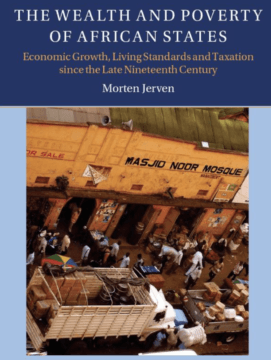
 Alden Young in Phenomenal World:
On May 1, 2014, Nigeria’s then-president, Goodluck Jonathan, addressed a crowd of workers in the country’s capital Abuja. He declared that “the challenge of the country is not poverty, but redistribution of wealth.” The prompt for his comment was a report issued only a few days prior, which labeled Nigeria, Africa’s most populous country, as one of only five nations that are home to two-thirds of the world’s population living in extreme poverty. Rejecting the categorization of Nigeria as a poor country, President Jonathan pointed to the country’s Gross Domestic Production (GDP), which he declared was “over half a trillion dollars.” Moreover, the economy, he maintained, was “growing at close to 7 percent.”
It was only a week before the president’s address that the official figure for Nigeria’s GDP had been significantly revised. The first reexamination of the structure of the Nigerian economy since 1990 showed an increase in the country’s 2013 GDP by 89 percent. Scholars were surprised by the dramatic growth in the banking and telecommunications sectors and the significant decline in the relative size of the hydrocarbon sectors.
With little outside recognition, the Nigerian economy had transformed itself in the space of a couple of decades.
More here.
 Stephen Ornes in Quanta:
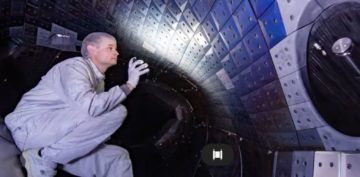 Kahled Talaat in Tablet (photo by Stefan Sauer/Picture Alliance via Getty Images)
 His fingernails are ragged. He wears designer suits but his choice of underwear, cheap Russian tighty-whities, is poignant. When he gets drunk, he talks about Stalin. He likes the dumbest game shows. Maybe he’s K.G.B. He does not know how to unfasten garters.
 How to walk properly, according to Lorraine O’Grady, the eighty-eight-year-old conceptual and performance artist: “With your chin tucked under your head, your shoulders dropped down, your stomach pulled up.” Good posture has become a concern for O’Grady in the past couple of years, as her latest persona, the Knight, is a character that requires her to wear a forty-pound suit of armor. “As long as I don’t gain or lose more than three or four pounds, I’m O.K.,” O’Grady told me in late August, over Zoom, while we discussed “Greetings and Theses,” the fourteen-minute film that constituted the official performance début of the Knight. The première was held, in late July, at the Brooklyn Museum, the site of the 2021 exhibition “
 There was no fanfare when “The Waste Land” first arrived. It was printed in the inaugural issue of The Criterion, a quarterly journal, in October, 1922. On the front cover was a hefty list of contents, among them a review by Hermann Hesse of recent German poetry; an article on James Joyce’s “
 The typical “nuclear bro” is lurking in the comments section of a clean energy YouTube video, wondering why the creator didn’t mention #nuclear. He is marching in Central California to oppose the closing of the state’s Diablo Canyon nuclear power plant. His Twitter name includes an emoji of an atom ⚛️. He might even believe that 100 percent of the world’s electricity should come from nuclear power plants. As a warming world searches for ever more abundant forms of clean energy, an increasingly loud internet subculture has emerged to make the case for nuclear. They are often — but not always — men. They include grass-roots organizers and famous techno-optimists like Bill Gates and Elon Musk. And they are uniformly convinced that the world is sleeping on nuclear energy.
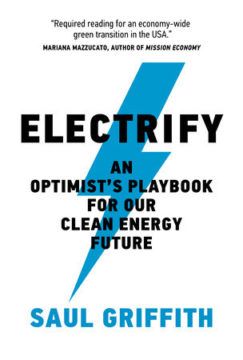 Climate change is a planetary emergency. We have to do something now — but what? Saul Griffith, an inventor and renewable electricity advocate (and a recipient of a MacArthur “genius” grant), has a plan. In his book “Electrify,” Griffith lays out a detailed blueprint for fighting climate change while creating millions of new jobs and a healthier environment. Griffith’s plan can be summed up simply: Electrify everything. He explains exactly what it would take to transform our infrastructure, update our grid, and adapt our households to make this possible. Billionaires may contemplate escaping our worn-out planet on a private rocket ship to Mars, but the rest of us, Griffith says, will stay and fight for the future.
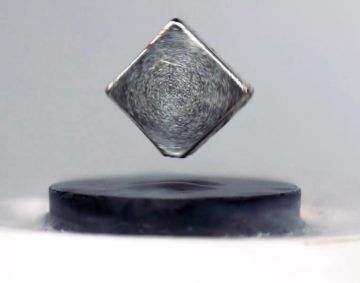 For decades, a family of crystals has stumped physicists with its baffling ability to superconduct — that is, carry an electric current without any resistance — at far warmer temperatures than other materials.
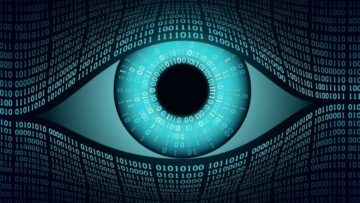 Did you know there are over 700 million government-owned surveillance cameras in China? I didn’t, until Liza Lin, The Wall Street Journal’s China correspondent,
  HAVING RESURFACED late in life due to a revival of her sex films, an eighty-nine-year-old Doris Wishman, clad in leopard print and wedge sandals, appeared on Late Night with Conan O’Brien in 2002. Conan is flummoxed by Wishman’s spiky retorts and willfully evasive manner. Affecting sheepishness when asked for the name of her latest (penultimate) film, she finally discloses the title: Dildo Heaven. Sensing discomfort, Wishman asks, “Conan, are you afraid of me?” The other guest, Roger Ebert, enters the fray to discuss Wishman’s work, announcing his familiarity with Deadly Weapons (1973) and Double Agent 73 (1974), which stars Chesty Morgan and her seventy-three-inch bustline. Ebert states that the only reason to watch these films, in his view, is to see Morgan entirely nude, and yet she remains mostly clothed. Wishman cannily replies: “Well Roger, I’m sorry you’re frustrated . . . Is there anything I can do?” Reframing male cinephilic desire as pitiful erotic disappointment, Wishman’s bait and switch is both the work of a cunning “exploiteer” in the old-school tradition, with some Borscht Belt thrown in, as well as a testament to the blurring of contraries she and her films embody: feigned prudery and ribald provocation, sincerity and self-consciousness. Asking Ebert why he didn’t put Dildo Heaven on his “Best Of” list, the filmmaker is met with the critic’s blanching reply—of course he likes to see films first before reviewing them! Wishman scoffs: “Ugh, how ordinary!”
 Proprioception, the sense of where we are in space, can do more than simply bring character into focus—it also grants a kind of topicality when employed effectively. In the opening scene of Jesmyn Ward’s National Book Award-winning
  The true horror of puberty isn’t the emergence of surprising hairs and baneful odors but the abrupt arrival of consequences. Physical ones, obviously — like the sudden possibility of getting pregnant or impregnating someone — but also existential consequences. To enter puberty is to discover not only that the stakes have ratcheted up, but that such a thing as “stakes” exist.
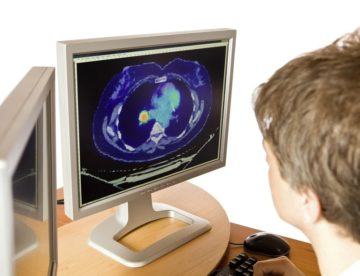 If a single medical objective could be applied to the entire range of cancers, it would be detecting the disease as soon as possible. “At the highest level, finding any cancer early gives you the opportunity for curative treatments,” says Andrea Ferris, CEO of research funding organization, LUNGevity. Although the goal of early detection emerged decades ago, much work remains to be done. Low-dose computed tomography (CT) scanning, used to detect lung cancer, has not changed much in the past ten years, and Ferris says that another part of the problem is a lack of public awareness of the “importance of screening and that it can save lives.”
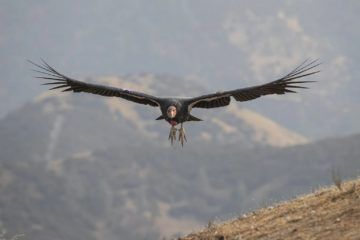 In 1986, the US Fish and Wildlife Service took drastic, controversial action: they captured all remaining condors from the wild to save them.