
Alberto Toscano in Sidecar:
‘The free person thinks least of all of death, and his wisdom is a meditation not on death but on life.’ Toni Negri, who died in Paris at the age of 90 on 16 December, turned this dictum of Spinoza into an ethical and political lodestar. The conclusion of the third and final instalment of his intellectual autobiography, Storia di un comunista, features a moving reflection on aging as a rejoicing in life and a paring down of action. Negri offers the overcoming of death – a resolutely atheist and collective idea of eternity – as the substance of his thought, politics, and life. He writes: ‘And yet the possibility of overcoming the presence of death is not a dream of youth, but a practice of old age; always keeping in mind that organising life to overcome the presence of death is a duty of humanity, a duty as important as that of eliminating the exploitation and disease that are death’s cause.’
Drawing perhaps on the distant memory of his own youthful Catholic activism, Negri extracts the materialist and humanist kernel of the resurrection of the flesh against all the miserable cults of finitude and being-towards-death. Negri’s lifelong war on the palaces was founded on the conviction that power, potestas, is nourished by a hatred of bodies and fixed in the threefold fetish of patriarchy-property-sovereignty. Its apparatchiks and administrators love that empty syllogism ‘every man is mortal’, which, Negri contends, is at the root ‘of the hatred of humanity, of that hatred that every authority, every power produces in order to affirm and consolidate itself: power’s hatred for its subjects.
More here.
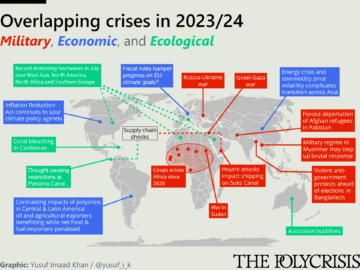 Tim Sahay in Polycrisis:
 I HAVE FREQUENTLY BEEN SEATED in the dark near those who have variously been called “the pilly-sweater crowd,” “cinemaniacs,” or “Titus-heads” (referring to the two main movie theaters at MoMA). They are pejorative terms for a certain type of New York City cinephile, one whose zeal for the seventh art seems to have been leached of all pleasure and has instead transmogrified into grim compulsion. Demographically, they are often (but not always) white, male, and middle-aged or older.
 A
A I
I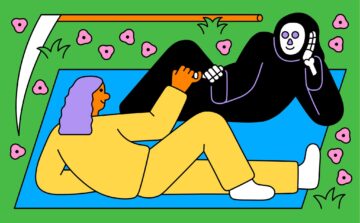 Ernest Becker was already dying when “The Denial of Death” was published 50 years ago this past fall. “This is a test of everything I’ve written about death,” he told a visitor to his Vancouver hospital room. Throughout his career as a cultural anthropologist, Becker had charted the undiscovered country that awaits us all. Now only 49 but losing a battle to colon cancer, he was being dispatched there himself. By the time his book was
  The emergence of English as the predominant (though not exclusive) international language is seen by many as a positive phenomenon with several practical advantages and no downside. However, it also raises problems that are slowly beginning to be understood and studied.
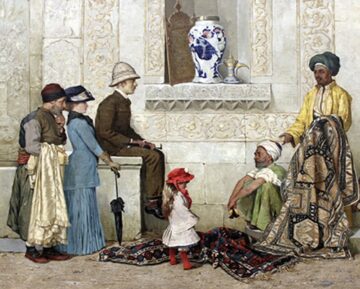 Some say that history begins with writing; we say that history begins with clothing. In the beginning, there was clothing made from skins that early humans removed from animals, processed, and then tailored to fit the human body; this technique is still used in the Arctic. Next came textiles. The first weavers would weave textiles in the shape of animal hides or raise the nap of the fabric’s surface to mimic the appearance of fur, making the fabric warmer and more comfortable.
 This was during the Long 2010s (2009-2022), a decade during which there occurred more mass protests than any decade in history. The protests were against the usual suspects: capitalism, racism, imperialism, greed, corruption. Two new books, Vincent Bevins’s If We Burn: The Mass Protest Decade and the Missing Revolution and The Populist Moment: The Left After the Great Recession by Arthur Borriello and Anton Jäger, are about these protests and why they seemed to summon more of what they protested against—more greed, more racism, more corruption. They take different approaches. The Populist Moment is an academic investigation into the electoral failures of left-wing candidates in Europe and the United States (Bernie Sanders, Jeremy Corbyn, Jean-Luc Melenchon, Greece’s Syriza party), while If We Burn is a journalistic account of street protests in the Third World (Brazil, Indonesia, Chile) as well as Turkey and Ukraine.
 From a certain point of view, the extraordinary abundance of chickens might be seen as a positive development: Here is a source of protein that is cheaply produced, transportable, happily consumed by a huge number of people across the world. And thanks in part to Peterson’s efforts at improving feed conversion efficiency, chicken has a much slimmer carbon impact than beef, which contributes more than
  Shortly after Rachel Bespaloff’s suicide in 1949, her friend Jean Wahl published fragments from her final unfinished project. ‘The Instant and Freedom’ condensed themes that occupied the Ukrainian-French philosopher throughout her life: music, rhythm, corporeality, movement and time. One of Bespaloff’s key ideas, ‘the instant’, is less a fragment of duration than a life-changing event, a moment of embodied metamorphosis. In the midst of a noisy world, torn between transience and eternity, the human being listens to the sound of history. Had she completed and published it, ‘The Instant and Freedom’ might have become the masterpiece of an important early existentialist thinker. Instead, her name is hardly mentioned today.
 A
A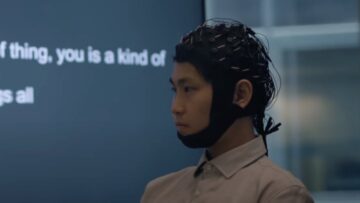 Wearing an electrode-studded cap bristling with wires, a young man silently reads a sentence in his head. Moments later, a Siri-like voice breaks in,
 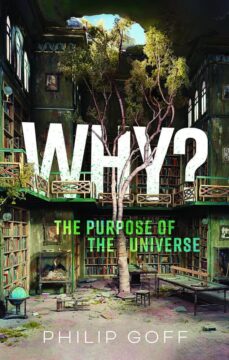 Why is there something rather than nothing? It’s meant to be the great unanswerable question. It’s certainly a poser. It would have been simpler if there’d been nothing: there wouldn’t be anything to explain.