Poet, Lucky Poet: The Poems of Seamus Heaney

Mark Jarman at the Hudson Review:

By the end of Heaney’s life, all literary laurels became destined for him and created a lore of fame, from the rhyming epithet “Famous Seamus,” said to have been coined by the English poet James Fenton, and anecdotes of his having to apologize once again to another worthy and deserving Irish poet when the award came instead and once again to Famous Seamus. I have heard the Irish poet Ciaran Carson speak of this dilemma. And I have heard Heaney’s friend Michael Longley who tells of an exchange with an English Don. “How do you feel about the Heaney phenomenon?” said Don asked Longley. To which Longley replied, “Envious.”
 
Heaney the poet is more the heir to Robert Lowell than to W. B. Yeats, though Lowell himself might be said to be heir to Yeats. Read Heaney’s poems and see the way the tones and textures of Heaney’s life collect sound and form not only from Lowell’s Life Studies but also from Theodore Roethke’s lyric sequences. By mid century the lyric in English had aspired to, in Hart Crane’s famous phrase, new thresholds, new anatomies.

more here.

Enjoying the content on 3QD? Help keep us going by donating now.

Wednesday, April 1, 2026

How Addiction Became a Central Motif in Crime Fiction

Theodore Martin at LitHub:

It has long been conventional for crime novelists to describe killers using the language of insanity, madness, and mental illness. But in the crime novels of the 1990s, another term keeps cropping up: sick. The murderer in Blanche on the Lam is “sick….Very sick.” In A Walk among the Tombstones, Block’s detective Matt Scudder decides that the serial killers are either “sick…or evil…take your pick.” In L.A. Confidential, the serial killer Douglas Dieterling isn’t mad, he’s “quite physiologically ill. He gets brain inflammations periodically.” The physiological effects of brain inflammation are also mentioned in White Butterfly, where the big reveal about serial killer J.T. Saunders is that he suffers from syphilis, which has affected his brain. As one of Mosley’s characters explains, “VD can make you insane.” Cornwell makes the sickness more literal still. The killer in All That Remains is identified only after it is discovered that he suffers from “aplastic anemia.”

Cornwell had used this device before. In her debut novel Postmortem (1990), Kay Scarpetta finds herself debating the health status of the serial killer she’s pursuing. “He isn’t sick, okay?” Scarpetta insists. “He’s antisocial, he’s evil.” Her colleague disagrees: “Has to be some kind of sickness. He knows he’s sick.”

more here.

Enjoying the content on 3QD? Help keep us going by donating now.

Bettina’s Obsessive Geometries

Katherine Rochester at Artforum:

IN 1974, a strand of hair twirled in a porcelain sink in room 503 of the Chelsea Hotel. It belonged to an artist named Bettina, who photographed its sinuous formations as water jostled it around. The resulting suite of sixty-three gelatin silver prints—Two Hours in the Life of One Hair Photographed in the Sink at One Minute Intervals While Agitated by Running Water—represented a selection from the 120 images she would have snapped given the stated parameters of the exercise. In fact, the series was vaster still, extending both backward and forward in time via works that explored organic forms through sundry media. Terminal Germination/Paris, ca. 1970, a black-and-white photocopy that preceded the photographs, comprised eight xeroxed drawings of morphing hair arranged in a two-by-four grid. Some vignettes had the grainy shading of excessive toner powder, while others were bleached out. Bettina followed these in 1971 with a group of wooden sculptures and line drawings exploring similar arabesque shapes. In the 1983–84 series “Retake/Outtake; Filmtwists,” she imagined a suite of monumental sculptures (never fabricated) for the city of Los Angeles, transforming the motif of the hair into ribbons of loosely woven metal, suggesting strips of unspooled celluloid.

more here.

Enjoying the content on 3QD? Help keep us going by donating now.

Down on your luck? How behavioural neuroscience could help

Nobuko Nakano in The Guardian:

When the founder of Panasonic, Kōnosuke Matsushita, was asked what quality he valued most in job candidates, his answer baffled everyone: whether they were lucky. Not their credentials, not their intelligence, not their experience. Luck. For years, this anecdote struck me as charmingly eccentric – the kind of thing a titan of industry gets away with saying because nobody around them dares to laugh. Then I began studying the neuroscience of fortunate people, and I stopped laughing, too.

What my research has revealed is that luck, far from being a roll of the cosmic dice, operates through identifiable patterns of brain chemistry and behaviour. The consistently lucky are not blessed by fate. They are running different neurological software – and the remarkable thing is that this software can be installed.

Consider what happens when someone simply declares: “I am a lucky person.” It sounds like wishful thinking. But brain imaging tells a different story.

More here.

Enjoying the content on 3QD? Help keep us going by donating now.

Claude Dispatch and the Power of Interfaces

Ethan Mollick at One Useful Thing:

Instead of having companies build a specialized interface for every kind of work, the AI generates the right interface on the fly. I suspect the future isn’t one interface to rule them all. It’s AI that generates the right interface for the moment, an agent on your desktop, a chart in a conversation, a custom app to solve a problem. We’re moving from adapting to the AI’s interface to the AI adapting its interface to you.

AI capability has been running ahead of AI accessibility. The models have been smart enough to do extraordinary things for a while now, but we’ve been making people access that intelligence through chatbots. And, as that cognitive load research shows, the chatbot format is actively working against them. As interfaces improve, we’re going to see what happens when a much larger number of people can actually use what AI is capable of.

More here.

Enjoying the content on 3QD? Help keep us going by donating now.

The Bills That Destroyed Urban America

Joseph Lawler in The New Atlantis:

Think of what the typical American city looks like today: its hollowed-out core dotted with parking lots, its run-down inner-city neighborhoods, its sprawl.

How did this happen? Cities weren’t like this a hundred years ago. They were real cities in the sense in which most people would understand the word, with jobs, businesses, houses, churches, and every other institution related to daily life concentrated around a dense center. Today, cities are almost the inverse of that, with a large population settled out in sprawl, and a hollowed-out center where far fewer people live.

Conversations about this transformation typically collapse into a focus on attitudes about cars. On one extreme, urbanists blame an American fetish for SUVs and highway construction for our lack of charming walkable neighborhoods and the destruction of areas that might have developed into such places. On the other extreme, suburbanists view urbanists as anti-car fanatics who want to use government policy to choke off the low-density single-family housing development that has characterized America since World War II.

What they both tend to overlook is that almost all Americans today have spent their entire lives under a set of federal laws and rules that have helped hollow out the cores of our cities.

More here.

Enjoying the content on 3QD? Help keep us going by donating now.

Artemis II mission is about to fly humans to the Moon — here’s the science they’ll do

Alexandra Witze in Nature:

If all goes to plan, as soon as tomorrow, NASA will launch four people on a journey around the Moon. The mission, known as Artemis II, would be the first time humans have left Earth’s protective environment and travelled into deep space since the US Apollo programme, which ended more than half a century ago. And it could carry its astronauts farther from Earth than any humans have ever travelled.

Artemis II is one in a series of missions that ultimately aim to build humanity’s first permanent base on the Moon. This mission is supposed to test the rocket, crew capsule and other space-flight hardware that NASA wants to use to land humans on the lunar surface in the coming years. During their nearly ten-day journey to the Moon and back, astronauts plan to run experiments that will set the stage for future explorers.

“What we’re trying to do is not pick up where Apollo left off, but to use our decades of experience and knowledge and planning to do this sustainable presence on the Moon — and then to do science alongside of that,” says Barbara Cohen, a planetary scientist at NASA’s Goddard Space Flight Center in Greenbelt, Maryland.

More here.

Enjoying the content on 3QD? Help keep us going by donating now.

Forget Antibiotics: These Killer Cells Wipe Out Deadly Superbugs in a Day

Shelly Fan in Singularity Hub:

A mixture of bacteria lounge in a dish. Like the bugs populating our guts, most are benign or beneficial. But a deadly strain hides among them. These bacteria can easily escape last-line antibiotics, rapidly spread, and cause mayhem. But in this case, a single dose of genetically engineered cells hunts them down and wipes out nearly the entire population in a day, while leaving all the other harmless cells alone.
This strategy, called minicell therapy, fights fire with fire: Researchers engineer hunter cells by stripping bacteria of the ability to replicate and then genetically loading them up with proteins to home in on dangerous foes. The cells grab their targets and inject toxins into them, releasing a hurricane of chemicals that causes the bacteria’s insides to collapse.

More here.

Enjoying the content on 3QD? Help keep us going by donating now.

Wednesday Poem

Paterson: Early Winter, ’78’

—for Ed Smith

I will see you once again
on the long silver train
people call “night”.

The sizzling green neon
of Van Houten Ave. pizzeria
will smooth the wrinkles
of your corduroy coat

& it’ll be what we expected
of that time and of that place
&, so, let it all slide into
the crisp russet Meadowlands.

Sun will rise again on the good friends
we once had, now dreaming on the sly
as we cash in the empties from our karma
& become an animation of two guys
walking through the paradise
that New Jersey once was.

by Joel Lewis
from The Rutherford Red Wheelbarrow, 2010

Enjoying the content on 3QD? Help keep us going by donating now.

Tuesday, March 31, 2026

On a new history of pedantry

Hannah Katznelson at The Hedgehog Review:

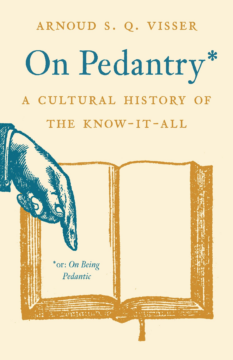
At the beginning of On the Nature of Things, a sort of textbook of Epicurean philosophy, the Roman poet Lucretius explains his choice to write in verse by comparing his poem to a cup of bitter medicine whose rim has been smeared with honey. Just as young patients will heal quicker if they enjoy taking their medicine, young students will benefit from encountering Epicurus’s difficult but edifying doctrine in a form they find pleasurable, even if that pleasure is only “lip-deep.” Arnoud S.Q. Visser’s On Pedantry: A Cultural History of the Know-It-All, a book about how intellectuals ranging from Socrates to Dr. Strangelove have made themselves disliked, takes a similar view of intellectual effort and enjoyment. The book is full of useful considerations for pedants hoping to be less irritating, but Visser ultimately considers that irritation the cost of doing business: Worthwhile intellectual work is unavoidably challenging, and sometimes even unpleasant.

Visser, an intellectual historian and scholar of Renaissance humanism at Utrecht University who has been as prolific writing for popular audiences as for academic ones, does a wonderful job of candy-coating this bitter pill. On Pedantry is relaxed and inviting; it is economical but judicious with historical detail, and discreet in its erudition.

More here.

Enjoying the content on 3QD? Help keep us going by donating now.

AI got the blame for the Iran school bombing but the truth is more worrying

Kevin T Baker in The Guardian:

On the first morning of Operation Epic Fury, 28 February 2026, American forces struck the Shajareh Tayyebeh primary school in Minab, in southern Iran, hitting the building at least two times during the morning session. American forces killed between 175 and 180 people, most of them girls between the ages of seven and 12.

Within days, the question that organised the coverage was whether Claude, a chatbot made by Anthropic, had selected the school as a target. Congress wrote to the US secretary of defense, Pete Hegseth, about the extent of AI use in the strikes. The New Yorker magazine asked whether Claude could be trusted to obey orders in combat, whether it might resort to blackmail as a self-preservation strategy, and whether the Pentagon’s chief concern should be that the chatbot had a personality. Almost none of this had any relationship to reality. The targeting for Operation Epic Fury ran on a system called Maven. Nobody was arguing about Maven.

Eight years ago, Maven was the most contested project in Silicon Valley. In 2018, more than 4,000 Google employees signed a letter opposing the company’s contract to build artificial intelligence for the Pentagon’s targeting systems. Workers organised a walk out. Engineers quit. And Google ultimately abandoned the contract. Palantir Technologies, a data analytics company and defence contractor co-founded by Peter Thiel, took it over…

More here.

Enjoying the content on 3QD? Help keep us going by donating now.

A blueprint for how we use AI to reinvent the way we govern ourselves

Andy Hall at Free Systems:

Right now is a weird time to be a political economist. AI is straining our already brittle political institutions. We might lurch into a dystopia in which we live in the grips of a techno-leviathan, forced by our employers to train our own AI replacements, then kicked to the curb in a society organized to the benefit of a tiny number of people who control the machinery that controls the world.
It’s also an electric time to be a political economist. With each new paper my lab puts out, and with each new experimental prototype in self governance we build using tools we couldn’t imagine having even a year ago, I’m starting to believe that AI presents an extraordinary opportunity to rebuild our society so we can keep slouching down the narrow corridor towards utopia.

More here.

Enjoying the content on 3QD? Help keep us going by donating now.

The Enigma of Gertrude Stein

David Schurman Wallace at The Nation:

No one understands Gertrude Stein. For this, we should all give thanks. It is almost a cliché to emphasize her work’s difficulty, but her writing remains imposing, both due to its sheer volume—her unpublished writings were originally collected in eight volumes, to say nothing of the numerous books published during her life—and its style.

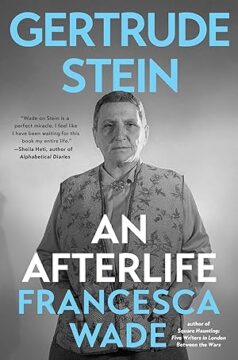
The style, of course, is what made her both famed and ridiculed, striking out from conventional narrative and often even the conventional meanings of words. If you ever find yourself absorbed in Stein, there is almost a natural desire to imitate her rhythms. Nobody ever entirely nails her peculiarities, though: the flat, dry vocabulary, the off-kilter blend of abstraction and table talk, and perhaps most of all the repetition—sentences that extend themselves and double back and fill up space with their insistence. As Francesca Wade quotes Stein in her new biography, Gertrude Stein: An Afterlife, “Repeating is the whole of living, and by repeating comes understanding, and understanding is to some the most important part of living.” Maybe the reverse maxim here is that we can never repeat enough, so we can never really understand.

more here.

Enjoying the content on 3QD? Help keep us going by donating now.

Alexandre Koberidze’s Dry Leaf

Mark Krotov at n+1:

Dry Leaf is concerned above all with the materiality of the camera—what it captures as it meanders off, and what it fails to detect. To paraphrase the title of Koberidze’s previous feature, what do we see when we look at (or through) the Sony Ericsson?

We see graininess, fuzziness, pixelation. We see shapes over details, colors over textures. In the absence of immediately legible images, details and textures don’t disappear, however—as Dry Leaf’s unclarity clarifies, they proliferate. A car driving down a road becomes a source of visual drama not because we wonder if it’ll have trouble traveling from one side of the frame to the other, but because its wheels may suddenly start to resemble spinning plates. A shot of a pond doesn’t need a swimmer or a fish to generate excitement—what’s thrilling is the moment when the image congeals and the pond acquires a thick, black border, a failure to process contrast that nevertheless reads as a real-life Cezanne landscape taking shape before our eyes. A white curtain in the breeze twitches when it should be billowing, and a newspaper being blown around a soccer stadium looks somehow heavier than it really is, flopping around the stands with an odd decisiveness.

more here.

Enjoying the content on 3QD? Help keep us going by donating now.

Abigail Adams Asked Her Husband to ‘Remember the Ladies’ as He Drafted America’s Laws. Here’s What She Really Meant

Ellen Wexler in Smithsonian:

As John Adams lobbied in Philadelphia for American independence, his wife, Abigail, was consumed with questions. She filled pages with them, often complaining when John didn’t answer fully or quickly enough. “What code of laws will be established?” she wrote to him from their home in Braintree, Massachusetts, in November 1775. “Who shall frame these laws? Who will give them force and energy?” Five months later, as members of the Second Continental Congress dragged their feet on separation from Britain, she wondered, “Shall we not be despised by foreign powers for hesitating so long?”

In her letters, Abigail kept her husband abreast of the siege of Bostonvividly describing “the rattling of the windows, the jar of the house and the continual roar of 24-pounders.” She read Thomas Paine’s “Common Sense” and asked how the seminal pamphlet had been received in Congress. “She prided herself on navigating the most important intellectual currents of her era,” biographer Woody Holton writes in Abigail Adams: A Life“To an extent that does not seem unusual today but that would have astonished her grandmother, Abigail liked to think about her thoughts.”

Fortunately, John also liked his wife’s inclination for reflection. In a teasing letter dated to 1764, the year they married, he wrote that her “habit of reading, writing and thinking” caused her to slouch. He also chided her for sitting too often with her legs crossed, which “springs I fear from the former source vizt. too much thinking. These things ought not to be!” By early 1776, John and Abigail both had a lot on their minds. They longed to speak freely about the creation of a new nation, which was looking more plausible every day. “Is there no way for two friendly souls to converse together although the bodies are 400 miles off?” John wrote. “Yes, by letter. But I want a better communication. I want to hear you think or to see your thoughts.”

More here.

Enjoying the content on 3QD? Help keep us going by donating now.

Blaise Pascal’s Night of Fire

Graham Tomlin in Plough:

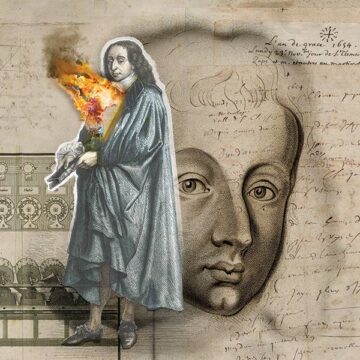
On a cold November night in 1654, a young Frenchman, well known in fashionable circles for his scientific experiments and mathematical genius, sat down to pray in his small apartment in Paris. What happened next surprised him. For about two hours, he had an extraordinary experience of the presence of God, which turned his life around and set him on a new trajectory.

The man was Blaise Pascal. He told no one of this experience, but wrote an account of it which he hid in the lining of his jacket. It was found by chance by a servant preparing his body for burial when he died eight years later. The document became known as the Mémorial and the event as Pascal’s “Night of Fire.”

The term “cultural Christianity” has become prominent recently, notably when the public atheist Richard Dawkins described himself as a “cultural Christian.” He claims to enjoy Christmas carols and church architecture, despite not believing a word of Christian doctrine – recognizing, as he put it, “a distinction between being a believing Christian and being a cultural Christian.”

Before his Night of Fire, Pascal was by no means an atheist like Dawkins, or even a mere cultural Christian.

More here.

Enjoying the content on 3QD? Help keep us going by donating now.