
Alexandra Witze in Nature:
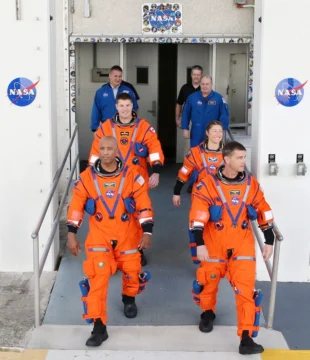 If all goes to plan, as soon as tomorrow, NASA will launch four people on a journey around the Moon. The mission, known as Artemis II, would be the first time humans have left Earth’s protective environment and travelled into deep space since the US Apollo programme, which ended more than half a century ago. And it could carry its astronauts farther from Earth than any humans have ever travelled.
Artemis II is one in a series of missions that ultimately aim to build humanity’s first permanent base on the Moon. This mission is supposed to test the rocket, crew capsule and other space-flight hardware that NASA wants to use to land humans on the lunar surface in the coming years. During their nearly ten-day journey to the Moon and back, astronauts plan to run experiments that will set the stage for future explorers.
“What we’re trying to do is not pick up where Apollo left off, but to use our decades of experience and knowledge and planning to do this sustainable presence on the Moon — and then to do science alongside of that,” says Barbara Cohen, a planetary scientist at NASA’s Goddard Space Flight Center in Greenbelt, Maryland.
More here.
Enjoying the content on 3QD? Help keep us going by donating now.