Giovanni Boccaccio’s 14th-century literary masterpiece The Decameron may hold the recipe to defy these troubled times. Boccaccio’s collection of 100 stories told over 10 days is set against the backdrop of a crisis that puts today’s credit problems in perspective: the black death. He begins it with a harrowing piece of reportage on the plague in his city, Florence, describing how the disease spread across Europe in 1347-8, killing rich and poor alike in such terrible numbers that bodies littered the streets, the sick were shunned by their families, and funeral rites were abandoned. He paints a picture of a society on the brink of absolute disappearance – would everyone in Florence die? Everyone in Europe? Yet this shocking opening is the prelude to a book of life, laughter – and sex.
This idea of nature’s harmonious balance has become not just the bedrock of environmental thought, but a driving force in policy and culture. It is the sentiment behind Henry David Thoreau’s dictum, “In wildness is the preservation of the world.” It lies behind last summer’s animated blockbuster “Wall-E,” in which a single surviving plant helps revive an earth smothered beneath the detritus of human overconsumption. It underlies environmental laws that try to minimize the damaging influence of humans on land and the atmosphere. In this line of thought, the workings of the natural world, honed over billions of years of evolution, have reached a dynamic equilibrium far more elegant – and ultimately durable – than the clumsy attempts humankind makes to alter or improve them. According to the paleontologist Peter Ward, however, nothing could be further from the truth. In his view, the earth’s history makes clear that, left to run its course, life isn’t naturally nourishing – it’s poisonous. Rather than a supple system of checks and balances, he argues, the natural world is a doomsday device careening from one cataclysm to another.
Pakistan’s new government, the only in the world headed by two former convicts—who have their fingers on the button of a nuclear-armed state, no less—is nothing if not a keen purveyor of irony. There’s currently an effort underway by the Pakistani diplomatic mission in Texas to raise funds for a chair of Pakistan Studies at the University of Texas in Austin. The chair, a dream of the Pakistani diplomatic community, is to be named after Charlie Wilson. For those who missed the movie, it’s worth noting that of all the people to name a chair of Pakistani Studies after, Charlie Wilson is possibly the stupidest.
“Good-Time Charlie,” as Wilson was affectionately known by Afghan warlords and Texan socialites alike, has the dubious reputation of being the godfather of what would later be known as the Taliban in Afghanistan. (He was also buddies with Nicaraguan dictator Anastasio Somoza.) In the 1980s, Wilson led Congress into supporting the CIA covert operation aimed at funneling money and arms into Afghanistan through Pakistan’s military and secret services, the ISI. That money, it should be said, did not go to Afghan refugees fleeing the Soviet’s communist invasion. No, it went to the mujahideen in the form of $17 million worth of anti-aircraft weapons, armaments, and other war toys. By the end of 1983, Wilson had managed to siphon $300 million of unused Pentagon cash to the Afghan mujahideen. Before they were the Taliban bad boys of the region, the mujahideen were one of Wilson’s pet projects. And now, Pakistan has decided to honor him by naming a chair of studies after him.
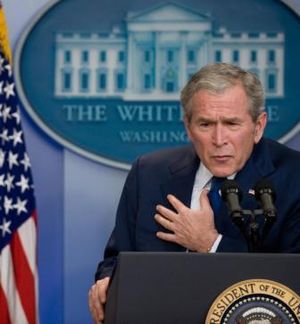
It was all there today — the introspection, the cluelessness, the smirkiness, the defiance, the sense of humor, the surprising humility. When George Bush said goodbye for the last time to the White House press corps this morning, he refelcted on everything from the 'Mission Accomplished' to Katrina to the failure to find weapons of mass destruction in Iraq. It was an unsusally emotional performance by the president who seemed ready to take his bows. “This is the ultimate exit interview,'' he said. Bush admitted that he felt lucky to be witness to the dawning of the Obama Presidency. “I consider myself fortunate to have a front-row seat for what is going to be a historic moment,'' said Bush, who will hand off the presidency to Obama on Jan. 20. “President-elect Obama's election does speak volumes about how far this country has come.” True that, but the big question is how farther we will have to go to get out of the hole he's left us in?
A groundbreaking medical treatment that could dramatically enhance the body's ability to repair itself has been developed by a team of British researchers.
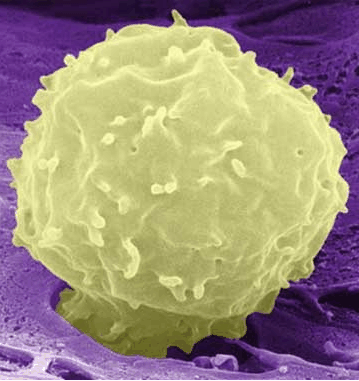
The therapy, which makes the body release a flood of stem cells into the bloodstream, is designed to heal serious tissue damage caused by heart attacks and even repair broken bones. It is expected to enter animal trials later this year and if successful will mark a major step towards the ultimate goal of using patients' own stem cells to regenerate damaged and diseased organs.
When the body is injured, bone marrow releases stem cells that home in on the damaged area. When they arrive, they start to grow into new tissues, such as heart cells, blood vessels, bone and cartilage.
Scientists already know how to make bone marrow release a type of stem cell that can only make fresh blood cells. The technique is used to collect cells from bone marrow donors to treat people with the blood cancer leukaemia.
Now a team led by Sara Rankin at Imperial College London has discovered a way to stimulate bone marrow to release two other types of stem cell, which between them can repair bone, blood vessels and cartilage. Giving mice a drug called mozobil and a naturally occuring growth factor called VEGF boosted stem cell counts in their bloodstream more than 100-fold.
Norman H. Olsen and Matthew N. Olsen in the Christian Science Monitor:
A million and a half Palestinians are learning the hard way that democracy isn't so good if you vote the wrong way. In 2006, they elected Hamas when the US and Israel wanted them to support the more-moderate Fatah. As a result, having long ago lost their homes and property, Gazans have endured three years of embargo, crippling shortages of food and basic necessities, and total economic collapse.
We spoke again Saturday with three of our longtime Gazan contacts. They and their families, all Fatah supporters, were in their eleventh day without electricity, running water, or heat. They are cowering in cold basements trying to protect their children from the storm of explosions that is filling Shifa hospital with amputees and the dead. Our friends in Israel are likewise living in fear.
The 850-plus dead Gazans, more than a dozen dead Israelis, and some 3,000 injured have since the end of the cease-fire become part of what Secretary of State Condoleezza Rice once called the birth pains of a new Middle East.
It didn't have to be this way. We could have talked instead of fought.
Hamas never called for the elections that put them in power. That was the brainstorm of Secretary Rice and her staff, who had apparently decided they could steer Palestinians into supporting the more-compliant Mahmoud Abbas (the current president of the Palestinian authority) and his Fatah Party through a marketing campaign that was to counter Hamas's growing popularity – all while ignoring continued Israeli settlement construction, land confiscation, and cantonization of the West Bank.
I recently purchased a kit called “Le Nez Du Vin” that professes to teach me how to identify various aromas in a glass of wine. The kit, which is imported from France, comes in a dictionary-sized case covered in red fabric so that it resembles an old book. Inside are a dozen tiny glass vials, each of which is redolent of a specific, essential red-wine scent when uncapped. These vials are cosseted in crushed velvet (or likely velour). It was purchased at Williams-Sonoma. It cost $130. Go ahead: Roll your eyes; chuckle derisively; whatever you have to do. I’ll wait until you finish. OK, finished? The “Le Nez Du Vin” kit contains two slim manuals both written by Jean Lenoir, a French wine critic who over 25 years ago developed this method of wine education by way of aromas. In the first book, Lenoir lays out his methodology, explaining the primary, secondary, and tertiary aromas in wine. He talks about fruity notes like black currant and cherry, floral notes like rose and violet, vegetal notes like green pepper and truffle, roasted notes like smoke and dark chocolate, and animal notes like leather and musk. He explains how the sense of smell works and how it relates to the “art” of wine tasting.
The list of cultural universals — those features that recur in every human society, from remote rainforest tribes to modern America — is surprisingly short. There's language, religion and a bunch of traits involving social structures, such as the reliance on leaders.
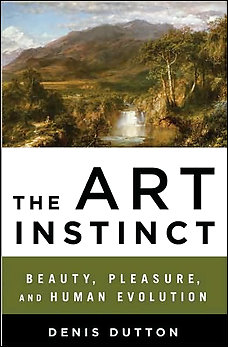
Denis Dutton, a New Zealand philosopher, would like to add one more item to this list: art. As he observes in his provocative new book, The Art Instinct, people the world over are weirdly driven to create beautiful things. These aesthetic objects are utterly useless — W.H. Auden pointed out that they make “nothing happen” — and yet we enshrine them in climate-controlled museums and pay millions of dollars for a silkscreen of a soup can. What began with a few horses on the walls of a French cave has blossomed into a human obsession.
The premise of Dutton's work is that this instinct for art isn't an accident. Instead, he argues that our desire for beauty is firmly grounded in evolution, a side effect of the struggle to survive and reproduce. In this sense, a cubist painting by Picasso is no more mysterious than the allure of a Playboy centerfold: Both are works of culture that attempt to sate a biological drive.
/// Watching the History Channel in a Topeka Hotel Ben Lerner
Well, who really believes, when the lamps are nailed down and this Haitian is shaking a song from one sad word. History is boring. It's so easy to warm to. And the Shiva ends and the people smooth their laps and stand to leave. And the faint rain, that starts when the headlights disappear is too predictable, making grief just another chore that we take up to keep from getting fat and poor. Of course, this man makes wonderful music, his leathery French, prone both to poetry and riot, is its own revolt. And below his left breast his skin erupts in authenticating pinks. His scars still wet, he goes on singing. But everywhere this channel's answered with another nakedness, somehow starkest when it's scrambled, that shows us as fluid, dividing packages, almost less animal, containing only what the other puts in. Everything's a dirty war. And in this music more redeemed— because the silly moans and disco riffs leave little room for cause, for the one-sided story beauty tells us in our separate rooms. ///
To get to the headquarters of the Strategic Plans Division, the branch of the Pakistani government charged with keeping the country’s growing arsenal of nuclear weapons away from insurgents trying to overrun the country, you must drive down a rutted, debris-strewn road at the edge of the Islamabad airport, dodging stray dogs and piles of uncollected garbage. Just past a small traffic circle, a tan stone gateway is manned by a lone, bored-looking guard loosely holding a rusting rifle. The gateway marks the entry to Chaklala Garrison, an old British cantonment from the days when officers of the Raj escaped the heat of Delhi for the cooler hills on the approaches to Afghanistan. Pass under the archway, and the poverty and clamor of modern Pakistan disappear.
Chaklala is a comfortable enclave for the country’s military and intelligence services. Inside the gates, officers in the army and the Directorate for Inter-Services Intelligence, known as the ISI, live in trim houses with well-tended lawns. Business is conducted in long, low office buildings, with a bevy of well-pressed adjutants buzzing around. Deep inside the garrison lies the small compound for Strategic Plans, where Khalid Kidwai keeps the country’s nuclear keys. Now 58, Kidwai is a compact man who hides his arch sense of humor beneath a veil of caution, as if he were previewing each sentence to decide if it revealed too much. In the chaos of Pakistan, where the military, the intelligence services and an unstable collection of civilian leaders uneasily share power, he oversees a security structure intended to protect Pakistan’s nuclear arsenal from outsiders — Islamic militants, Qaeda scientists, Indian saboteurs and those American commando teams that Pakistanis imagine, with good reason, are waiting just over the horizon in Afghanistan, ready to seize their nuclear treasure if a national meltdown seems imminent.
If Obama is serious about peacemaking he'll have to adjust that balance in two ways. First, whatever the transgressions of the Palestinians (and there are many, including terror, violence and incitement), he'll also have to deal with Israel's behavior on the ground. The Gaza crisis is a case in point. Israel has every reason to defend itself against Hamas. But does it make sense for America to support its policy of punishing Hamas by making life unbearable for 1.5 million Gazans by denying aid and economic development? The answer is no.
Then there's the settlements issue. In 25 years of working on this issue for six secretaries of state, I can't recall one meeting where we had a serious discussion with an Israeli prime minister about the damage that settlement activity—including land confiscation, bypass roads and housing demolitions—does to the peacemaking process. There is a need to impose some accountability. And this can only come from the president. But Obama should make it clear that America will not lend its auspices to a peacemaking process in which the actions of either side willfully undermine the chances of an agreement America is trying to broker. No process at all would be better than a dishonest one that hurts America's credibility.
Second, Obama will have to maintain his independence and tactical flexibility to play the mediator's role. This means not road testing everything with Israel first before previewing it to the other side, a practice we followed scrupulously during the Clinton and Bush 43 years.
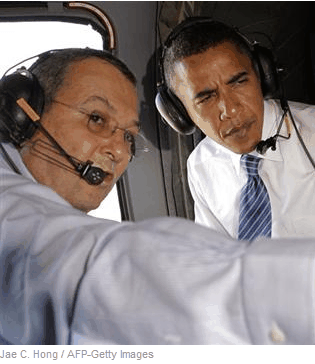
More here. [Photo shows Obama with Israeli defense minister Ehud Barak.]
On his PBS Journal Show last night, Bill Moyers delivered a poignant essay on Israel/Gaza (video below). The whole segment is worth watching — it begins with coverage of a mostly ignored anti-war march this week in Washington (while media hordes, down the street, fixated on the Roland Burris circus) — but Moyers' essay begins at roughly the 2:20 mark.
The most striking aspect is that sober, fact-based, even-handed commentary like this about Israel automatically subjects one to widespread, profoundly ugly accusations of being “anti-Israel” and even “anti-Semitic,” to the point where not a single U.S. Senator and no House member other than a handful dare utter anything other than unquestioning support for Israeli actions, such that most members of the U.S. Congress are, literally, far more willing to question and oppose American military actions than Israel's military actions (the establishment discussion rules are virtually identical to those that prevailed in the pre-Iraq-war days, though even more rigidly enforced: one can question the efficacy of the Israeli attack from the perspective of Israeli interests, but may not question its morality, legality or justifiability).
The answer is that both of them had their intentions badly misread. The one who should have been scary to people who knew him wasn’t; and the one who scared the people who didn’t know him turned out to not be scary at all.
As we’ll see below, this is a common pattern. But before going forward, let me first backtrack a bit.
Pardo was a churchgoer whom no one pegged as a homicidal maniac. “He’s a totally different person from what you hear and see on the news for what he did,” said a family friend named Amanda Dunn. “I’m shocked, literally, I’m shocked. I can’t believe that’s actually the same guy.”
Irfan, born in Detroit, is a tax attorney who lives with his family in Alexandria, Va. He was on his way from Washington to Florida with several members of his family for a religious retreat.
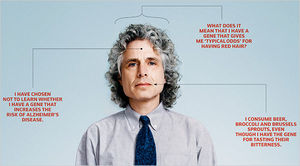
ONE OF THE PERKS of being a psychologist is access to tools that allow you to carry out the injunction to know thyself. I have been tested for vocational interest (closest match: psychologist), intelligence (above average), personality (open, conscientious, agreeable, average in extraversion, not too neurotic) and political orientation (neither leftist nor rightist, more libertarian than authoritarian). I have M.R.I. pictures of my brain (no obvious holes or bulges) and soon will undergo the ultimate test of marital love: my brain will be scanned while my wife’s name is subliminally flashed before my eyes.
Last fall I submitted to the latest high-tech way to bare your soul. I had my genome sequenced and am allowing it to be posted on the Internet, along with my medical history. The opportunity arose when the biologist George Church sought 10 volunteers to kick off his audacious Personal Genome Project. The P.G.P. has created a public database that will contain the genomes and traits of 100,000 people. Tapping the magic of crowd sourcing that gave us Wikipedia and Google rankings, the project seeks to engage geneticists in a worldwide effort to sift through the genetic and environmental predictors of medical, physical and behavioral traits.
It is three minutes past midnight on the 3 March 1991. When the film stops, Rodney King is lying motionless on the ground.
Slightly more than a year later, on 29 April 1992, the four policemen who assaulted King are cleared of all charges by a unanimous jury. That same day, Los Angeles erupts in violent riots, the most brutal in US history. Riots lasting six days. Entire blocks are burned down, more than 50 people are killed and thousands are injured. Not until the National Guard seizes the streets of Los Angeles does the violence come to an end.
Two years earlier, in 1990, the then fairly unknown historian and urban theorist Mike Davis published his analysis of the history and future of Los Angeles, City of Quartz. His excavation of social and ethnic tensions in Los Angeles suddenly seemed prophetic. In a stroke, Davis was transformed into an internationally established and esteemed social critic, his books and articles gaining readers far beyond the academic world.
Now, I am sitting in his kitchen in a small villa in central San Diego. Scratching away on his grey beard, he takes some vigorous sips of coffee and points out that the riots are still an open wound in the history of Los Angeles. Instead of trying to find explanations, most people in power have tried to forget.
“All we got was a story of police brutality which triggered the black community in Los Angeles to violence. But that is just a small part of the truth. It wasn't primarily African Americans who were looting stores and starting fires around the city. If you look at the arrests made by the police it appears that principally Latin Americans were responsible for the riots. And a closer look at the causes shows a web of explanations where police brutality is only one background among others.”
In Ireland, my favourite journalistic justification for this bloodbath came from my old mate Kevin Myers. “The death toll from Gaza is, of course, shocking, dreadful, unspeakable,” he mourned. “Though it does not compare with the death toll amongst Israelis if Hamas had its way.” Get it? The massacre in Gaza is justified because Hamas would have done the same if they could, even though they didn’t do it because they couldn’t. It took Fintan O’Toole, The Irish Times’s resident philosopher-in-chief, to speak the unspeakable. “When does the mandate of victimhood expire?” he asked. “At what point does the Nazi genocide of Europe’s Jews cease to excuse the state of Israel from the demands of international law and of common humanity?” I had an interesting time giving the Tip O’Neill peace lecture in Derry when one of the audience asked, as did a member of the Trinity College Dublin Historical Society a day later, whether the Northern Ireland Good Friday peace agreement – or, indeed, any aspect of the recent Irish conflict – contained lessons for the Middle East. I suggested that local peace agreements didn’t travel well and that the idea advanced by John Hume (my host in Derry) – that it was all about compromise – didn’t work since the Israeli seizure of Arab land in the West Bank had more in common with the 17th-century Irish Catholic dispossession than sectarianism in Belfast. What I do suspect, however, is that the split and near civil war between Hamas and the Palestinian Authority has a lot in common with the division between the Irish Free State and anti-treaty forces that led to the 1922-3 Irish civil war; that Hamas’s refusal to recognise Israel – and the enemies of Michael Collins who refused to recognise the Anglo-Irish Treaty and the border with Northern Ireland – are tragedies that have a lot in common, Israel now playing the role of Britain, urging the pro-treaty men (Mahmoud Abbas) to destroy the anti-treaty men (Hamas).