The Immortals by Amit Chaudhuri

From The Telegraph:

Chaudhuri_1365911c Salman Rushdie has pointed out that India – in the literary imagination – is a country of magnitude and multitude, a “non-stop assault on the senses, the emotions, the imagination and the spirit”. Amit Chaudhuri makes brief reference to such a “mythical composite of colour and smell” but goes on to show that his approach shares none of the gaudy exuberance celebrated – and often demonstrated – by Rushdie. Chaudhuri’s India is a land of “the banal and the everyday that comprise your life”. Despite the title, he is interested in the mortal and the mundane.

Indeed, it seems that only in the title has Chaudhuri veered away from the explicable. The Immortals tells the story of two families in Eighties Bombay joined by their “common, day-to-day pursuit of music”. There is Shyam Lal, the son of a famous singer, now a teacher supprting an extended set of relatives. He becomes the guru of Mallika Sengupta, a woman with a beautiful voice who “knew she could have been famous”, but less interestingly “opted for the life of a managing director’s wife”. Her son Nirmalya is interested in teenage philosophising and playing the harmonium. But then, not much of moment happens: Shyam gets ill, Mrs Sengupta gets old, Mr Sengupta gets pushed out of the company, Nirmalya gets to study philosophy in England. The novel becomes an ordered tabulation of their unremarkable existence, the words on the page like the “agglomeration of notes” on a music sheet.

Instead of Rushdie’s India, then, we have a much more muted evocation of ordinary India. Chaudhuri achieves this in a way that is oddly hard to describe, given a style that appears so keen to avoid both the exceptional and the exceptionable. So, without wishing to be too reductive, let us say that his writing is best embodied in – wait for it – his use of the semicolon. This enables him neatly to structure his descriptions, and fussily to add on extra qualifications: “the aroma from the kitchen hung among the guests like another visitor; no one remarked on it; no one was unaware of it”. It helps him linger on the “gorgeous banalities” under description.

More here.
Tuesday, March 17, 2009

Quantum friction: does it exist after all?

Edwin Cartlidge in Physics World:

For several decades physicists have been intrigued by the idea of quantum friction — that two objects moving past each other experience a friction–like lateral force that arises from quantum fluctuations in the vacuum.

Several independent groups of physicists have previously calculated that quantum friction could arise from the Casimir force between two plates — when those plates move relative to one another. There is also some indirect experimental evidence that such a lateral force exists.

Now, however, researchers in the UK having performed detailed calculations, which they claim show that there is no lateral force and that quantum friction therefore doesn’t exist.

In 1948 Dutch physicist Hendrik Casimir worked out that two uncharged, perfectly conducting metal plates placed in a vacuum should be attracted to one another. This force arises from the fact that, according to quantum mechanics, the energy of an electromagnetic field in a vacuum is not zero but continuously fluctuates around a certain mean value, known as the “zero–point energy”. Casimir showed that the radiation pressure of the field outside the plates will tend to be slightly greater than that between the plates and therefore the plates will experience an attractive force.

Remembering C. Wright Mills

Cwmills Norman Birnbaum in The Nation:

I first read C. Wright Mills in Dwight Macdonald's all too short-lived journal Politics in 1944. It was an essay on the plight of the intellectuals. I was 18 at the time and thought there was nothing better than becoming an intellectual–and I suppose I had John Dewey's influence on the New Deal generation in mind. Mills's earliest academic work was on American pragmatism, which he viewed as our way of connecting present and future, a dramaturgy of historical purpose. By the time I heard Mills speak, at a meeting of the Eastern Sociological Society in 1948, he had become exceedingly pessimistic about the liberating power of thought. That made sense to me. I was studying sociology in the graduate program at Harvard, where themes like class, gender and race were assiduously underemphasized. In the larger university there was almost nothing to be heard of Joseph Schumpeter's claim that intellectuals were ineradicably anticapitalist. Harvard's professors were too busy flying to Washington to staff the agencies of our expanding imperial power. One could not emigrate to Columbia University to study with Mills. His appointment was at Columbia College, and he warned graduate students away: he was thought an outsider in the “profession,” and association with him was unhelpful to their careers. Still, it was Mills (and to be sure, David Riesman) whom the New York intellectuals and their readers in the universities thought of when they thought of sociology at all. Mills was the self-designated survivor of a tradition of large historical and social criticism in American sociology that had largely disappeared by the time he apprenticed himself to it.

To tell the Truth

Daniel_Dennett_in_Venice_2006 From the archives of the New Humanist, Daniel Dennett:

Truth-telling is, and must be, the background of all genuine communication, including lying. After all, deception only works when the would-be deceiver has a reputation for telling the truth. Flattery would truly get you nowhere without the default presumption of truth-telling: cooing like a dove or grunting like a pig would be as apt to curry favour.

We alone among the animals appreciate truth “for its own sake.” And – thanks to the science we have created in the pursuit of truth – we alone can also see why it is that truth, without being appreciated or even conceived of, is an ideal that constrains the perceptual and communicative activities of all animals.

We human beings use our communicative skills not just for truth-telling, but also for promise making, threatening, bargaining, story-telling, entertaining, mystifying, inducing hypnotic trances, and just plain kidding around, but prince of these activities is truth-telling, and for this activity we have invented ever better tools. Alongside our tools for agriculture, building, warfare, and transportation, we have created a technology of truth: science. Scientists have faith in the truth, but it is not blind faith. It is not like the faith that parents may have in the honesty of their children, or that sports fans may have in the capacity of their heroes to make the winning plays. It is rather like the faith anybody can have in a result that has been independently arrived at by ten different teams.

The ultimate reflexive investigation of investigation occurs in that branch of philosophy known as epistemology, the theory of knowledge. Agreeing that truth is a very important concept, epistemologists have tried to say just what truth is – without going overboard. Just figuring out what is true about truth turns out to be a difficult task, however, a technically difficult task, in which definitions and theories that seem at first to be innocent lead to complications that soon entangle the theorist in dubious doctrines. Our esteemed and familiar friend, truth, tends to turn into Truth – with a capital T – an inflated concept of truth that cannot really be defended.

The Revenge of Karl Marx

Hitchens-marx-wide Hitchens in Vanity Fair The Atlantic:

As Wheen skillfully shows, there was an underlying love-hate relationship between Marx and capitalism. As early as the Manifesto, he had written of capitalism’s operations with a sort of awe, describing how the bourgeoisie had revolutionized all human and social and economic relations, and had released productive capacities of a sort undreamed-of in feudal times. Wheen speculates that Marx was being magnanimous because he thought he was writing capitalism’s obituary, and though this is a nice conceit, it does not quite explain Marx’s later failure, in Capital, to grasp quite how revolutionary capitalist innovation really was. (The chapter on new industrial machinery opens with a snobbish quotation from John Stuart Mill’s Principles of Political Economy: “It is questionable if all the mechanical inventions yet made have lightened the day’s toil of any human being.” This must have seemed absurd even at the time, and it appears preposterous after the third wave of technological revolution and rationalization that modern capitalism has brought in its train.) There’s also the not-inconsiderable question of capitalism’s ability to decide, if not on the value of a commodity, at least on some sort of price for the damn thing. Eugen von Böhm-Bawerk and the other members of the Austrian school were able to point out this critical shortcoming of Capital—no pricing policy—during Marx’s lifetime, and it would have been good if Wheen had found some room for the argument (especially vivid among Austrians for some reason) that went back and forth from Rudolf Hilferding to Joseph Schumpeter, whose imposing “creative destruction” theory of capitalism has its own dualism.

Science Cannot Fully Describe Reality, Says Templeton Prize Winner

From Science:

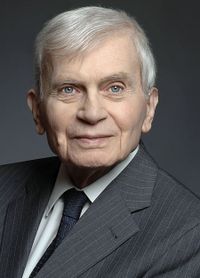
French What is reality? French physicist Bernard d'Espagnat, 87, has spent a lifetime grappling with this question. Over the years, he has developed the idea that the reality revealed by science offers only a “veiled” view of an underlying reality that science cannot access, and that the scientific view must take its place alongside the reality revealed by art, spirituality, and other forms of human inquiry. In recognition of these efforts, d'Espagnat has won this year's Templeton Prize, a £1 million ($1.4 million) award sponsored by the Templeton Foundation, which supports research at the intersection of science, philosophy, and religion.

In classical physics, what you see is what you get: Any measurement is presumed to reveal an intrinsic quality–mass, location, velocity–of the thing measured. But in quantum mechanics, things aren't so clear-cut. In general, the measurement of a quantum object can yield a range of possible outcomes, so that the original quantum state must be regarded as indefinite. More perplexing still are “entangled” states in which, despite being physically separated, two or more quantum objects remain linked, so that a measurement of one affects the measurements of the others (ScienceNOW, 13 August 2008).

Albert Einstein and others objected to the implications of these lines of thought and insisted that quantum mechanics was an incomplete theory precisely because it did not support old-fashioned literal realism. But that's a lost cause, says d'Espagnat, who studied particle physics early in his career. Instead, he has concluded that physicists must abandon naïve realism and embrace a more sophisticated philosophy of reality. Quantum mechanics allows what d'Espagnat calls “weak objectivity,” in that it predicts probabilities of observable phenomena in an indisputable way. But the inherent uncertainty of quantum measurements means that it is impossible to infer an unambiguous description of “reality as it really is,” he says. He has proposed that behind measured phenomena exists what he calls a “veiled reality” that genuinely exists, independently of us, even though we lack the ability to fully describe it.

More here.

In One Ear and Out the Other: Why the best jokes are the most difficult to remember

Natalie Angier in The New York Times:

Jokes A simple melody with a simple rhythm and repetition can be a tremendous mnemonic device. “It would be a virtually impossible task for young children to memorize a sequence of 26 separate letters if you just gave it to them as a string of information,” Dr. Thaut said. But when the alphabet is set to the tune of the ABC song with its four melodic phrases, preschoolers can learn it with ease.

And what are the most insidious jingles or sitcom themes but cunning variations on twinkle twinkle ABC? Really great jokes, on the other hand, punch the lights out of do re mi. They work not by conforming to pattern recognition routines but by subverting them. “Jokes work because they deal with the unexpected, starting in one direction and then veering off into another,” said Robert Provine, a professor of psychology at the University of Maryland, Baltimore County, and the author of “Laughter: A Scientific Investigation.” “What makes a joke successful are the same properties that can make it difficult to remember.”

This may also explain why the jokes we tend to remember are often the most clichéd ones. A mother-in-law joke? Yes, I have the slot ready and labeled. Memory researchers suggest additional reasons that great jokes may elude common capture. Daniel L. Schacter, a professor of psychology at Harvard and the author of “The Seven Sins of Memory,” says there is a big difference between verbatim recall of all the details of an event and gist recall of its general meaning.

“We humans are pretty good at gist recall but have difficulty with being exact,” he said. Though anecdotes can be told in broad outline, jokes live or die by nuance, precision and timing. And while emotional arousal normally enhances memory, it ends up further eroding your attention to that one killer frill. “Emotionally arousing material calls your attention to a central object,” Dr. Schacter said, “but it can make it difficult to remember peripheral details.”

More here.

Monday, March 16, 2009

Sunday, March 15, 2009

Stiglitz is Correct: Don’t Bow to the Dow

Dreier Peter Dreier over at TPM Cafe:

Political talk shows on TV are usually just shouting matches among journalists, academics, former politicians and others. Their “debate” is usually filled with clichés, not substance. This is especially true when discussing the economy, which “experts” tend to mystify rather than clarify, as though the economy operates on supply-and-demand auto-pilot, instead of being shaped by the decisions of corporate leaders, large-scale investors, and government officials.

But the debate between Stiglitz and Moore about the stock market — brief as it was — was important. And Stiglitz nailed it. The stock market is not a good indicator of the effectiveness of public policy, especially in response to announcements by government officials about new initiatives. The reliance by TV and radio newscasters, newspaper reporters and columnists, and quick-with-a-conclusion pundits on the stock market to assess the merits of a policy prescription, or even the health of the economy, is incredibly misleading.

Yet every night on the evening TV news, on National Public Radio, and elsewhere, we get reports on how the Dow Jones, S&P 500 and NASDAQ indices are doing — as though that tells us something about the strength of the economy. All it tells us is how stock traders and speculators are reacting to something they haven't had time or inclination to find out about. It's no accident that, according to the thesaurus, “speculation” is just another word for “rumor” and “gossip.”

The obsession with the stock market as an indicator of economic health reflects the problem that Obama identified in his speech to Congress:

“We have lived through an era where too often, short-term gains were prized over long-term prosperity; where we failed to look beyond the next payment, the next quarter, or the next election.”

Musil, Love and Error Theories

MusilJPeg30 Nick Smyth over at his blog Yeah, OK, but Still:

Robert Musil's The Perfecting of A Love is a short story which contains a very interesting argument. According to Catherine Wilson's (1984) reading, anyway, Musil's character Claudine realizes the power of the following set of thoughts:

  1. Either love is an earthly desire or attitude towards another, or it is not of this world, transcendental in some way.
  2. If love is an earthly desire or attitude, then it is always possible that a stronger, more urgent, more present desire will overwhelm it and cause betrayal.
  3. But true, actual love cannot be this contingent. It cannot be destroyed by the formation of some new desire.
  4. Therefore (by 1 and 3) love is not a desire, it is a transcendental state, not of this world.
  5. However, if love is not a desire, if love does not participate in the realm of earthly motivation, then an action taken from desire cannot be a betrayal of love, for love and desire are categorically different things.

Claudine, a married woman in love with her husband, allows a stranger to make love to her and is at first tormented by her infidelity. But the force of (5) strikes her and she realizes that she has not, in fact, betrayed her husband. She still loves him and this silly reversion of hers does not, indeed cannot affect that reality.

Karen Armstrong on God, Religion, Secularism, Fundamentalism and Dialogue

Armstrong Andrew Sullivan points us to this Bill Moyers interview with Karen Armstrong:

KAREN ARMSTRONG: Let me say this. In our discourse, it is not enough for us in the western democratic tradition simply to seek the truth. We also have to defeat and humiliate our opponents. And that happens in politics. It happens in the law courts. It happens in religious discourse. It happens in the media. It happens in academia. Very different from Socrates, the founder of the rationalist tradition, who when you had dialogues with Socrates, you came thinking that you knew what you were talking about.

Half an hour later, with Socrates, you realized you didn't know anything at all. And at that moment, says Socrates, your– quest can begin. You can become a philosopher, a lover of wisdom because you know you don't have wisdom. You love it. You seek it. And you had to go into a dialogue prepared to change, not to bludgeon your conversation partner into accepting your point of view. And every single point in a Socratic dialogue, you offer your opinion kindly to the other, and the other accepts it with kindness.

BILL MOYERS: But you can't have a dialogue with people who don't want to have-

KAREN ARMSTRONG: No.

BILL MOYERS: -a dialogue.

KAREN ARMSTRONG: But that doesn't mean we should give up altogether. Because I think the so called liberals can also be just as hard lined in their own way.

Sunday Poem

The Habits of Guilt
Aidan Murphy

It summons up schooldays in the abattoir.
It scalds your lungs with unwanted smoke.
as it thumbs up your eyelids in the small hours
chaining you to the bleakest sounds
of wind, rain and broken homes.

Smooching beside you
with its tongue in your ear, it somehow whispers,
if you weren’t so dumb in the first place
I wouldn’t be here; then, gargling
a barrel of nails it staggers from bed
with sleep-yellow eyes and insecticide veins.

On the verge of your most brilliant punchlines
it cackles, bursting into brazen mockery,
ripping the airvalves of your resources,
completing the ruin of your confidence.

But it can be so nice to come home to . . .

with its pipe and slippers and cosseting cushions
dispensing permission to weep indulgently
as its barbs inflict delicious pain.

David LaChapelle Retrospective in Paris

From lensculture:

Lachapelle_11 American Pop photographer David LaChapelle is in the art-world spotlight this year, with a big mid-career retrospective exhibition in Paris (February 6 – May 31), and a simultaneous solo show that just opened in Mexico City.

His work is over-the-top, which is often appropriate for his subject matter — celebrities, sex, drugs, money, greed, high-fashion and excess of all kinds. Recently, he's been applying his characteristic style to a wide range of other themes like war and the media, spirituality, natural disasters, floods and hurricanes, conspicuous consumption, fossil fuels and carbon footprints, old master artworks and surrealism.

As in any retrospective, there is a large variety of work, and the presentation of different phases of LaChapelle’s art is well-suited to the grand halls and majestic rooms of this opulent old building. (La Monnaie de Paris, the Parisian museum of coins and currency, is a shrine to the ideas of money and war medallions.)

More here.

Towards theocracy?

Pervez Hoodbhoy in Frontline:

Child Total separation of the sexes is a central goal of the Islamists. Two decades ago the fully veiled student was a rarity on Pakistani university and college campuses. The abaya was an unknown word in Urdu; it is a foreign import. But today, some shops in Islamabad specialise in abaya. At colleges and universities across Pakistan, female students are seeking the anonymity of the burqa. Such students outnumber their sisters who still dare show their faces.

While social conservatism does not necessarily lead to violent extremism, it does shorten the path. Those with beards and burqas are more easily convinced that Muslims are being demonised by the rest of the world. The real problem, they say, is the plight of the Palestinians, the decadent and discriminatory West, the Jews, the Christians, the Hindus, the Kashmir issue, the Bush doctrine, and so on. They vehemently deny that those committing terrorist acts are Muslims or, if faced by incontrovertible evidence, say it is a mere reaction to oppression. Faced with the embarrassment that 200 schools for girls were blown up in Swat by Fazlullah’s militants, they wriggle out by saying that some schools were housing the Pakistan Army, who should be targeted anyway.

More here. (Note: Thanks to Iqbal Riza).

the dream

American-dream-0904-01

These are tough times for the American Dream. As the safe routines of our lives have come undone, so has our characteristic optimism—not only our belief that the future is full of limitless possibility, but our faith that things will eventually return to normal, whatever “normal” was before the recession hit. There is even worry that the dream may be over—that we currently living Americans are the unfortunate ones who shall bear witness to that deflating moment in history when the promise of this country began to wither. This is the “sapping of confidence” that President Obama alluded to in his inaugural address, the “nagging fear that America’s decline is inevitable, and that the next generation must lower its sights.” But let’s face it: If Moss Hart, like so many others, was able to rally from the depths of the Great Depression, then surely the viability of the American Dream isn’t in question. What needs to change is our expectation of what the dream promises—and our understanding of what that vague and promiscuously used term, “the American Dream,” is really supposed to mean.

more from Vanity Fair here.

roomba faq

Roomba.adj

How do I introduce my Roomba to my parents?

Make sure your parents are sitting down. Tell them you know this sounds unusual, but Roomba, despite what they think, is a really special robot and gets along great with the kids. If your father starts saying, “No daughter of mine is going to …,” tell him he's being a narrow-minded technophobe.

What happens when I leave my Roomba home alone?

Roomba may or may not go through your things, sample your perfume, and call your ex-husband, pretending to be you.

What do I do if I get a higher than usual monthly cable bill with several adult pay-per-view titles charged to my account?

Calmly ask Roomba if you can have a word with it. Tell it you understand it's curious—it's only natural—but that the pay-per-views have to stop.

more from McSweeney's here.

Saturday, March 14, 2009

From Lady Di to Michelle Obama

Naomi wolf Naomi Wolf in Project Syndicate:

In one week, Michelle Obama sat for a formal White House portrait, dressed in somber, tailored clothes; posed for a snazzy People magazine cover, dressed in a slightly down-market, hot-pink lace outfit that showed plenty of skin; let the national media know that the First Family would be getting its new puppy from a rescue shelter; and had her press office mention casually that “secretaries and policy makers” had been invited for popcorn and movies at the White House.

That same week, in the midst of the worst economic crisis since the 1930’s, a national poll found that support for President Barack Obama was remarkably high, with respondents consistently saying that he “cares about people like me.”

These two phenomena are closely related. Almost from her first appearance in the public eye, Michelle Obama has used clothing, etiquette, and such cues as where she shops and entertains to send out a subtle but radical message to American voters and to the world. For the first time since the days of Andrew Jackson, the White House is aggressively “democratizing” the highest office in the land, and symbolically inviting in the common man – and now the common woman.

In other words, Mrs. Obama is managing to set herself up, unprecedentedly, as the “people’s First Lady.” She has carefully studied not only Jackie Kennedy – a comparison obvious from her sheath dresses, boat collars, and page-boy haircut – but also the triumphs and failures of that other glamorous but underestimated stealth radical, Princess Diana.

Princess Di’s legacy in generating iconography that opened the way to tremendous social change is grossly underappreciated.