Considering the The Art Instinct

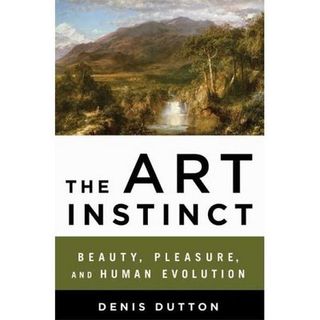
Art instinct Chris Shoen's review of Denis Dutton's book:

At the end of the introduction to The Art Instinct, Dutton sets himself a curious task. Having established that art is a phenomenon arising from a “universal aesthetic” that has been endowed in us by our genes, he then announces that the purpose of his book is to argue that art is actually the force that liberates us from biological imperatives: “The arts set us above the very instincts that make them possible.” He illustrates his stance with the scene from The African Queen where Charlie attempts to justify his drunken fatalism with an invocation to “human nature.” Replies Rose: “Human Nature is what we were put on this earth to rise above, Mr. Allnut.” Comments Dutton: “This book is on the side of Rose's famous retort.”

This may be the most essential statement Dutton makes in the book, as it acknowledges an intrinsic tension between nature and culture that has occupied moral theorists throughout human history. It is also a signal to the skeptical reader that Dutton does not intend to sidestep some of the thornier problems, both ethical and logical, that might arise from a thesis that Art–the apotheosis of culture–is in fact thoroughly biological.
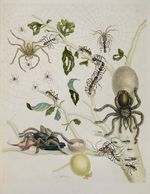

drawing the inner kingdoms

Spinnen

The invention of the microscope in the seventeenth century revealed a miniature world no less vast and complicated than the depths of the starry heavens, themselves gloriously unveiled not long before by the telescope. Creatures previously invisible to human eyes proved to be crafted in detail as marvelous as that of any visible plant or beast, a fact that threw religion and science (in those days still known as natural philosophy) into an existential confusion, from which neither discipline has yet emerged entirely. It was one thing to discover new continents or new constellations, and quite another to discover, as Antonie van Leeuwenhoek—the Dutch inventor of the microscope—did with some horror, that whole kingdoms of “animalcules” were carrying on their lives within his own mouth. One of the chief confusions presented by these tiny creatures was their place in the ranks of animal and vegetable. In 1705, when the erudite Swede Olof Rudbeck Junior published his biblical study The Selah Bird: Neither Bird nor Locust,[1] his readers were still as likely as the ancient Hebrews to see bugs and birds as essentially similar creatures.

more from the NYRB here.

against homes

Dubrowin__1237608058_3343

IN THE SOUL-SEARCHING sparked by the financial meltdown, Americans have started to look askance at some of the habits and policies that had come to define our country. Excessive consumption and living on credit are no longer seen as acceptable, let alone possible. “Deregulation” is suddenly a dirty word. Yet despite the housing crisis, one value, more deeply entrenched, remains sacrosanct: homeownership. Irresponsible mortgages have been universally condemned, but it is still widely assumed that we all aspire to own homes – and that we all should aspire to own homes. Homeowners are thought to be more engaged in their communities and to take better care of their houses and neighborhoods. On a nearly subconscious level, buying a home is a central part of the American dream. A picket fence may now be dispensable, but a house of one’s own is seen as the proper place to raise an American family – a prerequisite for stability, security, and adult life. And for decades – but increasingly under the Clinton and Bush administrations – federal policies have encouraged citizens to achieve this goal.

more from Boston Globe Ideas here.

Tuesday Poem

My Son and I Go See Horses
Marianne Boruch

Always shade in the cool dry barns
and flies in little hanging patches like glistening fruitcake.
One sad huge horse
follows us with her eye. She shakes
her great head, picks up one leg and puts it down
as if she suddenly dismissed the journey.

My son is in heaven, and these
the gods he wants to father
so they will save him. He demands I
lift him up. He strokes the old filly’s long face
and sings something that goes like butter
rounding the hard skillet, like some doctor
who loves his patients more
than science. He believes the horse

will love him, not eventually,
right now. He peers into the enormous eye
and says solemnly, I know you. And the horse
will not startle nor look away,
this horse the color of thick velvet drapes,
years and years of them behind the opera,
backdrop to ruin and treachery, all
innocence and its slow
doomed unwinding of rapture.
.

Son of poets Sylvia Plath and Ted Hughes kills himself

From The Guardian:

Nicholas-Hughes-son-of-po-001 Nicholas Hughes, the son of the poets Sylvia Plath and Ted Hughes, has hanged himself at the age of 47. The former fisheries scientist at the University of Alaska Fairbanks had carved out a successful scientific career in one of the remotest parts of the western world, but ultimately he could not escape the legacy of being the offspring of one of the most famous and tragic literary relationships of the 20th century.

Those who know little else about his mother know that she was the American-born poet who gassed herself in the kitchen of her north London home in February 1963 while her one-year-old son and his two-year-old sister, Frieda, slept in their cots in a nearby room. Plath had placed towels around the kitchen door to make sure the fumes did not reach her children. She had been distraught at the break-up of her relationship with Hughes, following her discovery of his infidelity. Six years after their mother's death, in 1969, their father's then partner, Assia Wevill, also killed herself, killing her four-year-old daughter Shura in the process.

More here.

Extravagant Results of Nature’s Arms Race

Nicholas Wade in The New York Times:

Beetle Nature is reputed to be red in tooth and claw, but many arms races across the animal kingdom are characterized by restraint rather than carnage. Competition among males is often expressed in the form of elaborate weapons made of bone, horn or chitin. The weapons often start off small and then, under the pressure of competition, may evolve to attain gigantic proportions. The Irish elk, now extinct, had antlers with a span of 12 feet. The drawback of this magnificent adornment, though, was that the poor beast had to carry more than 80 pounds of bone on its head.

In a new review of sexual selection, a special form of natural selection that leads to outlandish armament and decoration, Douglas J. Emlen, a biologist at the University of Montana, has assembled ideas on the evolutionary forces that have made animal weapons so diverse. Sexual selection was Darwin’s solution to a problem posed by the cumbersome weapons sported by many species, and the baroque ornaments developed by others. They seemed positive handicaps in the struggle for survival, and therefore contrary to his theory of natural selection. To account for these extravagances, Darwin proposed that both armaments and ornaments must have been shaped by competition for mates.

More here.

Monday, March 23, 2009

Sunday, March 22, 2009

Pitiless Eye

KATHRYN HARRISON in The New York Times:

Harrison-190 Fiction gives readers access to the private lives of characters who don’t know they’re being watched, people who seem real — as real as the reader, if their creator is sufficiently skilled — and whose unspoken thoughts and feelings are plundered for whatever enlightenment or diversion they might offer. No writer understands and gratifies the voyeurism inherent in reading fiction better than Mary Gaitskill. “Don’t Cry,” her third collection of stories, confirms what made “Bad Behavior” and “Because They Wanted To” such idiosyncratic and memorable books. She has a perturbing ability to generate what seems as much a vivisection as a narrative, slicing through her characters to expose interior lives that are more often “broken or incomplete” than in any way admirable. The people in Gaitskill’s stories often behave unconventionally and impulsively; they may seem to have an agency outside their author’s control, doing what not even she could expect, but they never escape her pitiless eye and meticulous hand.

Fiction gives readers access to the private lives of characters who don’t know they’re being watched, people who seem real — as real as the reader, if their creator is sufficiently skilled — and whose unspoken thoughts and feelings are plundered for whatever enlightenment or diversion they might offer. No writer understands and gratifies the voyeurism inherent in reading fiction better than Mary Gaitskill. “Don’t Cry,” her third collection of stories, confirms what made “Bad Behavior” and “Because They Wanted To” such idiosyncratic and memorable books. She has a perturbing ability to generate what seems as much a vivisection as a narrative, slicing through her characters to expose interior lives that are more often “broken or incomplete” than in any way admirable. The people in Gaitskill’s stories often behave unconventionally and impulsively; they may seem to have an agency outside their author’s control, doing what not even she could expect, but they never escape her pitiless eye and meticulous hand.

More here. (Note: Thanks to Alia Raza).

Gaza war crime claims gather pace as more troops speak out

Peter Beaumont in The Guardian:

ScreenHunter_01 Mar. 22 20.23 Worrying new questions have also been raised about the culture of the Israeli military, indicating a high level of dehumanisation and disregard for Palestinians among the chain of command and even among the military rabbinate.

An investigation by reporter Uri Blau, published on Friday in Haaretz, disclosed how Israeli soldiers were ordering T-shirts to mark the end of operations, featuring grotesque images including dead babies, mothers weeping by their children's graves, a gun aimed at a child and bombed-out mosques.

Another T-shirt designed for infantry snipers bears the inscription “Better use Durex” next to a picture of a dead Palestinian baby, with his weeping mother and a teddy bear beside him. A shirt designed for the Givati Brigade's Shaked battalion depicts a pregnant Palestinian woman with a bull's-eye superimposed on her belly, with the slogan, in English, “1 shot, 2 kills”.

More here.

A Bank Bailout That Works

Stiglitz Joseph Stiglitz in The Nation:

The politicians responsible for the bailout keep saying, “We had no choice. We had a gun pointed at our heads. Without the bailout, things would have been even worse.” This may or may not be true, but in any case the argument misses a critical distinction between saving the banks and saving the bankers and shareholders. We could have saved the banks but let the bankers and shareholders go. The more we leave in the pockets of the shareholders and the bankers, the more that has to come out of the taxpayers' pockets.

There are a few basic principles that should guide our bank bailout. The plan needs to be transparent, cost the taxpayer as little as possible and focus on getting the banks to start lending again to sectors that create jobs. It goes without saying that any solution should make it less likely, not more likely, that we will have problems in the future.

By these standards, the TARP bailout has so far been a dismal failure. Unbelievably expensive, it has failed to rekindle lending. Former Treasury Secretary Henry Paulson gave the banks a big handout; what taxpayers got in return was worth less than two-thirds of what we gave the big banks–and the value of what we got has dropped precipitously since.

Since TARP facilitated the consolidation of banks, the problem of “too big to fail” has become worse, and therefore the excessive risk-taking that it engenders has grown worse. The banks carried on paying out dividends and bonuses and didn't even pretend to resume lending. “Make more loans?” John Hope III, chair of Whitney National Bank in New Orleans, said to a room full of Wall Street analysts in November. The taxpayers put out $350 billion and didn't even get the right to find out what the money was being spent on, let alone have a say in what the banks did with it.

TARP's failure comes as no surprise: incentives matter.

Arendt and Heidegger, The Play

Arendt Michael Handelsaltz over at Jewish Theatre News:

In the scene portraying the nadir of Heidegger's career, he is standing far upstage, on the backdrop of a screen properly illuminated for a Nazi parade, wearing a Nazi uniform (the lighting, very impressive in general, was done by Keren Granke). Oded Kotler, with a haircut reminiscent of the Fuhrer's, looks like the real thing throughout the play. And here – and mainly in the explanations by Heidegger and Arendt for his behavior, in hindsight, the metaphor of the hammer and the carpenter, the tool and its user, resonates. The music heard in the background is Mahler's Sixth Symphony, chosen, no doubt, because the composer was Jewish, although Wagner would certainly have been more suitable and right for the spirit of the period and of the man.

Heidegger believed he was using Hitler, while pretending to be an obedient tool, to resurrect the genuine Germany. Arendt claimed the Nazis used him. On the other hand, Arendt understood during their relationship, certainly even more toward the end of her life, that she was a willing tool in Heidegger's hands, and he used her. The fact that he enjoyed it is not relevant here; she enjoyed herself, too.

In short: The philosopher and his student can philosophize about themselves, about the carpenter and about the hammer. But they, and all of us, merely function as a hammer. We are convinced that we are hitting nails on the head, or are iconoclasts, but in the final analysis the driving hand – our passions, history and simple human irony – use us.

A Brief Tour of Consciousness on the Neuron Express

A video interview with V. S. Ramachandran, over at The Science Network:

RAMACHANDRAN:…I think the problem with Ev Psych, by the way, and I’ve said this before in print.

BINGHAM: By which you mean…

RAMACHANDRAN: By which I mean evolutionary psychology, by which I mean you take every conceivable trait, physical or mental propensity and say, why did this evolve, it must have something to do with the way our ancestors were walking around the savanna and all the selection pressures. Now, of course, it’s partly true, that some of our mental traits are because of that. But some of it has this banal ring to it. You say, you know, men like young women because they are more fertile. Ok, maybe. But a, it involves the cultural dimensions of the mind and I think what’s unique about the human brain especially is we are the cultured primate; and I’m not saying this to be politically correct, I have absolutely no interest in politics. But what I’m saying is what’s unique about the human brain is the fact that we have systems of neurons including mirror neurons that enable us to assimilate culture and knowledge through imitation, through emulation, through learning, much more rapidly than any other brain of any other animal. This is what makes us uniquely human.

Ok, so that’s one problem with evolutionary psychology. The other, more serious problem, I think, is you can come up with any ad hoc theory you want and it becomes very difficult to test. For example, I could say, people say, well because we were on the savanna, we like this, we like young women, you know, men. And there are dozens of examples, maybe you could think of some. But you could say, well men or women like going to the Scripps aquarium. Why? Why do we like to go to the aquarium? Well its because our Devonian ancestors were fish, up in the Devonian seas, enjoy mating with other fish, obviously, and found them attractive. And maybe there’s a residue of this in the brain and that’s why we enjoy going to the aquarium. Now immediately that strikes you as ludicrous and absurd.

Freedom’s Just Another Word…

Hart-190 Gary Hart reviews Alan Wolfe's The Future of Liberalism and Jedediah Purdy's A Tolerable Anarchy, in the NYT:

Wolfe’s style is elucidatory rather than polemical. His balanced explication of ideas and their histories makes the book a candidate for advanced undergraduate courses, though more in political theory than in political science. He is strongest in showing the clash and bang of ideas in contest with one another. Most interesting, he demonstrates how conflicting ideas can be at once advantageous and antagonistic to the liberalism he advocates.

Having rejected Rousseau’s nature in favor of Kant’s culture (what Wolfe calls “artifice”) as the basis of liberal thought, he then points out that both Calvinism (or fundamentalist Christianity) and modern evolutionary theory (atheistic Darwinism) are predestinarian enemies of liberal self-determination; that neither socialism on the one hand nor the ruthless markets of Friedrich Hayek and Milton Friedman on the other guarantee any degree of equality of opportunity; that militarism’s roots in Romanticism produce today’s neoconservatism, itself a reaction against the perceived failure of cold war liberalism; that both traditional liberals and conservatives are guilty of a concentration of power that threatens freedom.

Wolfe falters, however, in applying his liberalist structure to the globalized world. Though shunning antiglobalist window smashing, he concludes that “the heyday of American liberalism’s commitment to an open global economy . . . is clearly over.” In response to this Canute-like assessment, reality might say, “Not so fast.”

Passages From India

Michael Dirda in The Washington Post:

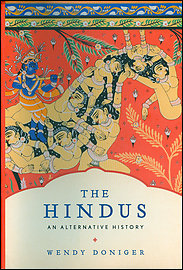
Book Any of us might make the same mistake: I didn't really notice the subtitle of Wendy Doniger's massive study, “The Hindus.” I knew that she was an eminent Sanskrit scholar at the University of Chicago, author of many books about cultural, religious and folkloric beliefs, and a translator of several Indian classics, including “The Rig Veda” and “The Kamasutra.” Her annotations to the latter, that notorious manual of sexual practice, are, I can attest, as entertaining and informative as the book itself.

However, “The Hindus: An Alternative History” is probably too scholarly and specialized for readers looking simply for an introduction to Indian philosophy and religion. In its notes Doniger suggests that her book could be used for a 14-week course, and I suspect that it originated as a series of class lectures. She herself recommends some more conventional histories and guides, including Gavin Flood's “An Introduction to Hinduism,” John Keay's “India: A History” and that old standby, A.L. Basham's survey “The Wonder That Was India.” While Doniger does trace the evolution of Hinduism from the time of the Indus Valley Civilization (2,500 B.C.) to the present, she deliberately emphasizes a small number of recurrent threads, in particular the ways that “women, lower classes and castes, and animals” have endured or surmounted their traditional status. Horses, for instance, are typically glamorous, cows sacred and dogs despised — but not always.

More here.

Saturday, March 21, 2009

Chickens and Eggs: A Memoir by Doris Lessing

Lessing_sv_ak_photo In Granta:

‘What a scatterbrain, what a feckless girl’—so my mother would say of me to a guest, a visiting policeman, a neighbour coming over about some farm problem. ‘What a harum-scarum!’ Did she believe in the evil eye? No. And the Chinese, who, we are told, may say of their own, ‘This is my worthless wife’, ‘This my useless son’. Are they averting the evil eye? ‘She’s such a flibbertigibbet,’ usually said with a fond little laugh. What could she have meant? But the real question came much later, for if you are thirteen, fourteen, what she says has to be taken as true. This knot of wants, needs, angers, attitudes, a confusion of emotions, amounts to being a scatterbrain, the feckless child? Later you had to ask, how could she have used those words on this over-serious, critical bookworm of a girl? A mystery.

Was it in order to cure my flightiness that she said I must look after the sitting hen ‘from start to finish’? Was she curing me of irresponsibility? But I was already bound to the hen, kneeling in front of her cage, an hour, two, most passionately identifying with this incarcerated one, who was as united with those eggs as if tied to them, peering out from the bars as the long hours, and days, went by on our farm in the old Southern Rhodesia.

Before my mother had made the hen my charge, I was gathering up her eggs. A hen, doing what her nature suggests, lays eggs under a bush, returning to add another, and another, but it is unlikely that an unguarded egg could survive more than a day or so.

War and Peace in Our Time

Michael Katz in New England Journal:

The main question for us to consider now is why there should suddenly be such a surge of interest in Tolstoy’s War and Peace, when there is certainly no shortage of translations of this famous work. Indeed, there have been at least ten previous English versions, the first translated (from the French) and published in 1886 by one Clara Bell, an enormously prolific professional translator; the second, in 1889, by Nathan Haskell Dole, an extraordinary character, writer, and journalist, whose apparent lack of skill in the enterprise was such that Tolstoy himself felt compelled to beg him to stop translating his works. The indefatigable Constance Garnett also undertook this demanding project, as did another husband-and-wife team, the highly reliable Louise and Aylmer Maude (who knew Tolstoy personally); the first Penguin edition (1957) was done by Rosemary Edmonds, followed a decade later by Ann Dunnigan’s in Signet Classics (1968). Of all these many previous versions, the two that have best stood the test of time and the stricter test of scholarly examination are those produced by the Maudes and Ann Dunnigan.

But why do we have three brand new translations now and why have they caused such a stir? Well, for one thing, as everyone knows, we are currently at war. A quick search of the internet with the two words “Tolstoy” and “Iraq” yields a wealth of articles with titles such as “Perhaps Saddam Read Tolstoy and Bush’s People Didn’t” (Ben Bagdikian, countercurrents.org, 2003) and “No Military Hope, So Send More Troops” (W. Patrick Lang and Ray McGovern, consortiumnews.com, 2006), not to mention the posts in various weblogs opining on the subject.

On July 17, 2007, in a New York Times op-ed column entitled “Heroes and History,” David Brooks observed:

Many will doubt this, but Bush is a smart and compelling presence in person, and only the whispering voice of Leo Tolstoy holds one back.

Tolstoy had a very different theory of history. Tolstoy believed great leaders are puffed-up popinjays. They think their public decisions shape history, but really it is the everyday experiences of millions of people which organically and chaotically shape the destiny of nations—from the bottom up.

If what is taken to be Bush’s theory of history is correct, the right security plan can lead to safety, the right political compromises to stability. But if Tolstoy is right, then the future of Iraq is beyond the reach of global summits, political benchmarks, and the understanding of any chief executive.

Does Video Game Criticism Need a Pauline Kael?

Pauline_kael_splash In Pop Matters, L. B. Jeffries wonders:

Greg Costikyan, who co-founded Manifesto Games and writes for the indie games blog Play This Thing! wrote an impassioned piece in February of 2008 calling for real criticism in video games. He argues that video games, caught up in consumer culture, only produce buyer’s guides. Proper criticism, he argues, does not depend upon whether or not you should buy something, but rather answers the “why, and how, and to what end.” One of the people he distinguishes from consumer guide writing is Pauline Kael. She was a critic who would better inform the audience, hold filmmakers to task, and explain the cultural impact of films to a broader audience. How would a person go about doing that in video games?

Kael is an interesting person to hope video game criticics will aspire to given the intense relationship she had with her artistic medium. Being mostly unfamiliar with her work, I was told I Lost It at the Movies was her best book and picked up a copy. I’ve seen about a third of the movies she references, but many of her larger observations about some films are outside my personal experience. As with the Lester Bangs piece, the goal here is to study her methods and see what someone dealing with a superficially unrelated medium could borrow.

Kael, much like video game critics today, was faced with a massive philosophical shift in her chosen artistic medium that large quantities of critics were against. This occurred during the ‘60s and ‘70s when sex, anti-heroes, and films that didn’t mindlessly make everyone happy were being released. David Cook, in A History of Narrative Film, marks this era of film with the release of Bonnie and Clyde. Its advertising slogan sums the film up decently: “They’re young! They’re in love! And they kill people!” Many critics panned the film, but it went on to become a box office smash. The problem with the movie is that if you walk in expecting a traditional gangster film, it’s not very good. If you walk in expecting a sharp political satire that blends comedy, violence, and sex, then it’s brilliant. Kael, at the time of Bonnie and Clyde’s release, was one of the few who stood up for it.