Tales from the quantum frontier

From MSNBC:

Quantum_hmed_11a The quantum world may seem so small and weird that there's no connection with everyday reality, but that impression couldn't be further from the truth. Newly published studies – and a newly released documentary – explore the big frontiers of the quantum information revolution. Actually, quantum physics is as connected to everyday reality as the device that's displaying these words of mine. If it weren't for the quantum nature of light, inventions such as computers, TVs and DVD players would be impossible.

Some aspects of quantum mechanics are easier to understand than others, however. It's one thing to wrap your mind around the idea that light comes in individual packets called photons, and quite another to suggest that a single photon can travel along two paths at once. Or to suggest that two photons can be linked so strongly that doing something to one of them affects the other. Even Albert Einstein said that was “spooky.” It may be that our brains just aren't programmed to pick up on the weirder implications of quantum physics, such as superposition, information teleportation and particle entanglement. But Anton Zeilinger, a University of Vienna physicist who pioneered the technology behind teleportation, says that doesn't always have to be the case.

More here.

Labor Pains

Rochelle Gurstein in Guernica:

Laborpains300 It is an historical irony that in last two years’ public discussions about bailing out Detroit, what was once perceived as the death of dignified labor was portrayed by Republican lawmakers and reactionary journalists as a kind of overpaid, over-compensated worker’s paradise. This characterization of the reasonable wages, paid vacations and sick days, health insurance, and retirement packages that labor unions gained in exchange for workers relinquishing the skills required to build cars reveals a distressing loss of historical memory. What is more, this talk of pampered workers is an outrageous libel on the uneasy bargain to which middle-class workers—both blue and white-collar alike—eventually submitted, trading meaningful work for the promise of better working conditions, a higher standard of living, and increased leisure time.

For decades now, manufacturers have demonstrated their contempt for this trade-off. Claiming competitive threats from “the global market,” more and more manufacturers and associated industries have moved their factories outside the United States to take advantage of poor people who have no choice but to accept meager wages. As for the few remaining manufacturers that have kept their factories in the U.S., most notably, the automobile industry, last spring we heard their obscenely rich executives explain to Congress that the main reason their companies were failing was the extreme financial burden of their workers’ benefits.

As we know, President Obama has been intent on saving Detroit. Last year, in his address to Congress on February 24, he announced, “We are committed to the goal of a re-tooled, re-imagined auto industry that can compete and win. Millions of jobs depend on it; scores of communities depend on it, and I believe the nation that invented the automobile cannot walk away from it.”

More here.

Can nuclear power make a comeback?

Hendrik Hertzberg in The New Yorker:

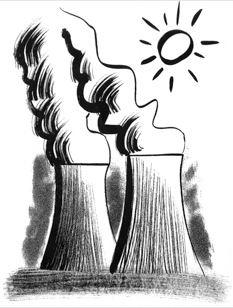
100322_talkcmmntillus_p233 Once the unpleasantness at Hiroshima and Nagasaki had had a little time to recede, America discovered that “the atom” wasn’t all bad. The bomb, yes—it was terrifying, as terrifying as a hundred 9/11s. American children got the wits scared out of them at school by being made to prepare for Armageddon by ducking, covering, and shutting their eyes tight lest the fireball melt them. Grownups were nervous, too, especially after 1949, when Stalin got his bomb. But in December of 1953 President Eisenhower went before the United Nations General Assembly to tell all mankind that the mushroom cloud had a silver lining. His plan, dubbed Atoms for Peace, promised “abundant electrical energy” for everyone.

Who could doubt that shining vision? Certainly not Lewis Strauss, Ike’s chairman of the Atomic Energy Commission, who predicted that nuclear technology would guarantee that “our children will enjoy in their homes electrical energy too cheap to meter.” Not Walt Disney, whose “Our Friend the Atom,” featuring a cartoon genie, entertained millions of schoolchildren fresh from ducking and covering. More surprising, in light of subsequent developments, Students for a Democratic Society, the paradigmatic organization of the new student left, had no doubts, either. S.D.S.’s founding document, the Port Huron Statement, issued in 1962, fretted at length about the Bomb. But among its Rousseauian “blueprints of civic paradise” was this:/p>

Our monster cities, based historically on the need for mass labor, might now be humanized, broken into smaller communities, powered by nuclear energy, arranged according to community decision.

The happy consensus did not last long. It was already breaking down by the nineteen-seventies, and by the late eighties it was gone, obliterated by the accidents at Three Mile Island, Pennsylvania, in 1979 (where no one was killed), and at Chernobyl, Ukraine, in 1986 (which caused thousands of deaths).

More here.

Gaza’s tragically peculiar economy

Rex Brynen in Foreign Policy:

ScreenHunter_04 Mar. 18 08.49 Last week Palestinians marked the 1,000th day of the “siege” of the Gaza Strip. The continuing economic embargo, with its attendant social and economic effects on the more than 1.5 million Gazans, makes for a depressing story. Equally depressing is the extent to which this situation has somehow become accepted as normal and acceptable by much of the international community.

The “1000th day” is in some ways misleading, for Gaza has long endured economic restrictions. The Israeli military occupation after 1967 (or, for that matter, Egyptian administration before it) was never especially development-friendly. With the establishment of the Palestinian Authority in 1994 there was hope for future economic growth. Instead, however, some incidents of terrorism led to a sharp reduction in the number of Gazans permitted to work in Israel-from tens of thousands in the early 1990s, to essentially zero today. Increasing limits on Gaza's imports and exports followed, and intensified with the eruption of the second intifada in late 2000. With Hamas' victory in the January 2006 Palestinian Legislative Council elections, as well as the seizure of IDF soldier Gilad Shalit in June of that year, the restrictions tightened still further in an attempt to unseat the Islamist movement. When Hamas seized direct control of Gaza in June 2007, the Israeli government officially designated the territory as an “enemy entity.”

Today, what is or is not allowed into Gaza is never entirely clear and can change from month to month. Broomsticks and chamomile have recently been permitted; toys, music, books, and shampoo with conditioner have been prohibited; and the importation of pasta required the direct intervention of US Secretary of State Hillary Clinton.

More here.

Wednesday, March 17, 2010

On Myth

Marina Warner in The Liberal:

Myth WRITERS don’t make up myths; they take them over and recast them. Even Homer was telling stories that his audience already knew. If some individuals present weren’t acquainted with Odysseus’s wanderings or the Trojan War, and were listening in for the first time (as I was when a child, enthralled by the gods and goddesses in H.A. Guerber’s classic retelling), they were still aware that this was a common inheritance that belonged to everyone. Its single author – if Homer was one at all – acted as a conduit of collective knowledge, picking up the thread and telling it anew.

In an inspired essay on ‘The Translators of The Arabian Nights’, Jorge Luis Borges praises the murmuring exchanges of writers across time and cultures, and points out that the more literature talks to other literatures, and reweaves the figures in the carpet, the richer languages and expression, metaphors and stories become. Borges wasn’t a believer in anything – not even magic – but he couldn’t do without the fantastic and the mythological. He compiled a wonderfully quixotic and useful bestiary, The Book of Imaginary Beings, to include the fauna of world literature: chimeras and dragons, mermaids and the head-lolling catoblepas whose misfortune is to scorch the earth on which he tries to graze with his pestilential breath. But Borges also included some of his own inventions – The Creatures who Live in Mirrors, for example, a marvelous twist on the idea of the ghostly double.

More here.

dog days

Aminatta-forna

First you notice the dogs. In all other ways Freetown is a West African city like any other, of red dust and raised cries, forty-degree heat and a year neatly segmented into two – hot and dry, hot and wet. Today water tips from the sky. Beneath the canopy of a local store three street dogs and a man holding a briefcase stand and contemplate the rain. Another dog shelters beneath the umbrella of a cigarette seller. A fifth follows a woman across the street, literally dogging her footsteps, using her as a beacon to navigate the traffic and the floodwater. In the dry season the kings of the city are the dogs. They weave through the crowds, lie in the roadside shade watching through slitted eyes, they circle and squabble, unite in the occasional frenzied dash. For the most part the people and the dogs exist on separate planes. The dogs ignore the people, who likewise step around and over them. On the road the drivers steer around reclining animals. This city has more street dogs than any I have known.

more from Aminatta Forna at Granta here.

antsy

E.O. Wilson

Anthill is E.O. Wilson’s first work of fiction. It contains what its title promises it will contain: an anthill, embedded at its core. Not a metaphorical anthill, a real anthill, filled to the brim with—well, ants. And thereby hangs its tale. People have long been fascinated by the similarities between ants and human societies. Though there are no ant symphony orchestras, secret police, or schools of philosophy, both ants and men conduct wars, divide into specialized castes of workers, build cities, maintain infant nurseries and cemeteries, take slaves, practice agriculture, and indulge in occasional cannibalism, though ant societies are more energetic, altruistic, and efficient than human ones. The mirroring makes us nervous: Are we not enough like ants or are we too much like them?

more from Margaret Atwood at the NYRB here.

black

L0060919_lafarge_black_web_NEW

A little while back, when I was working on one of my many doomed projects, I went into a cave. Not just a little cave, either, but an enormous emptiness in the ground, the trace of a watercourse that gnawed its way across half the state of Kentucky a few thousand years ago. We—this was my friend Wayne and I—went a long way in, then we sat down and turned off our lights. The darkness was like nothing I’d ever seen. I couldn’t see my hand in front of my face; after a while I could barely believe that my hand was there, in front of my face, 
waving. That darkness is what I think about when I think of black. I was going to write, the color black, but as every child knows black isn’t a color. Black is a lack, a void of light. When you think about it, it’s surprising that we can see black at all: our eyes are engineered to receive light; in its absence, you’d think we simply wouldn’t see, any more than we taste when our mouths are empty. Black velvet, charcoal black, Ad Reinhart’s black paintings, black-clad Goth kids with black fingernails: how do we see them?

more from Paul La Farge at Cabinet here.

The new Buddhist atheism

Mark Vernon in The Guardian:

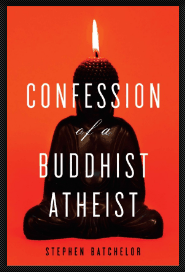
ScreenHunter_03 Mar. 17 14.08 In God is Not Great, Christopher Hitchens writes of Buddhism as the sleep of reason, and of Buddhists as discarding their minds as well as their sandals. His passionate diatribe appeared in 2007. So what's he doing now, just three years later, endorsing a book on Buddhism written by a Buddhist?

The new publication is Confession of a Buddhist Atheist. Its author, Stephen Batchelor, is at the vanguard of attempts to forge an authentically western Buddhism. He is probably best known for Buddhism Without Beliefs, in which he describes himself as an agnostic. Now he has decided on atheism, the significance of which is not just that he doesn't believe in transcendent deities, but is also found in his stripping down of Buddhism to the basics.

Reincarnation and karma are rejected as Indian accretions: his study of the historical Siddhartha Gautama – one element in the new book – suggests the Buddha himself was probably indifferent to these doctrines. What Batchelor believes the Buddha did preach were four essentials. First, the conditioned nature of existence, which is to say everything continually comes and goes. Second, the practice of mindfulness, as the way to be awake to what is and what is not. Third, the tasks of knowing suffering, letting go of craving, experiencing cessation and the “noble path”. Fourth, the self-reliance of the individual, so that nothing is taken on authority, and everything is found through experience.

More here.

Deconstructing Lady Gaga’s “Telephone” Video

Aylin Zafar in The Atlantic:

ScreenHunter_02 Mar. 17 14.00 Lady Gaga's latest music video, “Telephone,” premiered last week, and the 9 ½ minute spectacle was nothing short of what you'd expect from the Gagaloo. Teaming up with “Paparazzi” director Jonas Akerlund, “Telephone” picks up where his previous video left off—with Gaga heading to the slammer after killing off a lover who did her wrong. Saying she is “always trying to convolute the idea of what a pop music video should be,” Gaga told E! that she wanted to take “the idea that America is full of young people that are inundated with information and technology and turn it into something that was more of a commentary on the kind of country that we are.”

While many on the interwebs are raving about Gaga's latest, others wonder where the substance is. It's easy to say you want to take something with “quite shallow meaning, and turn it into something deeper,” but just because your video has a “Tarantino-inspired quality” doesn't make it profound. However, Gaga's talents aren't without merit. She's a great singer, captivating performer, pushes the boundary of style—she's basically a walking performance art piece.

We shouldn't just assume that a woman who cares so much about aesthetic and artistic value would just spew out a string of seemingly random images and product placements. To give Gaga a fair and fighting chance, we've deconstructed her pièce de résistance—and were rather surprised with what we came up with…

More here.

Karachi ‘water mafia’ leaves Pakistanis parched and broke

Corrupt politicians allow businessmen to siphon off as much as 41% of the city's water supply and turn around and sell it at exorbitant rates to residents, generating an estimated $43 million a year.

Alex Rodriguez in the Los Angeles Times:

ScreenHunter_01 Mar. 17 13.51 The water tanker mafia's prey can be found in slums like Karachi's Gulshan-Sikanderabad neighborhood, where every morning people buy water from the tankers, lug the plastic jugs back to their homes on wooden carts, then come back three or four more times in the afternoon and evening to buy more.

A family that makes $100 a month can spend as much as a quarter of that on water, which, elsewhere in Pakistan, costs pennies and flows out of household taps.

Water scarcity isn't the cause. Karachi has a steady water supply, and it has the network of pipes to pump ample water into every neighborhood, rich and poor.

But Karachi is also a city of opportunists forever on the prowl for under-the-table wealth.

More here.

Wednesday Poem

From: Home Fires

2. A Stove Lid for W.H. Auden

The mass and majesty of this world, all
…….That carries weight and always weighs the same . . .
……………………………………..”“The Shield of Achilles”

The mass and majesty of the world I bring you
In the small compass of a cast-iron stove lid.
I was the youngster in a Fair Isle jersey
Who loved a lifter made of stainless steel,
The way its stub claw found it's clink-fast hold,
The fit and weight and danger as it bore
The red hot solidus to one side of the stove
For the fire-fanged maw of the fire-box to be stoked,
Then the gnashing bucket stowed.
………………………………..So one more time
I tote it, hell-mouth stopper, flat earth disc,
And replace it safely. Wherefore rake and rattle,
Watch sparks die in the ashpan, poke again,
Think of dark matter in the starlit coalhouse.

by Seamus Heaney

from District and Circle
Farrar, Straus, and Giroux, 2006

Web-Smart Sitcom 3.0 Makers Update Ancient Comedy Formula

From Wired:

Backwash-660-tweaked Shorter and darker than the half-hour comedies that ruled TV for five decades, the new wave of net-based series draw from documentary-style breakthroughs The Office and Arrested Development, which gave the wheezing format a second wind early this decade. While a handful of TV comedies still feel fresh — witness nerd goddess Tina Fey’s half-hour gem 30 Rock, starring recent Wired cover boy Alec Baldwin — a promising crop of microbudgeted webcoms, like Crackle.com’s upcoming Reno, Nevada-based series Backwash (pictured), suggest that broadband, not broadcast, will deliver the big laughs in decades to come.

In advance of next month’s Streamy Awards honoring web-based entertainment, Wired.com deconstructs three examples of Sitcom 3.0 humor — no laugh track required. After you’ve taken a look at the clips, let us know what you think and weigh in with your own favorite web comedies.

More here.

Tuesday, March 16, 2010

the ethics of shock and incomprehension

Nonfiction021510_575

From two hundred yards, a handheld digital camera tracks a Humvee down a desolate road. Voices, in Arabic: “Keep the camera on it!” “Allahu akbar.” Most of the audience at last year’s MoMA screening of Mauro Andrizzi’s documentary Iraqi Short Films was probably thinking what I was. It was hardly surprising that many of them got up to leave before the conclusion of the film. I am going to watch these American soldiers die. The Humvee and the soldiers trundle along, perfectly in the center of the crosshairs of the camera. Then, unceremoniously, the Humvee explodes into a ball of flame. There is an audible gasp from the person sitting behind me. A few seconds later—and here is where many in the audience got up to leave—a second vehicle inches its way, in excruciating real time, to the crash site before also bursting into flame. Those who stayed until the end of the film witnessed a collage of sorts, a barrage of short clips of increasingly and astonishingly bloody footage. Soldiers and insurgents filming themselves firing machine guns at each other, tanks crushing cars and reducing buildings to rubble, graphic close-ups of dead and dying civilians, snipers on both sides recording their hits (“I got him, I got him” translates remarkably well from Arabic, as does “Shoot the motherfucker!”), KBR trucks ambushed, helicopters shot down, bombs dropping from the sky freeze-framed the moment before impact (“See you in fucking hell, dude,” one U.S. soldier offers in voiceover), masked insurgents and American soldiers alike mugging before the camera, British soldiers making amateur dance videos, alleged spies executed on the street by handgun, dead children, and many, many car bombs, IEDs, and people bursting into flame.

more from Nicholas Sautin at Guernica here.

is poetry translation possible? – Kirsch and Kaminsky

Translation

The realities of the world change. Languages such as Chinese, Spanish, French, and English are no longer confined to their original geographic locations (and some, like Yiddish, exist outside geography), and we certainly—thank God!—no longer live in the world Wyatt knew. That more poets are available to us is a great thing, and there is no reason to assume that people who are serious about contemporary poetry are going to be satisfied with a few anthologies and will abstain from a “good deal of study.” You cite Wyatt and Akhmatova as you say that too much is available: Armenian! Marathi! But as her contemporaries’ memoirs clearly tell us, Akhmatova did read quite a lot of poetry translated from Armenian. If she did, then why in the world shouldn’t we? No need to hide behind the large sign “Poetry is lost in translation” and pretend that works of art written elsewhere do not exist or should not be available to us. They exist. The genius of our literature, as you rightly quote Pound, feeds on our interaction with these works, and so there is a clear need for them to be brought over into English, if the genius of our literature is to be sustained.

more at Poetry here.

I feel … fermented

Takeshi-kitano-knitting-m-003

There’s plenty of evidence that artists can make decent movies – Steve McQueen, Sam Taylor Wood, Julian Schnabel to name a few – but it rarely works the other way around. Looking at Dennis Hopper’s goatee-stroking conceptual works, or Sylvester Stallone’s hamfisted attempts at abstract expressionism, you suspect they were misled into overestimating their talents by a coterie of star-struck sycophants. So when it was announced last year that Takeshi Kitano, Japan’s foremost film-maker, was holding an art exhibition in Paris, the alarm bells rang. Over the last 15 years, Kitano has turned out a series of spare, violent, existential thrillers, but increasingly his prime concern seems to be his own navel: last month saw the UK release of his 2005 film Takeshis’, a wilfully confusing essay exploring the many facets of Kitano’s personality. He followed that with the self-referential Glory to the Film-Maker, this time exploring the burden of being an important movie director. Variety magazine’s damning verdict? “Hailed as Kitano’s 8&½, pic weighs in closer to 1&¼”. And then there are the paintings. Anyone who has seen 1997’s Hana-Bi, Kitano’s best film, will be familiar with them: the movie is full of the director’s own artworks. At best, they are colourful, crafted examples of what you might call “the naive style”; at worst, they are the sort of amateurish doodles you might find at a flea market.

more from Steve Rose at The Guardian here.

Tuesday Poem

Proof

Her skin, saffron toasted in the sun,
eyes darting like a gazelle.

—That god who made her, how could he
have left her alone? Was he blind?

—This wonder is not the result of blindness:
she is a woman, and a sinuos vine.

The Buddha's doctrine thus is proven:
nothing in this world was created.
…………………………………….(Dharmakirti, 7th Century)


Prueba

La piel es azafrán al sol tostado,
son de gacela los sedientos ojos.

—Ese dios que la hizo, ¿cómo pudo
dejar que lo dejase? ¿Estaba ciego?

—No es hechura de ciego este prodigio:
es mujer y es sinuosa enredadera.

La doctrina del Buda así se prueba:
nada en este universo fue creado.
…………………………………….(Dharmakirti, siglo VII)

by Octavio paz

from The Collected Poems 1957-1987
publisher Carcenet Press Limited
translation Eliot Weinberger

Philosophers Rip Darwin

From The Chronicle of Higher Education:

Darwin Last year was the 200th anniversary of the birth of Charles Darwin and the 150th anniversary of the publication of his book, On the Origin of Species by Means of Natural Selection, or the Preservation of Favoured Races in the Struggle for Life. The anniversary was marked by conferences the world over. I will not tell you how many I attended; ecologically sensitive readers of The Chronicle might start whining about carbon footprints and that sort of thing. Let me just say that I found myself going no fewer than three times through the Quad City International Airport, in Moline, Ill. Moline!

I mention this as background to the publication of a new book by Jerry A. Fodor, a professor of philosophy at Rutgers University, and Massimo Piattelli-Palmarini, a professor of cognitive science at the University of Arizona. The title of the book, What Darwin Got Wrong (Farrar, Straus and Giroux), tells you their opinion of the old English naturalist and of his theory of evolution through natural selection. If Fodor and Piattelli-Palmarini were an isolated case, one could dismiss their book with a grimace (if you were a biologist), or welcome them with a cheer (if you were a creationist). But in the philosophical community, there is an increasingly vocal cadre of eminent philosophers harboring doubts about Darwin. To understand their critique, we must first put the clock back a year, to the beginning of the celebrations.

More here.