The Vast World of the Tiny, Arranged From A to Z

From The New York Times:

Book “The minuscule, a narrow gate, opens up an entire world.” This is both Hugh Raffles’s epigraph and the last line of his miraculous book “Insectopedia,” as inventive and wide ranging and full of astonishing surprises as the vast insect world itself. In 26 chapters varying from 2 to 42 pages, from “Air” to “Zen” and “The Art of ZZZs,” with “Chernobyl,” “Fever/Dream,” “Kafka,” “Sex,” “The Sound of Global Warming” and “Ex Libris, Exempla” in between, he takes us on a delirious journey, zooming in and out from the microscopic to the global, from the titillating to the profound, from Niger to China, from one square mile above Louisiana to the recesses of his own mind.

First, that square mile over Louisiana in “Air.” In 1926, P. A. Glick, a scientist from the federal Division of Cotton Insect Investigations, and colleagues from the Department of Agriculture, among others, counted about 25 million to 36 million insects, including a ballooning spider they found flying at 15,000 feet, “probably the highest elevation at which any specimen has ever been taken.” (A Boeing transatlantic passenger jet flies at an average of 35,000 to 40,000 feet.) We know how the Boeing gets up there, but the spider’s launch is an aeronautical feat unequaled by aerospace engineers. Here’s how Mr. Raffles describes what Mr. Glick observed: the spiders “not only climb up to an exposed site (a twig or a flower, for instance), stand on tiptoe, raise their abdomen, test the atmosphere, throw out silk filaments, and launch themselves into the blue, all free legs spread eagled, but they also use their bodies and their silk to control their descent and the location of their landing.” His own sense of wonder is infectious: “Thirty-six million little animals flying unseen above one square mile of countryside? The heavens opened.”

More here.
Psychopaths Keep Their Eyes on the Prize

Michael Torrice in Science:

ScreenHunter_05 Mar. 16 09.26 Whether it involves gambling away one's life savings or committing one murder after another, a psychopath inevitably leaves the rest of us wondering: What was going on in his head? Now researchers report that part of the answer may be hypersensitivity to rewards, which may create a pathological drive for money, sex, and status.

All psychopaths share two characteristic traits: an inability to empathize with others' emotions, such as the fear in a person's face, and impulsive, anti-social behavior, such as reckless risk taking or excessive aggression. Neuroscientists have pinpointed neural mechanisms that may cause psychopaths' lack of empathy. But very little research has looked at what leads to impulsivity-which in some ways might be more important, because it can help predict a psychopath's tendency towards violent crime.

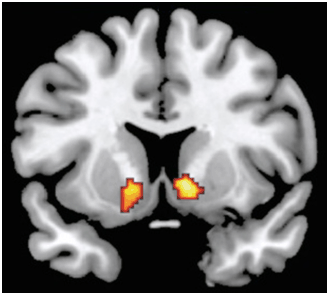
Neuroscientist Joshua Buckholtz of Vanderbilt University in Nashville and his colleagues decided to focus on a system of interconnected brain regions called the mesolimbic system, which motivate us to hunt for rewards by releasing the neurotransmitter dopamine. Drugs like heroine-to which psychopaths are also more susceptible—can push circuits in this system into overdrive, leaving addicts compulsively seeking another hit. The researchers hypothesized that psychopaths might also overreact to other rewards.

To test their hypothesis, the scientists studied how normal personality is affected by variations in the nucleus accumbens, a part of the mesolimbic system involved in motivation.

More here.

Glory, piety and politics in Pakistan

Nadeem F. Paracha in Dawn:

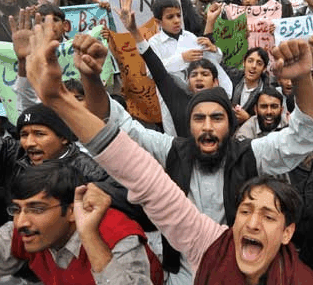
ScreenHunter_04 Mar. 16 09.22 The seeds of neo-religious traditionalism disguised as ‘modern Islam’ were thus sown, and a contemporary identification tool for a number of not-so-clear-minded middle-class youth was discovered. Hijab and beard became ‘cool’; so did the idea of trendy and hip looking folks sounding like 21st century versions of Abul Ala Mauddudi, or worse, yuppie adaptations of Mulla Omar! The tragic 9/11 episode, Bush’s diabolic invasion of Iraq, another military dictatorship in Pakistan, and the rise of the Taliban in the country, all this (and more), eventually began to politicise the otherwise apolitical wave of neo-traditionalist piety, attire and thought that had started sweeping across large sections of Pakistani middle-class.

TV personalities like Zaid Hamid and Aamir Liaquat, and politicians like Imran Khan and Munawar Hussan, are pegs of this new trend, mixing neo-traditionalist trappings of exhibitionistic piety, dress and claims with political discourses that may sound populist and radical, but in fact they are nothing more than the kind of reactionary and myopic mindset that sections of Pakistan’s military establishment started being plagued with during the Afghan jihad under Zia and after. Today society stands clearly polarised.

More here.

The pope’s entire career has the stench of evil about it

Christopher Hitchens in Slate:

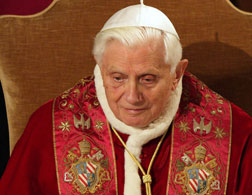
100315_FW_PopeTN There are two separate but related matters here: First, the individual responsibility of the pope in one instance of this moral nightmare and, second, his more general and institutional responsibility for the wider lawbreaking and for the shame and disgrace that goes with it. The first story is easily told, and it is not denied by anybody. In 1979, an 11-year-old German boy identified as Wilfried F. was taken on a vacation trip to the mountains by a priest. After that, he was administered alcohol, locked in his bedroom, stripped naked, and forced to suck the penis of his confessor. (Why do we limit ourselves to calling this sort of thing “abuse”?) The offending cleric was transferred from Essen to Munich for “therapy” by a decision of then-Archbishop Joseph Ratzinger, and assurances were given that he would no longer have children in his care. But it took no time for Ratzinger's deputy, Vicar General Gerhard Gruber, to return him to “pastoral” work, where he soon enough resumed his career of sexual assault.

It is, of course, claimed, and it will no doubt later be partially un-claimed, that Ratzinger himself knew nothing of this second outrage. I quote, here, from the Rev. Thomas Doyle, a former employee of the Vatican Embassy in Washington and an early critic of the Catholic Church's sloth in responding to child-rape allegations. “Nonsense,” he says. “Pope Benedict is a micromanager. He's the old style. Anything like that would necessarily have been brought to his attention. Tell the vicar general to find a better line. What he's trying to do, obviously, is protect the pope.”

This is common or garden stuff, very familiar to American and Australian and Irish Catholics whose children's rape and torture, and the cover-up of same by the tactic of moving rapists and torturers from parish to parish, has been painstakingly and comprehensively exposed. It's on a level with the recent belated admission by the pope's brother, Monsignor Georg Ratzinger, that while he knew nothing about sexual assault at the choir school he ran between 1964 and 1994, now that he remembers it, he is sorry for his practice of slapping the boys around.

Very much more serious is the role of Joseph Ratzinger, before the church decided to make him supreme leader, in obstructing justice on a global scale.

More here.

Monday, March 15, 2010

Obama Abroad

by Michael Blim

In Rome, the 64 bus takes all — pilgrims, pickpockets, and just folks — from the Stazione Termini to the Vatican. Though still an armpit-in-face experience, Roman hygiene, commercial deodorants or both have improved, so that one can focus one’s senses on the scene rather than devote some to avoiding smells. While traveling from the Piazza della Repubblica, where the old second hand book stands now must treat with new five star hotels winnowed out of its old colonnades, past the Quirinale and the Banca d’Italia, the last institutional redoubts not under Berlusconi’s control, the Via del Corso, Largo Argentina, and finally over the Bridge into Vatican City, I listened in on an animated conversation among three Roman women of a certain age returning home from a late afternoon walk in Centro. Though their dress was modest, almost matronly, there were enough rings and things to indicate that they were respectable and expected to be taken so. One sported more than a bit of coral and butch, red-dyed hair, suggesting to me that they were ladies of the neighborhoods rather than of the center. Proper, ordinary Roman women, in other words.

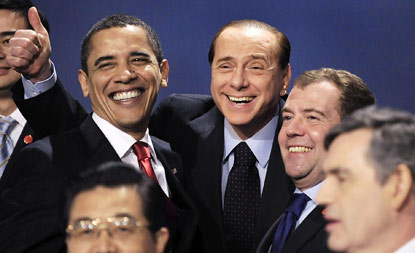
Obama-smile-415x253 Obama and American health care was on their minds. What kind of a country was it, they wondered, where half of the people don’t want health care reform? Obama was doing the right and obvious thing, and was being defeated by the lobbies. One opined that Obama was a failure, but her two companions argued that after only one year, it was too soon to tell. The lady in coral was indignant: she would never step foot in America, because what if she got sick? The uninsured don’t get treatment, and the poor are left in “mezzo la strada,’ in the middle of the street, with all of the indignity and danger being left in the street implies.

Three days later, amongst several of Italy’s elite, the refrain was the same. Americans left the uninsured sick in “mezzo la strada,” noted a parliamentarian seated to my right as we discussed the decline of the Italian leadership class amidst the splendor of the main sala of Siena’s Banca Monte dei Paschi, said to be the world’s oldest bank. Obama, once America’s knight in shining armor seemed to be becoming to them America’s Don Quixote, tilting at the windmills of power in a barbarian land. Despite the travesties of current Italian politics – Berlusconi is currently being tried for bribing a judge and consorting with the Mafia in proceedings he refuses to attend while Italy’s equivalent of AT & T was caught wittingly recycling billions of drug dollars made by Calabria’s mob – my hosts found themselves morally refreshed by America’s abysmal example. It took their minds off their troubles.

As I traveled over the Alps and onto Sweden, I expected more of the same, perhaps with more than a little sanctimony mixed in, and deservedly so. What state on the planet could be said to be a true welfare state if not Sweden?

Read more »

Sunday, March 14, 2010

India Will Never Be the Same Again

5152.gamechangerHartosh Singh Bal and Dhirendra K. Jha on the new gender quota for India's parliament, in Open the Magazine:

[W]hatever the short-term impacts on politics and governance, there was something new and refreshing about Sonia Gandhi’s candour on the day the Bill was passed. She told NDTV 24/7, “Well, it is a huge risk, but we have taken risks before. Whenever there is something revolutionary and new, there is opposition. There are difficulties in all parties, perhaps in my party too. But as I said the larger picture of women’s empowerment is more important.” What she has brought to the issue of empowerment is a vision that has been lacking in our politics of pragmatism, a vision that goes beyond the calculus of losses and gains.

A week before the Bill was tabled, she had told the Congress Parliamentary Party, “It is a matter of great pride that even though it has taken so long, it is our government that has cleared the legislation in the Cabinet… This year on 8 March is the centenary of International Women’s Day. What a gift to the women of India, if on this important day this historic legislation is introduced and passed!”

It took a day longer, but the deed was done. For those who had argued the Bill could well wait till the end of the session, it must now be clear that the symbolism of the occasion was central to its passage. In fact, symbolism has been the key to its very conception. The idea of the Bill was born in 1994 as various women’s organisations, including National Federation of Indian Women (NFIW) and All India Democratic Women’s Association (AIDWA), started gearing up for Fourth World Conference on Women due then at Beijing in 1995. This was later reflected in the election manifestos of various parties, including the Left parties, before the Lok Sabha election of 1996. The Deve Gowda Government took the first step, and after the idea of reserving seats was tabled in the Lok Sabha that very year, the Bill was referred to a joint parliamentary committee headed by the Communist Party of India (CPI) leader Geeta Mukherjee. It was this committee that recommended the 33 per cent reservation for women.

Born of symbolism, the impact though will be very real. The time for looking at whether the Bill should have been framed differently is now past. And it remains the case that our contradictory approach to reservations, justice and equity will bring new pitfalls as we continue to evolve our polity. But for the time being, what counts is the impact of the Bill.

One easy way to measure its impact is to look at Panchayati Raj Institutions (PRI) where the 33 per cent rule has been in force. All the criticisms levelled at the initiative remain valid, the ironic term ‘Sarpanch Pati’ is no aberration—a nationwide survey have shown more women than men have relatives who had contested elections earlier. But it has also shown that 37.3 per cent of all women candidates stand for elections because of this reservation. And that is probably the strongest argument for the Bill. Not that major legislative or normative changes in our politics are likely because of the Bill, but that it will create the perception of participation.

And this perception is what shapes the reality of a more equitable society.

World exclusive! Finnegans Wake nonsense!

From The Guardian:

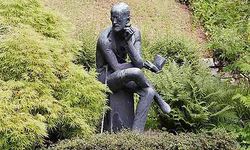
Statue-of-James-Joyce-by--001 People often wonder, rather unfairly, what exactly academics do with their time; what purpose they serve for culture and society. And now we know: they spend three decades making minor adjustments to Finnegans Wake. Well worth the time and effort, I'm sure you'll agree. No, I'm joking – sort of. Certainly, it's good that there are still people like Danis Rose and John O'Hanlon in our world, who devote themselves to something as knotty, exhausting and defiantly uncommercial as their new edition of that labyrinthine book. It's good that some people still do things for the love of art. On the other hand, in this case, the fact is that all their labours won't make a lick of difference because James Joyce's famously unreadable novel will unquestionably remain, well, unread. Finnegans Wake has attained mythic status, not because of inherent greatness or influence but because most people are unsure if it actually exists, since they've never met, or even heard about, anyone who's finished it. Rose and O'Hanlon say the new version is a “smoother” read – but this is clearly a fib, because Finnegans Wake is not, and never will be, comprehensible to anybody outside of, maybe, God. Maybe.

As I understand it, the book consists of one single word of approximately 550,000 letters. It's the work of linguistic gobbledegook that all other works of linguistic gobbledegook reverentially call “The Supreme Being”. Within days of publication, an entire Finnegans Wake-based industry had sprung up in academia, with eggheads under such pressures of production that they had to sub-contract much of the meta-textual and semiotic analysis work to factories in the Far East. For the rest of the literate world, however, it has remained an impenetrable morass of fevered gibberish, stylistic showing-off and made-up words that you can't even check in the dictionary.

More here.

It’s daylight science time again

From MSNBC:

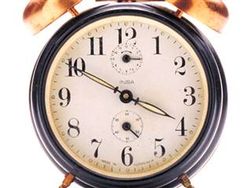
Time It’s that time of year, when crocuses bloom, the lawn starts to need mowing, and most Americans lose an hour’s sleep setting their clocks ahead. (Remember? Spring forward, fall back.) So here are answers to your questions about the time switch — and about sleep. Most Americans move their clocks ahead for daylight-saving time in the wee hours of the second Sunday in March. The day of the big switch used to be the first Sunday of April, but in 2005, Congress revised the rule as an energy-saving measure. What's the rationale behind the switchover? As the year progresses toward the June solstice, the Northern Hemisphere gets longer periods of sunlight. Timekeepers came up with daylight-saving time — or summer time, as it’s known in other parts of the world — to shift some of that extra sun time from the early morning (when timekeepers need their shut-eye) to the evening (when they play softball).

The idea is that having the extra evening sunlight will cut down on the demand for lighting, and hence cut down on electricity consumption — and that few people will miss having it a little darker at, say, 6 o'clock in the morning. At least that's how the theory goes. Not everybody goes along with the plan, as folks in places like Hawaii and most of Arizona know quite well. Each state or country comes up with its own schedule for the switch: Most European countries don't switch to summer time until the last weekend in March. And yes, some countries in the Southern Hemisphere are moving their clocks back an hour at this time of year.

More here.

Their land came to be known as Kafiristan

C. M. Naim in Outlook India:

Kalashpeople_20100312

When in 1888 Rudyard Kipling sent off his two rascally heroes to become kings in Kafiristan, this is how he described their first sighting of the local people: “Then ten men with bows and arrows ran down that valley, chasing twenty men with bows and arrows, and the row was tremenjus. They was fair men, fairer than you or me, with yellow hair and remarkable well built.” (Sadly, the 1975 film based on the story was shot in Morocco and not in Chitral, and John Huston’s “natives” were swarthy and dark-haired, true only to Hollywood anthropology.) Linguists who studied the relevant languages have declared them as old as the time when Aryan and Iranian languages had not branched away from each other—even older. These people made their home in a remote region, extremely picturesque but not possessing the wealth that attracted marauders and empire builders. Various invading hordes seemingly skirted them. And when the diverse people around them became Muslim, they collectively came to be known as “Kafirs,” and their land as “Kafiristan.”

However, what could survive ancient marauding failed against the combined might of 19th century colonialism and nationalism. The British in India came to terms with the Pathans in Kabul in 1893 and put down the infamous Durand Line (1896) that cut through the land of the Kafirs. Soon after, the Amir of the new nation of Afghanistan invaded his portion of the divide to establish his sovereignty. Those who could do so fled to Chitral, whose Muslim ruler let them settle near their brethren.

More here.

Green-Eyed Cab Ride

Arsalan Ali Faheem in 77 Long Drives:

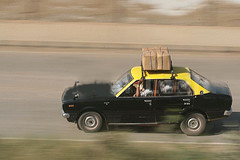
Taxi My neck stiffened.

There were gasps at the back.

You could smell fuel in the air.

Someone lit a cigarette.

I dug my shoes into the car’s frame. toes pressing down on the sole.

I dared a glance to the right. The d-man stared back. His right eye was green, left one was grey.

HIS RIGHT EYE WAS MADE OF GLASS!

As dread overwhelmed me, my heart sank! The Karachiite version of Mad-eye Moody could only see half the road!

He then began shouting in Pashto, and we continued our race to the after life. My Pashto is not very good, so I glanced back towards Jameel, whose expression was priceless. As Mad-eye continued to spit abuse (there was plenty of spitting here) at the other drivers, Jameel, in English, explained that it was regarding their sisters. I told him, that the driver had a glass eye. “What?!” ” Oh God were doomed!” they all shouted back.

Whatever it was, it worked, and through just the right amount of space between a colourful bus and a donkey cart, we speed through. Collective exhaling at the back and front.

More here.

“Final Solution” by Rakesh Sharma: Shows the brutality of conflict in India which receives virtually no mainstream press in the United States

Namit Arora in Shunya's Notes:

The 2002 communal riots in Gujarat may well go down as the darkest chapter in the first decade of 21st century India. An estimated two thousand Muslims were murdered, many burned alive. But what makes this a particularly dark event is the fact that it was methodically planned ahead and actively supported by the state government of the Hindu nationalist party BJP, led by Narendra Modi, still popular and in command in Gujarat…

…I had long heard of Rakesh Sharma's Final Solution, the acclaimed documentary film about the riots. A few months ago I found it on Google Video and I can't praise it enough. It is an outstanding record that expanded my understanding of the riots—from the political rallies before the riots, to the minds of the Hindutva ideologues, to their many grassroots organizations in the Sangh Parivar. Using eyewitness accounts, Sharma reveals how the events then unfolded, how the madness spread, and the stories of the people caught in its wheels. A must see for anyone interested in the politics of hate that grips humanity from time to time (duration: 150 mins).

A special report on managing information

From The Economist:

ScreenHunter_02 Mar. 14 08.09 When the Sloan Digital Sky Survey started work in 2000, its telescope in New Mexico collected more data in its first few weeks than had been amassed in the entire history of astronomy. Now, a decade later, its archive contains a whopping 140 terabytes of information. A successor, the Large Synoptic Survey Telescope, due to come on stream in Chile in 2016, will acquire that quantity of data every five days.

Such astronomical amounts of information can be found closer to Earth too. Wal-Mart, a retail giant, handles more than 1m customer transactions every hour, feeding databases estimated at more than 2.5 petabytes—the equivalent of 167 times the books in America’s Library of Congress (see article for an explanation of how data are quantified). Facebook, a social-networking website, is home to 40 billion photos. And decoding the human genome involves analysing 3 billion base pairs—which took ten years the first time it was done, in 2003, but can now be achieved in one week.

All these examples tell the same story: that the world contains an unimaginably vast amount of digital information which is getting ever vaster ever more rapidly. This makes it possible to do many things that previously could not be done: spot business trends, prevent diseases, combat crime and so on. Managed well, the data can be used to unlock new sources of economic value, provide fresh insights into science and hold governments to account.

But they are also creating a host of new problems.

More here.

Saturday, March 13, 2010

mark twain, bad guy

52572648

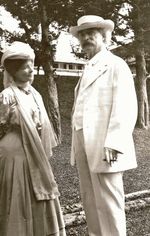
There are a lot of reasons why Laura Skandera Trombley spent 16 years working on a book about a woman whom generations of Mark Twain biographers dismissed as inconsequential to his life. But the biggest catalyst was the 450-page elephant in the room — a manuscript Twain wrote in his final years savaging the reputation of his former personal assistant, Isabel Van Kleek Lyon. That manuscript, never published but well known to Twain scholars, had little in common with “The Adventures of Huckleberry Finn” and the other books that made Twain one of the nation’s first celebrities. At its heart, Trombley believes, the manuscript was a blackmail tool, a libelous screed against Lyon, whose life Twain was fully prepared to ruin to protect family secrets and his place in American history. Early biographers believed the manuscript’s details, including Twain’s charge that Lyon tried to seduce him, to be true and that Lyon’s role in Twain’s life was too minute to bother with. But Trombley saw the work as an elaborate lie and wondered why Twain would bother.

more from Scott Martelle at the LAT here.

clive

Large-CliveJames867

‘An onlooker’, Clive James writes in North Face of Soho (2006), the fourth instalment of his memoirs, ‘might say that I have Done Something. But I’m still not entirely sure about the “something”, and not at all sure about the “I” … Who is this character?’ James’s CV takes a while to unpack even if you aren’t its owner, and it doesn’t help that people’s perceptions of him vary according to nationality and, above all, age. An Australian expatriate of Germaine Greer’s generation, he first began to claim the world’s notice as a student comedy impresario in late 1960s Cambridge before setting up shop as a pen for hire in London. Working chiefly for Karl Miller, Terence Kilmartin and Ian Hamilton, on the Listener, the Observer and the New Review, he quickly made a name for himself as a versatile, witty literary journalist with a non-waffling mode of address that was thought to be distinctively, and refreshingly, Australian. He also turned out comic verse – Peregrine Prykke’s Pilgrimage through the London Literary World and ‘The Book of My Enemy Has Been Remaindered’ – and wrote lyrics for Pete Atkin, a singer-songwriter friend. He has never completely kicked the Grub/Fleet Street habit and is probably best known to American audiences for his essays on literary and other topics in upmarket periodicals.

more from Christopher Tayler at the LRB here.

the man who ate his boots

Wheeler-t_CA0-articleLarge

When European merchants, navigators and chancers began searching for a northern sea route from the Atlantic to the Pacific, Henry VIII was still a bachelor. The mazy waterways were navigable for a scant three months a year, and as late as 1819 only two white men had seen the north coast of Canada. By the time a wooden ship finally pushed through, an indifferent world was looking elsewhere. But the fabled Northwest Passage has returned to the news pages as a warming climate unlocks its deep channels, allowing access to hydrocarbons below the seabed. Anthony Brandt anchors his robust new history, “The Man Who Ate His Boots,” in that modern context. The editor of narrative anthologies of both polar regions, Brandt concentrates on the first half of the 19th century, a period in which the search for the elusive passage gathered momentum in the slipstream of post-Napoleonic peace. Having set the scene with reference to the Far North and its occluded waters in myth and tradition, he works chronologically through the expeditions, analyzing a range of cultural and social influences on the naval panjandrums who dispatched so many little ships to high latitudes. Science, for example, had become increasingly important, especially terrestrial magnetism, the climate change du jour.

more from Sara Wheeler at the NYT here.