Please Don’t

David Byrne on the song “Please Don't” from his album (with Fatboy Slim) Here Lies Love, at his own website:

Here’s the video for the Santigold track “Please Don’t.” We did a photo session for a magazine the other day, and I told the interviewer that on this song, by the time you get to the chorus, she owns it — she’s turned it into a Santigold song. Perfect.

There are six of these videos that have been completed for this project. Most, like this one, use news and archival footage to, well, show that every word of the song is true! Most of the lyrics on this one are lifted gently from interviews and quotations — the “please don’t” chorus especially. At some point as first lady, Imelda began to feel that she could help Philippine interests by charming world leaders into seeing things her way. “Handbag diplomacy” she called it — as she liked to imply that to solve a problem, she could bypass President Marcos and just grab a handbag and hop on a plane with some of her assistants. It sometimes worked! There was, for example, an Islamic-backed insurgency rising in the south of the Philippine archipelago, and she thought that a leader in that part of the world, Qaddafi in this case, might help pull the plug on that support if he saw things her way. Apparently he did — the funding stopped and the insurrection lost momentum, and she later described him as a pushover, a mama’s boy.

Is The Bible More Violent Than The Quran?

Barbara Bradley Hagerty at National Public Radio:

Bible_wide When Osama bin Laden declared war on the West in 1996, he cited the Quran's command to “strike off” the heads of unbelievers. More recently, U.S. Army Maj. Nidal Hasan lectured his colleagues about jihad, or “holy war,” and the Quran's exhortation to fight unbelievers and bring them low. Hasan is accused of killing 13 people at Fort Hood, Texas, last year.

Given this violent legacy, religion historian Philip Jenkins decided to compare the brutality quotient of the Quran and the Bible.

“Much to my surprise, the Islamic scriptures in the Quran were actually far less bloody and less violent than those in the Bible,” Jenkins says.

Jenkins is a professor at Penn State University and author of two books dealing with the issue: the recently published Jesus Wars, and Dark Passages , which has not been published but is already drawing controversy.

Violence in the Quran, he and others say, is largely a defense against attack.

“By the standards of the time, which is the 7th century A.D., the laws of war that are laid down by the Quran are actually reasonably humane,” he says. “Then we turn to the Bible, and we actually find something that is for many people a real surprise. There is a specific kind of warfare laid down in the Bible which we can only call genocide.”

More here.

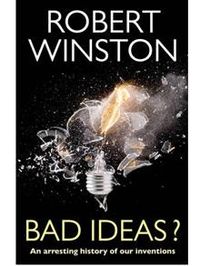
Bad Ideas?

From The Telegraph:

Winstonstory_1596941f There is no doubt that Robert Winston is on the side of the angels: he is professor of science and society and emeritus professor of fertility studies at Imperial College, fellow of the Academy of Medical Sciences, an honorary fellow of the Royal Academy of Engineering, fellow of the Royal College of Obstetricians and, well, the list goes on. More than that, though, he has always been keen to popularise science, even going so far as to appear as a fertility consultant on The Archers.

His new book, then, a history of the potential hazards the human race has created each time we’ve come up with something new, ought to be a bracing combination of the stringent and the accessible. Winston argues that scientists should engage more closely with the rest of us. This way, we can ensure scientific discoveries are not abused – to create the flame-thrower, say – or used in such a way that any advances are not accompanied by lethal by-products, such as the H1N1 virus that comes from the intensive rearing of pigs.

More here.

Sperm wars illuminated

From Nature:

Sp When the sperm of different male insects meet inside a female, they use everything from wrestling to chemical warfare to try and fertilize as large a share of her eggs as possible, according to two studies published this week. The studies also show that females don't just let the battle take its course, but manipulate it to their own ends. A US team has genetically engineered fruitflies to produce sperm that fluoresce in different colours. The researchers use the technique to watch the sperm of different males as they jostled for position inside a female, giving a first look at sperm competition in action.

And researchers in Denmark and Australia have shown that the seminal fluid of some ants and bees aids a male's own sperm and attacks his rivals. But queen ants, which need huge sperm reserves for the long years of egg-laying ahead, suppress this competition. Both studies are published in Science. For the fruitfly Drosophila melanogaster the most recent male to mate with a female fertilizes most of her eggs — 80% — and his predecessors lose out. But the mechanism by which the last male got this advantage wasn't known. “The female reproductive tract has been a black box,” says Scott Pitnick of Syracuse University in New York.

More here.

Friday, March 19, 2010

Manufacturing Depression

From The Guardian:

Painting-by-Daniel-Cacoua-001 Gary Greenberg is a psychotherapist who joined a clinical trial for an antidepressant at a time when he was mildly depressed. He was diagnosed as severely depressed, got better, and found that his pill was a placebo. His book contains a major attack on antidepressants, and he blames the drug companies for the false advertising of their positive effects. He is also very critical of the concept of depression itself.

He is right that quite a lot of random clinical trials have failed to demonstrate the effectiveness of antidepressants – as opposed to placebos – in curing depression. However, he ignores the evidence that, for severe depression, they really can help. He accuses the drug industry of downplaying the numerous side-effects, such as the 774 papers showing their effect on sexual performance. In addition, he argues that the industry has successfully campaigned to persuade doctors and the public that they suffer in enormous numbers from a disease called depression when in fact they might not. Only someone who has not been seriously depressed could accept that. He suggests that those who benefit from antidepressants that raise serotonin levels might instead be thought of as suffering from Prozac-deficit disorder.

His main thesis seems to be that depression is not a disease or an illness.

More here.

Our Money in Pakistan

James Traub in Foreign Policy:

Holbrooke Of the many levers Obama administration officials have installed on the mighty console that is AfPak strategy, the one to which the least attention has been paid is almost certainly the civilian assistance program in Pakistan. If journalists are embedding with USAID operatives in the vast, Taliban-plagued province of Baluchistan, not many of us have heard about it. And yet senior U.S. officials, most prominently Vice President Joe Biden, regularly note that Pakistan, with its 180 million people and nuclear stockpile, matters to the United States far more than Afghanistan. Thanks in no small part to Biden, who pushed legislation to massively increase civilian aid, Congress last fall passed the so-called Kerry-Lugar-Berman bill authorizing the expenditure of $7.5 billion in Pakistan over the next five years. Nowhere else does so much hang on the success or failure of development assistance.

And in few other places has the United States spent so much money so thoughtlessly in the past. In The Idea of Pakistan, historian Stephen P. Cohen concludes that decades of U.S. aid strengthened the hand of Pakistan's Army without making it pro-American and had economic consequences no less ambiguous, bolstering elites and self-appointed middlemen.

More here.

Holden Caulfield killed John Lennon

Mark+David+Chapman

Mark David Chapman, the young assassin, was carrying two things with him when he shot and killed John Lennon on the steps of the Dakota apartments in Manhattan: a pistol and a paperback copy of The Catcher in the Rye. The function of the pistol was obvious. Less obvious was the function of J. D. Salin­ger’s novel. Yet the book, it seems fair to say, must have had some special significance to Mark Chapman. Any attempt to uncover its significance is, in the nature of the case, highly speculative. Yet some aspects of The Catcher in the Rye, set beside Mark Chap­man’s murder of John Lennon, seems so sug­gestive that not to speculate upon the connec­tions between the two seems a temptation impossible to forgo. J. D. Salinger’s Catcher in the Rye was published in 1951. Like the Beatles, whose rise to fame came about roughly thirteen years later, the novel’s adolescent hero, Holden Caulfield, became a spokesman for a genera­tion of rebellious, supposedly much-misun­derstood youth. An oversimplified yet func­tional reading of the Salinger novel might conclude that all that the book advocates would fall under the heading of “innocence” and all that it condemns falls under that of “phoniness.” Holden Caulfield, during his somewhat aimless ramble through New York, feels overwhelmed by the phoniness he finds all around him. He struggles to preserve his own tenuous hold on youthful innocence–or, as he sometimes puts it, “niceness”–and de­spairs when he finds that innocence lost or threatened in the young people around him.

more from Daniel Stashower at The American Scholar here.

The overpopulation myth

Overcrowd

Many of today’s most-respected thinkers, from Stephen Hawking to David Attenborough, argue that our efforts to fight climate change and other environmental perils will all fail unless we “do something” about population growth. In the Universe in a Nutshell, Hawking declares that, “in the last 200 years, population growth has become exponential… The world population doubles every forty years.” But this is nonsense. For a start, there is no exponential growth. In fact, population growth is slowing. For more than three decades now, the average number of babies being born to women in most of the world has been in decline. Globally, women today have half as many babies as their mothers did, mostly out of choice. They are doing it for their own good, the good of their families, and, if it helps the planet too, then so much the better. Here are the numbers. Forty years ago, the average woman had between five and six kids. Now she has 2.6. This is getting close to the replacement level which, allowing for girls who don’t make it to adulthood, is around 2.3. As I show in my new book, Peoplequake, half the world already has a fertility rate below the long-term replacement level. That includes all of Europe, much of the Caribbean and the far east from Japan to Vietnam and Thailand, Australia, Canada, Sri Lanka, Turkey, Algeria, Kazakhstan, and Tunisia.

more from Fred Pearce at Prospect Magazine here.

The negative is no longer a square of film

Ja_129

Photography is dead. That news may come as a surprise, since obituaries about art tend to be written about painting. Invented in the 1830s, photo-graphy is still in its infancy as an art form compared to the centuries-old medium of painting. Despite inventions like portable paint tubes and fast-drying acrylic, painting has not undergone the transformations that digitalization is bringing to the medium of photography. Of course, I’m speaking about the death of film photography. Happy to save on the cost of film and the time taken to develop it, consumers embraced digitalization with such gusto that a whole industry is dying. In 2005, the film photography giant AgfaPhoto filed for bankruptcy. In 2009, Polaroid ceased the production of instant Polaroid film, and Kodak discontinued Kodachrome film. Digital photographs are not only cheaper and faster to produce; they can be stored endlessly and shared instantly with countless friends. Polaroids, though ‘instant’, could not be emailed and tweeted. For artists, such mass-market developments are turning film photography into a specialist field, like lithography.

more from Jennifer Allen at Frieze here.

Friday Poem

Clary

Her cart like a dug-out canoe.
Had been an oak trunk.
Cut young. Fire-scoured.
What was bark what was heartwood: P u r e C h a r – H o l e
Adze-hacked and gouged.
Ever after (never not) wheeling hollow there behind her.
Up the hill toward Bennett Yard; down through Eight-Mile,
..the Narrows.
C o m e s C l a r y b y h e r e n o w
Body bent past bent. ……Intent upon horizon and carry.
Her null eye long since gone isingglassy, opal.
—The potent (brimming, fluent) one looks brown.
C o u r s e s C l a r y s u r e a s b a y o u t h r o u g h h e r e n o w
Bearing (and borne ahead by) hull and hold behind her.
Plies the dark.
Whole nights most nights along the overpass over Accabee.
C r o s s e s C l a r y b l e s s h e r b a r r o w u p t h e r e n o w
Pausing and voweling there— the place where the girl fell.
( …………. )
Afterwhile passing.
Comes her cart like a whole-note held.

by Atsuro Riley

from Poetry, Vol. 192, No.5, September
publisher: Poetry, Chicago, 2008

Skeptical clergy a silent majority?

Daniel C. Dennett in the Washington Post:

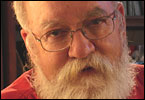
Daniel_c_dennett Here are some questions that have haunted me for years. How many preachers actually believe what they say from the pulpit? We know that every year some clergy abandon their calling, no longer able to execute their duties with conviction. This can never be a decision taken lightly, and many of them labored on for years before taking the leap. Are they the tip of an iceberg? Is there a problem of deep hypocrisy separating many pastors from their flocks? What is it like to be a non-believing preacher? How do they reconcile their private skepticism with the obligations of their position? And how did they get into their predicament?

Several years ago I set out to get some answers, in collaboration with Linda LaScola, a clinical social worker with years of experience as a qualitative researcher. I had told her of my interviews with deeply religious people while writing my book, “Breaking the Spell” (2006), and of my surprise at how many of them were eager to tell me, in confidence, that they didn't believe a word of the doctrines of the faith to which they were devoting their lives. Was this also true of ordained clergy? With some help from me and a network of advisers, LaScola identified some brave informants, all currently Protestant pastors with congregations, and interviewed them at length and in depth–and of course in deep confidence.

More here. Also read “Preachers who are not Believers,” a study by Daniel C. Dennett and Linda LaScola of the Center for Cognitive Studies at Tufts University.

Tooling Up: I’m Special, Aren’t You?

From Science:

HappyMan_Comstock_160 Like many parents, my mother and father tried as hard as they could to make me feel special. They instilled in me the belief that my future success in life was assured, and I left home believing that I could accomplish just about anything. My parents didn't know that they were doing me a great disservice. Of course you are special. Everyone is special. But in the job market, you have to compete with all those other special people. You will face disappointment. You will fail sometimes. In my view, believing otherwise — believing that the constraints and realities that apply to other people don't apply to you — is a poor philosophy upon which to build a life and career.

There's an oft-cited stereotype about the generation now entering the workforce — Generation Y, or the “Millennials”: They have a sense of entitlement. That may or may not be true; I'm not here to reinforce the stereotype. But I will say that, no matter which generation you're from, a sense of entitlement is not an advantage in looking for a job or moving into a new one. Instead, you need to be practical, realistic, and clear-headed about your abilities — and your competition — not just now but at every career stage. In this month's Tooling Up column, I'm going to describe some of the lessons and pitfalls I've learned about being “special.” I'll also make a few suggestions that you can take away to help you manage the transition from this innate sense of specialness to a more durable life philosophy for success.

More here.

The universe is a hologram made of tiny grains, or pixels, of spacetime

Ron Cowen in Science News:

ScreenHunter_01 Mar. 19 10.26 The Grinch detested the noise created by the tiny residents of Whoville. Cosmologist Craig Hogan, in contrast, has become enamored of a noise he claims is generated by something even tinier — a minuscule graininess in the otherwise smooth structure of spacetime.

Call it Hogan’s noise. Many physicists are skeptical, but if his hunch about the existence of this subatomic clatter proves correct, it could have a mind-boggling implication: that the entire universe is nothing more than a giant hologram.

What’s more, it would mean that the structure of spacetime on subatomic scales might soon be revealed. “What’s new is that we can make a prediction and design an experiment to measure something on the tiniest of scales in the universe, and that’s what hasn’t been done before,” says Hogan, director of the Fermilab Center for Particle Astrophysics in Batavia, Ill., and a researcher at the University of Chicago.

In fact, it’s just possible that a detector in Hannover, Germany, built for an entirely different study, may have already recorded the noise generated by the smallest units of spacetime in the universe.

More here.

Thursday, March 18, 2010

Jonathan Derbyshire Interviews Terry Eagleton

Terryeagleton460 In the New Statesman:

There's a good deal of nostalgia in your new book, The Task of the Critic, for the “socialist culture” of the Seventies.

What's wrong with a bit of nostalgia between friends? I think nostalgia sometimes gets too much of a bad press. One of Walter Benjamin's extraordinary achievements, for example, was to make a kind of revolutionary virtue out of a certain concept of looking back, or nostalgia. As a tutor at Oxford during that period, I could see all kinds of energies that simply had no outlet – all kinds of radical impulses that were rather inchoate, but certainly present. So I think nostalgia is justified to some extent.

There was at least one outlet for those energies, though: the Marxism seminar you ran at Wadham College, which you describe as a “hostel for battered leftists”. The left took even more of a battering in the intervening 30-odd years, didn't it?

I think the Gramsci formula about pessimism of the intellect and optimism of the will gets at something. But I was struck, when I spoke recently at King's College London, by the extraordinarily diverse number of militant projects and campaigns that were being either conducted or planned. It was like being back in the Seventies, or the late Sixties.

One of the leftist Oxford students from the earlier period whom you mention by name in the book is Christopher Hitchens. What do you make of his political trajectory?

I just turned down the offer of a public debate with him in the States. I've said what I want to say, and we wouldn't have got anywhere – it would only have been a sort of bloodsport.

Even then, Christopher was mesmerised by the idea of America. He always wanted a bigger scene.

What was definitive for him, politically, was the fatwa against Salman Rushdie in 1989. I think that was the turning point. The deep Islamophobic impulse he has stems from that. But he's still an idiosyncratic mixture of various political attitudes that don't always go together.

And I wouldn't for a moment underestimate his formidable eloquence and intellectual resources. I think he is a superb writer. But I think that the radical was always at war with the public school boy who wanted to succeed.

The Way Things Are and How They Might Be

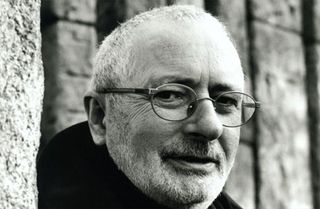
Tony-judt Tony Judt and Kristina Božić in the LRB:

Europeans fell in love with Obama even before he became president. At the same time we are hardly aware of who our new president is, the president of the EU. The feelings aren’t reciprocal, are they?

Enthusiasm for Barack Obama in the US was initially huge, but it had a very domestic dynamic, it was a story about how America could elect a black person only 150 years after slavery, 40 after segregation ended. It meant – though this was a little too optimistic – that we were finally ready to put an end to the race question. That he would change policies, present a new face of America, bring an end to the Bush era and begin a new relationship between America and the world: these considerations mattered only to a small number of people. Here is the asymmetry between American and European expectations: Europeans believed there would be a radical improvement, a moral regeneration of US foreign policy; they are disappointed, or will be, because this isn’t going to happen. Americans’ expectations were partly fulfilled by Obama’s election itself. It was bound to be disappointing from there on: the first black man to be elected president of the United States was never going to be an out and out radical, a wild, courageous, path-breaking liberal or social democrat.

Obama is none of these things. He is a compromiser, constantly trying to build a bipartisan relationship between the Republicans and the Democrats. Furthermore, it might have been more obvious in the US than in Europe that Obama was very distinctly part of the American tradition of rhetoric. He is a great speaker, a great mover of crowds and, in a way, a great manipulator of morality and ethical ideals. This tradition goes from Adlai Stevenson all the way back to Abraham Lincoln and on. What Obama is missing is the ability to channel his rhetoric into political strengths. The danger we Americans see is that he will be weakened by the gap between his rhetoric and his actions. This is true for his policies in the Middle East, and to an extent also for his response to the economic crisis. Europeans don’t see this yet.

the mundaneum

Inside_the_mundaneum

ON THE NIGHT OF JUNE 1, 1934, a Belgian information scientist named Paul Otlet sat in silent, peaceful protest outside the locked doors of a government building in Brussels from which he had just been evicted. Inside was his life’s work: a vast archive of more than twelve million bibliographic three-by-five-inch index cards, which attempted to catalog and cross-reference the relationships among all the world’s published information. For Otlet, the archive was at the center of a plan to universalize human knowledge. He called it the Mundaneum, and he believed it would usher in a new era of peace and progress. The Belgian government, however, had come to view Otlet and his fine mess of papers, dusty boxes, and customized filing cabinets as a financial and political nuisance. Thirteen years earlier, Otlet’s Mundaneum—then called the Palais Mondial—had occupied 150 gleaming rooms in the Palais du Cinquatenaire in Brussels. Thousands of visitors a day filed through, marveling at the seven-foot-high card-catalog cabinets lining the walls of an eighty-foot-long room. Otlet and other scholars delivered lectures on topics such as “The Problems of Language” and “The Necessity for Dental Hygiene” in a thousand-seat auditorium. Scores of workers operated the Mundaneum’s search service, which employed the card catalog to answer questions from the public.

more from Molly Springfield at Triple Canopy here.

hellebore

Nimura-Spring-Flowers

The dusty-pink flowers of the hellebore droop like the snowdrops, but its modesty is false. Unlike the pert green shoots of the bulbs, its leaves are tousled, as if it has woken from its winter’s sleep with bad hair. Hellebores come in a spectrum of colors. One winter-blooming pale-pink-and-white variety is called Christmas rose: a shepherd girl, weeping because she had nothing to offer the newborn Christ, attracted the attention of a sympathetic angel, who revealed the flower where her tears had fallen. But this particular specimen is no blushing virgin. Its petals (sepals, technically) are veined, green-tinged, leathery. They make me think of dragon wings, arresting and faintly menacing. Hellebore, from the Greek for “injure” and “food,” is poisonous and feared in folklore along with hemlock, nightshade, and aconite. In the 6th century B.C., the League of Delphi attacked the fortified city of Kirrha, poisoning the city’s water supply with crushed hellebore leaves, whereupon diarrhea besieged the defenders from within—an early act of chemical warfare. The mythological seer Melampus was summoned by the king of Argos when his three royal daughters suddenly shed their clothes and ran naked through the streets, mooing like cows, bewitched by Dionysus. Melampus brewed a potion of hellebore and restored the princesses to sanity, thereby winning one of them to wed. Perhaps the plant’s purgative properties expelled the lingering influence of the god of wine.

more from Janice P. Nimura at The Morning News here.

bad news from the Oracles of Astrampsychus

TLS_Beard_698086a

Is my wife having a baby? Am I going to see a death? Will I become a councillor? Am I going to be sold? Am I about to be caught as an adulterer? These are just a few of the ninety-two questions listed in one of the most intriguing works of Classical literature to have survived: the Oracles of Astrampsychus, a book which offers cleverly randomized answers to many of ancient life’s most troubling problems and uncertainties. The method is relatively straightforward, but with just enough obfuscation to make for convincing fortune-telling (“easy to use but difficult to fathom” as one modern commentator nicely put it). Each question is numbered. When you have found the one that most closely matches your own dilemma, you think of a number between one and ten and add it to the number of your question. You then go to a “table of correspondences” which converts that total into yet another number, which directs you in turn to one of a series of 103 lists of possible answers, arranged in groups of ten, or “decades” (to make things more confusing there are actually more lists of answers than the system, with its ninety-two questions, requires or could ever use). Finally, go back to the number between one and ten that you first thought of, and that indicates which answer in the decade applies to you.

more from Mary Beard at the TLS here.

Scientists supersize quantum mechanics

From Nature:

News.2010.130 A team of scientists has succeeded in putting an object large enough to be visible to the naked eye into a mixed quantum state of moving and not moving. Andrew Cleland at the University of California, Santa Barbara, and his team cooled a tiny metal paddle until it reached its quantum mechanical 'ground state' — the lowest-energy state permitted by quantum mechanics. They then used the weird rules of quantum mechanics to simultaneously set the paddle moving while leaving it standing still. The experiment shows that the principles of quantum mechanics can apply to everyday objects as well as as atomic-scale particles. The work is simultaneously being published online today in Nature and presented today at the American Physical Society's meeting in Portland, Oregon.

According to quantum theory, particles act as waves rather than point masses on very small scales. This has dozens of bizarre consequences: it is impossible to know a particle's exact position and velocity through space, yet it is possible for the same particle to be doing two contradictory things simultaneously. Through a phenomenon known as 'superposition' a particle can be moving and stationary at the same time — at least until an outside force acts on it. Then it instantly chooses one of the two contradictory positions.

More here.