small bites are good for you

Dukakis

But new research suggests that the specter of the shrinking sound bite is anything but new. In fact, quotations from politicians have been getting shorter for more than a century. According to a new article in the academic journal Journalism Studies by David M. Ryfe and Markus Kemmelmeier, both professors at the University of Nevada, newspaper quotations evolved in much the same way as TV sound bites. By 1916, they found, the average political quotation in a newspaper story had fallen to about half the length of the average quotation in 1892. One way to interpret this, of course, is that we’ve been getting dumber since 1892 instead of since 1968. But Ryfe and Kemmelmeier also suggest that the truth is more complicated. The sound bite, they argue, stems less from a collapse in standards or seriousness than from the rise of a more sophisticated and independent style of journalism — which means the sound bite might not be such a bad thing. Letting politicians ramble doesn’t necessarily produce a better or more informative political discourse. Daniel Hallin, the professor behind the original study on TV sound bites, actually made the same point back in 1992, but Dukakis and his fellow critics passed right by it in their excitement over those ugly statistics. And that’s one of the ironies here: The best research on sound bites was itself turned into a sound bite.

more from Craig Fehrman at the Boston Globe here.
Tuesday Poem

Ledge

Birds that love
high trees
and winds
and riding
flailing branches
hate ledges
as gripless
and narrow,
so that a tail
is not just
no advantage
but ridiculous,
mashed vertical
against the wall.
You will have
seen the way
a bird who falls
on skimpy places
lifts into the air
again in seconds—
a gift denied
the rest of us
when our portion
isn't generous.

by Kay Ryan
from The Best of It
Grove Press, 2010

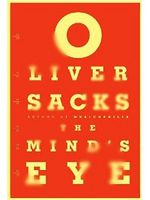
The Mind’s Eye

From The Telegraph:

Mindstory_1793532f Late in 2005, the writer and neurologist Oliver Sacks, then aged 72, began to notice something odd during his habitual daily swim. While he did the backstroke, a pattern of close-set wavy lines and starry coruscations played on the ceiling above him. Sacks dismissed them as artefacts of his visual cortex, lingering symptoms from his frequent migraines. But a week before Christmas, as he entered a cinema, a more pronounced fluttering started up in his right eye.

By the time the film began, a quivering scotoma, or blind spot, had flared up before him “like a white-hot coal, with spectral colours”. Two days later he was diagnosed with a malignant melanoma behind the retina, and he wrote in his journal: “I am in the best possible hands, but I feel a terrified child, a child screaming for help, inside me.” Sacks’s own adventure at the edges of seeing – the cancer itself proved curable, but his vision was permanently impaired – forms the core of The Mind’s Eye. It is a reflection, in seven essays, on the optical effects of certain neurological disasters and on the response of the brain to partial or complete blindness.

More here.

Searching for the Source of a Fountain of Courage

Natalie Angier in The New York Times:

Courage Courage is something that we want for ourselves in gluttonous portions and adore in others without qualification. Yet for all the longstanding centrality of courage to any standard narrative of human greatness, only lately have researchers begun to study it systematically, to try to define what it is and is not, where it comes from, how it manifests itself in the body and brain, who we might share it with among nonhuman animals, and why we love it so much. A new report in the journal Current Biology describes the case of a woman whose rare congenital syndrome has left her completely, outrageously fearless, raising the question of whether it’s better to conquer one’s fears, or to never feel them in the first place. In another recent study, neuroscientists scanned the brains of subjects as they struggled successfully to overcome their terror of snakes, identifying regions of the brain that may be key to our everyday heroics.

Researchers in the Netherlands are exploring courage among children, to see when the urge for courage first arises, and what children mean when they call themselves brave. The theme of courage claims a long and gilded ancestry. Plato included courage among the four cardinal or principal virtues, along with wisdom, justice and moderation. “As a major virtue, courage helps to define the excellent person and is no mere optional trait,” writes George Kateb, a political theorist and emeritus professor at Princeton University. “One of the worst reproaches in the world is to be called a coward.”

More here.

Monday, January 3, 2011

Motorcycle Meditations / Bali

By Aditya Dev Sood with photographs by Nita Soans Sood

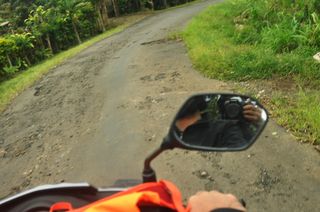
Orange bag on road copy My knees are spread wide, my arms loose and ready, back supple and straight. Walls of green moss on black stone, flurries of fern and plant, the waving arms of trees fly by on the right. Sheets of terraced paddy step carefully down and into the ravine on the left, giving way to distant valleys, lake, and mountain. My mind is alert but high, this is not a normal kind of wakefulness, not a dream, and not slumber. It is a different, fourth kind of consciousness, a flow state, a murmuring of interior thoughts that I seem to be pulling in and out of, pitched to the drone of the bike, the winding of the road.

Nita and I had imagined this road trip through Bali a couple of years ago, the last time we were here. Then we were weighed down with luggage and hotel bookings and yearned to be able to be able to just ride out and find ourselves in a new part of the island whenever we wanted. This time, we’ve got one rucksack, now between my knees, and a smaller backpack, slung from the handlebars, and Nita has her camera bag under one arm, and we’re off and about, on the road in Bali.

Stepped terraces copy

Read more »

Sunday, January 2, 2010

Why Criticism Matters: Translating the Code Into Everyday Language

02anderson-articleInline Sam Anderson on the issue, in the NYT:

I tend to shy away from big, sweeping, era-defining statements. It’s the fastest possible way to be wrong about the world, and usually just an excuse for various forms of sloppy thinking: cherry-picking, scapegoating, doomsaying, fear-mongering, sandbagging, arm-twisting, wool-gathering, leg-pulling. And yet it would be hard to dispute that over the last 5 or 10 years, the culture’s relationship to time has changed pretty drastically. The shift is so obvious that it’s boring, by now, even to name the culprits: Google, blogs, texting, tweets, iPhones, Facebook — a little army of tools that have given rise to (and grown out of) radically new habits of attention. Many of us are now addicted, on the dopamine-receptor level, to a moment-by-moment experience of life that’s defined by a behavior sometimes referred to as “time slicing”: jumping every few seconds between devices or windows or tabs, constantly swiveling the periscope of our attention around and around the horizon to see where the latest relevant data-burst might come from.

Whether this shift is good or bad or neutral is a cripplingly complex question, and very hard to discuss without falling into clichés about the Death of Literature and the Extinction of Humanity and How Google Is Stealing Everybody’s Grandmother’s Favorite Jewelry. (It helps to remember, when you start having these thoughts, that every era in the history of humanity has lamented the rise of whatever technology it happened to see the rise of.)

What we can say, for sure, is that sustained exposure to the Internet is changing the way many readers process the written word. Texts are shorter and more flagrantly interconnected, with all kinds of secret passageways running into and out of one another. This has already changed the way we produce, read, share and digest our writing. Inevitably, it will also redefine what it means to practice book criticism, at least for those of us who aspire to write for something like a general audience.

Mr. Borges’s Garden

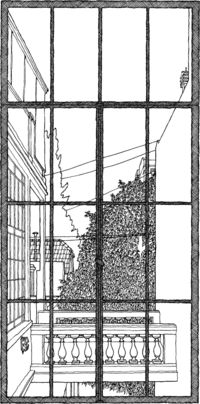
Windowsimg-custom1 MÁRIA KODAMA and MATTEO PERICOLI in The New York Times:

A certain house in the Buenos Aires neighborhood of Recoleta has a window that is doubly privileged. It overlooks a courtyard garden of the kind known here as a pulmón de manzana — literally, the lung of a block — which affords it a view of the sky and an expanse of plants, trees and vines that meander along the walls of neighboring houses, marking the passage of the seasons with their colors. In addition, the window shelters the library of my late husband, Jorge Luis Borges. It is a real Library of Babel, full of old books, their endpapers scribbled with notes in his tiny hand. The window has one more surprise. From it, I can see the garden of the house where Borges once lived, and where he wrote one of his best-known short stories, “The Circular Ruins.’’

As afternoon progresses and I look up from my work to gaze out this window, I may be invaded by springtime, or if it’s summer, by the perfume of jasmine or the scent of orange blossom, mingled with the aroma of leather and book paper, which brought Borges such pleasure.

More here.

Sunday Poem

Sonnet 87
William Shakespeare

Farewell! thou art too dear for my possessing,
And like enough thou know'st thy estimate:
The charter of thy worth gives thee releasing;
My bonds in thee are all determinate.

For how do I hold thee but by thy granting?
And for that riches where is my deserving?
The cause of this fair gift in me is wanting,
And so my patent back again is swerving.

Thyself thou gav'st, thy own worth then not knowing,
Or me, to whom thou gav'st it, else mistaking;
So thy great gift, upon misprision growing,
Comes home again, on better judgment making.

Thus have I had thee as a dream doth flatter—
In sleep, a king; but waking, no such matter.

The Happy Marriage Is the ‘Me’ Marriage

From The New York Times:

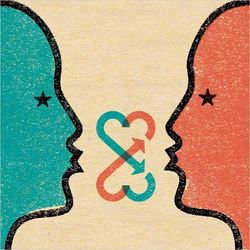
POPE-popup Caryl Rusbult, a researcher at Vrije University in Amsterdam who died last January, called it the “Michelangelo effect,” referring to the manner in which close partners “sculpt” each other in ways that help each of them attain valued goals. Dr. Aron and Gary W. Lewandowski Jr., a professor at Monmouth University in New Jersey, have studied how individuals use a relationship to accumulate knowledge and experiences, a process called “self-expansion.” Research shows that the more self-expansion people experience from their partner, the more committed and satisfied they are in the relationship.

To measure this, Dr. Lewandowski developed a series of questions for couples: How much has being with your partner resulted in your learning new things? How much has knowing your partner made you a better person? (Take the full quiz measuring self-expansion.) While the notion of self-expansion may sound inherently self-serving, it can lead to stronger, more sustainable relationships, Dr. Lewandowski says. “If you’re seeking self-growth and obtain it from your partner, then that puts your partner in a pretty important position,” he explains. “And being able to help your partner’s self-expansion would be pretty pleasing to yourself.”

More here.

The Birth and Death of Human Rights Doctrine

From Slate:

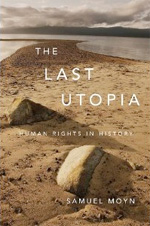
Book Human rights—the notion that the protection of the immutable rights and freedoms of every individual on the planet supersedes all other concerns—did not always enjoy this prominent place in our political debate. Most historians have located the ideology's origins in previous eras, from the ancient Greeks and Hebrews to the Enlightenment to post-World War II. In his erudite new book, The Last Utopia: Human Rights in History, Samuel Moyn proposes a more recent source. He argues that it was only in the 1970s, when other utopian ideologies—socialism, anti-colonialism, and anti-communism—fell by the wayside that human rights assumed its stature as the ultimate moral arbiter of international conduct.

As Moyn tells it, human rights might trace its philosophical lineage to earlier times—few ideas emerge from the intellectual womb as orphans—but its dominant role was not assured until a particular point in time. He takes issue most forcefully with the belief that human rights' ascension was an answer to the extermination of European Jewry. “Contrary to conventional assumptions, there was no widespread Holocaust consciousness in the postwar era, so human rights could not have been a response to it,” he writes.

More here.

Saturday, January 1, 2010

pure american crazy

600full-tim-burton

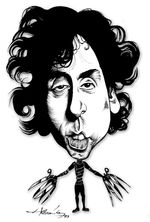
If, as William Carlos Williams wrote, “The pure products of America / go crazy,” where does that leave Tim Burton, a pure product not just of America but also of Southern California, land’s end of our national phantasmagoria? Hollywood, maybe, where Burton — born in Burbank, raised on TV and the films of Ray Harryhausen, educated at the California Institute of the Arts — landed in the late 1970s. Or London, where he now lives with the actress Helena Bonham Carter and their two kids. Really, though, the landscape Burton occupies is one of the imagination, a territory marked by whimsy and darkness, in which the visuals are the main event. “My background is animation,” he says by phone from his home in England. “Early on, I was essentially a nonverbal person.” Even now, the director of “Beetle Juice,” “Batman,” “Corpse Bride” and “Edward Scissorhands” seems not completely comfortable in conversation; he pauses, backtracks, like someone speaking in a second language, as he discusses “The Art of Tim Burton,” a lavish art book featuring more than 1,000 images, some of which go back to childhood.

more from David L. Ulin at the LA Times here.

why criticism matters

02kirsch-articleInline

Three years ago, Cynthia Ozick published an essay in Harper’s Magazine lamenting the decline of criticism, which she argued was impoverishing literature itself. Without the “consciousness that only a critical infrastructure can supply,” Ozick wrote, readers and writers are doomed to talk at cross-purposes, or at random; it takes a corps of influential critics to unite individual reactions into a common discussion. Indeed, this excellent novelist and excellent critic concluded, “Superior criticism not only unifies and interprets a literary culture but has the power to imagine it into being.” To see what we are missing, all we have to do is contrast our own moment with the postwar decades “when Lionel Trilling prevailed at Columbia,” and “Edmund Wilson, Irving Howe and Alfred Kazin enlivened the magazines.” There is a grim comedy, then, in turning to Kazin’s essay about criticism — written in 1960, when Ozick’s giants walked upon the earth — and reading about “the absence of echo to our work, the uncertainty of response, the confusion of basic terms in which we deal.” It seems to be a case of “the worst is not / So long as we can say, ‘This is the worst.’ ” What looked to Kazin like a dwindling, fissiparous literary culture looks to us like a golden age. (As yet another great critic, Randall Jarrell, once said, in a golden age people go around complaining about how yellow everything looks.)

more from Adam Kirsch at the NYT here.

Forgive Me, Spirit of Science: Dawkins on His Love of the KIng James Bible

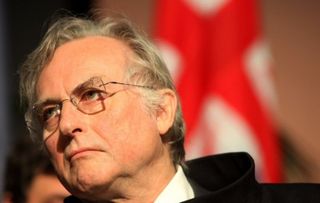
20101229_86279444_w In the New Statesman:

The King James Bible occupies nearly 42 pages of the Oxford Dictionary of Quotations, only narrowly beaten by Shakespeare, with 45. Not just literature in the high sense but everyday speech is laced, suffused – riddled, even – with biblical phrases the status of which ranges from telling quotation (“They have sown the wind and they shall reap the whirlwind”) to cliché (“No peace for the wicked”) and all points between. A word in season and perhaps we can see eye to eye. Although I wouldn't call the Bible my ewe lamb, and I would have to go the extra mile before I killed the fatted calf for it, you don't need the wisdom of Solomon to see how biblical imagery dominates our English. If my words fall on stony ground – if you pass me by as a voice crying in the wilderness – be sure your sin will find you out. Between us there is a great gulf fixed and you are a thorn in my flesh. We have come to the parting of the ways. I fear it is a sign of the times.

It has to be the King James version, of course. Modern translations break the spell as surely as a sounding brass or a tinkling cymbal. Listen to this, if you can bear to, from the Good News Bible, whose clunking title matches its style:

It is useless, useless, said the Philosopher. Life is useless, all useless./You spend your life working, labouring, and what do you have to show for it? Generations come and generations go, but the world stays just the same.

Older readers might hear the voice of Tony Hancock. Or is it Victor Meldrew? Anyway, now here's the real thing:

Vanity of vanities, saith the Preacher, vanity of vanities, all is vanity./What profit hath a man of all his labour which he taketh under the sun?/One generation passeth away, and another generation cometh: but the earth abideth for ever.

Real thing? Well, let me not emulate that notorious slogan against the teaching of Spanish in Texas schools: “If English was good enough for Jesus Christ, it's good enough for the children of Texas.” Hebrew, alas, is a sealed book to me (yes, that's another one: Isaiah 29:11), but I have it on respected authority that Ecclesiastes, at least, is pretty damn good poetry in the original. If so, it certainly doesn't make it through the Good News mangling. But I shall argue that poetry can gain in translation, and I believe this may have been achieved with the King James Bible.

A Theory of Menopause

SiowAloysius Siow interviewed by Romesh Vaitilingam in Vox EU:

Menopause – or post-reproductive survival – is rare among mammals and, from an evolutionary perspective, anomalous since it reduces consumption for current offspring without producing future offspring. Aloysius Siow of the University of Toronto talks to Romesh Vaitilingam about his theory of menopause, which is based on the fact that, unlike other mammals, humans understand the reproductive process. The interview was recorded at the Centre for Market and Public Organisation in Bristol in October 2010.

Listen here

.