More than 40 years later, I still remember the bright sun and the palm trees when we got off the plane. California in 1968 was a magical place, a magnet for those seeking new opportunities or to lose an old identity. The Golden State was allowing the rich to get richer and the middle class to live out the American dream in its pristine state. The public schools and expanding state-university system (two separate systems, in fact) were the envy of the nation. The corruption and Mob influence that had paralyzed many eastern and midwestern states and cities were largely absent. When my parents announced they were uprooting the Glazer family from a cozy suburb of Philadelphia, as 5 million people did from eastern and midwestern towns between 1950 and 1980, the news was met with a mixture of awe (“California…” they would breathlessly whisper) and bewilderment (“But what is there?”). The very act of migrating by plane was itself somewhat grand. In the years before airline deregulation, one dressed up to fly, as if sailing on an ocean liner, and at prices not all that much lower than an ocean voyage’s. And yet those we were leaving behind acted as though we were traveling by caravan, leaving civilization and going into the wilderness.
George Price was born a Jewish half-breed to parents who kept his Semitic side a secret; lived much of his life an aggressive atheist and skeptic of the supernatural; and died a Christian, twice converted, albeit, to his mind, a defeated one. Several years before he abandoned his career in a mission to shelter and comfort homeless alcoholics, he made a number of extraordinary contributions to evolutionary biology, a field in which he had no training. Educated as a chemist, Price had worked previously for the Manhattan Project on uranium enrichment, helped develop radiation therapy for cancer, invented computer-aided design with IBM and dabbled in journalism. Shortly after Christmas 1974, Price slashed his carotid artery with a pair of tailor’s scissors in his room in a London squat. John Maynard Smith, with whom Price published a paper that applied game theory to natural selection, was one of the few people, along with some of those homeless alcoholics, to attend his funeral. Also present was William Hamilton, the father of kin selection, which proposed that self-sacrificing behavior was able to evolve between related organisms because of the advantages conferred to their shared genes. Price used Hamilton’s ideas about kin selection to derive his own equation, one that could explain selection at multiple levels of organization—the genetic level, as well as among individuals in kin groups and populations of unrelated others. The equation marked a breakthrough in the field: Price had provided a working mathematical model for the emergence of altruism in a theory of the world that took dogmatic self-interest as its first principle.
Almost twenty years ago Bob Hicok published his first collection of poems, a chapbook called Bearing Witness. It’s a little hard to believe that a poet who in his latest book has a poem entitled “Hope is a thing with feathers that smacks into a window” ever could have been satisfied with that earnest, earlier title. Sure, the movement from simplicity to the witty, complex, and allusive is emblematic of the changes this poet has undertaken over a couple of decades. But there is something else in the earnestness of that early title, a sense that the act of poetry could bear witness—reach out past the merely personal and the purely linguistic—and perhaps even that it should. Behind the more nuanced frame of the recent work, that attitude has continued to inform Hicok’s poems, even as they have become syntactically complex, seriously humorous, and imaginatively demanding. I should disclose, though I do so with some embarrassment, that at the request of the publisher I contributed a particularly fatuous blurb for Bearing Witness. But I remember being genuinely impressed by Hicok’s facility with constructing wildly different personae for his poems.
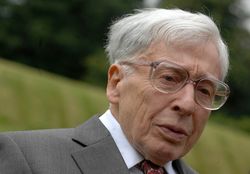
The father of in vitro fertilization (IVF) has won this year's Nobel Prize in physiology or medicine. Robert G. Edwards, an emeritus professor at the University of Cambridge in the U.K., is the sole winner of the prize. “His achievements have made it possible to treat infertility, a medical condition afflicting a large proportion of humanity including more than 10% of all couples worldwide,” the Nobel Committee wrote, noting that approximately 4 million children have been born following IVF.
Edwards is seriously ill and apparently was unable to take the phone call from the Nobel Committee notifying him of the prize. Göran Hansson, secretary of the 2010 Nobel Assembly, said that he had talked to Edwards's wife, who said she was very happy and was sure Edwards would be as well. In the 1950s, inspired by work that showed that rabbit egg cells could be fertilized in the lab and give rise to offspring, Edwards worked to understand the biology of human egg cells, sperm, and embryos. His research clarified how human eggs mature, how hormones regulate their maturation, and when the eggs can be fertilized by sperm. He also figured out the conditions necessary for sperm to activate and fertilize the egg. In 1969, he and his colleagues managed to fertilize a human egg in a test tube for the first time. But the resulting embryo was fragile and didn't develop. Edwards collaborated with gynecologist Patrick Steptoe, who had developed the technique of laparoscopy to retrieve mature eggs from ovaries. The embryos that resulted from fertilizing those oocytes developed further, but the pair ran into strong opposition to their research, and in 1971, the U.K. Medical Research Council denied their request for further funding. A private donation allowed them to continue their work. Ultimately, in 1978, Louise Brown, the first “test tube baby,” was born. Steptoe died in 1988; because Nobel prizes are awarded to living scientists only, he could not have been included in the prize.
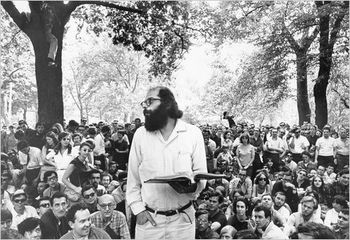
There are movies based on literary works (“Paradise Lost” is on the way, I am told), bio-pics about literary greats (“Bright Star,” “The Hours”), movies that feature a bit of literary criticism (“Animal House,” “Dead Poets Society,” “The History Boys”), even movies — documentaries — about literary critics (Zizek and Derrida, who are only literary critics occasionally), but no movies I know of about literary criticism as such. None, that is, until “Howl,” the new movie about Allen Ginsberg starring James Franco, which is not only about literary criticism but is the performance of literary criticism, an extended “explication de texte.”
It is also a narrative, kind of. There are four time frames: (1) Ginsberg writing “Howl” on an old black typewriter (a nostalgia-producing image if there ever was one) (2) Ginsberg declaiming “Howl” to an appreciative “with-it” audience in what appears to be the poem’s first public reading (3) Ginsberg being interviewed about “Howl” and other things by someone you never really see and can barely hear, and (4) the trial of poet-bookstore owner Lawrence Ferlinghetti, who had been indicted for publishing and distributing an obscene work, that is, a work that appeals only to prurient interests, has a tendency to incite lustful thoughts and has no redeeming social or literary value. Although the movie jumps back and forth among these time frames with no warning, continuity is provided by the trial whose events unfold in sequence; when the trial is over, the movie is over. But the real business of the movie — the effort to figure out what “Howl” means — is not over because it has barely begun, even though everyone has a go at it, including the members of Ginsberg’s audience who produce a running commentary in their facial expressions.
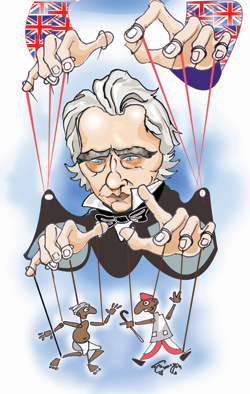
Thomas Babington Macaulay, commonly known as Lord Macaulay, is widely recognised yet inadequately understood in Southasia. While the legacy of his ‘decisions’ is correctly criticised, that criticism is often for the wrong reasons. Macaulay served on the Supreme Council of India from 1834 until 1838, during which time he sided with Governor-General William Bentinck in the adoption of English as the medium of instruction from the sixth standard onwards. Today, he is castigated for his infamous comment:
We must at present do our best to form a class who may be interpreters between us and the millions whom we govern – a class of persons Indian in blood and colour, but English in tastes, in opinions, in morals and in intellect.
This single sentence bears the burden of all the subsequent problems with education in India. It is a pity that the rest of the 1835 Minute on Education, of which this comment is a part, is left unexamined. Indeed, merely inserting the two sentences that immediately precede and follow the comment begins to add a layer of complexity. Part of the preceding sentence reads: “it is impossible for us, with our limited means, to attempt to educate the body of the people.” And the one that follows states:
To that class we may leave it to refine the vernacular dialects of the country, to enrich those dialects with terms of science borrowed from western nomenclature, and to render them by degrees fit vehicles for conveying knowledge to the great mass of the population.
From these three sentences, one could interpret Macaulay as saying that, given limited resources, it would be cost-effective to train master-trainers in modern methods to further disseminate knowledge to the masses – prescribing, in effect, a ‘trickle down’ strategy for mass education. Clearly, one cannot read into the text either an aversion to mass education or a rejection of vernacular languages, the charges most often levelled against Macaulay.
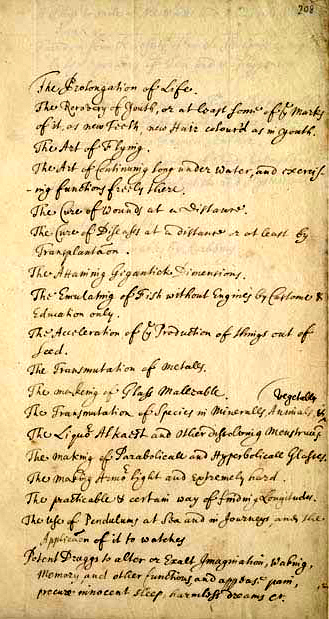
Felicity Henderson in the blog of the History of Science Center at The Royal Society:
Boyle's List of Scientific Projects:
The Prolongation of Life. The Recovery of Youth, or at least some of the Marks of it, as new Teeth, new Hair colour’d as in youth. The Art of Flying. The Art of Continuing long under water, and exercising functions freely there. The Cure of Wounds at a Distance. The Cure of Diseases at a distance or at least by Transplantation. The Attaining Gigantick Dimensions. The Emulating of Fish without Engines by Custome and Education only. The Acceleration of the Production of things out of Seed. The Transmutation of Metalls. The makeing of Glass Malleable. The Transmutation of Species in Mineralls, Animals, and Vegetables. The Liquid Alkaest and Other dissolving Menstruums. The making of Parabolicall and Hyperbolicall Glasses. The making Armor light and extremely hard. The practicable and certain way of finding Longitudes. The use of Pendulums at Sea and in Journeys, and the Application of it to watches. Potent Druggs to alter or Exalt Imagination, Waking, Memory, and other functions, and appease pain, procure innocent sleep, harmless dreams, etc.
John Allen Paulos in his Who's Counting column at ABC News:
Assume that you know that a woman has two children, at least one of whom is a boy. You know nothing about this boy except his sex. Given this knowledge, what is the probability that she has two boys?
You might jump to the conclusion that the answer is […] 1/2, reasoning that the sex of one child has no bearing on the sex of the other. This conclusion is incorrect, however, since you don't know whether the boy you know about is the older or the younger child.
So let's look at the possibilities. Listing two children in the order in which they might be born, we note four possibilities: B-B, B-G, G-B, G-G. Since you know that at least one of the two children is a boy, the G-G possibility is eliminated. Of the three remaining equally likely possibilities (B-B, B-G, and G-B) only one results in two boys. Therefore the correct conclusion in this case is that the probability the woman has two boys is 1/3, not 1/2…
Now for the odd result. Suppose that when children are born in a certain large city, the season of their birth, whether spring, summer, fall, or winter, is noted prominently on their birth certificate. The question is: Assume you know that a lifetime resident of the city has two children, at least one of whom is a boy born in summer. Given this knowledge, what is the probability she has two boys?
Can we create a National Digital Library? That is, a comprehensive library of digitized books that will be easily accessible to the general public. Simple as it sounds, the question is extraordinarily complex. It involves issues that concern the nature of the library to be built, the technological difficulties of designing it, the legal obstacles to getting it off the ground, the financial costs of constructing and maintaining it, and the political problems of mobilizing support for it.
Despite the complexities, the fundamental idea of a National Digital Library (or NDL) is, at its core, straightforward. The NDL would make the cultural patrimony of this country freely available to all of its citizens. It would be the digital equivalent of the Library of Congress, but instead of being confined to Capitol Hill, it would exist everywhere, bringing millions of books and other digitized material within clicking distance of public libraries, high schools, junior colleges, universities, retirement communities, and any person with access to the Internet.
But for two still-green plants the zucchini have been pulled
a heap of hollow stalks and yellow leaves lies at the end of their once-lush row
the reaper’s been through the day of zucchini is done
The sun-starved weeds that hunkered tenuously under the zuke’s broad fronds sprout now in the short late sun unaware of their cramped circumstances: the late hour, the short days, the persistence of cosmic revolutions, the meaning of the cant of axes: the pinch of relativity—
Just 10 weeks ago I wrote of the first zucchini: a compliant stud swelling in shade, I said,
bound for succulent sacrifice in a sauté and I spoke true —it was like savoring sun
but now, from one of two remnants plants, I pluck Mr. Last without remorse hoping
that in this or some other inevitable revolution in one certain approaching autumn or another
I’ll be attuned enough to know what it means to be myself matter-of-factly plucked
In 1953, the architect Benjamin Thompson (1918-2002) opened a store called Design Research on Brattle Street in Cambridge, Mass. Thompson, a former partner of the Modernist master Walter Gropius, wanted a place where people could buy everything they needed for contemporary living. He made Marimekko dresses and Iittala glasses must-haves, eventually opening stores in New York and San Francisco and designing a striking new glass-and-concrete home for the Cambridge store that opened in 1969. ‘‘The architect’s place on this planet,’’ he said, ‘‘is to create that special environment where life can be lived to its fullest.’’ D/R, as it was known, closed in 1978, but many people, including me, never got over it.
The history and influence of D/R are examined in ‘‘Design Research: The Store That Brought Modern Living to American Homes’’ (Chronicle), a new book by Jane Thompson and Alexandra Lange. Thompson, a respected urban planner (who won this year’s Lifetime Achievement honor at the National Design Awards), is the architect’s widow and, after meeting him in the 1960s, worked with him on pioneering projects like Faneuil Hall Marketplace and the South Street Seaport.
After what seems like an orgy of bad economic decision making, not just on the part of the bankers and hedge fund managers on Wall Street, but really all of us, it appears at first blush quite correct when we hear that we all must pay a price for the “good times” of the late 90s and the early part of this decade. Unsurprisingly, politicians across the world are taking advantage of this guilty sentiment to call for “austerity,” meaning cuts in government spending. Take a look at this Newsweek article, for example:
With a deficit set to top 11 percent of gross domestic product this year, and a debt of $1.12 trillion and rising, [David] Cameron prescribed a harsh regimen of spending cuts and possible tax increases. Tony Blair’s motto was “Cool Britannia.” Cameron’s is likely to be “Austerity Now!”
It seems to make economic sense: we all borrowed too much to indulge our inflated sense of our own status in the last decade, so we must now live with less. It is quite naturally thought of as the “pain after the party,” as professor of political economy at Brown University Mark Blyth characterizes the popular view of the downside of economic cycles. But economics is never that simple, is it? No, it isn’t. The bedrock of our economy is confidence in the market, and in this column, Paul Krugman explains why fiscal austerity will not assure markets:
For the most part, this debate has been between those like me and Brad DeLong, who assert that budget-cutting should be postponed until we’re no longer in a liquidity trap, and those who insist that we must cut immediately, even though it would inflict economic damage and do little to improve the long-run budget position, because immediate cuts are necessary to achieve credibility with the markets.
My response, and Brad’s, has been to say that right now there’s no hint in the data that the United States (or the UK) has a problem with the markets, and to question why the deficit hawks are so sure about what the market will want in the future, even though it doesn’t want it now.
But I suddenly realized this morning that there’s yet another question for the deficit hawks: what evidence do you have that fiscal austerity of the kind you’re demanding would reassure markets, even if they did lose confidence?
Consider, if you will, the comparative cases of Ireland and Spain.
Go ahead and read the rest of Krugman’s piece. (He does have a Nobel after all!) And Brad DeLong has his own comment on Krugman here. One of the bigger problems is that “austerity” would not affect all economic classes equally. But let me let the aforementioned Mark Blyth explain that better: as the last word, and to make things as simple as they should ever be (Einstein’s purported comment on the presentation of science to the public was something like, “It should be made as simple as possible but not more so!”), I give you Dr. Blyth:
If the financial press is to be believed, the world is on the verge of a currency war. Central bankers have pulled out their bazookas in a desperate, take-no-prisoners effort to weaken their currencies.
* The Fed is preparing for another round of quantitative easing. If this results in a weaker dollar that boosts US exports, then no one on the FOMC will complain.
* The Bank of Japan, disconcerted by the conjuncture of a strong currency and weak economy, has already intervened in the foreign exchange market to push down the yen.
* The ECB has extended the term of its special bank credit facilities and will ramp up its government bond purchases if Europe’s sovereign debt crisis worsens. * China continues to limit the appreciation of the renminbi
. * Brazil and India, having seen their currencies rise to painful levels, may feel compelled to take countermeasures.
The repercussions could be devastating. Congress, seeing the US denied the benefits of a more competitive currency, is threatening China with a putative tariff. China has already fired a warning shot across America’s bow by slapping a tariff on US poultry exports. This dangerous dynamic, if allowed to spiral out of control, could bring down the global trading system.
Is the danger real?
Is the situation really so worrisome? Yes and no. Yes, sharp currency swings create tensions and have unintended consequences. But there is no need for sharp swings in the exchange rates between the dollar, euro and yen. The US, Japan and Europe all have weak economies. They all would benefit from a round of quantitative easing. If their central banks ease simultaneously, there is no reason for investors to favour one of their currencies over the others.
The problem is that the Fed, BOJ and ECB have not indicated when they will move and what kind of easing they will undertake.
* If the Fed moves but the ECB hesitates, the dollar will fall against the euro.
* If the ECB, seeing the European economy weaken, then follows, the initial currency swing will be reversed, wrong-footing investors who chose to ride the trend.
These are precisely the circumstances in which currency volatility demoralizes financial markets and fans trade tensions.
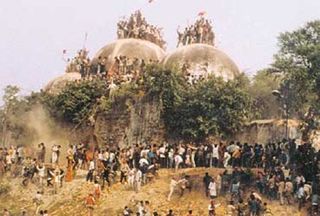
So who is anxious over India’s image in the wealthy world? That particular burden is borne by India’s small affluent elite, for whom the last few months have been full of painful and awkward self-reckonings. Certainly, the fear of violence over Ayodhya was only the latest in a long line of reminders that, as the columnist Vir Sanghvi put it, “as hard as we try to build a new India … old India still has the power to humiliate and embarrass us.”
Since June, a mass insurrection, resembling the Palestinian intifada, has raged in the Indian-held Valley of Kashmir. Defying draconian curfews, large and overwhelmingly young crowds of Kashmiri Muslims have protested human rights abuses by the nearly 700,000 Indian security forces there. Ill-trained soldiers have met stone-pelting protesters with gunfire, killing more than a hundred Kashmiris, mostly teenagers, and ensuring another militant backlash that will be exploited by radical Islamists in Pakistan.
A full-blown insurgency is already under way in central India, where guerrilla fighters inspired by Mao Zedong’s tactics are arrayed against a government they see as actively colluding with multinational corporations to deprive tribal people of their mineral-rich lands. In recent months, the Maoists have attacked the symbols of the state’s authority — railroads, armories, police stations — seemingly at will, killing scores of people.
Yet the greatest recent blow to wealthy Indians’ delusions on the subject of their nation’s inexorable rise has been the Commonwealth Games, for which Delhi was given a long and painful facelift. For so many, the contest was expected to banish India’s old ghosts of religious and class conflict, and cement its claims to a seat at the high tables of international superpowers.
But the games turned into a fiasco well before their scheduled opening.
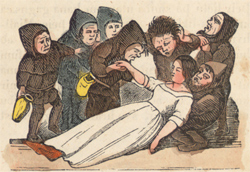
In 1810, the Grimm Brothers first wrote down the story of Snow White, as told to them by some anonymous German folks. I’ve read this story countless times since discovering it in my adolescence. Even so, it’s the Disney version, Snow White and the Seven Dwarfs, that is the definitive Snow White story for me, though I hadn’t seen it since I was a child. The look of Snow White — her blue-and-red capped sleeves, her cherry-colored Clara Bow lips — and the seven dwarfs with their funny names, are all from Disney’s telling. This Snow White is so palpable for me, and for most Americans, that one might believe Snow White an American invention.
How is it that fairy tales can be so far removed in content from our daily experience, and yet have so much power over it? We sing fairy tale songs and our sleep is dappled with fairy tale leitmotifs. We tell fairy tales to our children. Why? To improve them? To delight them? To terrorize them? To learn the consequences of good and evil? As those who have read them can confirm, the stories recorded by the Brothers Grimm (Snow White included) are horrifying and grisly. They are not at all what we mean today by “child-friendly.” Do you remember how, in the original Cinderella, the stepsisters tried to force the glass slipper to fit them by slicing off parts of their feet?
Experts will tell you that fairy tales — folk tales — were never meant for children at all. In the not-so-long-ago days of yore, the people of the world were illiterate, intransient, and in need of entertainment. It might be that folktales, they say, had no moral or even practical purpose. Fairy tales were outrageous because they were soap opera, full of the melodramatic fantasies of average people: dirty beautiful maids rescued by princes; animals punished for greed; children punished for greed; blood; revenge; true love. If your child happened to be listening to this pulp and became terrified into obedience, well that was merely a bonus.
Philip Roth's recent novels have often gestured playfully towards the idea of a serene late style. Simon Axler in The Humbling (2009) broods on Prospero's “Our revels now are ended” speech from The Tempest; Nathan Zuckerman, Roth's most famous mask, sets a scene in Exit Ghost (2007) to Richard Strauss's Four Last Songs – music chosen “for the profundity that is achieved not by complexity but by clarity and simplicity . . . The composer drops all masks and, at the age of 82, stands before you naked. And you dissolve.” Do these references mean that Roth, who is now 77, is abjuring furious artifice for a sage-like calm? Of course not. Late Roth has more in common with the late Ibsen described in an essay by Edward Said: “An angry and disturbed artist who uses drama as an occasion to stir up more anxiety, tamper irrevocably with the possibility of closure, leave the audience more perplexed and unsettled than before.” Said called this kind of style, which he found deeply interesting, a “deliberately unproductive productiveness, a going against”.
In the spring of 1997, the literary quarterly Granta published an issue devoted to India’s Golden Jubilee. The tone was cautious but celebratory: on the cover, the country’s name was printed in bright red letters, followed by an exclamation point. Fifty years after partition, an independent India was rapidly establishing itself as an international power. The issue, which consisted largely of contributions from native Indians writing in English, was a testament both to the country’s extraordinary intellectual and artistic richness, and to one of the few legacies of British colonialism that could be unequivocally celebrated by readers in South Asia and the West: a common language. Seventeen years after Salman Rushdie’s shot across the bow with “Midnight’s Children,” a new generation of Indian writers was, in Granta’s words, “matching India’s new vibrancy with their own.”
…
Now, Granta has assembled another well-timed issue devoted to the subcontinent, but this time the subject is Pakistan, partition’s other child.
I've been smoking so much pot lately, I figure out what my poems are going to do before I write them, which means when I finally sit down in front of the typewriter . . . well . . . you know . . .
I moved back in with my parents, and I'm getting really good at watching TV. Soon as I saw the housewife last night on Inevitable Justice, I knew her husband was the killer and I told her so and I was right.
Remember whenever Jamie Lee Curtis would come on TV and we'd yell, Hermaphrodite! all happy? I maintain her father, Tony, is an American treasure, and have prepared a mental list of examples why, so should we happen to meet again, my shit's backed up.
There were too many therapists in the city—97% of all therapists are certifiable ding-dongs by nature, which is fine if you live in Platteville, Nebraska, where there's only
like three therapists in the whole town (the odds are in your favor), but if ten thousand therapists are lurching around the streets, chances are one thousand will be 100% batshit nuts.
I had a choice between watching Robert Frost talking about his back yard on Large American Voices and Farrah Fawcett on True Hollywierd. I chose Farrah, because I knew what was going to happen, and I was right.
Here's something I've been trying to work in: 10 rations = 1 decoration. What do you think? 10 monologues = 5 dialogues, 10 millipedes = 1 centipede, .000001 fish = 1 microfiche . . .
I've got a million of those. I wrote them down, back when I was writing things down. But I've been thinking I should tip the Domino's kid more than a buck on 14. Should I?
by Jennifer L. Knox from the Best American Poetry – 2006