dissatisfied onto death

0162_gauguin3

The Italian conceptual artist Alighiero Boetti, as his onetime protégé Francesco Clemente recalled, “considered that there was a big difference between people who moved north towards power, order, and control, and people who moved south, away from them.” Boetti himself had moved from Turin, in Italy’s industrial north, down to Rome, and then, for a while, to Kabul, Afghanistan. But historically, this southward vector has rarely been the one chosen by artists, whose profession magnetically draws them toward courts and capitals, patrons and potentates. Paul Gauguin was one of the first to take the opposite route, and he remains the most emblematic and radical of those who’ve tried to flee the world’s metropolitan centers, submitting without resistance to what Charles Baudelaire had once diagnosed in his poem “Le Voyage” as the “Singulière fortune où le but se déplace, Et n’étant nulle part, peut être n’importe où,” or, to turn French verse into English prose, the “singular fate of having a goal that keeps shifting, and being nowhere, might be anywhere.” The story is well enough known: Gauguin, grandson of a pioneer of socialist feminism, Flora Tristan, was born in Paris in the revolutionary year of 1848; he spent part of his childhood in Peru (where his grandmother had roots) and part in France, before spending much of his young manhood at sea as a merchant marine and then a naval sailor. He liked to think of his Peruvian forebears as Indians. “As you can see,” he would later explain, “my life has always been very restless and uneven. In me, a great many mixtures. Coarse sailor. So be it. But there is also blue blood, or, to put it better, two kinds of blood, two races.”

more from Barry Schwabsky at The Nation here.
the grinning watch of the Muse of Impossibility

Amos-golem

One day in December 1919, the twenty-year-old Jorge Luis Borges, during a short stay in Seville, wrote a letter, in French, to his friend Maurice Abramowicz in Geneva, in which, almost in passing, he confessed to Abramowicz contradictory feelings about his literary vocation: “Sometimes I think that it’s idiotic to have the ambition of being a more or less mediocre maker of phrases. But that is my destiny.” As Borges was well aware even then, the history of literature is the history of this paradox. On the one hand, the deeply rooted intuition writers have that the world exists, in Mallarmé’s much-abused phrase, to result in a beautiful book (or, as Borges would have it, even a mediocre book), and, on the other hand, to know that the muse governing the enterprise is, as Mallarmé called her, the Muse of Impotence (or, to use a freer translation, the Muse of Impossibility). Mallarmé added later that all who have ever written anything, even those we call geniuses, have attempted this ultimate Book, the Book with a capital B. And all have failed.

more from Alberto Manguel at Threepenny Review here.

ONWARD CHRISTIAN NURSES

Ridley_10_10

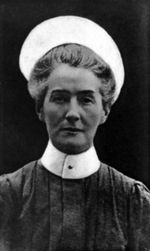
At 7am on 12 October 1915 a slight, upright Englishwoman, neatly dressed in a coat and skirt and wearing a hat, was tied to a stake in a field outside Brussels, blindfolded, and shot by a German firing squad. The woman was Edith Cavell, a 49-year-old hospital matron in Brussels. She had been found guilty by a German court martial on a charge of treason. Cavell’s crime was to aid the escape of Allied soldiers who had become separated from their regiments and stranded in German-occupied Belgium. She helped hundreds of soldiers to cross the border to neutral Holland. Her execution was one of the iconic atrocities of the First World War. It was hugely damaging to the Germans. Diana Souhami’s concern in this compelling biography is to show how it was that Cavell, a devoted, dutiful nurse, became involved in such dangerous and duplicitous work, and why she died.

more from Jane Ridley at Literary Review here.

Wednesday, October 20, 2010

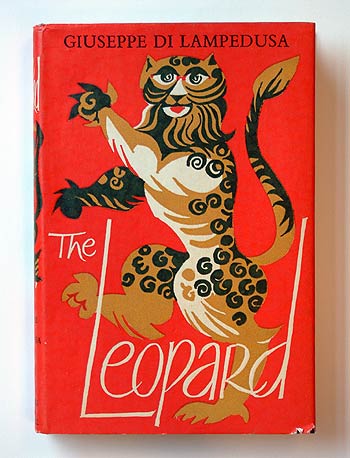
The Leopard

Review of Giuseppe Tomasi Di Lampedusa's novel by Ruchira Paul in Accidental Blogger:

08dilampedusa The Leopard, written by Giuseppe Tomasi Di Lampedusa was published a year after the author’s death in 1957. Based on the life of his great-grandfather, the benevolent Sicilian tyrant Don Fabrizio, the Prince of Salina, Lampedusa’s account is meticulous in attention, generous in admiration and tinged with half hearted regret for the loss of a certain way of life. I say half-hearted because it is not entirely clear whether the author, the penurious descendant of a once prosperous and proud feudal family, gently mocks his ancestor’s grandiose ways while harboring considerable affection for the man himself.

The title character, Don Fabrizio aka The Leopard (a nickname derived from the family’s coat of arms) is a fascinating character. Large and proud, possessing big appetites and enormous physical strength, the Prince was elegant, generous, occasionally unthinkingly cruel and often unexpectedly melancholy. He supported the brood of offspring he had spawned with his long suffering wife as well as a large retinue of servants and dependants. But he was not above casting a jaundiced eye on their minor shortcomings. His wife's hysterical sorrow exasperated him; his sons disappointed him; his daughters' emotional upheavals irritated him. Outwardly reverential toward the ever present Jesuit clergy (the Jesuit intially opposed the Italian revolution for unification that is the backdrop of the novel) he rarely missed an opportunity to mock the resident priest Father Pirrone for his piety and poor personal hygiene. In fact the only character in the novel toward whom The Prince was unfailingly affectionate and forgiving was his charming and ambitious nephew Tancredi Falconeri, a penniless aristocratic young man who fought on the side of Garibaldi’s Red Shirts who brought the battle for the Risorgimento to the Sicilian shores in 1860.

The novel, after its posthumous publication, became an instant sensation. It was embraced and assailed by both the left and the right of the Italian political divide. Many conservatives felt that Lampedusa had betrayed his own noble heritage by mocking the upper class while some on the left interpreted his views as a repudiation of the Italian unification.

More here.

To Choose Austerity is to Bet it All on the Confidence Fairy

Joseph_stiglitz_140x140 Joseph Stiglitz in The Guardian:

The Keynesian policies in the aftermath of the Lehman brothers bankruptcy were a triumph of economic theory. In Europe, the US and Asia, the stimulus packages worked. Those countries that had the largest (relative to the size of their economy) and best-designed packages did best. China, for instance, maintained growth at a rate in excess of 8%, despite a massive decline in exports. In the US the stimulus was both too small and poorly designed – 40% of it went on household tax cuts, which were known not to provide much bang for the buck – and yet unemployment was reduced from what it otherwise would have been – over 12% – to 10%.

The stimulus was always thought of as a stopgap measure until the private sector could recover. In some countries, such as the US, politics rather than economics drove the size and design, with the result that they were too small and less effective than they might have been. Still, they worked. Now, financial markets – the same shortsighted markets that created the crisis – are focusing on soaring deficits and debts.

We should be clear. Most of the increase is not due to the stimulus but to the downturns and the bank bailouts. Those in the financial market are egging on politicians to ask whether we can afford another stimulus. I argue that Britain, and the world, cannot afford not to have another stimulus. We cannot afford austerity. In a better world, we might rightfully debate the size of the public sector. Even now there should be a debate about how government spends its money. But today cutbacks in spending will weaken Britain, and even worsen its long-term fiscal position relative to well-designed government spending.

There is a shortage of aggregate demand – the demand for goods and services that generates jobs. Cutbacks in government spending will mean lower output and higher unemployment, unless something else fills the gap. Monetary policy won't. Short-term interest rates can't go any lower, and quantitative easing is not likely to substantially reduce the long-term interest rates government pays – and is even less likely to lead to substantial increases either in consumption or investment.

Anish Kapoor, Turning the World Upside Down

2010-09-28-14-30-06-4ca1fbeec674c-Press Page image DSC4140 Sue Hubbard in The New Statesman:

The camera obscura (Latin for a darkened room) is an optical device that projects an image of its surroundings onto a screen and was one of the inventions that led to photography. Consisting of a box or room with a hole in one side, light from an external scene passes through the hole and strikes a surface inside where it is reproduced, upside-down, but with colour and perspective preserved.

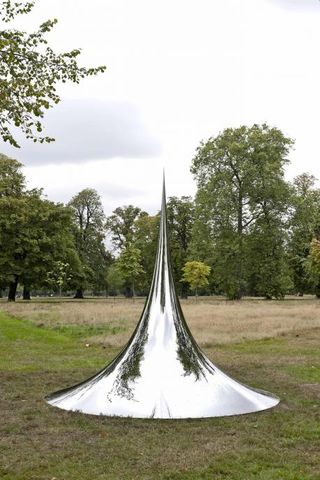
To come across Anish Kapoor's startlingly beautiful C-Curve sculpture in the middle of Kensington Gardens is to experience the effects of the camera obscura but without the darkened room. Walk towards the highly polished concave surface of stainless steel and the surrounding lawns, autumn trees and people will appear upside down like a child's vision of Australia, where everything is topsy-turvy. Move around to the bulging convex facade and the world will be the right way up again.

Clouds, dog-walkers, babies and bikers all pass across the silver screen in a filmic version of real life. The players in this pageant stroll on and off stage passing, only for a moment, like the shadows in Plato's cave. “Life's but a walking shadow, a poor player, That struts and frets his hour upon the stage, And then is heard no more,” Macbeth despaired. What is real? What is a chimera? asks Kapoor in these mirroring multiplications and inversions of our surroundings, which pose questions about our very existence.

From the first encounter with these four stainless steel structures placed within Kensington Gardens, we are reminded that the world is rarely what it seems. As Alice discovered in the looking glass, reality is a slippery concept. The symbolism of the mirror is ancient; from Narcissus to Snow White, it is an image that has caught the human imagination.

Also see here

.

Splices of Time

Tina Hesman Saey in Science News:

Fruit flies and plants have independently come up with similar ways to mark time, a new study suggests.

Both modify the products of certain genes based on daily rhythms set by the organisms’ circadian clocks, the study shows. The finding, published online October 20 in Nature, may help scientists better understand how plants and animals respond to light-dark cycles.

Most research on circadian clocks has focused on the process by which the biological timekeepers turn genes on and off. But the new study shows that the clocks also govern how molecules of RNA that are transcribed from a gene are spliced together for translation into the gene’s protein product.

“This paper certainly adds a very novel twist,” says Yi Liu, a biologist at the University of Texas Southwestern Medical Center at Dallas who was not involved in the study.

Marcelo Yanovsky, a plant physiologist and geneticist at the IFEVA Institute of Agronomy and the Fundación Instituto Leloir in Buenos Aires, Argentina, and his colleagues searched for genes in the plant Arabidopsis thaliana that cause it to raise its leaves to the light during the day and let them droop back down in the dark. The researchers found a form of the plant that moved its leaves out of sync with the usual 24-hour rhythm, in a 30-hour cycle, and traced the source of the longer cycle to a mutation in the gene PRMT5.

PRMT5 makes an enzyme that adds methyl groups to histone proteins — proteins that form spools on which DNA is wound to fit inside cells. The addition of the chemical tag causes DNA to pack more tightly and shuts down gene activity. The team found that the enzyme also adds methyl groups to proteins involved in cutting and pasting RNA molecules that will later be made into proteins.

The cut-and-paste process is known as alternative splicing, and it allows cells to create different versions of proteins much the way that film editors can splice scenes together to produce movies with alternative endings.

Magic by Numbers

17gilbertimg-articleInline Daniel Gilbert in the NYT:

I RECENTLY wound up in the emergency room. Don’t worry, it was probably nothing. But to treat my case of probably nothing, the doctor gave me a prescription for a week’s worth of antibiotics, along with the usual stern warning about the importance of completing the full course.

I understood why I needed to complete the full course, of course. What I didn’t understand was why a full course took precisely seven days. Why not six, eight or nine and a half? Did the number seven correspond to some biological fact about the human digestive tract or the life cycle of bacteria?

My doctor seemed smart. She probably went to one of the nation’s finest medical schools, and regardless of where she trained, she certainly knew more about medicine than I did. And yet, as I walked out of the emergency room that night with my prescription in hand, I couldn’t help but suspect that I’d just been treated with magic.

Certain numbers have magical properties. E, pi and the Fibonacci series come quickly to mind — if you are a mathematician, that is. For the rest of us, the magic numbers are the familiar ones that have something to do with the way we keep track of time (7, say, and 24) or something to do with the way we count (namely, on 10 fingers). The “time numbers” and the “10 numbers” hold remarkable sway over our lives. We think in these numbers (if you ask people to produce a random number between one and a hundred, their guesses will cluster around the handful that end in zero or five) and we talk in these numbers (we say we will be there in five or 10 minutes, not six or 11).

But these magic numbers don’t just dominate our thoughts and dictate our words; they also drive our most important decisions.

The ‘why’ of a leopard’s spots

From MSNBC:

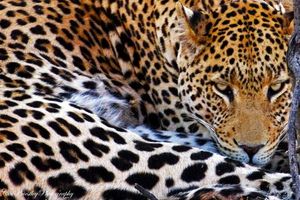
Leo Researchers have followed up on Rudyard Kipling's classic tale to investigate why some leopards got their spots — and why others are spotless. In one of his “Just-So Stories,” Kipling suggested that the leopard scrounged up his distinctive rosettes because he had to stalk his prey undetected in a “great forest, 'sclusively full of trees and bushes and stripy, speckly, patchy-blatchy shadows.” Biologists think Kipling wasn't far wrong: The leopard-spot camouflage helps the cats move stealthily through the shadowed forest. But why aren't all big cats spotted? Researchers at the University of Bristol have developed a mathematical model that links the patterning of the leopard and 34 other species of wild cats to their different habitats. A paper about their research is being published in the Proceedings of the Royal Society B.

The model suggests that cats living in the trees within dense habitats, with high activity at low light levels, are the most likely to have complex color patterns in their fur. The cats that spent their time in well-lit and uniform environments, such as plains and grasslands, were more likely to have small spots or plain coats. The analysis supports the view that different patterns of camouflage reflect adaptation to different environments — and it also suggests that those patterns can change relatively quickly.

More here.

living v dwelling

Prairie-town-small-town-usa-168x125

“A genuine liberal arts education will equip a person to live well in a place,” Orr wrote. “To a great extent, formal education now prepares its graduates to reside, not to dwell. The difference is important. The resident is a temporary and rootless occupant who mostly needs to know where the banks and stores are in order to plug in.” By contrast, “the inhabitant and a particular habitat cannot be separated without doing violence to both. The sum total of violence wrought by people who do not know who they are because they do not know where they are is the global environmental crisis…. Knowledge for the resident is theoretical and abstract, akin to training. For inhabitants, knowledge in the art of living aims toward wholeness. Those who dwell can only be skeptical of those who talk about being global citizens before they have attended to the minute particulars of living well in their place.” As this insignificant little piece goes live, I will be convening a class not around Bloom’s Closing but around the little-known works of David Orr, whose books I humbly commend to anyone who has indulged me thus far.

more from Jason Peters at Front Porch Republic here.

a taxidermic moment

86cda9e2-d806-11df-b044-00144feabdc0

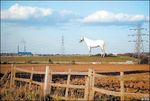
Call me a Yahoo but if you prick up your ears you might just catch the sound of mass whinnying; the pawing of hoofs and the odd titanic neigh coming from somewhere in north Kent where Mark Wallinger will be installing his colossal gee-gee by the Ebbsfleet railway station in time for the Olympic influx in 2012. Fifty metres high, that’s a hell of a croup, a monster fetlock. But then contemporary art seems so stampeded with equimania that an extra-terrestrial visiting in time for Frieze (and they probably are) could be forgiven for assuming that, from Queen to commoners, Britain is in the grip of an esoteric cult of the filly and the stallion. Petrified horses are closing in on the West End of London where War Horse commands the stage. On Park Lane, David Backhouse’s Animals in War memorial features a noble patriotic dobbin and only a few months back, minding my own business at night, I caught sight of something colossal mounted on high where the Lane meets Bayswater Road. By daylight, the object turned out to be one of Nic Fiddian-Green’s decapitated and slightly shattered outsize horse-heads.

more from Simon Schama at the FT here.

with Tom in Tbilisi

543774010_d7b21296fa_o

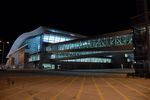
My friend Tom invited me to visit him in Tbilisi. He’s a fearless, openhearted man, an international aid worker who had put in hard time in Rwanda and Sierra Leone. Now, he was the head of child protection for UNICEF in Georgia. “You can stay at my apartment, I’ve plenty of room. It’ll more than cancel out the price of the ticket to get here.” To entice me further he quoted a piece of graffito he had seen scrawled on the side of a building that afternoon: NO GOD, ONLY KINGS. “That’s the kind of place this is. Original. Enigmatic. Unexpected.” He reminded me that Joseph Stalin and George Balanchine were both Georgian—”a major murderer and a major modernist”—a fact that seemed to suggest a great deal about the country, while at the same time increasing its aura of mystery. “I’ll book a flight for next month,” I told him. Tom met me at the airport. He appeared to enjoy my startled reaction to the new, gleaming terminal, which seemed much grander than required for the small former Soviet republic. “It’s one of Georgia’s many attempts to make its fantasy about itself feel real,” he said. The fantasy sharpened when we drove into the city along George W. Bush Street, smoothly paved and with a billboard of Bush waving to his Georgian comrades, free marketers all.

more from Michael Greenberg at Bookforum here.

Tuesday, October 19, 2010

There They Go Again

Goldstein145a Nancy Goldstein in the Washington Post has some comments on the debate between the candidates for the Senate seat from Delaware. Let's hope this is not an accurate description of the state of politics:

So what do we get if we assess this morning's debate primarily in terms of tone and cadence, with substance following a distant third? He: Angry daddy. Impatient, know-it-all older brother. Responds with a veritable wall of verbiage delivered in a flat, tense, aren't-you-a-moron tone, even when expressing compassion (as Coons did when talking about the importance of lessening stigma against people with HIV/AIDS). She: Passionate black-sheep aunt. Unfairly treated younger sister. Can't answer half the questions, but her initial response is often simple and straightforward. Openly frustrated and befuddled with a system, and an opponent, that she doesn't like or understand.

My point isn't that O'Donnell's the winner when it comes to tone and Coons is the winner when it comes to content. It's that he's saying many of the right things, but in a way that makes you want to sit next to someone else at Thanksgiving. She, on the other hand, may be a mess, and the accusations she lobbed at Coons during the debate may or may not be true. But they hit a nerve with everyone who finds politicians like Coons hard to understand or privileged or aloof: That he's a rich kid who went to Yale and married into yet more money. That he interrupts her when he feels like it, but sics the moderator on her when the tables are turned. That he treats military funerals as a photo op. That he doesn't answer the questions.

Over time, it's not surprising that the Coonses of the world–the professional politicians, the guys who talk the talk and wear the suit and know all the stuff that confuses you, and went to a good school, are going unheard by Americans who constantly feel dismissed and disrespected by the system that rules them but rarely serves them.

The History of Artificial Light and How It Has Changed Who We Are

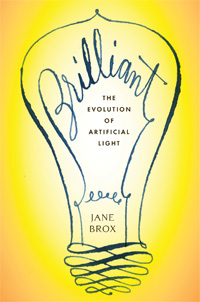
Brilliant-cvr George Russell in PopMatters:

For most of us artificial light is known only by its absence. At night walk down any street in any town in the industrialized world and your shadow will blink off and on as it follows you, intermittently illuminated by ubiquitous street lamps.The generation of Americans that can remember a time without artificial light, those living in rural areas during the first half of the 20th century, before power lines reached them, are quickly dying off. My grandparents were of that generation – a rancher and a farmer that were each born by the light of a kerosene lamp.

Today, artificial light is a constant companion. Darkness implies a situation to be remedied, if only by the dim light of a television or computer screen. However, our relationship with it has also blinded us to its effects. For most of us, the charges on a monthly electric bill serve as the only reminder that there is any cost at all to flipping a light switch. Brilliant, The Evolution of Artificial Light, shows how artificial light and its twin invention, electricity, have in one way or another shaped everything that we have become.

The book follows the path of this catalyzing technology as it winds it way from the last Ice Age into present day. As Brox connects the dots from early humans using stone lamps for painting the walls at Lascaux, to the the whaling trade as it arose to supply the world with lamp oil, to Edison’s Menlo Park and the dawn of modernity, to the massive power grids of today, a story of evocation begins to emerge. Seeing the broad strokes of history laid out in front of you, it’s difficult not to see a form taking shape in the flickering candlelight.

What that form is has yet to reveal itself, but its effects have probably been best described by Marshall McLuhan in 1964 when he wrote in Understanding Media, “The electric light escapes attention as a communication medium just because it has no ‘content’. And this makes it an invaluable instance of how people fail to study media at all. […] The message of the electric light is like the message of electric power in industry, totally radical, pervasive and decentralized. For electric light and power are separate from their uses, yet they eliminate time and space factors in human association exactly as do radio, telegraph, telephone and TV, creating involvement in depth.”

By focusing almost entirely on the evolution of light and electricity, in a few hundred pages Brox achieves what could be considered a historical proof of McLuhan’s ideas. She shows in Brilliant that technology, as extensions of our own bodies and minds, are what shape humanity; not the messages contained in the technology, nor the petty power struggles of day to day politics and ideologies. We have made our tools, and in turn our tools have made us.

Existence of Habitable Exoplanet Questioned

Ls_GJ581g_FNLa Ron Cowen in Science News:

In late September, an experienced group of U.S. astronomers made headlines with news of the first extrasolar planet likely to be hospitable to life. The planet lies at a distance from its parent star at which water could be liquid (SN: 10/23/10, p. 5).

But a Swiss team of veteran planet hunters has now cast some doubt on that finding. On October 11, Francesco Pepe of the Geneva Observatory in Sauverny, Switzerland, announced at an extrasolar planet meeting in Torino, Italy, that a combination of old and new data acquired by his team shows no sign of the planet, dubbed Gliese 581g.

“If a signal corresponding to the announced Gliese 581g planet was present in our data,” Pepe says, “we should have been able to detect it.”

Other astronomers say that only time, and more studies, will tell if the first exoplanet in the habitable zone has truly been found or not. “I don't know if we should be in such a hurry to say one way or the other,” says MIT astronomer Sara Seager. “We will have consensus at some point; I don't think we need to vote right now.”

clawing back to shakespeare

William-Shakespeare-006

I wanted to say something to counteract the perception of Shakespeare’s compositional method as a kind of lyric soduku, and put in a word for the kind of glorious, messy procedure I’m quite certain it was, whatever the crystalline and symmetrical beauty of the final results. Like most poets, Shakespeare uses the poem as way of working out what he’s thinking, not as a means of reporting that thought. Often he’ll start with nothing more than a hangover, a fever and a bad night spent being tormented by the spectre of his absent lover. Then he’ll use the sonnet as a way of making sense of it all – a way, first, to extract a logic from pain, and then a comfort from that logic, however warped it might be. Form, in other words, allows him to draw some assuagement from the very source of the agony itself. So I decided to try to honour this sense of free play by taking as different an approach as the individual poem might itself prompt. Sonnet 109, for example, is a patently disingenuous excuse offered for Shakespeare’s negligence of his lover, and I made a parallel translation from bullshit into English.

more from Don Paterson at The Guardian here.

Tuesday Poem

After Half a Century

Finally after half a century, a clearly observable law has been found:
For mankind, all matters proceed
Along geometric lines

(If you put one grain of rice on the first intersection of a game board, two grains of rice on the second, four grains of rice on the third, and continue along these lines, what vast quantities will you have by the time the board is covered? When the ancient king was told the answer, how surprised he was . . . )

By the time I realized what was happening, I was clinging to the earth
So I would not be shaken off as it spun with ever greater speed
My hair, dyed in two parts with night and day, had come loose
(Yet still I toyed with dice in one hand)

As it turns, it is stripped page by page like a calendar pad growing thin
A cabbage growing small, shorn of leaves before our eyes
Once, this planet had plenty of moisture
(But that was in the days when those things that now belong to dead languages –
Things such as dawn, looks, and smiles – were still portents of things to come)
That’s right, for mankind, all matters proceed along geometric lines

Four and a half more centuries into the future
The shriveled brain that revolves
Rattling in the cranium’s hollow will grow still
Like the pale eye of a hurricane

All will see its resolution in those moments
As the rolling dice tumble, turning up their black eyes
Then finally coming to a halt

by Chimako Tada
from Fū o kiru to (Upon Breaking the Seal)
publisher: Shoshi Yamada, Tokyo, 2004

translator: Jeffrey Angles
from Forest of Eyes: Selected Poetry of Tada Chimako
publisher: University of California Press,
Berkeley, California, USA, 2010

Translator's Note: The second stanza of this poem refers to a legend of Krishna, who appeared to an ancient king of southern India and challenged him to the game of chauturanga, saying that if he won, he would take the quantity of rice described in Tada’s poem. By the time the king lost, he realised the quantity of rice he had to forfeit was greater than all of the rice in all the granaries of the kingdom.

Read more »

The Fine Structure Constant is Probably Constant

Sean Carroll in Cosmic Variance:

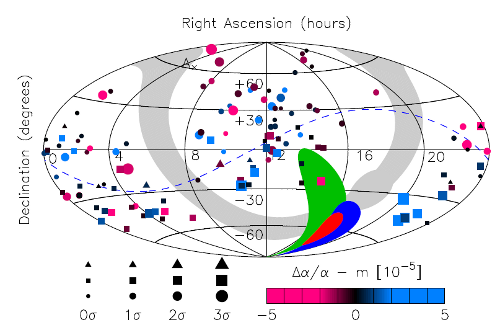
A few weeks ago there was a bit of media excitement about a somewhat surprising experimental result. Observations of quasar spectra indicated that the fine structure constant, the parameter in physics that describes the strength of electromagnetism, seems to be slightly different on one side of the universe than on the other. The preprint is here.

Remarkable, if true. The fine structure constant, usually denoted α, is one of the most basic parameters in all of physics, and it’s a big deal if it’s not really constant. But how likely is it to be true? This is the right place to trot out the old “extraordinary claims require extraordinary evidence” chestnut. It’s certainly an extraordinary claim, but the evidence doesn’t really live up to that standard. Maybe further observations will reveal truly extraordinary evidence, but there’s no reason to get excited quite yet.

Chad Orzel does a great job of explaining why an experimentalist should be skeptical of this result. It comes down to the figure below: a map of the observed quasars on the sky, where red indicates that the inferred value of α is slightly lower than expected, and blue indicates that it’s slightly higher. As Chad points out, the big red points are mostly circles, while the big blue points are mostly squares. That’s rather significant, because the two shapes represent different telescopes: circles are Keck data, while squares are from the VLT (”Very Large Telescope”). Slightly suspicious that most of the difference comes from data collected by different instruments.

Alphadot_quasars

But from a completely separate angle, there is also good reason for theorists to be skeptical, which is what I wanted to talk about. Theoretical considerations will always be trumped by rock-solid data, but when the data are less firm, it makes sense to take account of what we already think we know about how physics works.

More here.

Mehdi Karroubi on Iran’s Green Movement

Laura Secor interviews Karroubi in The New Yorker:

LAURA SECOR: There is a widespread perception outside Iran that the Green Movement has been defeated. We no longer hear about millions-strong demonstrations, and a great many opposition figures have been imprisoned or forced out of the country. Is there still a Green Movement in Iran? Does it have an organized structure and a strategy for achieving its goals?

200981010222641580_5 MEHDI KARROUBI: Because of heavy government suppression, people are not visible in the streets, chanting and demonstrating. But the movement runs very deep. If the government allowed any kind of activity in the streets, the world would see millions of people. The authorities know it, and that is why they have cracked down for the last sixteen months, shutting down any kind of opposition in the most brutal ways. The government has many problems at the moment…. The economy and foreign policy are both sources of conflict. All of this makes it very hard for the current administration to accomplish anything. In the first months and days after the election, many officials from the top down were sent to prison, and this has continued. These are clear signs that the movement is still alive.

More here.