Reading Lolita at Twelve

Nick Antosca in The Paris Review:

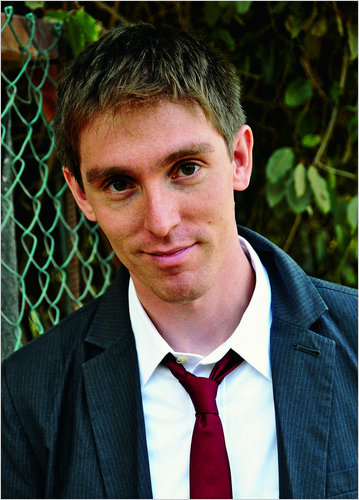
Lolita For much of middle school, I’d been enamored of a smart and introverted girl in my grade. I’ll call her Anna. Red-haired, freckled, and painfully pale, Anna was hardly a dead ringer for Dolores Haze, but I was observant enough to recognize the “ineffable signs—the slightly feline outline of a cheekbone, the slenderness of a downy limb”—that marked her as a nymphet.

My imagination required a corresponding nympholept, and the Humbert Humbert of Brunswick Middle School could only be our affable fourth-period teacher, a tall, handsome, offhandedly suave man who was soon slipping in Anna’s bedroom window to ravish her—and be ravished by her—on a nightly basis, as a perturbed cocker spaniel looked on. (I’d once overheard her mention her dog at school.) I loathed and admired him. How could I ever hope to compete?

What Nabokov prettified with a murderer’s fancy prose style, I saw with bracing clarity. This was 1995, and hardcore Internet porn was not yet easily accessible to twelve-year-olds, but my imagination was ambitious. No permutation of heterosexual sex escaped it.

More here.

An Empirical Perspective on Religious and Secular Reasons

3017257227_7f7a90bc4d John H. Evans in Immanent Frame:

The use of religious reasons by ordinary citizens talking over the fencepost may be different than their use by activists. I recently published an empirical analysis of whether there is a shared moral language among diverse religious people in the U.S. used in debates over reproductive genetic technologies. In one chapter, I evaluate whether people would want to refer to religious reasons in discussing reproductive genetics with their neighbors. I asked in-depth interview respondents whether one should explain one’s position on reproductive genetic technologies to a Hindu neighbor “using religious terms or secular terms.”

In my interviews, a majority of the people thought one should use religious discourse with the Hindu neighbor, with conservative Protestants being the most likely to say so. Interestingly, a majority of the secular respondents also thought that one should use religious discourse, which I will address below. The most prevalent reason given for advocating the use of religious reasons is that using only secular reasons is not possible if you are religious. For example, a Pentecostal woman said that she would use religious reasons because “that’s who I am . . . so that’s probably how it would come across.” A traditional evangelical woman said, “I can’t separate that because my spiritual beliefs influence everything I do and say. If I really feel that that’s the core of who I am, then to say, ‘it only influences me some of the time,’ is a mistake.”

This seems to be empirical support for the claim made by Calhoun and many others, such as Wolterstorff and Habermas, that people who are religious cannot separate out their religious reasons and their secular reasons—or, more subtly, that they cannot translate between the two. They have no choice but to use religious reasons.

Not quite.

The Real Danger to the Economy

Obama_barack-032510_jpg_230x867_q85 George Soros in The NYRB:

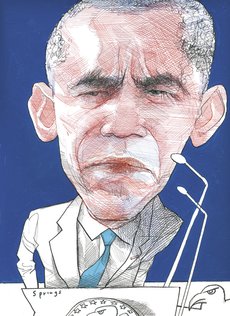
The imbalances that were at the root of the crash of 2008 remain to be corrected and the private sector is unable to do it on its own. The US still consumes more than it produces, running a chronic trade deficit. Consumption is too high at nearly 70 percent of GDP, compared to an unsustainably low 35.6 percent for China. Households are overindebted and need to increase their savings rates. The US economy badly needs investments that enhance productivity but the private sector is unwilling or unable to provide them. US corporations operate very profitably but instead of investing their profits they are building up their liquidity—accumulating money, not investing it. In these circumstances there is a strong case for government intervention. Admittedly, consumption cannot be sustained indefinitely by running up the national debt. But to cut back on government spending at a time of large-scale unemployment would ignore all the lessons learned from the Great Depression.

The obvious solution is to draw a distinction in the budget between investments and current consumption and to provide additional stimulus for investments but not for consumption. Such a stimulus program coupled with a gradual appreciation of the renminbi would go a long way toward correcting the prevailing imbalances. Consumers would spend less on imported goods because they would cost more and corporations would find it more profitable to invest at home, creating more jobs. The trade deficit would shrink. Prices would move toward the inflation target of 2 percent, removing the threat of a deflationary spiral. The economy could start growing its way out of the prevailing imbalances.

The Knobe Effect

Knobe Melodye in Child's Play:

As an avid reader of Language Log, my interest was recently piqued by a commenter asking for a linguist’s eye-view on the “Knobe Effect”:

“Speaking of Joshua Knobe, has any linguist looked into the Knobe Effect? The questionnaire findings are always passed off as evidence for some special philosophical character inherent in certain concepts like intentionality or happiness. I’d be interested in a linguist’s take. If I had to guess, I’d say the experimenters have merely found some (elegant and) subtle polysemic distinctions that some words have. As in, ‘intend’ could mean different things depending on whether the questionnaire-taker believes blameworthiness or praiseworthiness to be the salient question. Or ‘happy’ could mean ‘glad’ in one context but ‘wholesome’ in another, etc…”

Asking for an opinion, eh? When do I not have an opinion? (To be fair, it happens more than you might expect).

But of course, I do have an opinion on this, and it’s not quite the same as the one articulated by Edge. This post is a long one, so let me offer a teaser by saying that the questions at stake in this are : What is experimental philosophy and is it new? How does the language we speak both encode and subsequently shape our moral understanding? How can manipulating someone’s linguistic expectations change their reasoning? And what can we learn about all these questions by productively plumbing the archives of everyday speech?

For those who are not familiar, Joshua Knobe is an up-and-coming ‘experimental philosopher’ at Yale, and is well-known for his experimental work looking at how we interpret a person’s actions depending on linguistic context. The idea underpinning his approach is that we can better understand philosophical concepts if we look at how people use and respond to them in practice. Many of these experiments focus on intentionality : i.e., in what contexts do we say that a person acted intentionally, and in what contexts unintentionally? Based on these findings, Josh wants to claim that he has discovered something ‘deep’ about the nature of theory of mind, intentional action, and moral judgment. But has he? I’d argue that he’s discovered something about how we use certain words and what we take them to mean. Is that deep? Perhaps! Read on — and you tell me.

There is one thing I’d say first though, which is that while Josh’s approach is widely taken to be innovative or revolutionary, it’s almost certainly not. Wittgenstein proposed this method of investigation in the 1930′s, and Chomsky roundly denied that linguistic research could tell us anything about these kinds of ‘philosophical’ questions in the 1960′s, in response to an enthusiastic outburst by Zeno Vendler.

Experimental Error: Electile Dysfunction

From Science:

Tea You probably won't hear too many people admit this, but … I'm from Delaware. From the placid waterways of Sussex County, to the credit card companies of Wilmington, to the rolling hills that are more likely in Pennsylvania, my home state is a hotbed of scientific innovation. Or was. When I was in third grade, my teacher asked us to raise our hands if one or both parents worked for local chemical giant DuPont. Almost every hand went up. My mother worked for nearly 20 years as a scientist at DuPont, which later became DuPont Merck, which then became DuPont Pharmaceuticals, whose campus then became a ghost town when it was bought by Bristol-Myers Squibb. You suck, Bristol-Myers Squibb. Recently, however, I was alarmed to hear that my fellow Delawareans voted to oust Representative Mike Castle, a solid moderate who pushed for embryonic stem cell research and was handily elected as the Republican representative of a largely Democratic state for nine consecutive terms, in favor of Christine O'Donnell, who, as far as I can tell, is a houseplant.

Suddenly, Delaware became the bellwether state for the nation, presaging Tea Party upsets from New York to New Hampshire in the coming midterm elections. Television pundits asked difficult questions, such as “Can the Democrats hold on to their legislative majorities?” and “Which state is Delaware in?” The issues receiving the most attention in this election have been the ones Tea Partiers are proud to stand behind: lowering taxes, reducing government spending, and proving that Hawaii is Kenya. But ask any Tea Partier to define “science” and you'll get an answer whose value is less certain: “Something it's important to stop doing.” I tried reaching several Tea Party candidates and officials to learn their specific views on today's major scientific issues, but no one returned my calls, so I guess I'm on my own. (It probably didn't help that I have the same name — same spelling, too — as the political director of MoveOn.org.) Here, as well as I can determine, are the Tea Party's views on science. In a couple of weeks, when you tap Diebold's proprietary and easily hacked touchscreens — that is, when you attempt to cast your ballot — remember what might happen to your beloved science career if the Tea Partiers triumph:

The space program:

The Tea Party isn't opposed to outer space per se. After all, the Scientologists in its ranks claim that their founder came from there. They just don't like us fiddling around in the heavens without a purpose prescribed by the heavens, or at least one comprehensible to a fifth-grader. For example, one of NASA's current projects is called “Aeronomy of Ice in the Mesosphere.” Boring! Who even knows what these crazy words mean? “Aeronomy”? “Mesosphere”? “Ice”? None of these words appear in the Bible! No, the Tea Party will support the space program only if we tether our efforts to an arbitrary timeframe, a simplistic goal, and a meaningless patriotic gesture: We will put an American on Callisto by 2023, and he will plant a flag made of guns!

More here.

Friday Poem

Now That I have Cable

now that i have cable i feel
i am able to mainline culture
where before i barely
got a sniff. oh, i was able

to quote yeats or baudelaire or
know the details of the natural
world the way others
knew britney spears and tony

soprano, but the pictures
paled after a while, and i went
to the channels i hadn’t paid to get,
that were scrambled

but not enough so i didn’t
know what i was missing. and
that is why i now get the cubist
cocksuckers’ channel

and why i don’t feel
as if i am on the periphery any more
but i can step right up with my
hungry eyes on britney

and quote french poetry
to her blonde good looks.
if her head is empty, why,
mine is quickly emptying

too, and i say things like
what’s up with that? and everything
seems better, more satisfying
and infinitely more true.

by Robert Allen
from Jacket Magazine
October 2007

My meals with W. H. Auden, E. M. Forster, Philip Larkin, and William Empson

Steven L. Isenberg in The American Scholar:

Arts-graphics-2008_1186341a The British writers W. H. Auden, E. M. Forster, Philip Larkin, and William Empson paid respectful attention to each other: Larkin wrote “English Auden was a superb and magnetic wide-angled poet, but the poetry was in the blaming and the warning.” Empson thought Auden a “wonderful poet” and put Larkin among the “very good poets.” Auden wrote a sonnet for Forster, and Empson wrote a poem called “Just a Smack at Auden.” Forster’s novels were touchstones for Auden, who cabled “Morgan” Forster on his 80th birthday these good wishes: “May you long continue what you already are stop old famous loved yet not yet a sacred cow.” Empson thought Forster’s Aspects of the Novel—lectures he had heard as a student at Cambridge—“a model.”

For me the four have another thing in common, the unlikely and unexpected occasions of my having met each of them for lunch. Those visits are always with me, and while I kept no diary and so remember fewer of their words than I wish, the memories I do have are testimony to their humanity and kindness.

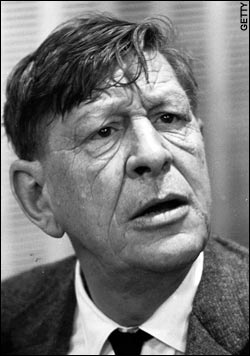
More here. [Photo shows Auden.]

Malawi cichlids – how aggressive males create diversity

Ed Yong in Not Exactly Rocket Science:

ScreenHunter_02 Oct. 22 10.52 Certain groups of animals show a remarkable capacity for quickly evolving into new species to seize control of unexploited niches in the environment. And among these ecological opportunists, there are few better examples than the cichlids, a group of freshwater fishes that are one of the most varied group of back-boned animals on the planet.

In the words of Edward O. Wilson, the entire lineage seems “poised to expand.” The Great Lakes of Africa – Tanganyika, Malawi and Victoria – swarm with a multitude of different species; Lake Malawi alone houses over 500 that live nowhere else in the world. All of these forms arose from a common ancestor in a remarkably short span of time. Now, a new study suggests that this explosive burst of diversity has been partly fuelled by rivalry between hostile males.

Michael Pauers of the Medical College of Wisconsin found that male cichlids have no time for other males that look like them. They will bite, butt and threaten those who bear the same colour scheme. In doing so, they encourage diversity in the lake since mutant males with different tints are less likely to be set upon by territorial defenders.

This process is just part of the cichlids’ tale. Their rise to dominance in the African lakes probably happened in several stages and were driven by different evolutionary forces.

More here.

The Readers Behind Bars Put Books to Many Uses

Dwight Garner in the New York Times:

JUMPBOOK-popup Avi Steinberg’s memoir, “Running the Books,” about his job as a prison librarian at “the Bay” — the Suffolk County House of Correction in South Bay near Boston — gets off to an obnoxious start.

Mr. Steinberg is a self-described “asthmatic Jewish kid,” a young Harvard graduate and a stalled novelist. He applied for the prison library job when he saw it posted on Craigslist. He needed the health insurance. Probably he needed a book idea too.

The early bits of “Running the Books” are as hopped-up as a spaniel with a new rubber ball. The tone is, more or less, “Augusten Burroughs Goes to the Clink.” Here’s a not atypical passage: “It was official. I was now on the side of angels. The Po-Po. The Fuzz. The Heat. The Big Blue Machine.”

But a funny thing happens to “Running the Books” as it inches forward. Mr. Steinberg’s sentences start to pop out at you, at first because they’re funny and then because they’re acidly funny. The book slows down. It blossoms. Mr. Steinberg proves to be a keen observer, and a morally serious one. His memoir is wriggling and alive — as involving, and as layered, as a good coming-of-age novel.

More here.

Thursday, October 21, 2010

Big Ideas from Small Countries

Ve798c_thumb3 Jeffrey Frankel in Project Syndicate:

[W]here should countries look now, in 2010, for models of economic success to emulate?

Perhaps they should look to the periphery of the world economy. Many small countries there have experimented with policies and institutions that could usefully be adopted by others.

Costa Rica in Central America and Mauritius in Africa each pulled ahead of its regional peers some time ago. Among many other decisions that have worked out well for them, both countries have foregone a standing army. The results in both cases have been a political history devoid of coups, and financial savings that can be used for education, investment, and other good things.

A panoply of innovations has helped Chile to outperform its South American neighbors. Chile’s fiscal institutions insure a countercyclical budget. Many governments increase spending excessively in booms, and then are forced to cut back in downturns, thereby exacerbating the cyclical swings.

There are two key elements to Chile’s fiscal institutions:

● A structural budget balance rule allows deficits only to the extent that the current price of copper is below its 10-year equilibrium or output is below its long-term trend.

● Two panels of technical experts are the ones to judge trends in copper prices and output, respectively, insulated from the political processes that can otherwise succumb to wishful thinking.

These institutions are particularly worthy of imitation by other commodity-exporting countries, in order to defeat the so-called “natural-resource curse.” Even advanced countries such as the US and UK could learn something from Chile, given that in the last expansion they evidently forgot how to run countercyclical fiscal policy.

Singapore achieved rich-country status with a unique development strategy. Among its many innovations were a paternalistic approach to saving and use of the price mechanism to defeat urban traffic congestion (an approach later adopted by London).

Mr. Grumpy Goes Back to Africa

Vs naipaul - gettyEmily Witt in The New York Observer:

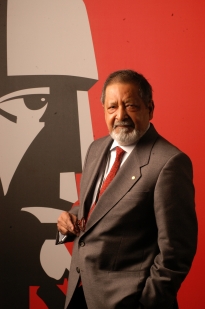
Pick up the collected essays of any member of what we might imagine as a dream team of postcolonial literature and it will include an annoyed complaint about V. S. Naipaul. Salman Rushdie, Edward Said, Chinua Achebe, Derek Walcott—each has publicly registered his disgust with the Nobel Prize winner from Trinidad. Mr. Naipaul's novels are one source of dismay, but what enrages everyone is his travel writing. At issue is Mr. Naipaul's callous treatment of respective homelands or religions, his use of minor samples to draw broad and negative conclusions, his unfairness, prejudice and blind pessimism. But also, really, it's that even though his work is exasperating, ill-informed and usually kind of offensive, people still think he's great.

Consider the bulk of Mr. Naipaul's travel oeuvre. It's pretty repetitive. He goes to some non-European place—India, Congo and Iran are some previous destinations—and, in a style that Mr. Rushdie called “a novelist's truth masquerading as objective reality,” Mr. Naipaul complains. He complains about the natives' disrespect for hygiene, regular garbage collection and the tenets of the Enlightenment. He subjects his readers to the country's abhorrent lack of concern for his own personal comfort, dietary preferences and taste in architecture. If the destination had also been a former colony, Mr. Naipaul depicts the colonial era as the only respite such countries have had from the chaos and tyranny of their own people. Then he gives the book a vaguely imperial title: An Area of Darkness, or India: A Wounded Civilization, or, his latest effort, The Masque of Africa.

The Masque of Africa is ostensibly about how traditional African religions have co-existed with Islam and Christianity. Mr. Naipaul sees the latter two as external influences and, one gathers, somehow inauthentic. He calls the Christian-Muslim-traditional medley “African belief,” and he travels to Uganda, Ghana, Nigeria, the Ivory Coast, Gabon and South Africa to document its manifestations and—cultural determinist to the end—figure out how it continues to affect the quality of African life.

His haphazard methods, though, are not up to the task.

Military-Publishing Complex

51tnpEO+EYL._SL500_AA300_ Nick Turse in The American Conservative:

Quick — name the five most important, influential, and best known books on the Afghan War. Okay, name three. Okay, I’ll settle for two. How about one?

While the American war in Vietnam raged, publishers churned out books whose titles still resonate. In 1967 alone, classics like Mary McCarthy’s Vietnam, Howard Zinn’s Vietnam: The Logic of Withdrawal, Thich Nhat Hanh’s Vietnam: Lotus in a Sea of Fire, not to mention Norman Mailer’s Why Are We in Vietnam: A Novel all hit the shelves.

In fact, between 1962 and 1970, as American involvement in the conflict accelerated and peaked, some 9,430 books were written about the Vietnam War. From 2002 to 2010, less than half as many — 4,221 texts of all types — have been written about the Afghan War.

Of course, it didn’t help that, from 2003-2008, the Iraq War sucked up all the attention and left Afghanistan largely “forgotten,” analytically and otherwise, nor did it help that the Afghan War never had a significant antiwar movement. The vibrant, large-scale movement of the Vietnam years, filled with people eager to learn more about just what they were protesting, proved an engine that drove publishers. Significant numbers of books produced by and for members of that movement investigated aspects of the civilian suffering the American war brought to Indochina. Not surprisingly, the Afghan War has produced many fewer works on the conflict’s human fallout, and books like Zinn’s, calling for withdrawal, have been few and far between.

Four decades ago, a stream of books was being produced for popular audiences that exposed the nature of war-making and focused readers’ attention on the misery caused by U.S. military actions abroad. Today, a startling percentage of the authors who bother to focus on the current conflict are producing works dedicated to waging the seemingly endless American war in Afghanistan better.

E-Mail Auto-Response

Martin Marks in The New Yorker:

Dear Friend, Family Member, Loved One, and/or Business Associate:
101025_r20147_p233 Thank you for your e-mail, which, if it is under three (3) sentences long, I have read. Owing to the large volume of e-mails I’m receiving at this time, please note that it will sometimes take up to fourteen (14) calendar days, though sometimes longer (and sometimes much longer), to respond to your e-mail; in the interim, please rest assured that I am attempting to address, resolve, or think about the matter you have described, unless, of course, I’m avoiding the matter entirely. Some possible reasons for this include:

Thinking about the matter gives me a headache.

—Thinking about the matter takes longer than forty-five (45) seconds.

—Thinking about the matter is simple enough, and takes less than forty-five (45) seconds, but, when combined with all the other e-mails in my in-box, it creates a synergy of matterdom, exacerbating the headaches mentioned at the beginning of this list.

Please note that if your e-mail is more than three (3) sentences in length I have read the first three (3) sentences, skimmed the opening paragraph, and sort of eyeballed the rest of it. Please do not expect a response to your e-mail anytime soon, if at all, for I am not a mind reader, and therefore cannot guess the nature of anything beyond the first three (3) sentences. For those of you who continue to insist on sending e-mails longer than three (3) sentences, here is a Wikipedia entry on haiku. Reformat your e-mails accordingly, as in this example:

I am busy now;
The Internet has stolen
So much precious time.

More here.

bacteria have powers to engineer the environment, to communicate, and may even think

Valerie Brown in Miller-McCune:

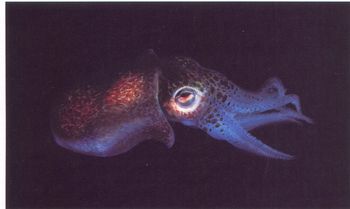
Vibrio_fischeri A few scientists noticed in the late 1960s that the marine bacteria Vibrio fischeri appeared to coordinate among themselves the production of chemicals that produced bioluminescence, waiting until a certain number of them were in the neighborhood before firing up their light-making machinery. This behavior was eventually dubbed “quorum sensing.” It was one of the first in what has turned out to be a long list of ways in which bacteria talk to each other and to other organisms.

Some populations of V. fischeri put this skill to a remarkable use: They live in the light-sensing organs of the bobtail squid. This squid, a charming nocturnal denizen of shallow Hawaiian waters, relies on V. fischeri to calculate the light shining from above and emit exactly the same amount of light downward, masking the squid from being seen by predators swimming beneath them.

For their lighting services, V. fischeri get a protected environment rich in essential nutrients. Each dawn, the squid evict all their V. fischeri to prevent overpopulation. During the day, the bacteria recolonize the light-sensing organ and detect a fresh quorum, once again ready to camouflage the squid by night.

More here.

Postcard From Palestine

Christopher Hayes in The Nation:

ScreenHunter_01 Oct. 21 15.14 The first thing you notice when you drive into Hebron is the lack of cars. Since 1997 this second-largest Palestinian city in the West Bank, the only one with an Israeli settlement in its midst, has been formally divided. Within the Israeli section, which takes up much of the historic downtown, Palestinians are not allowed to drive, so they walk or use donkey carts. When people are ill or injured, they are carried to the hospital. It is not surprising, therefore, that many of the 30,000 Palestinians who once lived here have moved out. According to a 2007 report from Israeli human rights organizations, more than 1,000 Palestinian housing units in the area have been left vacant, and more than 75 percent of the businesses in the central district have closed. A handful of shops remain open; a cluster or two of children play in the street. But that's it. The streets are buried under the heaviness of an ominous quiet. Periodically, buses rumble past bringing settlers to and from the adjoining settlement, Kiryat Arba, and Israel proper. In the absence of routine urban noise, their engines sound like gunshots.

I went to Israel and the West Bank with a group of American journalists on a trip sponsored by the New America Foundation. We were led through the streets of Hebron by Mikhael Manekin, a former Israel Defense Forces soldier who patrolled the city during the second intifada. He now runs an organization called Breaking the Silence, which collects testimony about IDF human rights abuses from Israeli soldiers. I had heard of Hebron, of course, but it was lodged vaguely in my mind as one of those foreign places where awful things happen. To see it in person is to understand viscerally that the status quo in the West Bank cannot hold. To see it is to understand just what occupation requires.

More here.

Socrates – a man for our times

From The Guardian:

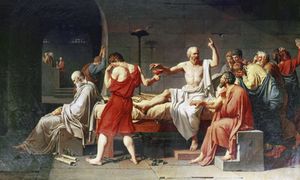
Soc Two thousand four hundred years ago, one man tried to discover the meaning of life. His search was so radical, charismatic and counterintuitive that he become famous throughout the Mediterranean. Men – particularly young men – flocked to hear him speak. Some were inspired to imitate his ascetic habits. They wore their hair long, their feet bare, their cloaks torn. He charmed a city; soldiers, prostitutes, merchants, aristocrats – all would come to listen. As Cicero eloquently put it, “He brought philosophy down from the skies.” For close on half a century this man was allowed to philosophise unhindered on the streets of his hometown. But then things started to turn ugly. His glittering city-state suffered horribly in foreign and civil wars. The economy crashed; year in, year out, men came home dead; the population starved; the political landscape was turned upside down. And suddenly the philosopher's bright ideas, his eternal questions, his eccentric ways, started to jar. And so, on a spring morning in 399BC, the first democratic court in the story of mankind summoned the 70-year-old philosopher to the dock on two charges: disrespecting the city's traditional gods and corrupting the young. The accused was found guilty. His punishment: state-sponsored suicide, courtesy of a measure of hemlock poison in his prison cell.

The man was Socrates, the philosopher from ancient Athens and arguably the true father of western thought. Not bad, given his humble origins. The son of a stonemason, born around 469BC, Socrates was famously odd. In a city that made a cult of physical beauty (an exquisite face was thought to reveal an inner nobility of spirit) the philosopher was disturbingly ugly. Socrates had a pot-belly, a weird walk, swivelling eyes and hairy hands. As he grew up in a suburb of Athens, the city seethed with creativity – he witnessed the Greek miracle at first-hand. But when poverty-striken Socrates (he taught in the streets for free) strode through the city's central marketplace, he would harrumph provocatively, “How many things I don't need!”

More here.

Revving up expression of a single gene in the brain reverses depression symptoms

From Nature:

Depress Gene therapy delivered to a specific part of the brain reverses symptoms of depression in a mouse model of the disease — potentially laying the groundwork for a new approach to treating severe cases of human depression in which drugs are ineffective. But the invasive nature of the treatment, and the notorious difficulty in translating neuropsychiatric research from animal models to humans, could complicate its path to the clinic. Many researchers believe that poor signalling of the neurotransmitter serotonin is responsible for causing depression, and common antidepressants act by increasing serotonin's concentration. Research published today in Science Translational Medicine1 uses a virus to deliver an extra dose of the gene p11 to the adult mouse brain. The protein expressed by the gene is thought to bind to serotonin receptor molecules and ferry them to the cell surface, positioning them to receive serotonin's signals from neighbouring cells.

“I think it awakens the possibility of gene therapy for neuropsychiatric diseases,” says Husseini Manji, a senior investigator at Johnson & Johnson Pharmaceutical Research & Development in Titusville, New Jersey, who was not involved in the study. But, he adds, “thinking about delivering a gene to the brain poses all sorts of challenges”.

More here.

Thursday Poem

Bastille Day

The first time I saw Paris
I went to see where the Bastille
had been, and though
I saw the column there
I was too aware that
the Bastille was not there:
I did not know how
to see the emptiness.
People go to see
the missing Twin Towers
and seem to like feeling
the lack of something.
I do not like knowing
that my mother no longer
exists, or the feeling
of knowing. Excuse me
for comparing my mother
to large buildings. Also
for talking about absence.
The red and gray sky
above the rooftops
is darkening and the inhabitants
are hastening home for dinner.
I hope to see you later.

by Ron Padgett
from Jacket Magazine, April 2005