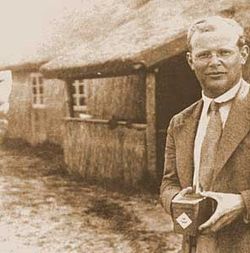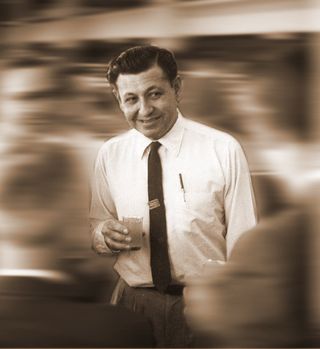
Of course, it’s even worse to know what the first line in your obit should be—and then not rate an obit at all, because people forgot you. Such was the fate of Albert Ghiorso (hard “g”), who helped discover more chemical elements, a dozen, than any human being who ever lived. Yet his death earned just three measly mentions in newspapers across the country (and those weeks after he died). I’d like to do the little I can to rectify that.
I wrote about Ghiorso in a recent book, and beyond the wizardry of his science, I remember most of all his mischief. He specialized in building radiation detectors that could pick out the presence of just a few atoms of new elements. The discovery of a new element was always a celebratory event—the periodic table is the most precious real estate in science—so during one experiment Ghiorso decided to wire his radiation detector to his building’s fire alarms at the University of California at Berkeley, so it would briiiiiing every time an atom appeared. For various reasons his team ran the experiment at night, and they cheered all through the a.m. as the atoms rang out. It was a complete success, except Ghiorso forgot to unwire the fire alarm the next morning. While he was at home sleeping, it went off during the day, forcing a panicked evacuation. The administration was not amused. In discovering a different element, berkelium, element 97, Ghiorso suggested using “Bm” as the chemical symbol for it, because it had been such a “stinker” to discover. To the eternal disappointment of every sophomore chemistry student in the world, the idea was vetoed.