pro cab

CALLOWAY-246x300

Few cinematic cameos have been more galvanizing than Cab Calloway’s in The Blues Brothers. In the 1980 film, he plays a janitor who suddenly dons white tie and tails, gets up on stage in front of an admiring group of long-haired rock and soul musicians, and proceeds to steal the show not only from its stars, Dan Aykroyd and John Belushi, but also from James Brown, Ray Charles, and Aretha Franklin, all of whom made cameo appearances of their own. How? By singing “Minnie the Moocher,” a swinging lament for an opium addict he had written a half-century earlier. Calloway, who was 73 years old in 1980, was little more than a name to the baby boomers who were seeing him for the first time. They had no idea how famous he had once been, or that the big band he led throughout the 30s and 40s was one of the most successful jazz groups of its day. Even those who were aware of Calloway’s triumphs as a bandleader had mostly been inclined to deprecate him. Only a limited number of his 78s had been transferred to LP by 1980, and it was common for jazz critics to dismiss him as a flamboyant clown, a zoot-suited purveyor of novelty tunes like “A Chicken Ain’t Nothin’ but a Bird.” It was conventional wisdom that Calloway’s “inane vocal antics” (in the phrase of the highbrow British jazz critic Max Harrison) served to obscure the playing of his sidemen, who included such world-class instrumentalists as the tenor saxophonist Chu Berry, the trumpeter Dizzy Gillespie, and the bassist Milt Hinton.

more from Terry Teachout at Commentary here.

roland’s most unusual work

TLS_Hanrahan_733425a

Kate Briggs’s wonderful translation finally makes available in English a most unusual book by one of the most significant literary figures of the twentieth century. The Preparation of the Novel comprises the notes of the third and last lecture course Roland Barthes delivered at the Collège de France, cut short in 1980 by his untimely death. Although the three lecture series were posthumously published in French in the order they were given, Columbia University Press have brought out the final course before the first one (How To Live Together, their translation of the second appeared in 2005) – an indication of just how intriguing a book this is. The uncertainty begins with the title. Is The Preparation of the Novel merely a course/class/series of lecture notes about the preparation of the novel, or is it also part of that preparation? From the outset, both interpretations are carefully invited: although Barthes denies, contrary to rumours circulating at the time, that he is writing a novel (and states that, if he were, he would not propose a course on its preparation), at the same time he acknowledges the deeply personal nature of the course’s origin and stresses that the “fantasy” it mobilizes is his own “Fantasy-of-the-Novel”. The ambiguity this creates about the book’s genre never disappears, reinforced by the contradictory positions adopted at different moments.

more from Mairéad Hanrahan at the TLS here.

Seeing Dubai Through a Cell Phone Camera

From Smithsonian:

Dubai In his new book, iDubai, Sternfeld has published scores of these photographs: an opulent chrome sports car awaits its valet parker outside the Kempinski Hotel; a model of downtown Dubai features red “sold” flags poking from the skyscrapers. Others feature aisles of colorful packaged goods, shopping carts overflowing with toys, and tourists bent intently over their own smart phones, oblivious to the nearby stranger photographing them with his. And yet Sternfeld says he came to feel a certain affinity. Some of the malls were “imaginative, interesting places” with a “dreamlike quality.” More important, they served a vital social role as town centers, places for friends and family to gather. And he often noticed scenes of paternal love—men eating with children at the food court, or pushing a stroller into a glass elevator, or, as on the opposite page, contemplating the wonders of an indoor ski slope—an aspect of the Arabic male he felt was underrepresented in Western media.

The photographs in iDubai are deeply ambivalent. The perversity of modernity, from Sternfeld’s point of view, is that even these moments of familial togetherness take place within a culture that is ultimately unsustainable and destructive. He has emphasized that iDubai is a criticism of globalized, and not Arab, consumerism; what he hopes for is a greater appreciation of what he sees as our shaky future.

More here.

Thursday Poem

First Lesson

Lie back, daughter, let your head
be tipped back in the cup of my hand.
Gently, and I will hold you. Spread
your arms wide, lie out on the stream
and look high at the gulls. A dead-
man’s float is face down. You will dive
and swim soon enough where this tidewater
ebbs to the sea. Daughter, believe
me, when you tire on the long thrash
to your island, lie up and survive.
As you float now, where I held you
and let go, remember when fear
cramps your heart what I told you:
lie gently and wide to the light-year
stars, lie back, and the sea will hold you.

by Philip Booth
from Strong Measures: Contemporary
American Poetry in Traditional Forms

Harper Collins 1986

How much sex is enough?

From PhysOrg:

Mouse2_0 Dr Renée Firman at the Centre for Evolutionary Biology, University of Western Australia, has used house mice to show that sperm from rival males compete to fertilise females and that, over several generations, polygamy can select for mice who produce more sperm, with stronger motility, than monogamous males. After 12 generations of competitive selection (polygamous) or relaxed selection (monogamous) female mice were mated twice, in succession, with males from both groups. While 53% of the litters had mixed paternity, 33% of litters were fathered by the polygamous males compared to 14% by monogamous males. Polygamous males retained this advantage regardless of whether they were mated first or second, demonstrating that the increased fitness applies to both offensive and defensive competition. The selection procedure had no obvious effect on male size or behaviour, nor did it affect female fertility.

So in the age old debate about the merits of monogamy versus polygamy is seems that, for male mice at least, the more partners you have the more fertile your offspring will be.

More here.

Wednesday, January 19, 2011

steve jobs and the liver theft

Jobs-liver-transplant

Given his symptoms, in the absence of further information, the most likely reason is recurrence or complications of his cancer. If that’s the case, then Jobs, having gamed the system to obtain a liver that could have saved somebody else, might soon take that liver to his grave. And he’s had it less than two years. Is this what’s now unfolding? We don’t know, because Jobs won’t tell us anything. “My family and I would deeply appreciate respect for our privacy,” he pleads. I hear you, Steve. We’re all pulling for you. It’s your life and your family. But that liver wasn’t yours. Somebody died to make it available. And other people who aren’t billionaires may have died on waiting lists so you could have it. What was your cancer situation when you got the transplant? Has the cancer returned? You owe us some answers.

more from William Saletan at Slate here.

the greatest New York novel

Criticschoices110117_books_560

New York is, famously, the everything bagel of megalopolises—one of the world’s most diverse cities, defined by its churning mix of religions, ethnicities, social classes, attitudes, lifestyles, etc., ad infinitum. This makes it a perfect match for the novel, a genre that tends to share the same insatiable urge. In choosing the best New York novel, then, my first instinct was to pick something from the city’s proud tradition of megabooks—one of those encyclopedic ambition bombs that attempt to capture, New Yorkily, the full New Yorkiness of New York. Something like, to name just a quick armful or two, Manhattan Transfer, The Bonfire of the Vanities, Underworld, Invisible Man, Winter’s Tale, or The Amazing Adventures of Kavalier & Clay—or possibly even one of the tradition’s more modest recent offspring, like Lush Life and Let the Great World Spin. In the end, however, I decided that the single greatest New York novel is the exact opposite of all of those: a relatively small book containing absolutely zero diversity. There are no black or Hispanic or Asian characters, no poor people, no rabble-rousers, no noodle throwers or lapsed Baha’i priests or transgender dominatrixes walking hobos on leashes through flocks of unfazed schoolchildren. Instead there are proper ladies behaving properly at the opera, and more proper ladies behaving properly at private balls, and a phlegmatic old Dutch patriarch dismayed by the decline of capital-S Society. The book’s plot hinges on a subtly tragic love triangle among effortlessly affluent lovers. It is 100 percent devoted to the narrow world of white upper-class Protestant heterosexuals. So how can Edith Wharton’s The Age of Innocence possibly be the greatest New York novel of all time?

more from Sam Anderson at New York Magazine here.

What makes a “picture”?

195_Sillman-Get-the-Moon_medium

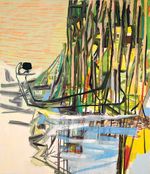
Amy Sillman and Tom McGrath are very different kinds of New York artists—Amy a modern-day action painter, Tom a new breed of realist—who share an ontological approach to the problem of pictorial staging: What is this thing I am making, they ask, and how can it be said to “represent” anything other than itself? Tom uses creamy, wet paint applied with directness and brio to depict more or less real places; Amy’s paintings, though populated with figures and figurative gestures, use the canvas as a workshop in which eccentrically shaped blocks of color are cobbled together in a kind of improvisational architecture, like memories of houses that you never actually lived in. Amy comes to us by way of abstraction, and over the past decade has been completely refurbishing the formal elements of painting: color, line, shape, and texture. Tom, a younger, cerebral artist, has established himself as an innovator by painting something that had not previously been considered a subject for art—the world viewed through the windshield of a car.

more from David Salle at Paris Review here.

“Spiritual Doorway in the Brain”

From Salon:

Brain We've all heard about the bright white light at the end of the tunnel, but what's really going on in a “near-death experience”? That's what neurologist and medical doctor Kevin Nelson tries to uncover in his first book, “The Spiritual Doorway in the Brain: A Neurologist's Search for the God Experience.” Dr. Nelson is one of the world's leading researchers in the biology of near-death and other mystical experiences, and his fascinating book takes the reader from investigations of MRI studies of the brain to historical anecdotes and philosophical inquiry. Three decades of research led Dr. Nelson to a unique and unexpected conclusion about near-death experiences — rather than arising from parts of the brain that are unique to higher cognitive functions, they actually involve the oldest, most primitive parts of our brain, and might also relate to having dreams while still awake.

What happens near death, and what does it have to do with God?

More here.

Wednesday Poem

Tao’s a bottomless well
ever used, never drawn down
Call it eternal no thing ness;
an infinite no thing filled with all;
a void of countless possibilities.
Tao is in our face
under our nose.
What made Tao is older than God.
What made it, who knows?
-Lao-Tzu in The Tao Te Ching


There is Nothing False in Thee

There is nothing false in thee.
In thy heart the youngest body
Has warmth and light.
In thee the quills of the sun
Find adornment.

What does not die
Is with thee.

Thou art clothed in robes of music.
Thy voice awakens wings.

And still more with thee
Are the flowers of earth made bright.

Upon the deeps the fiery sails
of heaven glide.

Thou art the radiance and the joy.
Thou heart shall only fail
When all else has fallen.

What does not perish
lives in thee.

by Kenneth Patchen
from Kenneth Patchen Selected Poems
Modern Library, 1937-1957

Single Worm Neurons Remotely Controlled with Lasers

From Scientific American:

Single-worm-neurons_1 Scientists have come a step closer to gaining complete control over a mind, even if that mind belongs to a creature the size of a grain of sand. A team at Harvard University has built a computerized system to manipulate worms—making them start and stop, giving them the sensation of being touched, and even prompting them to lay eggs, as seen in the video above—by stimulating their neurons individually with laser light, all while the worms swim freely in a petri dish. The technology may help neuroscientists for the first time gain a complete understanding of the workings of an animal's nervous system.

More here.

Good Manners in the Age of WikiLeaks

Slavoj Žižek in the London Review of Books:

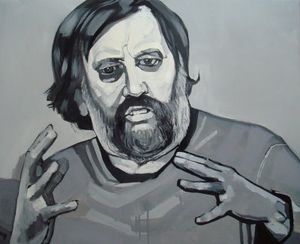
Zizek In one of the diplomatic cables released by WikiLeaks Putin and Medvedev are compared to Batman and Robin. It’s a useful analogy: isn’t Julian Assange, WikiLeaks’s organiser, a real-life counterpart to the Joker in Christopher Nolan’s The Dark Knight? In the film, the district attorney, Harvey Dent, an obsessive vigilante who is corrupted and himself commits murders, is killed by Batman. Batman and his friend police commissioner Gordon realise that the city’s morale would suffer if Dent’s murders were made public, so plot to preserve his image by holding Batman responsible for the killings. The film’s take-home message is that lying is necessary to sustain public morale: only a lie can redeem us. No wonder the only figure of truth in the film is the Joker, its supreme villain. He makes it clear that his attacks on Gotham City will stop when Batman takes off his mask and reveals his true identity; to prevent this disclosure and protect Batman, Dent tells the press that he is Batman – another lie. In order to entrap the Joker, Gordon fakes his own death – yet another lie.

The Joker wants to disclose the truth beneath the mask, convinced that this will destroy the social order. What shall we call him? A terrorist? The Dark Knight is effectively a new version of those classic westerns Fort Apache and The Man Who Shot Liberty Valance, which show that, in order to civilise the Wild West, the lie has to be elevated into truth: civilisation, in other words, must be grounded on a lie. The film has been extraordinarily popular. The question is why, at this precise moment, is there this renewed need for a lie to maintain the social system?

More here.

A new Supreme Court of Assholedom

Matt Taibbi in Rolling Stone:

ScreenHunter_09 Jan. 19 09.22 I want to create a new Supreme Court of Assholedom. Structured much like the actual U.S. Supreme Court, it will employ nine justices, whose job it will be to regularly preside over important cases of national social consequence — to wit, to decide a) whether or not a certain person is an asshole, and b) if he or she is, how much of an asshole.

The court will consider cases of all types. They will have titles ranging from things like United States v. Sarah Palin after the Tucson Shooting, to Taibbi v. Fat Guy in the Next Seat Who Monopolized the Whole Armrest on a Flight to Denver, to Humanity v. Anyone Who Has Ever Generated and/or Sent a Spam Message.

The court will focus particularly on establishing case law in those areas where existing laws don't apply. For instance, it's not against the law to be the highly-compensated attorney representing the Gigantic International Megabank that recently foreclosed on an old lady in suburban New Jersey because she entered one number incorrectly on one check for one monthly mortgage payment (there actually is such a case). That's not illegal, but if that's how you make your living — if you paid for your S-Class Mercedes helping Jamie Dimon and Lloyd Blankfein throw old ladies out of their houses — I'm pretty sure you're an asshole.

But how much of an asshole? That's an interesting question, and another one of the court's mandates. My idea is to create a points scale of 1 to 10,000, with one point meaning less of, to not at all of, an asshole and ten thousand points of course being a total asshole. Here we have a graph showing points A (100 points), B (5,000 points), and C (10,000 points) that will serve as the basic guideline for the court's deliberations…

More here.

Literature and Exile

A speech delivered by Roberto Bolaño in 2000 in Vienna. From The Nation:

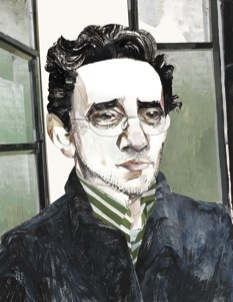
RobertoBolano I've been invited to talk about exile. The invitation I received was in English, and I don't speak English. There was a time when I did or thought I did, or at least there was a time, in my adolescence, when I thought I could read English almost as well, or as poorly, as Spanish. Sadly, that time has passed. I can't read English. By what I could gather from the letter, I think I was supposed to talk about exile. Literature and exile. But it's very possible that I'm completely mistaken, which, thinking about it, would actually be an advantage, since I don't believe in exile, especially not when the word sits next to the word “literature.”

It's a pleasure for me, I should say right away, to be with you here in the celebrated city of Vienna. For me Vienna is strongly associated with literature and with the lives of some people very near to me who understood exile in the way I sometimes understand it myself, which is to say, as life or as an attitude toward life. In 1978, or maybe 1979, the Mexican poet Mario Santiago spent a few days here on his way back to Israel. As he told it, one day the police arrested him and then he was expelled. In the deportation order, he was instructed not to return to Austria before 1984, a date that struck Mario as significant and funny and that today strikes me the same way.

More here.

Tuesday, January 18, 2011

europe hits the wall?

Questioning_wideweb__430x286 Samuel Abrahám: Multiculturalism was originally an affirmative term indicating the diversity of the “melting pot”. Today, however, it has come to be associated with ethnic ghettoes. Rather than celebrating difference and creating respect for pluralism, multiculturalism has brought new conflicts. Kenan Malik, what went wrong?

Kenan Malik: It seems to me that part of the problem is confusion over what we mean by multiculturalism. It can mean one of two things. First: diversity as lived experience. Second: multiculturalism as a political process. To talk of diversity as lived experience is to talk of the experience of living in a society that, through mass immigration, has become more open, more vibrant and more cosmopolitan. In that sense, the mass immigration of the past 50 years has been of great benefit, it seems to me. But multiculturalism as a political process has come to mean something very different, namely the process of managing that diversity by putting people into ethnic boxes. It's a process through which cultural differences are institutionalized, publicly affirmed, recognized and institutionalized; through which political policy is predicated on the ethnic box to which one belongs. That seems to me deeply problematic.

more from Kenan Malik and Fero Sebej at Eurozine here.

don’t criticize it…

Drugexperiment1__1295041698_3046

Faced with both a public health crisis and a public relations disaster, Portugal’s elected officials took a bold step. They decided to decriminalize the possession of all illicit drugs — from marijuana to heroin — but continue to impose criminal sanctions on distribution and trafficking. The goal: easing the burden on the nation’s criminal justice system and improving the people’s overall health by treating addiction as an illness, not a crime. As the sweeping reforms went into effect nine years ago, some in Portugal prepared themselves for the worst. They worried that the country would become a junkie nirvana, that many neighborhoods would soon resemble Casal Ventoso, and that tourists would come to Portugal for one reason only: to get high. “We promise sun, beaches, and any drug you like,” complained one fearful politician at the time. But nearly a decade later, there’s evidence that Portugal’s great drug experiment not only didn’t blow up in its face; it may have actually worked. More addicts are in treatment. Drug use among youths has declined in recent years. Life in Casal Ventoso, Lisbon’s troubled neighborhood, has improved.

more from Keith O’Brien at the Boston Globe here.

Tuesday Poem

Son From Dukathole

From Katlehong I come
by train not by taxi –
a taxi to Dukathole stops
anytime, anywhere, anyhow.
A train to Dukathole.

I’m an alien;
beings are made of dust,
smoke, noise here.

Planet Dukathole has an ear
of sound. Ghetto-blasters
compete with one another
blaring smoky hits,
blaring away poverty.
All is kwaito.
No kwasa-kwasa,
no mbaqanga,
no reggae and no
jazz.

I’m an alien,
children here have a group soul
and compound eyes.

They see all
at once – the alien,
dusty games,
smoky dances,
passers-by,
gangsters’ cars
zipping along.

Where is the house . . . ?
Even Phillip Tobias, cannot
dirt-read us.

I’m an alien here,
I can’t ask anyone.

“Eita Blazah!”
Their greetings
followed by whistles.

I don’t look back.

“For Reclamation, Blazah?”

Dusty footsteps; white noises.

by Angifi Dladla
from We Are All Rivers
Chakida Publishing, Katlehong, 2010

Friends connect on a genetic level

From Nature:

Friends Groups of friends show patterns of genetic similarity, according to a study published today in The Proceedings of the National Academy of Sciences1. The findings are based on patterns of variation in two out of six genes sampled among friends and strangers. But the claim is a hard sell for some geneticists, who say that the researchers have not analysed enough genes to rule out alternative explanations. The team, led by James Fowler, a social scientist at the University of California, San Diego, looked at the available data on six genes from roughly 5,000 individuals enrolled in unrelated studies, and recorded the variation at one specific point, or single nucleotide polymorphism (SNP), in each gene, and compared this between friends and non-friends.

After controlling for genetic likeness due to sex, age, race or common ancestry, friends still tended to have the same SNP at one position in a gene encoding the dopamine D2 receptor, DRD2. Friends also showed more variation at one position in a cytochrome gene, CYP2A6, than non-friends. An 'opposites attract' phenomenon may account for the variation in CYP2A6 among friends, say the authors. This result indicates that genetic patterns aren't always the result of friends who connect through similar activities, such as running marathons or playing musical instruments.

More here.

How fences could save the planet

Mark Stevenson in the New Statesman:

Kids-earth Nobody would blame you for being pessimistic about the future. After all, if you listen to the media (and, it seems, anybody over 25) we're all going to hell in the proverbial handcart, as the Four Horsemen of the Apocalypse – economic meltdown, climate change, terrorism and, who else, Simon Cowell – bear down on us.

But I have news. Some people are rather fed up of this narrative and are quietly getting on with solving the grand challenges our planet faces, using both new technologies and forgotten wisdom. Their mantra? “Cheer up, it might just happen.” I've spent the past 18 months researching a book about these people.

One of them is Tony Lovell, an accountant from Australia, where farming has become synonymous with drought. A decade of low rainfall, heatwaves and wildfires has scorched much of the land. Australians call it “the Big Dry” and it means that when the rains come – as they are doing now on the eastern seaboard – water runs over the parched surface, resulting in devastating floods. Many farms survive on “drought assistance” handed out by the government. Rural suicide is depressingly common.

Lovell thinks he has the answer. At a climate-change conference in Manchester, I find him talking about a new method of farming. “This is a typical ranch in Mexico,” he explains, showing an image of a terracotta dust bowl with bare, compacted soil. Then he puts up a second image of lush green vegetation. “This is the ranch next door. Same soil, same rainfall. These pictures were taken on the same day.”

More here.