3QD Arts & Literature Prize 2011 Finalists

Hello,

The editors of 3QD have made their decision. The twenty semifinalists have been winnowed down to six, and three wildcard entries added. Thanks again to all the participants.

Once again, Carla Goller has provided a “trophy” logo that our finalists may choose to display on their own blogs. And if you like our site, please do add us to your blogroll!

So, here it is, the final list that I am sending to Laila Lalami, who will select the 1st, 2nd, and 3rd prize winners: (in alphabetical order by blog name here)

  1. Finalist_2011_Arts2 3 Quarks Daily: Joothan: A Dalit's Life
  2. Accidental Blogger: The Leopard _ Giuseppe Tomasi Di Lampedusa
  3. Chapati Mystery: The Stay-at-Home Man
  4. Jadaliyya: The Poetry of Revolt
  5. Millicent and Carla Fran: Why Don't Women Submit?
  6. Sepia Mutiny: Letter to a Young Islamophobe
  7. The Millions: Her Story Next to His: Beloved and The Odyssey
  8. The Millions: Reading and Race: On Slavery in Fiction
  9. Writing Without Paper: Consider the Pomegranate

We'll announce the three winners on March 21, 2011.

Good luck!

Abbas

P.S. The editors of 3QD will not be making any comments on our deliberations, or the process by which we made our decision, other than to simply say that we picked what we thought were the best posts out of the semifinalists, and added three others which we also liked.

Saturday, March 12, 2011

Why Angry Birds is So Successful and Popular: A Cognitive Teardown of the User Experience

1-birds Charles L. Mauro over at Pulse>UX blog (h/t Jennifer Ouellette):

The usual question: Over the past 30+ years as a consultant in the field generally known as human factors engineering (aka usability engineering), I have been asked by hundreds of clients why users don’t find their company’s software engaging. The answer to this persistent question is complex but never truly illusive. This question yields to experience and professional usability analysis.

The unusual question: Surprisingly, it is a rare client indeed who asks the opposing question: why is an interface so engaging that users cannot stop interacting with it? This is a difficult question because it requires cognitive reverse engineering to determine what interaction attributes a successful interface embodies that result in a psychologically engaging user experience. This question pops up when products become massively successful based on their user experience design – think iPhone, iPad, Google Instant Search, Nintendo Wii, Microsoft Kinect.

The interesting question: Recently clients have asked about the phenomenally successful casual computer game Angry Birds, designed for mobile phones, tablets and other platforms. For those who don’t have a clue what Angry Birds is all about, here is a quick synopsis. The game involves employing a sling shot to propel small cannonball-shaped birds with really bad attitudes at rather fragile glass and timber houses populated by basically catatonic green pigs. The basic thrust of the game is to bring about the demise of the pigs as quickly and expertly as possible by collapsing the pigs’ houses on top of their (sometimes) helmeted heads. Obviously, this sounds like a truly dumb concept. However, there is a catch.

Why is it that over 50 million individuals have downloaded this simple game? Many paid a few dollars or more for the advanced version. More compelling is the fact that not only do huge numbers download this game, they play it with such focus that the total number of hours consumed by Angry Birds players world-wide is roughly 200 million minutes a DAY, which translates into 1.2 billion hours a year. To compare, all person-hours spent creating and updating Wikipedia totals about 100 million hours over the entire life span of Wikipedia (Neiman Journalism Lab). I say these Angry Birds are clearly up to something worth looking into. Why is this seemly simple game so massively compelling?

The Battle for Libya

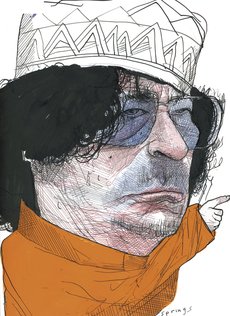
Qaddafi_muammar-040711_jpg_230x867_q85 Nicolas Pelham in the NYRB:

Tucked between the Mediterranean and the Sahara, the Libyan town of Brega was a rather somnolent back-of-the-beyond place on the Gulf of Sidra in the north of the country. Oil workers went there for its high wages and decent schools—an engineer at the Sirte Oil Company earned ten times more than his counterpart in the armed forces.

No longer. Brega, which sits on an oil lake, has become a battlefield in the fight against the government of Colonel Muammar Qaddafi. Bombs drop among oil depots filled with hundreds of thousands of barrels, and in the past two weeks, the company managers have had to deal with four changes of regime. To hedge bets they keep in touch with both the rebels in Benghazi, to the east, and the Qaddafi regime in Tripoli, to the west.

The battle for Brega and a nearby but larger terminal, Ras Lanuf, has significantly upped the stakes in Libya’s conflict. It is being fought halfway between Colonel Qaddafi’s tribal heartland of Sirte and the rebel base in Benghazi, a city of 800,000, and has drawn traditional desert tribes into the revolution, including the large Maghraba and Zawiya clans, on whose coastal scrubland Brega lies. It also threatens to draw in an outside world jittery that southern Europe’s nearest oil supplies are now jeopardized.

On March 10, Qaddafi launched a blistering counterattack on Ras Lanuf, dropping bombs among the vast oil kettles and darkening the sky with burning kerosene. The volunteers shot back with their small antiaircraft guns at the invisible whoosh of fighter jets, but many were forced to retreat. The colonel’s aerial and tank bombardment was slowing, if not stopping, the advance. As the fighting intensifies, those of the rebel forces that, until now, stayed on the sidelines are rapidly being drawn into the conflict. Away from the front many are unsettled with fear. What if the weapons turn out to be chemical weapons, asks a Benghazi shopkeeper. Was it worth it?

I found you in the form of a large cold cooked chicken

828faba6-4b87-11e0-89d8-00144feab49a

The marriages of poets rarely present an encouraging picture. Penelope Gilliatt once wrote one of her lacerating short stories about a poet’s wife in a Northumbrian cottage. She slowly sinks into despair at living with “his visions of moral order in biology and the superior integrity of sap, expressed in a thin precise style like the print of a hopping bird in snow”, until she finally reveals all in a television profile and they separate. The real-life records of the partnerships embarked upon by Ted Hughes, Ezra Pound, Robert Lowell or TS Eliot (first time round) are hardly more encouraging. And few observers would have given much of a chance to the union between the 52-year-old WB Yeats and 24-year-old Bertha Georgie Hyde-Lees, when they emerged from London’s Harrow Road register office in 1917. Yet it was the foundation of an enduring and loving partnership, which anchored his life until his death 22 years later, and it famously also brought him new insights and a new kind of collaboration through psychical research. The importance of Yeats’s marriage to his poetry has come more and more clearly into focus with the publication of full and authorised biographies, using a great hoard of family letters as well as Yeats’s correspondence with his vast range of friends and acquaintances, slowly appearing in immaculately edited volumes from Oxford University Press under John Kelly’s general editorship.

more from Roy Foster at the FT here.

the information

The-Information-Gleick-James-9780307914965

Partway through “The Information: A History, a Theory, a Flood,” James Gleick describes a technological innovation so transformative that it was heralded as “one of the grand way-marks in the onward and upward march of the human intellect” by the New York Times. “What was the essence of the achievement?” Gleick asks. “‘The transmission of thought, the vital impulse of matter.’ The excitement was global but the effects were local. … Information that just two years earlier had taken days to arrive at its destination could now be there — anywhere — in seconds. This was not a doubling or tripling of transmission speed; it was a leap of many orders of magnitude. It was like the bursting of a dam whose presence had not even been known.” Sound familiar? It should. The telegraph, after all, changed everything when it was popularized in the 1840s; by 1858, a transatlantic cable had put Britain’s Queen Victoria and President James Buchanan in direct contact, while news, gossip and commercial orders blazed across the wires. “Some worried that the telegraph would be the death of newspapers,” Gleick writes, although “newspapers could not wait to put the technology to work.” All of a sudden, information was not just a tool but also a commodity. “Because the telegraph was an information technology,” he posits, “it served as an agent of its own ascendency.” The story of the telegraph is central to “The Information,” which is a wide-ranging, deeply researched and delightfully engaging history — going back to Homer and Socrates (who distrusted written language as a corruption of pure memory) and extending, in loosely chronological fashion, to our contemporary culture of downloads and data clouds — of how we have come to occupy a world defined in bits and bytes.

more from David L. Ulin at the LAT here.

nagel on brooks

The_social_animal_brooks_torrent

Still, even if empirical methods enable us to understand subrational processes better, the crucial question is, How are we to use this kind of self-understanding? Brooks emphasizes the ways in which it can improve our prediction and control of what people will do, but I am asking something different. When we discover an unacknowledged influence on our conduct, what should be our critical response? About this question Brooks has essentially nothing to say. He gives lip-service to the idea that moral sentiments are subject to conscious review and improvement, and that reason has a role to play, but when he tries to explain what this means, he is reduced to a fashionable bromide about choosing the narrative we tell about our lives, “the narrative we will use to organize perceptions.” On what grounds are we supposed to “choose a narrative?” Experiments show that human beings feel greater sympathy for those who resemble them — racially, for example — than for those who do not. How do we know that it would be better to counter the effects of this bias rather than to respect it as a legitimate form of loyalty? The most plausible ground is the conscious and rational one that race is irrelevant to the badness of someone’s suffering, so these differential feelings, however natural, are a poor guide to how we should treat people. But reason is not Brooks’s thing: he prefers to quote a little Sunday school hymn about how Jesus loves the little children, “Be they yellow, black or white / they are precious in his sight.” This is an easy case, but harder ones also demand more reflection than he has time for. Brooks is right to insist that emotional ties, social interaction and the communal transmission of norms are essential in forming individuals for a decent life, and that habit, perception and instinct form a large part of the individual character. But there is moral and intellectual laziness in his sentimental devaluation of conscious reasoning, which is what we have to rely on when our emotions or our inherited norms give unclear or poorly grounded instructions.

more from Thomas Nagel at the NYT here.

England ‘healthier than the US’

Michelle Roberts at the BBC:

ScreenHunter_02 Mar. 12 14.02 People living in England enjoy better health than Americans, despite less investment in healthcare, research published in the US has revealed.

Across all ages, US residents tend to fare worse in terms of diabetes, high cholesterol and heart disease markers, data on over 100,000 people show.

The reason remains a mystery, says the US team, and challenges the idea that resources necessarily improve health.

It may be due to the UK's bigger drive on disease prevention, they say.

More here.

Dear Dad, With Love

David Kroll in Take As Directed:

ScreenHunter_01 Mar. 12 13.52 Today marks 12 years since you died.

Well, it might have been today, possibly yesterday, I hope not too many days ago.

You see, you died alone in your apartment you rented from your sister downstairs. Yet no one checked on you as your mail accumulated Monday and Tuesday. One of your drinking buddies from the Disabled American Veterans post told me proudly at your funeral that he probably had with you your last beer that Saturday night. So, maybe it was the 8th or 9th?

When I think back, though, I believe you died some eight years earlier, just after your 50th birthday party. For your wife, my Mom, it was even long before that – she is a saint for staying with you as long as she did – no offense, Dad – and I know she still loves you no matter what.

Our family runs rich with depression and alcoholism but you died exceptionally early; my Dad – the young, fit, handsome fella you were in those pictures with little me at the Jersey shore, at home, or with me in that horrible Easter outfit – had died back then and was replaced for the last eight, ten, fourteen years by someone else.

More here.

Saturday Poem

Overland to the Islands

Let's go—much as that dog goes,
intently haphazard. The
Mexican light on a day that
'smells like autumn in Connecticut'
makes iris ripples on his
black gleaming fur—and that too
is as one would desire—a radiance
consorting with the dance.
Under his feet
rocks and mud, his imagination, sniffing,
engaged in its perceptions—dancing
edgeways, there's nothing
the dog disdains on his way,
nevertheless he
keeps moving, changing
pace and approach but
not direction—'every step an arrival.'

by Denise Levertov
from Overland to the Islands
publisher: Jonathan Williams, 1958

Plasticize Me

From Guernica:

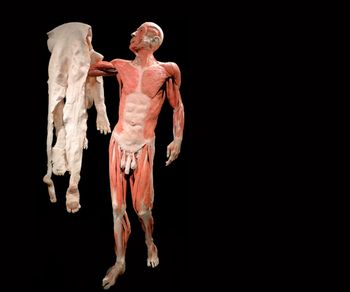
Manseau-575 Questions concerning the ethical treatment of the dead have been with us at least since Sophocles, for whom a single act of leaving a corpse unburied brought mayhem that threatened the stability of society. In Antigone, the punishment King Creon gives to the murdered Polynices is so severe that it extends beyond the limits of life. According to Polynices’s sister Antigone, death is only the beginning of the torments a body can face: “As for the hapless corpse of Polynices, it has been published to the town that none shall entomb him or mourn, but leave him unwept, unsepulchred, a welcome store for the birds, as they espy him, to feast on at will.”

For Sophocles, to leave the dead unburied is an insult not just to the deceased or his family, but to the gods. That proper treatment should be given to human remains, Antigone insists, is among “the unwritten and unfailing statutes of heaven.” She defies the state and risks her life in the attempt to see these statutes carried out, and calls upon others to do the same, even asking her reluctant sister, “Will you aid this hand to lift the dead?”

More here.

How to Memorize Everything

From The New York Times:

Horowitz-popup When we meet Joshua Foer, his memory is “nothing special.” A year later, he is able to memorize the order of a shuffled deck of cards in less than two minutes and the names of 99 people he’s just met. He has also etched in his brain images of his friend urinating on Pope Benedict’s skullcap, of Rhea Perlman involved in indelicate acts with Manute Bol, and of other things most of us would try hard to forget. Let it never be claimed that there is no cost to self-improvement.

A mere millennium ago, being able to remember and recite a text verbatim was not a game or a party trick. It was an art. More than that, it was part of being cultured: a person without memory was a person without ethics or humanity. Today, memorization is limited to Shakespeare monologues and Robert Frost poems in high school. Phone numbers and friends’ birthdays are “remembered” by cellphones and computers. Indeed, much of our daily memory has been offloaded onto external devices. The advantage to this is clear: information is portable and searchable, and not taking up valuable space in our noggins. Until you lose your iPhone.

More here.

3QD Arts & Literature Prize 2011 Semifinalists

Hello,

The voting round of our Arts & Literature prize (details here) is over. A total of 1,516 votes were cast for the 70 nominees (click here for full list of nominees). Thanks to the nominators and the voters for participating.

Carla Goller has designed a “trophy” logo that our top twenty vote-getters may choose to display on their own blogs. So here they are, in descending order from the most voted-for:

  1. Semifinalist_2011_Arts Tolstoy Is My Cat: Flash Fiction: Snow
  2. The Millions: Reading and Race: On Slavery in Fiction
  3. The Millions: Brideshead Revisited
  4. Jadaliyya: The Poetry of Revolt
  5. Accidental Blogger: The Leopard _ Giuseppe Tomasi Di Lampedusa
  6. Plum: Hair Myth
  7. The Millions: Her Story Next to His: Beloved and The Odyssey
  8. The Millions: Beyond Harry, Oz, and Narnia: Lev Grossman’s The Magicians
  9. The Millions: On Bad Reviews
  10. 3 Quarks Daily: New York’s Empire State of Mind: The Colonization of ‘Up’ Part I
  11. The Millions: Chasing the Whale: Banksy, Obsession, and the Sea
  12. Fernham: Pearls and Power
  13. Stuck In A Book: Is there no balm in…
  14. Millicent and Carla Fran: On The Face That Launched a Thousand Clicks, Or What The Social Network Isn’t About
  15. Millicent and Carla Fran: Why Don't Women Submit?
  16. 3 Quarks Daily: Joothan: A Dalit's Life
  17. Chapati Mystery: The Stay-at-Home Man
  18. M. A. Peel: Oh Frabjous Day: Woolverton's FanFic Love for Alice
  19. Writing Without Paper: Consider the Pomegranate
  20. The Millions: The Sorry State of the Rejection Letter

The editors of 3 Quarks Daily will now pick the top six entries from these, and after possibly adding up to three “wildcard” entries, will send that list of finalists very soon to Laila Lalami. We will also post the list of finalists here then.

Good luck!

Abbas

Friday, March 11, 2011

Dancing Around the Flame

Binayaksenlarge Madhusree Mukerjee in Dissent:

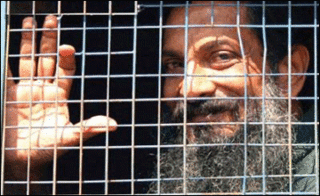
ON CHRISTMAS Eve, 2010, an Indian court sentenced Binayak Sen, a doctor who has for decades given medical care to indigenous people in forests of central India, to life imprisonment for sedition and conspiracy. Sen’s real crime was to have investigated and publicized the forced expulsion, accompanied by killing, rape, torture, and house-burning, of about 350,000 aboriginal villagers in a state-sponsored campaign against Maoist guerillas. Months earlier, policemen had shot dead Maiost leader Cherukuri “Azad” Rajkumar, who had emerged from his jungle hideout to engage in peace talks with the Indian government; a journalist accompanying him was also killed. The close range from which the shots were fired point to murders in custody. (According the Asian Centre for Human Rights, the Indian administration reports the deaths, in police and judicial custody, of more than 1,500 prisoners each year, and the number has increased steeply in recent years.) In October 2009, when security forces razed the village of eighteen-month-old Katam Suresh, they chopped off three of his fingers and killed his mother, grandmother, grandfather, and eight-year-old aunt. His twenty-year-old father was saved by being away. But this January, possibly because their names had featured in a court petition filed by human rights workers, the boy and his father were taken away by the police. Both remain missing.

Why is the world’s largest democracy “killing its own children,” as a judge on India’s Supreme Court recently remarked? There are several answers, but when it comes to the jungles of central India, most observers point to a 2009 statement by Prime Minister Manmohan Singh: “if [Maoist] extremism continues to flourish in important parts of our country which have tremendous natural resources of minerals and other precious things, that will certainly affect the climate for investment.” Almost all of India’s Maoist guerillas are indigenous people who shelter in rugged terrain that is rich in minerals and water. As the state fights them back, it appears to be clearing the land of residents in order to access these resources—and motivating ever more of the dispossessed to join the insurgency in the process. The real reason behind India’s worsening human rights record could be the investment boom and resource rush that underpin its explosive economic growth.

Crazy Talk and American Politics: or, My Glenn Beck Story

Photo_10229_landscape_large Frances Fox Piven in The Chronicle of Higher Education:

Most academics probably paid little attention at the end of January when Glenn Beck explained to his listeners that the protests in Egypt would lead to the establishment of a Muslim caliphate that would engulf Europe while China would extend its domination to New Zealand and, curiously, the Netherlands would fall to Russia. But there is a sense in which we should have.

Glenn Beck claims about two million daily viewers on his TV show, and that in addition to a three-hour radio program, best-selling books, and an Internet “news” site known as The Blaze. True, for more than a year his ratings have been falling from their peak of three million daily viewers. But millions continue to turn to this Fox News personality for an interpretation of their world, and the interpretation they get is lunacy.

Propaganda and its place in American politics is not my academic specialty. But I have been prodded to think about it a lot in recent months because I have been made into a central character in Beck's stories about the evils that have befallen America.

According to Beck, I—together with my husband, Richard Cloward, with whom I frequently collaborated before his death—am the proponent of a theory of “orchestrated crisis” that lies behind an array of threats to American society, including the emergence of Students for a Democratic Society, Acorn, George Soros and the Open Society Institute, the New York City fiscal crisis, the election of Barack Obama, and the recent financial meltdown.

The plan for all that is said to have been laid out in an article we published in The Nation magazine in 1966 and, according to right-wing blogs and those who post on them, the influence of our plan is evident everywhere in American politics and public policy, but especially in the Obama administration.

Online posters eagerly identify the connecting threads that depict me as puppet master: I taught at Columbia University when Obama was a student there, and I probably taught him. I spoke at a conference in the 1980s that he probably attended. I was on Obama's transition team. Obama's policies, and especially health-care reform, are obviously a plan to implement my crisis strategy.

None of that is true, of course. So what was this strategy that excites such paranoid imaginings?

Popular Philosophy and Kuhn’s Ashtray

John Holbo over at the Crooked Timber (which for a long time I have look at every morning before I look at the New York Times):

I’ve enjoyed the Kuhn’s Ashtray series (to which my attention was drawn by our Kieran). It has a lot of good points and I’m basically sympathetic to Morris’ skepticism about Kuhn; but, all the same, this may be the moment to nip a pernicious new literary sub-genre in the bud. Wittgenstein’s Poker. Kuhn’s Ashtray. The trope: philosopher reduced to inarticulacy by devastating objection exhibits instability of character by resorting to ineffective physical violence. What’s next? Kant’s Mustard Pestle? Hume’s Sock Full of Pennies? It’s funny until someone gets hurt.

More seriously, there is a problem in Morris’ series that you get a lot in popularizations of intellectual controversies, when you are trying to convey the gist of an allegedly devastating objection to someone’s position. In this case it goes like so: Kuhnian incommensurability is self-undermining. If the view makes sense, then the view says we can’t attain to the vantage point we would need to achieve the view, so it doesn’t make sense.

But a popular, simplified account of the anti-Kuhn argument shouldn’t make it sound as thought the popular, simplified version of the anti-Kuhn argument itself – as opposed to the more sophisticated thing it is simplified down from – is sufficient to knock the actual Kuhn, as opposed to the simplified-for-the-NY-Times Kuhn. It isn’t as though Kuhn had just never heard this objection, before a youthful Morris brought it up.

Of course, if someone threw an ashtray at my head, I might not be feeling intellectually charitable either.

bad shapes that mean nothing

2490366778_6d833716b2

There are stories about the rising jets of steam, that they are the ghosts of old Masai warriors trying to make their way to heaven, and being pulled back, by the gravity of hell. I heard them come in last night, the Masai moran, and their cattle. The strong smell of urine and dung flooded our house; and old throaty songs, and the cowbells. They sang the whole night, and for a while I could pretend that time had rolled back, and I sat among them, as a biblical nomad, or much as my great-grandparents would have. I decide to spend some days travelling around, to avoid my parents, to follow a road and think about things other than what is wrong with my life. What a wonderful thing, I think, if it was possible to spend my life inhabiting the shapes and sounds and patterns of other people.

more from Binyavanga Wainaina at Granta here.

The Most Conceited of Cities

Barcelona at Night

One of the innumerable ways of differentiating large cities would be to divide them into the boastful and the conceited, in the certain knowledge that there isn’t a city in the world that doesn’t fit one of those two categories. It might seem, at first sight, that the categories are too alike, inhabit the same semantic area—that the frontier between them is too blurred and therefore pointless. For me, though, there is a big difference, which has to do above all with character, because ultimately it is character, far more than the look of a place or the customs of its inhabitants, that leaves its mark on you as visitor and stays with you when you leave. Boastful cities tend to be insecure, child-like, and chatty (even vociferous), unenigmatic and exhausting, impatient places eager for praise and in a hurry to captivate. If you don’t watch out, they’ll take you off on a tour, or plunge you into the hustle and bustle, and thus not allow you, as a visitor, to go poking around on your own account and at your own pace; they’ll try by every means possible, however disrespectful or loutish, to impose their own wishes on anyone who dares to tread their streets. In other words, they try to draw you in, to subdue and overwhelm you.

more from Javier Marías at Threepenny Review here.

too much bishop for bishop

Bernard_1-032411_jpg_190x660_q85

One wishes only to celebrate the twin volumes of Elizabeth Bishop’s poems and prose, published this year to mark the centenary of her birth. Bishop was one of the great artists of the twentieth century; her poems now tower over the landscape alongside those of Eliot and Stevens. Before her death in 1979, her sex and her distinctive tones of modesty and good humor may have misled all but her best readers into thinking of her as a minor poet. But by the mid-1980s, when her longtime editor Robert Giroux published the first comprehensive volumes of her poetry and prose, the authority and scope of her work became fully apparent. Modesty and mastery went hand in hand; good humor was the useful conveyance of profound and often shattering wisdom. It is no exaggeration to say that her poems get larger and stranger and more overwhelming with every reading. But there is a vexing problem that these new editions raise. One might call it the new biographical fallacy, born of this age of too much information. If the old biographical fallacy was the use of the life of the artist to interpret the work, the new biographical fallacy results from the impulse to lumber an artist’s work with the detritus, literary and otherwise, of the artist’s life. Correspondence, diaries, jottings, drafts, interviews—the stuff of a life in letters—are piled up for consideration, not just in the relatively circumscribed and well-understood havens of biography or critical study, but in published volumes of what is called the author’s work.

more from April Bernard at the LRB here.