Indian History Happens Elsewhere. In Chicago, For Instance

Authorphoto_1 Amitava Kumar in Indian Site:

“I am an American, Chicago born – Chicago, that somber city…” That was Saul Bellow in The Adventures of Augie March, introducing us to a city in motion, a city made of immigrants whose energy, and whose words, the stories that they forged for themselves, were changing America. But Bellow’s first-generation immigrants and even their offspring spoke with “an unerasable Yiddish twang”. His Chicago wasn’t made up of Indians or Pakistanis or Sri Lankans or Bangladeshis, the mixed nation of what one desi rapper has called “oblique brown.” But they are there, and from this distance they are shaping events, for good and for bad, in their homelands too.

For the past several days, I have been following the tweets of reporters inside the Chicago courtroom where former Pakistani Army doctor Tahawwur Rana was standing trial. Late last evening there was a tweet from Chicago Sun-Times reporter Rummana Hussain: “#Ranatrial: There is a verdict!”

The jury was split. It found Rana guilty of providing material support to Lashkar-e-Taiba as well as participating in the conspiracy to commit terrorist acts against the Danish newspaper that printed cartoons of the Prophet Muhammad. However, the jury acquitted Rana of what might be regarded as the principal charge, of involvement in the November 2008 attacks on Mumbai.

Questioning “Social Contagion”

110630_SCI_christakis_fowlerTN Dave Johns in Slate:

Have you heard that divorce is contagious? A lot of people have. Last summer a study claiming to show that break-ups can propagate from friend to friend to friend like a marriage-eating bacillus spread across the news agar from CNN to CBS to ABC with predictable speed. “Think of this 'idea' of getting divorced, this 'option' of getting divorced like a virus, because it spreads more or less the same way,” explained University of California-San Diego professor James Fowler to the folks at Good Morning America.

It's a surprising, quirky, and seemingly plausible finding, which explains why so many news outlets caught the bug. But one weird thing about the media outbreak was that the study on which it was based had never been published in a scientific journal. The paper had been posted to the Social Science Research Network web site, a sort of academic way station for working papers whose tagline is “Tomorrow's Research Today.” But tomorrow had not yet come for the contagious divorce study: It had never actually passed peer review, and still hasn't. “It is under review,” Fowler explained last week in an email. He co-authored the paper with his long-time collaborator, Harvard's Nicholas Christakis, and lead author Rose McDermott.

A few months before the contagious divorce story broke, Slate ran an article I'd written based on a related, but also unpublished, scientific paper. The mathematician Russell Lyons had posted a dense treatise on his website suggesting that the methods employed by Christakis and Fowler in their social network studies were riddled with statistical errors at many levels. The authors were claiming—in the New England Journal of Medicine, in a popular book, in TED talks, in snappy PR videos—that everything from obesity to loneliness to poor sleep could spread from person to person to person like a case of the galloping crud. But according to Lyons and several other experts, their arguments were shaky at best. “It's not clear that the social contagionists have enough evidence to be telling people that they owe it to their social network to lose weight,” I wrote last April. As for the theory that obesity and divorce and happiness contagions radiate from human beings through three degrees of friendship, I concluded “perhaps it's best to flock away for now.”

The Death Throes of Franco: Spain’s New Reckoning with the Dictatorship and Civil War

Franco-spanishcivilwar-jd Julián Casanova in Eurozine:

The arrival of a socialist government under José Luís Rodríguez Zapatero opened a new era. For the first time in the thirty-year-old democracy, politics was to take the initiative in redressing this historic injustice. This was the prime significance of the bill introduced at the end of July 2006, later to be known as the Ley de Memoria Histórica (The Historical Memory Act). This led to memory being discussed more openly than ever before, and the past was to become a lesson for the present and the future. The bill did not deal with different interpretations of the past: it was not trying to define responsibility or point the finger of guilt. Nor did it propose a Truth Commission, as had been set up in other countries to register the mechanisms of death, violence and torture and identify the victims and their executioners.

Even so, it provoked strong reaction from the opposition Right (Mariano Rajoy, the leader of the PP, stated that his party would repeal the Act if it came to power), the Catholic Church and its media outlets. Esquerra Republicana (the Catalan Republican Left party) rejected it because it failed to call for the quashing of Francoist trials, while the moderate Basque and Catalan nationalists also imposed their conditions: the former requiring the return of Basque government documents held in the Archive at Salamanca, the latter calling for clearer acknowledgement of crimes and violence on the Republican side.

Spanish democracy needed this act, which was finally passed on 31 October 2007, and while it did not go far enough, it did open new avenues for moral redress and legal and political recognition for the victims of the Civil War and Francoism.

Saving Affirmative Action from Itself

Affirmativeaction2 Nicolaus Mills in Dissent:

THESE DAYS the future of affirmative action in higher education is in jeopardy. A series of states—among them Michigan, California, Florida, Nebraska, and Arizona—have banned the consideration of race, ethnicity, or gender by any unit of state government, including public colleges and universities. As a result, state-run institutions of higher education with the greatest capacity for accepting minorities are increasingly less able to do so.

Nor can these institutions turn to the public for support on affirmative action. By a 55-to-36 percent margin voters believe affirmative action should be abolished altogether, and by a 61-to-33 percent margin they oppose affirmative action for blacks in hiring, promotion, and college entry, according to a 2009 Quinnipiac University poll.

This negative view of affirmative action in higher education can, in part, be explained by the rightward shift of the country since 1980 and the pressures the current recession has put on state budgets. But even more important is the way in which affirmative action has strayed from its 1960s roots and lost sight of its own history.

Today, the only way affirmative action in higher education can save itself from losing still more public support is for it to become far more inclusive in practice. It needs to reach high-school students who for a variety of reasons—not just because of their race or ethnicity—have been disadvantaged in the struggle to get into college.

Soft-drink Cans Beat the Diffraction Limit

News406-i0.1 Jon Cartwright over at Nature News [h/t: Jennifer Ouellette:

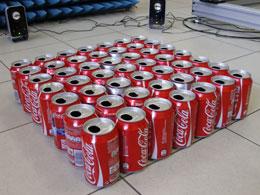
Sound, like light, can be tricky to manipulate on small scales. Try to focus it to a point much smaller than one wavelength and the waves bend uncontrollably — a phenomenon known as the diffraction limit. But now, a group of physicists in France has shown how to beat the acoustic diffraction limit — and all it needs is a bunch of soft-drink cans.

Scientists have attempted to overcome the acoustic diffraction limit before, but not using such everyday apparatus. The key to controlling and focusing sound is to look beyond normal waves to 'evanescent' waves, which exist very close to an object's surface. Evanescent waves can reveal details smaller than a wavelength, but they are hard to capture because they peter out so quickly. To amplify them so that they become detectable, scientists have resorted to using advanced man-made 'metamaterials' that bend sound and light in exotic ways.

Some acoustic metamaterials have been shown to guide and focus sounds waves to points that are much smaller than a wavelength in size. However, according to Geoffroy Lerosey, a physicist at the Langevin Institute of Waves and Images at the Graduate School of Industrial Physics and Chemistry in Paris (ESPCI ParisTech), no one has yet been able to focus sound beyond the diffraction limit away from a surface, in the 'far field'. “Without being too enthusiastic, I can say [our work] is the first experimental demonstration of far-field focusing of sound that beats the diffraction limit,” Lerosey says.

Steven Kaplan on the History of Food

Food-jesus_0 Over at The Browser's Five Books:

[L]et’s get started by talking about your first book, Capitalism and Material Life by Fernand Braudel. I don’t think he would have seen his work in the context of the history of food necessarily – is that right?

No, he certainly did not see this as a history of food – and I don’t see this as being food history, in any narrow way. It is, however, one of the books that has most shaped my perspective on how to think about the history of food, and that’s why I chose it. In the 1950s and 60s, Braudel talked about “total history” – in ways that now seem both quaint and megalomaniacal. “Total history” meant trying to look across the long run (in French, the longue durée) at all the aspects of the human experience. Braudel began this study by talking about “capitalism and material life,” because for the 400-year eco-cycle that he was looking at, the driving force for much of material life was the development of capitalism, and material life was to a great extent about eating and clothing and shelter (in that order). He’s talking about the basics of what makes a society and an economy operate, he’s talking already in the 1960s, when he wrote this book, about what we today call globalisation, and he’s enormously interested in what I call the construction of the everyday order, or what we could call the banality of things – that is to say, the everyday life that people struggle to get by in.

What’s really interesting about all this is that Braudel is constantly talking about the way in which the fundamentals of material life really begin with food. For me, this is a very powerful story, because it’s a story about how societies are organised in ways that permit them to reproduce themselves; permit them to overcome horrors like the Black Death – in which a third of the European population is wiped out – and to overcome the famines that are structurally inscribed in the nature of things, and to develop systems of exchange through markets that acquire relative sophistication. These are the kinds of questions that historians (even historians of food) tend frequently not to think about, because they’re really the big, structural questions.

Insight: A Conversation with Gary Klein

From Edge:

Klein300 [GARY KLEIN:] What's the tradeoff between people using their experience (people using the knowledge they've gained, and the expertise that they've developed), versus being able to just follow steps and procedures? We know from the literature that people sometimes make mistakes. A lot of organizations are worried about mistakes, and try to cut down on errors by introducing checklists, introducing procedures, and those are extremely valuable. I don't want to fly in an airplane with pilots who have forgot their checklists, and don't have any ways of going through formal procedures for getting the planes started, and handling malfunctions, standard malfunctions. Those procedures are extremely valuable, and I don't doubt any of that. The issue is how does that blend in with expertise? How do people make the tradeoffs when they start to become experts? And does it have to be one or the other? Do people either have to just follow procedures, or do they have to abandon all procedures and use their knowledge and their intuition? I'm asking whether it has to be a duality. I'm hoping that it doesn't and this gets us into the work on system one and system two thinking.

System one is really about intuition, people using the expertise and the experience they've gained. System two is a way of monitoring things, and we need both of those, and we need to blend them, and so it bothers me to see controversies about which is the right one, or are people fundamentally irrational, and therefore they can't be trusted? Obviously system one is marvelous. Danny Kahneman has put it this way, “system one is marvelous, intuition is marvelous but flawed.” And system two isn't the replacement for our intuition and for our experience, it's a way of making sure we don't get ourselves in trouble.

More here.

Remembering Stieg Larsson

From The New York Times:

Larsson Eva Gabrielsson and Stieg Larsson spent 32 years together in Sweden and were soul mates, collaborators and fellow travelers. But one thing they were not was husband and wife, a fact that became critical when Larsson died unexpectedly in 2004 at the age of 50. That Larsson wrote an improbably successful trilogy of novels that began with “The Girl With the Dragon Tattoo” and went on to sell more than 50 million books worldwide complicated every aspect of his passing. Sweden has no “automatic right of inheritance” provision for common-law spouses, so Larsson’s brother and father have come to control his lucrative literary estate. Gabrielsson’s book, “ ‘There Are Things I Want You to Know’ About Stieg Larsson and Me,” is an attempt to regain custody of Larsson’s legacy, not only from his family but also from a world hungry to commercialize his every aspect, with films both Swedish and American, companion books and journalistic examinations of the “Girl” phenomenon and the man who created it.

Famous only in death, Larsson was a fervent feminist, an author of numerous books and articles about right-wing Swedish extremism, and a socialist to his core. As Gabrielsson explains, much of his life’s work was embodied in Expo, a small political magazine that struggled to stay afloat. The crime novels were “like therapy,” she writes. “He was describing Sweden the way it was and the way he saw the country: the scandals, the oppression of women, the friends he cherished and wished to honor.” Fans of his books looking for an intimate peek into the life of a man who summoned a dark, scary version of Sweden will not be disappointed, but that understanding does not come easily. The book is a short, highly emotional tour though a widow’s grief and dispossession, and the details of the couple’s life together are jarringly juxtaposed with blood feuds and score-settling.

More here.

Friday, July 8, 2011

The Genius of Buster

Jana Prikryl on Buster Keaton, in the NYRB:

More than fifty years have passed since critics rediscovered Buster Keaton and pronounced him the most “modern” silent film clown, a title he hasn’t shaken since. In his own day he was certainly famous but never commanded the wealth or popularity of Charlie Chaplin or Harold Lloyd, and he suffered most when talkies arrived. It may be that later stars like Cary Grant and Paul Newman and Harrison Ford have made us more susceptible to Keaton’s model of offhand stoicism than his own audiences were. Seeking for his ghost is a fruitless business, though; for one thing, film comedy today has swung back toward the sappy, blatant slapstick that Keaton disdained. There’s some “irony” in what Judd Apatow and Adam Sandler do, but it’s irony that clamors to win the identification of the supposedly browbeaten everyman in every audience. Keaton took your average everyman and showed how majestically alone he was.

Zoobotics

20110709_stp003 In the Economist:

UNTIL recently, most robots could be thought of as belonging to one of two phyla. The Widgetophora, equipped with claws, grabs and wheels, stuck to the essentials and did not try too hard to look like anything other than machines (think R2-D2). The Anthropoidea, by contrast, did their best to look like their creators—sporting arms with proper hands, legs with real feet, and faces (think C-3PO). The few animal-like robots that fell between these extremes were usually built to resemble pets (Sony’s robot dog, AIBO, for example) and were, in truth, not much more than just amusing toys.

They are toys no longer, though, for it has belatedly dawned on robot engineers that they are missing a trick. The great natural designer, evolution, has come up with solutions to problems that neither the Widgetophora nor the Anthropoidea can manage. Why not copy these proven models, the engineers wondered, rather than trying to outguess 4 billion years of natural selection?

The result has been a flourishing of animal-like robots. It is not just dogs that engineers are copying now, but shrews complete with whiskers, swimming lampreys, grasping octopuses, climbing lizards and burrowing clams. They are even trying to mimic insects, by making robots that take off when they flap their wings. As a consequence, the Widgetophora and the Anthropoidea are being pushed aside. The phylum Zoomorpha is on the march.

Is Palestine Next?

Adam Shatz in the London Review of Books:

441px-Palestine_COA_(alternative)_svg No one in the Arab world was watching the news more closely than the Palestinians during the revolutions in Tunisia and Egypt. The first emotion they experienced was disbelief; the second – particularly when they saw Palestinian flags being raised in Tahrir Square – was relief that they were no longer alone. Arab lethargy has been a virtual article of faith among Palestinians, who felt that their neighbours had betrayed them in 1948 and had done nothing to help them since. The Palestinian national movement, which rose to prominence under Yasir Arafat’s leadership in the late 1960s, was defined in large part by its belief that Palestinians had to rely on themselves. Mahmoud Darwish was not the only one to note that during the siege of Beirut in 1982, when Israel invaded Lebanon in an attempt to crush the PLO, tens of thousands of Israelis protested in Tel Aviv but the Arabs were too busy watching the World Cup Final to take to the streets.

The old Arab order was buried in Tahrir Square. Young revolutionaries rose up against a regime which for three decades had stood in the way of Palestinian aspirations. It seemed too good to be true and some pundits in Palestine wondered whether it wasn’t an American conspiracy. But it wasn’t, and Palestinians began to re-examine what had been one of their most disabling convictions: the belief that the US controls the Middle Eastern chessboard, and that the Arab world is powerless against America and Israel. ‘There has been a kind of epistemic break,’ a young Palestinian said to me. The excitement among Palestinians sometimes seems to be mixed with unease, even envy: the spotlight has been stolen from them. As a Hamas councilwoman in Nablus put it, ‘For 60 years they were watching us. Now we are watching them.’ But Palestinians have prided themselves on being the vanguard of protest in the Arab world and they will not be content to remain spectators for long.

More here.

A little cis story

PZ Myers in Pharyngula:

Pzm_profile_pic I found a recent paper in Nature fascinating, but why is hard to describe — you need to understand a fair amount of general molecular biology and development to see what's interesting about it. So those of you who already do may be a little bored with this explanation, because I've got to build it up slowly and hope I don't lose everyone else along the way. Patience! If you're a real smartie-pants, just jump ahead and read the original paper in Nature.

Svbmap Let's begin with an abstract map of a small piece of a strand of DNA. This is a region of fly DNA that encodes a gene called svb/ovo (I'll explain what that is in a moment). In this map, the transcribed portions of the DNA are shown as gray shaded blocks; what that means is that an enzyme called polymerase will bind to the DNA at the start of those blocks and make a copy in the form of RNA, which will then enter the cytoplasm of the cell and be translated into a protein, which does some work in the activities of that cell. So svb/ovo is a small piece of DNA which, in the normal course of events, will make a protein.

More here.

10 Ways Arab Democracies Can Avoid American Mistakes

Juan Cole in Informed Comment:

Juan-cole-headshot 1. Contemporary political campaigns in the US depend heavily on television commercials. In the UK these ads are restricted, and in Norway they are banned. Consider banning them. But whatever you do, do not let your private television channels charge money for campaign advertisements. Television advertisements account for 80-90 percent of the cost of a senate or presidential campaign in the US, and the next presidential campaign will cost each candidate $1 billion. The only way a candidate can win is to fall captive to the billionaires and their corporations, leaving the people powerless and victimized by the ultra-wealthy. Consider putting a ban on paid radio and television political ads in the constitution, because otherwise if it is only a statute, the wealthy will try to buy the legislature so as to overturn it.

2. Do not hold your elections on work days. America’s robber barons put elections on Tuesdays in order to discourage workers, including the working poor, from voting. In many democracies, the poor do vote, as in India, but in the US they have been largely successfully discouraged from doing so. Policies are therefore mainly made for the wealthy few, ruining the lives of millions of workers. France, in contrast, holds its elections on Sundays. In the first round of the 2007 French presidential election, 84% of the electorate turned out. In contrast, in the hotly contested and epochal 2008 presidential election in the US, the turnout was only 64%.

3. Have compulsory, government-run voter registration at age 18 or whatever the voting age is. Voluntary voter registration, especially when it must be undertaken months before the polls, is just a way of discouraging citizens from voting. This voluntary system is favored by the wealthy and the racists in the United States, who consistently oppose efforts to make it easier to register. Compulsory voter registration is correlated with high electoral turnout.

More here.

Pakistan v. Pakistan: On Anatol Lieven

Fatima Bhutto in The Nation:

Fatima372ready To write a book about Pakistan and give it the subtitle “A Hard Country” is a bit like writing a book on Russia and calling it “Russia: A Cold Country,” or dubbing one on Australia “A Far Away Country.” As Anatol Lieven explains, the accidental author of his book’s subtitle is a landowner-politician in the Sindh province of southern Pakistan. “This is a hard country,” the man told Lieven, a place where anyone not in government needs protection from the police, the courts, the bandits, from practically every corner of society. As Lieven shows, while Pakistan may not be hard to understand, it is a dangerous, fearsome country, a hard place to live and harder still to govern. Besides, “A Hard Country” has a nice ring when you consider that the preliminary title of Lieven’s project was “How Pakistan Works.” That would have made for a very short book.

One could also say that Pakistan, despite having the sixth-largest population in the world, is the most familiar unfamiliar country. Everyone knows why they should be afraid of Pakistan—terrorism, Al Qaeda, the Taliban, Asif Zardari (the country’s current president). But good explanations of what any of these menaces mean in a Pakistani context, and how they came to be a part of the nation’s nightmarish social fabric—if indeed they are—are hard to come by. It is a relief that Lieven begins with a calming down, stressing that for all the country’s problems, and contrary to the sensationalism of headline editors in the West, Pakistan is not a failed state. Nor are its problems regional exceptions; insurgencies, rebellions, corruption, autocratic tendencies and inept elites, he reminds us, are rampant throughout southern Asia. Lieven has written a sensible and thorough exploration of Pakistan’s political sphere—from its politicians, provinces and state structures to the burgeoning Taliban, which are unfairly coming to define the sixty-four-year-old country in Western minds. The terror inflicted on Pakistan by the Taliban, Lieven assures, is a sign not of the group’s strength but its weakness: the surest way to fail at building a mass movement is to kill the people most likely to offer support. Absent institution building, a revolt within military ranks and alliances with popular uprisings, the Taliban are a guerrilla movement operating in a blind alley. Pakistan is not, then, in danger of imploding—not unless the United States allows its disastrous war in Afghanistan to spill over into all of Pakistan, or dispatches the Navy SEALs to kill an Al Qaeda lieutenant living in the country.

More here. (Note: Thanks to dear friend C.M.Naim)

Gourmand Syndrome

From Smithsonian:

Pesto-gourmand-resized Outside magazine isn’t usually my source for food knowledge, but I recently read an intriguing tidbit there. The article was about a young professional snowboarder, Kevin Pearce, who sustained brain damage from a near-fatal accident in the halfpipe in December 2009. He’s lucky to be alive and sentient, but the trauma has taken its toll: He had to relearn how to walk, may never snowboard again—and almost certainly will never compete—and has serious short-term memory deficits.

One side effect is less troubling, though more relevant to a food blog: Ever since awakening from his post-accident coma, Pearce has had frequent, intense cravings for basil pesto, a food he had no special feelings for before. Although the article doesn’t go into more detail about this quirk of his brain injury, he’s not an isolated case. When a certain part of the right hemisphere of the brain is damaged by trauma, stroke or tumors, some patients develop “gourmand syndrome.” First identified by neuroscientists in the 1990s, the disorder is marked by “a preoccupation with food and a preference for fine eating.”

More here.

Friday Poem

Ripe in the Arbours of the Nose

Even rippled with sun
the greens of a citrus grove darken
like ocean deepening from shore.
Each tree is full of shade.

A shadowy fast spiral through
and a crow’s transfixed an orange
to carry off and mine
its latitudes and longitudes
till they’re a parched void scrotum.

Al-Andalus has an orange grove
planted in rows and shaven above
to form an unwalkable dream lawn
viewed from loggias.
One level down,
radiance in a fruit-roofed ambulatory.

Mandarin, if I didn’t eat you
how could you ever see the sun?
(Even I will never see it
except in blue translation).

Shedding its spiral pith helmet
an orange is an irrigation
of rupture and bouquet
rocking the lower head about;

one of the milder borders
of the just endurable
is the squint taste of a lemon,

and it was limes, of dark tooled green
which forgave the barefoot sailors
bringing citrus to new dry lands.

Cumquat, you bitter quip,
let a rat make jam of you
in her beardy house.

Blood orange, children!
raspberry blood in the glass:
look for the five o’clock shadow
on their cheeks.
Those are full of blood,
and easy: only pick the ones that
relax off in your hand.

Below Hollywood, as everywhere
the trees of each grove appear
as fantastically open
treasure sacks, tied only at the ground.

by Les Murray
from The Biplane Houses
publisher: Black Inc., Melbourne, © 2006,

Thursday, July 7, 2011

SlutWalks and the Future of Feminism

Slut_walk-300x197 Jessica Valenti in The Washington Post:

More than 40 years after feminists tossed their bras and high heels into a trash can at the 1968 Miss America pageant — kicking off the bra-burning myth that will never die — some young women are taking to the streets to protest sexual assault, wearing not much more than what their foremothers once dubbed “objects of female oppression” in marches called SlutWalks.

It’s a controversial name, which is in part why the organizers picked it. It’s also why many of the SlutWalk protesters are wearing so little (though some are sweatpants-clad, too). Thousands of women — and men — are demonstrating to fight the idea that what women wear, what they drink or how they behave can make them a target for rape. SlutWalks started with a local march organized by five women in Toronto and have gone viral, with events planned in more than 75 cities in countries from the United States and Canada to Sweden and South Africa. In just a few months, SlutWalks have become the most successful feminist action of the past 20 years.

In a feminist movement that is often fighting simply to hold ground, SlutWalks stand out as a reminder of feminism’s more grass-roots past and point to what the future could look like.

The marches are mostly organized by younger women who don’t apologize for their in-your-face tactics, making the events much more effective in garnering media attention and participant interest than the actions of well-established (and better funded) feminist organizations. And while not every feminist may agree with the messaging of SlutWalks, the protests have translated online enthusiasm into in-person action in a way that hasn’t been done before in feminism on this scale.