on the wall

Overpass_Jeff_Wall_ftr

In wanting to make photography an art for the museum—for the great hall, not the library or the print room—Wall has succeeded more than he could have hoped. In the past few years alone there have been three major presentations of his work: one at the Schaulager in Basel and the Tate Modern in London; another at MoMA, the Art Institute of Chicago and the San Francisco Museum of Modern Art; and a third at the Deutsche Guggenheim in Berlin. But there can be too much of a good thing; maybe Wall’s work is becoming overfamiliar. Certainly a reaction to his prominence has quietly set in. Has Wall lost his edge, become too much the official artist? I’ve heard this opinion voiced, perhaps not in so many words, by more than a few colleagues. A more grounded expression of discontent was recently put forth by Julian Stallabrass in New Left Review. Stallabrass attributes Wall’s success to what he labels the “conservative and spectacular elements of his practice”—which he claims have intensified in recent years—“increasingly accompanied by other conservative attachments,” by which he means a retreat from the leftist political commitment previously manifested in Wall’s imagery and writing. For Stallabrass this withdrawal is epitomized by Wall’s remaking of his Eviction Struggle, from 1988, as An Eviction in 2004, which he says transformed an image of class conflict into an anodyne and universal “meditation on human imperfection.” On the face of it, Stallabrass argues a credible case, and his target would hardly be the first artist to have grown complacent and conservative with age. After all, success conspires to translate art’s discoveries into platitudes, to divert the artist from making to managing (not only staff but one’s career and the interpretation of one’s work), and to focus the artist’s mind on interests that appear to coincide with those of the wealthy who sustain him through their patronage.

more from Barry Schwabsky at The Nation here.

hail, thetan!

Inside-scientology

Quite often, religion proves every bit as stupid as it is crucial. Which is to say that the sheer preposterousness of a religion—any religion—can serve as a measure of spiritual need. The longing for cosmological certainty is so great that humanity is susceptible to all kinds of bunkum. The sad truth: Our most fundamental trait is foolishness. Janet Reitman’s Inside Scientology grew out of a National Magazine Award–nominated piece for Rolling Stone, and there are two reasons you might consider reading it. One, per the above rule of cracked religiosity, you might hope for an explanation of why something as zany as Scientology can even happen. Two, you might be curious about Scientology because Tom Cruise is a Scientologist and because, well, people just seem to talk about it a lot. If you’re in the latter camp, this book will serve you fine—maybe even too fine, as Reitman has a fetish for detail. But if you’re looking for more than shallow news value, you’re going to be disappointed.

more from J. C. Hallman at Bookforum here.

the greek scenario

GreekCrisisImage

It isn’t the consequences for Greece of a Lehman-type ‘credit event’ that worry the central bankers and governments: the risk of ‘contagion’, as they call it, throughout the Eurozone is what preoccupies them. The euro was not designed to default, so when Greece does, other European countries who have had to ask for non-bailout bailouts – Ireland and Portugal – will have their ability to repay their debts questioned. If one or other of them undergoes a ‘rollover’, or ‘restructuring’, or ‘rescheduling’ of its debt – all polite words for default – the next country in line will be Spain, and that is where everything changes. The ECB/EU/IMF ‘troika’ can write a cheque and buy the Greek economy, or the Irish economy or the Portuguese economy. But Spain is the world’s twelfth-largest economy, and the ECB can’t just write a cheque and buy it. A Spanish default would destroy the credibility of the euro, and quite possibly the currency itself, at least in its current form. This is why the current situation has developed, in which governments are reluctant to lend Greece money because they don’t think they’re going to get all of it back, but they’re determined to do so anyway because they need to buy time. The euro was launched with a fundamental democratic deficit, which didn’t trouble the European elite behind it because they had come to believe in a version of manifest destiny.

more from John Lanchester at the LRB here.

The Anatomy of Influence

From The Telegraph:

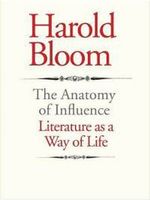
Bloom_main_1934545f For Dante, notes Harold Bloom, the “perfect human age” was 81 (9 times 9), and if the author of the Commedia had reached that milestone, rather than dying at 56, he believed “he would have comprehended everything”. Bloom himself will be 81 this month. Blessed with a reading speed of 400 pages an hour and a memory as sticky as flypaper, though he might not know everything, he is one of very few living critics who could reasonably claim to have read everything that matters.

Of the several hundred books he has edited or written, including bestselling defences of the Western canon and Shakespeare, his most famous work remains The Anxiety of Influence (1973). It was the first of Bloom’s many attempts to turn readers’ assumptions upside-down and inside-out. As he described it, the scene of writing was an environment every bit as dangerous as Darwin’s tangled bank. Far from being meek and bookish, poets spent their creative lives trying to elbow each other out of the way in a desperate attempt to catch the eye of posterity. “Strong” poets rewrote their predecessors in order to take their place in the pantheon; lines of poetry were at once a literary genealogy and an imaginary piano wire used to strangle one’s rivals. This self-styled “swan song” is offered as Bloom’s final journey into the “labyrinth” of literary influence. Around 30 writers – all male – form a dense tangle of literary relationships that Bloom unpicks, although roughly two-thirds of the book is taken up by “our two towering precursors, Shakespeare and Whitman”.

More here.

Thirst for Fairness May Have Helped Us Survive

Natalie Angier in The New York Times:

Angier Among the Ache hunter-gatherers in eastern Paraguay, healthy adults with no dependent offspring are expected to donate as much as 70 to 90 percent of the food they forage to the needier members of the group. And as those strapping suppliers themselves fall ill, give birth or grow old, they know they can count on the tribe to provide. Among the !Kung bushmen of the Kalahari in Africa, a successful hunter who may be inclined to swagger is kept in check by his compatriots through a ritualized game called “insulting the meat.” You asked us out here to help you carry that pitiful carcass? What is it, some kind of rabbit? Among the Hadza foragers of northern Tanzania, people confronted by a stingy food sharer do not simply accept what’s offered. They hold out their hand, according to Frank Marlowe, an anthropologist at Durham University in England, “encouraging the giver to keep giving until the giver finally draws the line.”

Among America’s top executives today, according to a study commissioned by The New York Times, the average annual salary is about $10 million and rising some 12 percent a year. At the same time, the rest of the tribe of the United States of America struggles with miserably high unemployment, stagnant wages and the worst economic crisis since the Great Depression. Now, maybe the wealth gap is a temporary problem, and shiny new quarters will soon rain down on us all. But if you’re feeling tetchy and surly about the lavished haves when you have not a job, if you’re tempted to go out and insult a piece of corporate meat, researchers who study the nature and evolution of human social organization say they are hardly surprised. Darwinian-minded analysts argue that Homo sapiens have an innate distaste for hierarchical extremes, the legacy of our long nomadic prehistory as tightly knit bands living by veldt-ready team-building rules: the belief in fairness and reciprocity, a capacity for empathy and impulse control, and a willingness to work cooperatively in ways that even our smartest primate kin cannot match.

More here.

The possibility of treating aging is not just an idle fantasy

David Gems in American Scientist:

ScreenHunter_10 Jul. 05 11.01 The 20th century brought both profound suffering and profound relief to people around the world. On the one hand, it produced political lunacy, war and mass murder on an unprecedented scale. But there were also extraordinary gains—not least in public health, medicine and food production. In the developed world, we no longer live in constant fear of infectious disease. Furthermore, a Malthusian catastrophe of global population growth exceeding food production—a terrifying prospect predicted first in the 18th century—did not materialize. This is largely due to a steep decline in birth rates, for which we can thank the education, emancipation and rationality of women. Most people in the developed world can now expect to live long lives.

Yet, as too often happens, the solution of one problem spawns others. Because we are having fewer children and living longer, the developed world is now filling up with old people. In Japan, for example, where the population is aging particularly quickly, the ratio of people less than 20 years old to those over 65 is plummeting, from 9.3 in 1950 to a predicted 0.59 in 2025. In Europe and the United States, we see ever more bald and grey heads on streets and in parks and shopping malls. Although this is something to celebrate, old age unfortunately has myriad ways of making us ill. It brings cardiovascular disease that leads to heart attacks and strokes; neurodegenerative diseases such as Alzheimer’s and Parkinson’s that erode the self; and macular degeneration, which blinds. And, of course, there is cancer. Aging has been described as the greatest of all carcinogens.

More here.

Pakistan’s Spies Tied to Slaying of a Journalist

Jane Perlez and Eric Schmitt in the New York Times:

General-pasha Obama administration officials believe that Pakistan’s powerful spy agency ordered the killing of a Pakistani journalist who had written scathing reports about the infiltration of militants in the country’s military, according to American officials.

New classified intelligence obtained before the May 29 disappearance of the journalist, Saleem Shahzad, 40, from the capital, Islamabad, and after the discovery of his mortally wounded body, showed that senior officials of the spy agency, the Directorate for Inter-Services Intelligence, directed the attack on him in an effort to silence criticism, two senior administration officials said.

The intelligence, which several administration officials said they believed was reliable and conclusive, showed that the actions of the ISI, as it is known, were “barbaric and unacceptable,” one of the officials said. They would not disclose further details about the intelligence.

But the disclosure of the information in itself could further aggravate the badly fractured relationship between the United States and Pakistan, which worsened significantly with the American commando raid two months ago that killed Osama bin Laden in a Pakistan safehouse and deeply embarrassed the Pakistani government, military and intelligence hierarchy. Obama administration officials will deliberate in the coming days how to present the information about Mr. Shahzad to the Pakistani government, an administration official said.

More here. [Photo shows General Pasha, chief of the ISI.]

Pakistani Military Still Cultivates Militant Groups, a Former Fighter Says

Carlotta Gall in the New York Times:

ScreenHunter_09 Jul. 05 10.11 The Pakistani military continues to nurture a broad range of militant groups as part of a three-decade strategy of using proxies against its neighbors and American forces in Afghanistan, but now some of the fighters it trained are questioning that strategy, a prominent former militant commander says.

The former commander said that he was supported by the Pakistani military for 15 years as a fighter, leader and trainer of insurgents until he quit a few years ago. Well known in militant circles but accustomed to a covert existence, he gave an interview to The New York Times on the condition that his name, location and other personal details not be revealed.

Militant groups, like Lashkar-e-Taiba, Harakat-ul-Mujahedeen and Hizbul Mujahedeen, are run by religious leaders, with the Pakistani military providing training, strategic planning and protection. That system was still functioning, he said.

The former commander’s account belies years of assurances by Pakistan to American officials since the Sept. 11, 2001, attacks that it has ceased supporting militant groups in its territory.

More here. [Photo shows General Kayani, chief of the Pakistan Army.]

Monday, July 4, 2011

Sunday, July 3, 2011

Feminism in the 21st century

Zoe Williams in The Guardian:

ScreenHunter_07 Jul. 03 19.43 What is feminism? “Simply the belief that women should be as free as men . . . Are you a feminist? Hahaha. Of course you are.”

Caitlin Moran's How to be a Woman is firm, delightfully firm, on many things – heels (against), pubic waxing (against), abortion (for), the disadvantages of economising on sanitary products – and she is firm, she insists on, this simple definition of feminism. Feminism is just equality. Would a man be allowed to do it? Then so should you. Would a man feel bad about it? No? Then nor should you. Everything else – the pressure to be sisterly (“When did feminism become confused with Buddhism?”); the idea that we should be held to account, as feminists, for every possible ill that could befall the modern woman (“There's a whole generation of people who've confused 'feminism' with 'anything to do with women'”) – all of that is just hassle in disguise.

Moran is right, it is simple: and yet, for such a simple message, its cultural penetration has been patchy, fluctuating and disappointing. People who like to sound the death knell for the ideology – it's remarkable even that such people still exist – point to the fact that young women tend not to describe themselves as feminists.

More here.

In defense of the other woman

Jessa Crispin in The Smart Set:

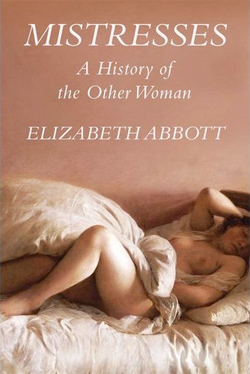
ID_BS_CRISP_MISTR_AP_001 There are rational human beings who are still angry at Angelina Jolie for stealing Brad Pitt and who need to talk about this online. The woman is supposed to tend to her own nest, that’s her nature, and so with the mistress there must be something damaged, something sick, some as-yet unknown or diagnosed personality disorder warping her feminine desires, or else why go after another woman’s husband?

Because if we believe that monogamous marriages that produce children are the strongest units of our society — and we do — then the mistress becomes the termite gnawing at the foundations. And we don’t much care if pests have feelings; we simply want them dead. Americans love marriage. By which I mean of course that Americans hate marriage. Lisa Appignanesi reports in All About Love: Anatomy of an Unruly Emotion that Americans are the marrying-est of all the countries. “Americans have the highest divorce, romantic break-up and remarriage rates in the world: 10 percent of American women — a far greater proportion than their European sisters — will have lived with three or more husbands or domestic partners by the age of 35.” Even after the shine wears off and we’re disillusioned about that “til death” stuff, we fight to find new spouses. And yet, when we are married, all we can do is complain about it. How stifling it is. How boring, how dull, how sexless and dispassionate. It’s because of these opposing feelings that we defend the institution of marriage so vigorously. Underground ambivalence often presents itself as vicious certainty.

We mistakenly equate the mistress with the homewrecker because we hear from the homewrecker all of the time, from Jolie to Rielle Hunter to Monica Lewinsky.

More here.

On the Poverty of Indian Muslims

Anjum Altaf in The South Asian Idea:

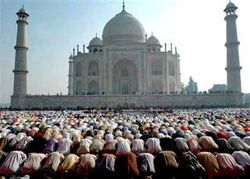
Muslim%20India_1 The 2006 Sachar Committee report on the status of the Muslim community in India found that Muslims were amongst the poorest of the poor in the country.

How do we square that with the fact that up until 1857 Muslims had ruled parts of India for over 800 years? I mention this fact because, in the minds of some people, Muslims had expropriated all the wealth of India during this period and oppressed all the non-Muslims.

India has been independent for a little more than 60 years, so this transformation from being the owners of the land to being the poorest of the poor could not conceivably have occurred during this short period.

So, did the decline of the Muslims occur during the less than hundred years of British rule between 1857 and 1947? If so, how?

I don’t know. I am writing this post partly to find out and partly to discharge a long-owed debt to Dr. G.M. Mekhri, a remarkable man in my opinion, who I met just once in the mid-1980s and have never forgotten because he had a very unique perspective on this issue.

Dr. Mekhri had a hypothesis that intrigued me. I don’t really know if it would survive a rigorous test but that seems beside the point. What fascinated me was the audacity and innovativeness of his thinking and his ability to communicate the excitement of such thinking to a younger generation.

More here.

A candid view of Candide

Julian Barnes in Guardian:

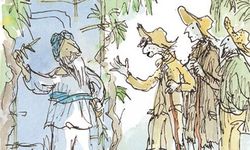
Quentin-Blake-illustratio-007 Just as it's a fair bet that Borges's famous summing-up of the Falklands war – “two bald men quarrelling over a comb” – will outlast in the public memory details of the actual events, so the four crunch words used by Voltaire to characterise Admiral Byng's death have endured better than the actual rights and wrongs of the matter. Voltaire's treatment of the case has a sharper edge to it because during his two-year exile in England (1726-28) he had known Byng as a young navy captain; 30 years later, despite their two countries being at war, he intervened (even taking an affidavit from the opposing French admiral) in an attempt to save the Englishman from execution. In the novel, Candide, having tired of the wit and corruption of France, arrives at Portsmouth on a Dutch ship from Dieppe. “You are acquainted with England,” he says to his travelling companion Martin, “are they as great fools in that country, as in France?” “Yes, but in a different manner,” replies Martin, citing the two countries' current squabble over “a few acres of snow” in Canada. As their ship docks, they observe a kneeling, blindfolded figure on the deck of a man-of-war. Candide enquires about the matter. He is told that an English admiral is being punished “because he did not put a sufficient number of his fellow creatures to death”; the court has found that in an engagement with the French admiral, “He was not near enough to his antagonist.” “But,” Candide replies, with an innocent's logic, “the French admiral must have been just as far from him.” True, comes the reply, “But in this country it is found requisite, now and then, to put one admiral to death, pour encourager les autres.”

More here.

Jackson Pollock, artist and physicist?

From PhysOrg:

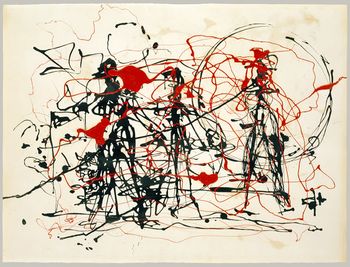
Pol Pollock's signature style involved laying a canvas on the floor and pouring paint onto it in continuous, curving streams. Rather than pouring straight from the can, he applied paint from a stick or a trowel, waving his hand back and forth above the canvas and adjusting the height and angle of the trowel to make the stream of paint wider or thinner. Simultaneously restricted and inspired by the laws of nature, Pollock took on the role of experimentalist, ceding a certain amount of control to physics in order to create new aesthetic effects. Mahadevan, collaborating with art historian Claude Cernuschi and physicist Andrzej Herczyński, both at nearby Boston College, took an interest in Pollock when his colleagues suggested that the artist may have exploited the same aspects of fluid dynamics that Mahadevan has studied in the past.

Instabilities in a free fluid jet can form in a few different ways: the jet can break into drops, it can splash upon impact with a surface, or it can fold and coil, as when a stream of honey lands on a slice of toast. The artist Robert Motherwell produced drips and splashes by flicking his brush; Pollock's technique, on the other hand, is defined by the way a relatively slow-moving stream of paint falls onto the canvas, producing trails and coils. In a sense, the authors note, Pollock was learning and using physics, experimenting with coiling fluids quite a bit before the first scientific papers on the subject would appear in the late 1950s and '60s.

More here.

Sunday Poem

In the City of Light

The last thing my father did for me
Was map a way: he died, & so
Made death possible. If he could do it, I
Will also, someday, be so honored. Once,

At night, I walked through the lit streets
Of New York, from the Gramercy Park Hotel
Up Lexington & at that hour, alone,
I stopped hearing traffic, voices, the racket

Of spring wind lifting a newspaper high
Above the lights. The streets wet,
And shining. No sounds. Once,

When I saw my son be born, I thought
How loud this world must be to him, how final.

That night, out of respect for someone missing,
I stopped listening to it.

Out of respect for someone missing,
I have to say

This isn’t the whole story.
The fact is, I was still in love.
My father died, & I was still in love. I know
It’s in bad taste to say it quite this way. Tell me,
How would you say it?

The story goes: wanting to be alone & wanting
The easy loneliness of travelers,

I said good-bye in an airport & flew west.
It happened otherwise.
And where I’d held her close to me,
My skin felt raw, & flayed.

Descending, I looked down at light lacquering fields
Of pale vines, & small towns, each
With a water tower; then the shadows of wings;
Then nothing.

My only advice is not to go away.
Or, go away. Most

Of my decisions have been wrong.

When I wake, I lift cold water
To my face. I close my eyes.

A body wishes to be held, & held, & what
Can you do about that?

Because there are faces I might never see again,
There are two things I want to remember
About light, & what it does to us.

Her bright, green eyes at an airport—how they widened
As if in disbelief;
And my father opening the gate: a lit, & silent

City.

by Larry Levis
from Blackbird, Fall 2006