Political Theology

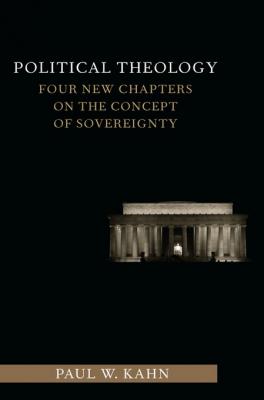
0231527004 Over at The Immanent Frame, Gil Anidjar,Bruno Gulli, Nancy Levene, George Shulman, Anders Stephanson, and Paul W. Kahn on Paul Kahn's Political Theology: Four New Chapters on the Concept of Sovereignty, which “contends that American political experience is incomprehensible outside the terms of political theology—not because the United States is, or ever was, a 'Christian nation,' but because the state 'creates and maintains its own sacred space and history.'” Stephanson:

Unending controversy, raw and existential, attaches to Carl Schmitt, but Paul Kahn cleverly (and, given his aims, rightly) avoids all, or almost all, of that by taking Political Theology as a pure reference text and simply rewriting it in his own idiom and according to his own inclinations. This is a bold move, which works well, though in the end I am not persuaded. And persuasion is in fact very much the name of the game, for Kahn is preoccupied with what he thinks of as “rhetoric”—philosophy and politics as dialogue and persuasion. Thus, he refers throughout to the inclusive “we,” an imagined community of Americans in general and liberals in particular. Because I do not belong to that community, I am not rhetorically addressed, which is not to say that the exercise fails to stimulate.

Schmitt’s basic idea, in the Theology, is that any normal constitutional order of “sovereignty” presupposes the abnormal, the exception, and the right to decide when that condition exists. Beyond the norm and the normal, then, there is no super-norm that informs all the others; there is only the lurking decision about the exception of existential emergency. That “space” becomes the overdeterminant of sovereignty. What makes this “theological” in a hidden way is that (i) actual historical developments turned Christian/religious notions into secularized concepts of the state; and (ii) those concepts, by analogy, include the premise of the miracle, here turned into the “exception.” Deism and liberalism eventually banished both God and the miracle from the proceedings, creating an agreeable façade of order, normality, rationality, science, legitimacy, and civilized conversation amongst those of requisite, recognized competence. The transcendent power is bracketed, the immanent will of the people or nation becomes constitutive.

Kahn’s riff on this is, strictly speaking, not a gloss; he has not set out to expand the contended body of Schmittiana. He wants instead to argue the case for Schmitt’s decisional exception and political theology in a contemporary U.S. liberal frame—a tall order.

‘It Is Time To Say Goodbye’

9351A838-824B-4C2A-9C73-EB71C548849E_w527_s Vladimir Tolz remembers Yelena Bonner, who, I just found out, died a month ago, in Radio Free Europe/Radio Liberty:

It often happens that even when you try to prepare yourself for something tragic and inevitable, you find yourself completely unprepared when it actually occurs. That is what happened to me when I heard the news of the passing of Yelena Bonner. Forgive me, but I can't get used to calling her anything other than what I called her during the many years of our friendship — Lusya.

I was awakened by the buzzing of my iPhone. One after another came e-mails from our friends in English and in Russian: “Yelena Georgiyevna is dead.” “Lusya, may God protect you!” A friend called from Paris, crying, unable to speak. All I could make out was: “I feel so bad. They are all leaving. All the closest ones….” She hadn't cried so fiercely even when her mother died. And it kept on and on.

Of course, throughout the last few months, when Lusya was suffering in hospitals (undergoing yet another heart surgery), we understood that the end was near. Last autumn she called and said: “Fly out here. It is time to say goodbye.”

But when I arrived, we spent a week together in a little cottage on Cape Cod, where we spent our days on the veranda. Our farewell somehow moved to the back burner. Instead, we spent whole days remembering events from our past (mostly the funny ones) and reciting beloved poems. Lusya remembered so much — Pushkin, Baratynsky, Pasternak, Tsvetaeva. She burst out laughing when I recalled these lines from Joseph Brodsky's “Cape Cod Lullaby”:

Stuffiness. A person is on a veranda with a towel wrapped around
His throat. A night moth, with all its unenviable body,
Strikes the iron screen, and bounces away, just like a bullet
Sent by nature from an invisible bush
To hit nature itself, to strike one in a hundred
In the middle of July.

She said: “That's us. That's about me…”

Ways With Words: Judy Golding’s memoir ‘fuelled by anger’

From The Telegraph:

WilliamGolding_1464784c Judy Golding’s autobiography, Children of Lovers, portrays the Lord of the Flies author as a man who could be a wonderfully entertaining father but also capable of cruelty towards his offspring. In the book, she writes that “I need to make these two men one . . . the warm, embracing man I adored, and the indifferent, sometimes self-centred, occasionally cruel man, who could drink too much, could be crushing, contemptuous, defeating, deadening. This is hard.” Speaking at the Telegraph Ways With Words festival, Judy, now 66, said that she did not take lightly the decision to lay bare the family’s secrets. “I hesitated hugely and I was bolstered by very good friends, one of whom said to me every few months, ‘Are you going to tell the truth about your father?’” she said. “I know that I come over as quite angry and in a sense you have to be fuelled by a sort of anger. But I certainly don’t regret it.”

Golding and his wife, Ann, were devoted to one another – to the exclusion of Judy and her brother, David. The title of the memoir is taken from the proverb ‘the children of lovers are orphans’. “Every parent – and this is true of my parents as much as anyone – would like to do the best for their children. But it’s certainly true that their relationship did feel exclusive to me and I think to my brother as well,” she said. I just felt my parents looked at each other and found in each other a mirror. They were entwined in some fairytale and we were on the outside. But children normalise those things and get on with it.” She said of her father, who died in 1993: “He was an extremely funny man, and I remember as a child lying on the floor and my stomach hurting because I was laughing so much. “But you saw the other side too and that was his tendency to – there is a phrase for it now – self-medicate with alcohol.”

More here.

Francis Fukuyama goes back to the beginning

From The City Journal:

Chimp It’s possible that Francis Fukuyama does not take unmixed pleasure in his fame as the author of The End of History and the Last Man. Ever since Fukuyama published that book in 1992—indeed, ever since he published the article on which it was based in The National Interest in 1989—he has been shadowed by the phrase “the end of history.” Since then, he has written five more books on big, complex subjects, ranging from the decline of trust in American society to the future of genetic engineering, and he has participated in countless policy debates. Yet on the cover of his new book, The Origins of Political Order, he once again is identified as “the author of The End of History and the Last Man.”

Will this book—a 500-page survey of the growth of states “from prehuman times to the French Revolution,” with a promised second volume taking the story up to the present—finally be the one to emancipate Fukuyama from the end of history? The question is justified not simply by the size, scope, and ambition of the project but, above all, by its emphasis on origins. If the end of the Cold War represented the end of history, Fukuyama’s new book starts over at the beginning, with the emergence of the first states out of kin-based tribes more than 4,000 years ago. In the introduction, Fukuyama explains that his purpose in The Origins of Political Order is to offer a new theory of political development, to supersede the one that his mentor Samuel Huntington advanced in his 1968 study Political Order in Changing Societies.

More here.

the guilt writer

63251629-15125409

Guilt was Patricia Highsmith’s great theme. In her books even the good know they’re not innocent, and they carry an apprehension that they too will be found out. “Night was falling quickly, with visible speed like a black sea creeping over the earth,” reflects Robert Forester at the beginning of “The Cry of the Owl” (Grove: 272 pp., $14), one of her lesser-known works from 1963 and one of her most unsettling. Which is saying plenty. Forester is driving through the woods of Pennsylvania, about to do something he knows he shouldn’t. He’s an ordinary, decent guy and has a good job as an engineer with a firm called Langley Aeronautics. But he’s recently divorced and depressed, and he likes to stand in the dark, watching a woman he doesn’t know through her kitchen window. He sees her frying chicken or hanging the curtains or setting the table for dinner. He never gets close enough to tell whether she’s pretty or not, but he already knows she has a boyfriend she likes. She drives a light-blue Volkswagen. The happiness that Robert imputes to the life of this woman he’s never met calms him and gives him comfort. He genuinely wants the best for her. Yet he’s a voyeur, and doesn’t he deserve to be punished? He will be, beyond all measure.

more from Richard Rayner at the LA Times here.

as real as god

4d5297f6-ae82-11e0-844e-00144feabdc0

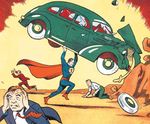
We know their stories far better than we think. One was bitten by a radioactive spider. One vowed revenge when his parents were shot dead by a mugger. One is a billionaire who built a metal suit to keep his heart going. And one has an origin myth so familiar that it could be summed up in four captions, eight terse words, on the first page of a recent retelling: “Doomed planet. Desperate scientists. Last hope. Kindly couple.” Superhero comics – secular modern myths, written in collaboration by generations of writers – have tracked our culture for more than 70 years, providing wish fulfilment fantasies, cultural exemplars, vehicles of satire and cautionary tales of the abuse of power. Attempts to work out what they say about us have been around nearly as long. When Jerry Siegel and Joe Shuster created Superman in 1938, as fascism took Europe in its grip, they intended him to be, in Siegel’s words, “a character like Samson, Hercules and all the strongmen I ever heard of, rolled into one”. Umberto Eco proposed, in a 1970s essay on Superman, that in a society increasingly dominated by machines, it was down to the “positive hero” of myth to “embody to an unthinkable degree the power demands that the average citizen nurtures but cannot satisfy”. As the comics writer Grant Morrison pithily observes in Supergods, his book-length analysis of the superhero phenomenon, the idea of these characters has long been “at least as real as the idea of God”.

more from Tim Martin at the FT here.

the avant-garde as cruelty

Bkr-Kipnis-t_CA0-sfSpan

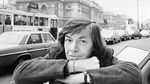
Well-meaning laments about violence in the media usually leave me wanting to bash someone upside the head with a tire iron. To begin with, the reformist spirit is invariably aimed down the rungs of cultural idioms, at cartoons, slasher films, pornography, rap music and video games, while the carnage and bloodletting in Shakespeare, Goya and the Bible get a pass. Low-culture violence is literal, while high-culture violence is symbolic or allegorical and subject to critical interpretation. Low-culture violence coarsens us, high-culture violence edifies us. And the lower the cultural form, or the ticket price, or — let’s just say it — the presumed education level of the typical viewer, the more depictions of violence are suspected of inducing mindless emulation in their audiences, who will soon re-enact the mayhem like morally challenged monkeys, unlike the viewers of, say, “Titus Andronicus,” about whose moral intelligence society is confident. Maggie Nelson has her laments about violent representations, but in “The Art of Cruelty” she refreshingly aims them largely up the cultural ladder, at the fine arts, literature, theater — even poetry. What interests her is the “full-fledged assault on the barriers between art and life that much 20th-century art worked so hard to perform,” often by enlisting violence and cruelty, simulated or actual, including cruelties inflicted physically on the person of the artist, or affectively on the psyches of the audience.

more from Laura Kipnis at the NYT here.

Friday, July 15, 2011

Unsung Hero

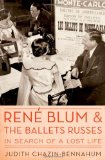
Cov_rene_blumEd Voves reviews Judith Chazin-Bennahum's René Blum and the Ballets Russes in California Literary Review:

The story of the Ballet Russes is so bound to the legendary lives of Serge Diaghilev and Vaslav Nijinsky that it is easy to forget the ballet company’s decades of survival and achievement after its glory days before the outbreak of World War I. That the Ballet Russes did survive was due in large measure to a man who has been unfairly relegated to the footnotes of European history.

That man was René Blum. Given his contributions to the literature, theater and dance of the 20th century, it is shocking that this cultural pioneer and victim of the Nazi Final Solution should be virtually forgotten.

In an important new book, Judith Chazin-Bennahum places Blum’s role as a guiding force in modern arts and letters in its true historical context. Along with reviving the Ballet Russes after Diaghilev’s death in 1929 and encouraging the budding genius of George Balanchine, Blum played a key role in the publication of the first volume of Marcel Proust’s Rembrance of Things Past. One of the organizers of the 1925 exhibition that established Art Deco as the signature design style of the period between the world wars, Blum was also a trend-setting journalist and a decorated hero of the French Army on the Western Front.

René Blum was also a French Jew.

Blum’s life spanned the years 1878 to 1942. All of Blum’s many accomplishments were bracketed between the anti-Semitic turmoil of the Dreyfus Affair that tormented France from 1894 to 1904 and the Nazi-led Holocaust in which he perished. To his dying day, Blum thought of himself as a French patriot. Yet it was the complicity of French officials during the German occupation that set him on the road to Auschwitz.

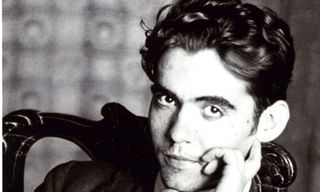
The Final Hours of Federico García Lorca

Museum-dedicated-to-Feder-007 Giles Tremlett in The Guardian:

One of the great mysteries of Spain's recent history may have been solved by a local historian from the southern city of Granada, who claims to have found the real grave of the executed playwright and poet Federico García Lorca.

Miguel Caballero Pérez spent three years sifting through police and military archives to piece together the last 13 hours of the life of the author of Blood Wedding, Yerma and The House of Bernarda Alba, who was shot by a right-wing firing squad early in the Spanish civil war.

He now claims to have identified the half-dozen career policemen and volunteers who formed the firing squad that shot Lorca and three other prisoners, as well as the burial site. And he blames Lorca's death on the long-running political and business rivalry between some of Granada's wealthiest families – including his father's own García clan.

“I decided to research archive material rather than gather more oral testimony because that is where the existing confusion comes from – with so many supposed witnesses inventing things,” explained Caballero, who has published his results in a Spanish book called The Last 13 Hours of García Lorca.

Caballero said his original intention had been to verify information gathered in the 1960s by a Spanish journalist, Eduardo Molina Fajardo, who was also a member of the far-right Falange organisation that supported the dictator General Francisco Franco.

“Because of his own political stance, Molina Fajardo had access to people who were happy to tell him the truth,” said Caballero. “The archives bear out most of what he said, so it is reasonable to suppose he was also right about the place Lorca was buried.”

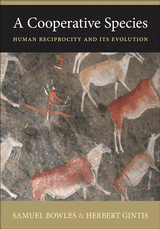
A Cooperative Species: Human Reciprocity and Its Evolution

J9474 Chapter 1 from Samuel Bowles and Herbert Gintis's new book:

Is our conscience nothing but “the inner voice that tells us that somebody might be looking,” as the jaundiced H.L. Mencken (1949) put it? Or did the 20th century American essayist overlook humanity’s penchant genuinely to care for others, including total strangers, and to act morally, even when nobody is looking? And if Adam Smith’s affirmation of humanity’s moral sentiments is more nearly correct than Mencken’s skepticism, how could this oddly cooperative animal, Homo sapiens, ever have come to be?

In the pages that follow we advance two propositions.

First, people cooperate not only for self-interested reasons but also because they are genuinely concerned about the well-being of others, try to uphold social norms, and value behaving ethically for its own sake. People punish those who exploit the cooperative behavior of others for the same reasons. Contributing to the success of a joint project for the benefit of one’s group,even at a personal cost, evokes feelings of satisfaction, pride,even elation.Failing to do so is often a source of shame or guilt.

Second, we came to have these “moral sentiments” because our ancestors lived in environments, both natural and socially constructed, in which groups of individuals who were predisposed to cooperate and uphold ethical norms tended to survive and expand relative to other groups, thereby allowing these prosocial motivations to proliferate. The first proposition concerns proximate motivations for prosocial behavior, the second addresses the distant evolutionary origins and ongoing perpetuation of these cooperative dispositions.

Cooperation was prominent among the suite of behaviors that marked the emergence of behaviorally modern humans in Africa.

Is Sex Passé?

SEX-articleLarge Erica Jong in the NYT:

My daughter, Molly Jong-Fast, who is in her mid-30s, wrote an essay called “They Had Sex So I Didn’t Have To.” Her friend Julie Klam wrote “Let’s Not Talk About Sex.” The novelist Elisa Albert said: “Sex is overexposed. It needs to take a vacation, turn off its phone, get off the grid.” Meg Wolitzer, author of “The Uncoupling,” a fictional retelling of “Lysistrata,” described “a kind of background chatter about women losing interest in sex.” Min Jin Lee, a contributor to the anthology, suggested that “for cosmopolitan singles, sex with intimacy appears to be neither the norm nor the objective.”

Generalizing about cultural trends is tricky, but everywhere there are signs that sex has lost its frisson of freedom. Is sex less piquant when it is not forbidden? Sex itself may not be dead, but it seems sexual passion is on life support.

Katha Pollitt counters, in The Nation:

What is Jong’s evidence for this supposed outbreak of chastity? Well, there’s her daughter, who’s in her mid-thirties and contributed an essay called “They Had Sex So I Didn’t Have To,” about her parents’ child-embarrassing shenanigans, and a handful of other anthology participants. Oh, and cybersex (quick someone, tell Anthony Weiner’s pen pals they should claim they were driven by a “lust for propriety” rather than, well, lust). And babies—“our current orgy of multiple maternity” with family beds and breastfeeding “at all hours so your mate knows your breasts don’t belong to him.” (Well, they don’t belong to him, do they? I thought Isadora Wing’s revolutionary point was that a woman’s breasts, and all the rest of her, belong to herself. )

Even for a trend story, “Is Sex Passé?” is pretty shaky. Molly Jong-Fast is just one person. A handful of New York writers is just one handful. In fact, there is really no evidence that young women, of whatever class, educational level or ethnicity, married or single, mothers or not, are less interested in sex than comparable women were in 1973, let alone in the 1950s.

On the Chinese House-Price Bubble

220px-Colonial_buildings_in_old_Shanghai Christian Dreger and Yanqun Zhang in Vox (photo from Wikipedia):

For many observers, the Chinese economy has been spurred by a bubble in the real-estate market, probably driven by the fiscal stimulus package and massive credit expansion (Nicolas 2009). For example, the stock of loans increased by more than 50% since the end of 2008.

In reaction to the global crisis, the government urged banks to increase lending (Cova et al. 2010). Mortgage loans have played a significant role, as they account for one third of total lending activities. Banks have provided easy credit for housing development, probably without sufficient evaluation of risks. In addition, state-owned enterprises have stimulated the development, having access to low-cost capital and believing they are too big to fail.

There are several indications that the market might have overheated in recent years. In some cities, buyers are picked up by the seller in a lottery. The rapid increase in house prices triggers exuberant expectations and speculation. Some real-estate developers have started hoarding houses by delaying their sales hoping for higher profits. Due to higher-price expectations, families are stretching to pay prices at the edge of their means or beyond.

To dampen the evolution, the People’s Bank of China has increased its nominal interest rate. The Chinese government has also introduced measures to combat record prices, including mortgage rates and down-payment requirements for second homes. In some cities, house owners are restricted in new house purchases. Many state-run mortgage lenders have cut mortgage discounts. Additional taxes on property are in the pipeline. While housing prices in the first-tier cities stopped rising further, they are still at record levels. Housing prices are not only a problem from an economic perspective, they’re also an issue of the people’s livelihood that can affect social stability. Households with average income increasingly feel that they cannot afford to buy a house (Deng et al. 2009).

Moral Progress and Animal Welfare

Jo4148c_thumb3 Peter Singer in Project Syndicate:

Mahatma Gandhi acutely observed that “the greatness of a nation and its moral progress can be judged by the way its animals are treated.” To seek to reduce the suffering of those who are completely under one’s domination, and unable to fight back, is truly a mark of a civilized society.

Charting the progress of animal-welfare legislation around the world is therefore an indication of moral progress more generally. Last month, parallel developments on opposite sides of the world gave us grounds for thinking that the world may, slowly and haltingly, be becoming a little more civilized.

First, the British House of Commons passed a motion directing the government to impose a ban on the use of wild animals in circuses. The motion followed the release of undercover footage, obtained by Animal Defenders International, of a circus worker repeatedly beating Anne, an elephant. The measure was, at least initially, opposed by the Conservative government, but supported by members of all political parties. In a triumph for parliamentary democracy, the motion passed without dissent.

More controversially, the lower house of the Dutch parliament passed a law giving the Jewish and Islamic communities a year to provide evidence that animals slaughtered by traditional methods do not experience greater pain than those that are stunned before they are killed. If the evidence cannot be provided, stunning before slaughter will be required in the Netherlands.

China’s Other Revolution

Ndf_36.4_box Edward S. Steinfeld in Boston Review, with responses from Andrew G. Walder, Helen H. Wang, Baogang He, Ying Ma and Guobin Yang:

China’s institutional transformation is hard to see in part because it has diverged from standard theoretical accounts of how change is supposed to take place. In China institutional change has been incremental and evolutionary, radical in its ultimate effect, but hardly in its origin and unfolding. Change has not come in response to exogenous shocks or what Ira Katznelson has called “unsettled times.”

It is also difficult to identify who is responsible for change. For at least fifteen years, there has been no charismatic leader or coherent group of reformers of the type associated with post-Soviet Russia. There are no visionary policy elites negotiating the complex terrain of domestic politics. None of the recent “administrations” have had a discernible institutional mission, whether to end socialism, build capitalism, privatize industry, or seek any of the other systemic transformations articulated by post-socialist reformers elsewhere.

But—despite the persistence of an authoritarian, single-party state—the composition of elites drawn into the policy process has evolved. Whereas in the early 1990s, for example, overseas-trained returnees were held suspect, barred from positions of influence, today such individuals routinely populate the high echelons of the state economics bureaucracy. The minister of science and technology earned a PhD in Germany, where he subsequently worked for a decade at Audi. The number-two official at the central bank—and the head of the State Administration of Foreign Exchange—earned a PhD in the United States, where he was a tenured professor of economics. The head of the government’s banking regulatory commission has an MBA from the University of London; the head of the Shanghai government’s Office for Financial Services is a Stanford-trained economist; and the list goes on. Twenty years ago, these people would not have returned to China, let alone been appointed to positions at the core of the state.

More is Less!

Control-room-225x300 Aidan Randle-Conde over at Quantum Diaries:

Life is full of uncertainty. And so is particle physics. No matter how sophisticated our models are or how good our understanding is there are still things we don’t know. This is research after all. Uncertainty is a huge part of everything we do.

Every time we make a measurement of anything, we have to give in our result, by saying “It’s this much, give or take that much”, and we refer to the “that much” as the uncertainty. (This has nothing to do with the famous Heisenberg uncertainty!) There are four main sources of uncertainty in our measurements:

– Statistical uncertainty
– Model dependent uncertainty
– Uncertainty from other measurements
– Systematic uncertainty

The statistical uncertainty simply comes from having low numbers of events to work with and we can reduce this uncertainty by recording more data. This is why we love luminosity so much, and why we spend thousands of hours babysitting the detector.

The model dependent uncertainty comes from our choice of physical model and usually limited by how well we can simulate different models of physics. For a lowly experimental physicist like me the best thing to do is ask the theorists for these uncertainties. They’re often larger than we’d like, but that’s the price we pay for having access to cutting edge models.

The uncertainty from other measurements is usually included when we expect another measurement to more precise in the future. (We can hope!) A good example is the uncertainty on luminosity. As our understanding of the detector improves, this uncertainty can decrease.

The final uncertainty, the systematic uncertainty, is the one that keeps physicists awake at night.

Women and Alcohol

From Harvard Magazine:

Greenfield_Shelly When Shelly F. Greenfield joined the Harvard Medical School faculty in 1992, scientists were just beginning to document the fact that men and women become addicted to alcohol, and recover from that illness, differently—to recognize that “there may be gender-specific variables that affect health,” says the professor of psychiatry at McLean Hospital. During the last 15 years, scientists have documented notable gender differences in the physiological effects of alcohol—differences summed up in Women & Addiction, a 2009 volume co-edited by Greenfield, who has pioneered more effective treatment programs for women struggling with addiction to alcohol and other substances. Women initially metabolize only about a quarter as much alcohol in the stomach and intestines as men do (a fact not documented until 1990); consequently, more alcohol enters the bloodstream as ethanol. Women’s generally lower body mass, and lower body water content, also act to intensify alcohol’s effects.

Due at least partly to these physiological differences, the disease of alcohol dependence proceeds on a faster course in women, requiring medical treatment four years sooner, on average, than for male problem drinkers. Alcohol-addicted women are also quicker to develop cirrhosis, fatty liver, and cognitive impairment, and have a greater risk of dying in alcohol-related accidents than men do. These gender differences are not confined to humans: female rats become addicted to a wide range of substances, including alcohol, nicotine, cocaine, heroin, and methamphetamines, more quickly than males.

More here.

It’s Lonely—And Stressful—At the Top

From Science:

Bonobo For savanna baboons (Papio cynocephalus), ruling a banana republic comes at a price. A new analysis of fecal samples reveals that these alpha males have higher levels of stress hormones than their immediate underlings and similar levels to low-ranked monkey serfs. The findings, reported online today in Science, challenge the prevailing thinking among primate scientists, who believe that—outside of times of social upheaval, during which cocky upstarts dispose more dominant males—alphas should live in stress-free bliss. But savanna baboons may not have the time to sip cocktails. In these societies, the rank-and-file frequently topple their leaders, so the top dogs scuffle much more than subordinates to hold onto power. Such constant stress can hamper the immune response and monkey health, potentially holding these kings back from siring as many offspring as they should.

More here.

Thursday, July 14, 2011

the clock

Tumblr_lo94i5u3Fz1qhwx0o

The premise of David Thomson’s great novel Suspects (1985) is that all the people in film noir either are related to or know each other. He fills out their otherwise abbreviated lives with what happened before, after, and during the film stories they inhabit, mingling the real and the fictional, the actors’ present role with past and future ones. Thus Vivian Sternwood from The Big Sleep turns out to be best friends with Evelyn Cross Mulray from Chinatown and, later in life, has an affair with Jonathan Shields, the Kirk Douglas character in The Bad and the Beautiful. Norma Desmond (Gloria Swanson) from Sunset Boulevard marries the Count von Rauffenstein (Erich von Stroheim in La Grande Illusion) after marrying Max von Mayerling (Erich von Stoheim in Sunset Boulevard), and so on. Christian Marclay’s epic work The Clock — the winner of the Golden Lion at the Venice Biennale, showing at LACMA until July 31 — ratchets this narrative playfulness up several notches, with implications for how we see not only visual storytelling (movies, television), but also time itself. The Clock is a film that lasts twenty-four hours, and every minute of the day is accounted for by at least one and often several images of clocks on buildings, clocks beside beds, grandfather clocks that need adjusting, watches on arms, car radios, cell phones, CCTV time codes, video tape recorders, and all other forms of twentieth- and twenty-first century time-keeping.

more from Leo Braudy at the LA Review of Books here.

sir walter

Article00

THAT SIR WALTER SCOTT was the first best-selling author is indisputable. His first major poem was so successful that the publisher offered the world’s first advance for the rights to his next work, sight unseen. Waverley (1814), his anonymously published debut novel, had sold more than fifty thousand copies by the time the “collected” edition of his works appeared. Even this figure must be an underestimate, since it excludes the pirated versions that appeared in Dublin, Boston, Philadelphia, and Calcutta and the translations into most major European languages. Even a relatively minor novel, The Fortunes of Nigel (1822), sold out its initial printing before 10:30 AM on the day of publication. Scott’s popularity, both commercially and critically, was unprecedented. But why he became the first best seller is a more problematic question. The stereotype of the best seller is of a formulaic kind of writing; a genre that delivers exactly what the reader expects, as unchangingly as McDonald’s burgers. It is striking that Scott was aware throughout his career of the dangers of acquiring “the character of a mannerist.”

more from Stuart Kelly at Bookforum here.