The Storm after the Calm

Px1990c_thumb3 Michel Rocard in Project Syndicate:

Could the financial crisis of 2007-2008 happen again? Since the crisis erupted, there has been no shortage of opportunities – in the form of inadequate conclusions and decisions by officials – to nurture one’s anxiety about that prospect.

Over the course of the three G-20 summits held since the crisis, world leaders have agreed to tighten financial regulation slightly, but only for banks, while leaving other market players free of restrictions and scrutiny. As was true before the crisis, no one is monitoring the almost limitless “virtual” market for derivatives, where money moves freely without official rules or contact with the real economy.

And large players have plenty of cash with which to speculate, especially given the United States Federal Reserve’s decision to inundate the world with a sea of liquidity. The result has not been investment in productive assets that boost employment in the US, as the Fed intended, but rather a run-up in global commodity prices and a growing bubble in the housing markets of the major emerging economies.

Simply put, there are no brakes that could stop the global economy from blundering into another financial crisis.

Fooled by Science

Brooks_david-081811_jpg_230x825_q85 H. Allen Orr on David Brooks' The Social Animal: The Hidden Sources of Love, Character, and Achievement in the NY Review of Books:

The Social Animal is more ambitious and, in some ways, more serious than his earlier books. Gone is the focus on what are likely passing fads in American culture and gone, at least largely, is the irreverent wit that characterized his previous efforts. Instead, The Social Animal is an attempt to write an accessible treatment of a set of weighty topics, many of which require Brooks to stretch in a distinctly scientific direction. The book, which was excerpted earlier this year in The New Yorker, focuses on big and somewhat diffuse questions: What has science revealed about human nature? What are the sources of character? And why are some people happy and successful while others aren’t?

To answer these questions, Brooks surveys a wide range of disciplines, including evolutionary psychology, neurobiology, cognitive science, behavioral economics, education theory, and even the findings of marriage experts.

Given all this, you might expect The Social Animal to be a dry recitation of facts. But Brooks has structured his book in an unorthodox, and perhaps unfortunate, way. Instead of a chapter on evolutionary psychology, followed by one on child development, and so on, he tells a story. Following Rousseau’s approach in Émile, Brooks makes his larger points within a fictional narrative. This literary conceit is presumably intended both to keep the reader’s attention and to provide a natural frame for all the research that Brooks reports. So as the characters in his narrative live through childhood, we hear about the science of child development, and as they begin to date we hear about the biochemistry of sexual attraction. Nothing if not thorough, Brooks carries this conceit through to the death of one of his characters.

The Milkman in the Night

The-Milkman-in-the-Night Marina Lewycka reviews Andrey Kurkov’s The Milkman in the Night, in the FT:

Andrey Kurkov’s new book is a surreal tale of post-Soviet Ukraine, in the same vein as his cult novel Death and the Penguin but with less poignant irony and more straight farce.

The Milkman in the Night opens with a night-time murder, followed by the interception at an airport of a suitcase full of mysterious ampoules and some bizarre goings-on at a private clinic where impoverished single mothers are paid to express their surplus breast milk. From there the plot unwinds in a complex helter-skelter of more and more improbable events. Sometimes the inventiveness is exhilarating, at other times the sheer implausibility of the narrative can grate.

The characters who unleash these extraordinary plots are humble people eking out a precarious living in the unglamorous corners of Kiev and its impoverished hinterland. Irina, a single mother, travels into Kiev every day from the snowbound village of Lipovka to sell her breast milk. Dima, a sniffer-dog handler at Boryspil airport, tries to change his luck by stealing a dodgy suitcase. Semyon, a private bodyguard to a parliamentary deputy, is revealed to be a sleepwalker with a separate nocturnal life of which his daytime self is completely unaware; his wife Veronika makes friends with the eccentric widow of the pharmacist whose murder opens the book.

In the best absurdist tradition, the priest who comes to exorcise Dima’s house and car charges extra because there are no airbags, while the murdered pharmacist had developed an elixir called Anti-Wimp, which stimulates not only courage but also an exaggerated sense of social justice (politicians order it by the bucket-load). If this isn’t enough, the pharmacist’s widow has his body plasticised and seats him by the window in her apartment until it begins to smell; her friend does the same with her dead husband and the two women finally bury their spouses next to each other. And so it goes on.

Beauty and Mumbai’s beastly trade

From The Independent:

Bombay Sonia Faleiro was simply in search of a story she could sink her teeth into. A campaigning reporter on a number of Indian newspapers, the 33-year-old from Goa adhered to one overriding credo: “To convey information about people we know nothing of.”

And so, when she came across a small news item about dance bars in Mumbai, dens of iniquity in which disadvantaged young women were used and abused by the city's elite, she knew that here was something worth delving into. “I met with one of the girls, Leela,” she says, “a 19-year-old who had no doubt suffered [as a child, her father sent her out to be gang-raped by the police] but who, since arriving [in Mumbai], was so alive, and so optimistic.” Faleiro spent several months shadowing this engagingly self-dramatising heroine, convinced that she was worthy of far more than a mere article. The result, six years after they first met, is Beautiful Thing, a book that throws the doors open on Mumbai's sex trade.

More here.

Know Thyself: Easier Said Than Done

From The New York Times:

Book A few days before a review of my latest book appeared in these pages, I wrote to my editor, saying I had seen an advance copy and how much I liked the color illustration of the yellow moon. He replied that I must be mistaken, since the Book Review doesn’t use color. The next weekend he wrote to say he couldn’t think what had come over him — he reads the Book Review every week, and had somehow not noticed the color. Odd. And yet these lapses can happen to the best of us. Ask yourself what the Roman number four on the face of the church clock looks like. Most people will answer it looks like IV, but almost certainly the truth is it looks like IIII.

Why are we so bad at knowing — in this case remembering — what passes through our own minds? The philosopher Eric Schwitzgebel, in “Perplexities of Consciousness,” contends that our minds, rather than being open-access, are largely hidden territory. Despite what we believe about our powers of introspection, the reality is that we know awfully little about what our conscious experience amounts to. Even when reporting current experience, we make divergent, confused and even contradictory claims about what it’s like to be on the inside.

More here.

Friday, July 29, 2011

Balanced Diets

Mason490x300NEW-thumb-490x300-2273 Daniel Mason in Lapham's Quarterly:

On June 6, 1800, nearly a year into his scientific journey through South America, Alexander von Humboldt arrived at a mission on the Orinoco River called La Concepción de Uruana. It was a stunning site. The village sat at the foot of granite mountains, amidst huge pillars of stone that rose above the forest. Weeks before, Humboldt had seen mysterious etchings on the summits of such rocks—painted, the natives told him, by ancestors carried up there by the waters of a great flood.

Although weakened by bouts of fever and hunger, Humboldt was in fine spirits. In the preceding months he had watched the Leonid meteor shower fill the sky, experienced his first earthquake, and confirmed the communication of the Orinoco and the Amazon rivers through the Casiquiare Canal. He had collected electric eels and watched the dissection of a manatee. If at times the mosquitoes were so thick as to obscure the horizon and prevent his reckoning of latitude, or if other times ant hordes filled his canoe, he pushed on, spurred, he wrote, by an uncertain longing “for what is distant and unknown.”

Humboldt and his botanist companion Aimé Bonpland (and Indian servants, and pressed plants, and jars of preserving spirits, and a chattering menagerie of birds and monkeys in cages on his boats) stayed at Uruana for only one day, conversing with the missionary Fray Ramon Bueno and visiting the Otomac villagers. For all of nature’s splendors, it was the people of Uruana that most caught Humboldt’s attention: “a tribe in the rudest state,” “considered dirty even by their neighbors,” “ugly, savage, vindictive, and passionately fond of fermented liquors,” and yet presenting “one of the most extraordinary physiological phenomena” Humboldt had ever seen. The Otomacs ate earth, “a prodigious quantity” of it. During the two to three months of the rainy season, when the high and turbulent waters of the river made fishing difficult, they claimed to eat nothing but.

The Kingdom and the Towers

9-11 Anthony Summers and Robbyn Swan in Vanity Fair (h/t: Andrew Sullivan):

For 10 years now, a major question about 9/11 has remained unresolved. It was, as 9/11-commission chairmen Thomas Kean and Lee Hamilton recalled, “Had the hijackers received any support from foreign governments?” There was information that pointed to the answer, but the commissioners apparently deemed it too disquieting to share in full with the public.

The idea that al-Qaeda had not acted alone was there from the start. “The terrorists do not function in a vacuum,” Defense Secretary Donald Rumsfeld told reporters the week after 9/11. “I know a lot, and what I have said, as clearly as I know how, is that states are supporting these people.” Pressed to elaborate, Rumsfeld was silent for a long moment. Then, saying it was a sensitive matter, he changed the subject.

Three years later, the commission would consider whether any of three foreign countries in particular might have had a role in the attacks. Two were avowed foes of the United States: Iraq and Iran. The third had long been billed as a close friend: Saudi Arabia.

In its report, the commission stated that it had seen no “evidence indicating that Iraq cooperated with al-Qaeda in developing or carrying out any attacks against the United States.”

Iran, the commission found, had long had contacts with al-Qaeda and had allowed its operatives—including a number of the future hijackers—to travel freely through its airports. Though there was no evidence that Iran “was aware of the planning for what later became the 9/11 attack,” the commissioners called on the government to investigate further.

This year, in late May, attorneys for bereaved 9/11 family members said there was revealing new testimony from three Iranian defectors. Former senior commission counsel Dietrich Snell was quoted as saying in an affidavit that there was now “convincing evidence the government of Iran provided material support to al-Qaeda in the planning and execution of the 9/11 attack.” That evidence, however, has yet to surface.

As for Saudi Arabia, America’s purported friend, you would have thought from the reaction of the Saudi ambassador, Prince Bandar bin Sultan, that the commission had found nothing dubious in his country’s role. “The clear statements by this independent, bipartisan commission,” he declared, “have debunked the myths that have cast fear and doubt over Saudi Arabia.” Yet no finding in the report categorically exonerated Saudi Arabia.

Dissenter

5922 Over at Tablet Magazine, “the debut edition of 'Long Story Short,' a new podcast on people and ideas in Jewish life”:

Rosa Luxemburg was always an anomaly. One of the fiercest thinkers of the early 20th century, this Marxist philosopher and firebrand activist led masses of rebels during a time when politics was governed entirely by men. Living in Berlin, she was of Polish Jewish descent but not at all concerned with the plight of Jews. Unlike her male, dogmatic, and dull peers, she believed in love and passion and life’s small but great joys. In 1919, when she was just 47 years old, she was brutally murdered by her opponents. Long after many of her colleagues have been reclassified as tyrants by history’s unremitting hand, Luxemburg’s popularity is greater than ever; each year, thousands of young activists flock to her grave for inspiration.

But how is Luxemburg relevant to Jewish history? And what, if anything, would she have to say to Sarah Palin and her Tea Party supporters? The critic and essayist Vivian Gornick joined Long Story Short host Liel Leibovitz to discuss these questions in the first installment of Long Story Short

What I Think About When I Think About Dominique Strauss-Kahn

Rochelle Gurstein in The Nation:

Dsk-fmi Now that Nafissatou Diallo has taken the extraordinary step of telling the public her version of what Dominique Strauss-Kahn did to her at the Sofitel Hotel in clinical and tearful detail, I found myself revisiting the many dispiriting thoughts that have come to me regarding this case. When I first read the New York Times report of what happened, I was revolted. And so I read with approval all the criticism of the blinding arrogance and staggering stupidity of powerful men like Dominique Strauss-Kahn who had abused their position and taken advantage of women. I felt a kind of moral satisfaction when I saw a picture of a crowd of hotel maids (mostly minority and I assumed poorly paid) assembled in front of the courthouse yelling “shame” at Strauss-Kahn when he appeared for his arraignment.

Then it turned out the accuser was an “unreliable witness.” She had lied on her application for asylum, she had lied on her income tax returns, she had been less than forthright about her boyfriend in jail, and she had told conflicting stories about what happened after she was allegedly sexually assaulted by Strauss-Kahn. She was a liar, the consensus emerged but, as commentators who were still sympathetic to her pointed out, that did not mean that she was lying about what Strauss-Kahn did to her in the hotel room. Yet, even as I continued to entertain that possibility, I felt the force of the outraged reaction of the French to what they saw as a barbaric legal system, inflamed and abetted by a salacious, rumor-mongering press—and I understood. I cringed as I thought about the infamous “perp walk” (that awful little phrase) and felt the hollowness, as I have often felt before, of our vaunted legal principle of the presumption of innocence.

From there, and before I could help it, I felt myself being pushed into a familiar and discomfiting inner dialogue that starts with acknowledging the distressing truth that I somehow manage to live, as do most people, as if I did not know about the odious barbarisms of our legal system. The leering spectacle of the “perp walk” is the least of it.

More here.

Gaddafi is stronger than ever in Libya

Richard Seymour in The Guardian:

Libya-demonstration-007 The war on Libya has not gone well. Kim Sengupta's report on Wednesday detailed this starkly:

“Fresh diplomatic efforts are under way to try to end Libya's bloody civil war, with the UN special envoy flying to Tripoli to hold talks after Britain followed France in accepting that Muammar Gaddafi cannot be bombed into exile.

The change of stance by the two most active countries in the international coalition is an acceptance of realities on the ground. Despite more than four months of sustained air strikes by Nato, the rebels have failed to secure any military advantage. Colonel Gaddafi has survived what observers perceive as attempts to eliminate him and, despite the defection of a number of senior commanders, there is no sign that he will be dethroned in a palace coup.

The regime controls around 20% more territory than it did in the immediate aftermath of the uprising on 17 February.”

If the Gaddafi regime is now more in control of Libya than before, then this completely undermines the simplistic view put about by the supporters of war – and unfortunately by some elements of the resistance – that the situation was simply one of a hated tyrant hanging on through mercenary violence.

More here.

Why So Smart? Why So Dumb?

Hugo Mercier in Psychology Today:

Hugo-Mercier Reasoning is funny. Not the act of reasoning-although it can also be fun-but the cognitive skill that allows us to figure out math problems and decide what computer to buy. We can agree that reasoning is responsible, at least in part, for some of the greatest achievements of humankind, from calculus to the International Space Station. Yet we should also agree that people can reason their way to asinine beliefs — we are poisoned by the souls of aliens dropped in volcanoes millions years ago — and disastrous decisions — Napoleon's ‘invasion' of Russia. And it's not that some people are smart while others are dumb: Isaac Newton spent more time bent on alchemy than on mathematics and, for their many faults, neither L. Ron Hubbard nor Napoleon were dunces.

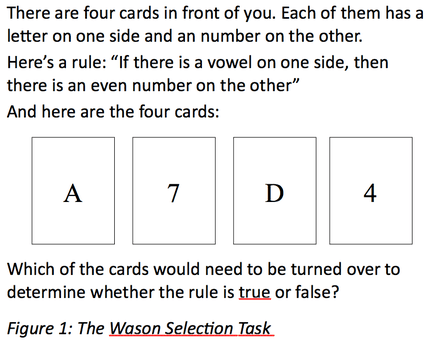
Psychologists interested in reasoning cannot expect to recreate such dramatic events as the creation of calculus or the decision to attack Russia in the lab. Instead, they must work with ‘toy models,' simple problems that people can try to solve in less than half an hour before going back to their routine. The most commonly used of these problems is known as the Wason Selection Task — after its creator the pioneering psychologist Peter Wason. Many of you may already be familiar with it, but if you aren't, you can try to solve the problem yourself – it's laid out in figure one. Take your time.
ScreenHunter_06 Jul. 29 16.42
Did you answer A, or A and 4? If yes, you are in good company, comfortably sitting with the large majority of the thousands of people who've faced the Wason Selection Task. But psychologists would not be nearly as interested in a problem that most people get right: the correct answer, arrived at by about 10% of participants, is A and 7. Why 7? Because if there's a vowel and the other side of the 7 card, then the rule is false. Why not 4? Because even if there's a consonant on the other side of the 4 card, the rule can still be true: it doesn't say that a consonant must have an odd number on the other side. Here's a nice toy model of reasoning's failures: a simple task leading to abysmal performance.

Now for the toy model of reasoning's successes. It is called the Wason Selection Task — after its creator the pioneering psychologist Peter Wason. It is depicted in figure one. A large majority of people manages to find the correct solution, showing how efficient reasoning can be at solving logical problems.

Wait. How can the very same problem illustrate both reasoning's failures and its successes? The task is the same. The people solving it are the same. What's the catch? The context. In the first toy model, people face the problem on their own. In the second they solve it in groups.

More here.

The Asylum Seeker

Suketu Mehta in The New Yorker:

Assylum... The writer met Caroline one Friday evening in the cafeteria of the upscale Manhattan supermarket where she worked. She was a twenty-something African immigrant without papers who was living three lives: as Cecile Diop, a woman with papers who had been in the country for ten years; as Caroline the African rape and torture victim; and as herself, a middle-class young woman who wanted to make a life in America. (Names and other identifying details have been changed throughout.) Diop, a fellow expat from central Africa, had lent Caroline her Social Security number so that she could get the job. Caroline was expecting her first paycheck, which she would give to Cecile to cash. “Some of them take half,” Caroline said, about such arrangements between immigrants. Caroline had come to the U.S. the previous summer for a family wedding. When her parents left, she stayed, even after her tourist visa expired. Now she was working on a story—a four-page document that she would give to the lawyer she had hired, and to immigration officials—saying that she was beaten and raped more than once by government soldiers in her country. “I have never been raped,” she admitted. It’s not enough for asylum applicants to say that they were threatened, or even beaten. They have to furnish horror stories. Inevitably, these atrocity stories are inflated, as new applicants for asylum get more inventive about what was done to them. Caroline’s parents are supporters of a controversial opposition leader, and government soldiers ransacked their house twice. Although they didn’t rape her or her sisters, they beat her brother. To buttress her asylum claims, Caroline has to obtain a letter from a hospital stating that she had been treated for torture. Describes her therapy sessions. Caroline was getting help in crafting her narrative from a Rwandan man the writer calls Laurent, who was a sort of asylum-story shaper among Central Africans. The writer accompanied Caroline to the immigration office where she made her case for asylum. Describes her interview with the immigration official, Novick. He wanted specifics about her rape and mistreatment back home. Last year, about fifty thousand people applied for asylum here. Less than five per cent came from central Africa. In all, 21,113 applicants were given asylum. The majority of asylum seekers in America, immigration experts say, really would be at serious risk if they were returned to their countries. Caroline does indeed have a “well-founded fear of persecution” if she returns, but she felt that she had to augment the story with a rape because the immigration system can better comprehend such a story. A couple of weeks later, Caroline returned to the asylum office and was told that her application had been approved.

How to Eat Like the President of the United States

From Smithsonian:

Food Richard Nixon: This president was eating his share of humble pie when he resigned his office in the wake of the Watergate scandal. But his actual last meal at the White House was a simple affair: slices of pineapple arranged around a plop of cottage cheese, paired with a glass of milk and served on a silver tray. Somehow I don’t think this particular dish will catch on in popularity, at least given the context in which it was served.

Ronald Reagan: This former commander in chief started eating jelly beans in the late 1960s as a means of helping him kick a smoking habit—and his affection for the candies grew to the point that, in 1973, he wrote to the chairman of the Jelly Belly company saying “we can hardly start a meeting or make a decision without passing around the jar of jelly beans.” Video on display shows Reagan heading a cabinet meeting with his hand perpetually dipping into a glass jelly bean jar.

Michelle Obama: One of the closing images of the show is of Michelle Obama’s vegetable garden on the south lawn. First planted in 2009, it was the first vegetable garden to grace the executive mansion’s property since the Franklin Delano Roosevelt administration. (The Clintons kept a small garden on the White House roof, but were told that planting a bona-fide garden on the grounds would break with the formal aesthetic of the White House property.) The 2011 garden includes a melange of vegetables such as spinach, peas, broccoli and lettuce. The produce will be used in the White House kitchen.

More here.

Thursday, July 28, 2011

the age of dissolution

Ganga-2

At the beginning of time, the great gods churned the ocean and found the nectar of immortality, only to have the demon-god Rahu steal it and gulp it down. The sun and moon gods tattled to Vishnu, who beheaded the demon; his body perished, but his head, having absorbed the nectar, had become immortal. Since then, whenever he can manage it, Rahu, the lord of petroleum mining, fertilizers, chemicals, stock markets, and destructive growth—that is to say, the lord of contemporary India—swallows the sun and the moon. But they always sail back out of his gaping throat and rearrange themselves in the sky. At 6:24 a.m. on July 22, 2009, I stood with seventy thousand people hip-deep in the gray, gluey mud of the Ganga, swirling with ashes, flowers, sloughed-off sin, and fecal bacteria.1 Although the sun had stumbled into a stratus sky only an hour ago, the clouds gave way and starlight began to play on the opalescent tides. We battled a compulsion to stare straight into the cosmic misalignment; we mutely implored the sun to pass through Rahu’s mouth, throat, and neck once again.

more from Bidisha Banerjee at Triple Canopy here.

The woman is perfected

Sylvia-plath

It’s always interesting when a very strange book is also an enduringly popular book. The Bell Jar has sold more than three million copies and is a mainstay of American high school English classes; it was made into a movie in 1979, and another version, starring Julia Stiles, is currently in production. Like The Catcher in the Rye, it is a touchstone for a certain kind of introspective, moody teenager—the kind of teenager who used to listen to the Cure and, later on, Tori Amos, and who these days listens to—actually I have no idea, but she definitely has a blog. (There are an amazing variety of embarrassing shrines to The Bell Jar online.) Unlike Catcher, it also has other sources of partisan support: feminists of the 1970s claimed Plath as a martyred patron saint of repressive domesticity, and mental illness advocates have found in her work easily identifiable symptoms and syndromes that were misdiagnosed and barbarically treated. As much as it was initially underappreciated by the British press, The Bell Jar was overpraised on its American publication. As such, it has frustrated generations of critics and biographers by refusing to be quite the great novel you’d want a great poet’s only novel to be. The book’s appeal comes into focus only when a reader drops her outsized expectations; after that, a more complex story reveals itself. Under the pretense of describing mental breakdown and recovery, Plath was free to bare her stand-in narrator’s nastiest, most selfish impulses. In doing so, she both dramatized and exemplified the conflict inherent in trying to be both a great writer and a nice person.

more from Emily Gould at Poetry here.

the Lithuanian Holocaust

Ponary_memorial_jpg_470x472_q85

In early July the words “Hitler was right” were painted in Russian on the memorial stone to the 72,000 Jews who were murdered at the Ponary Forest near Vilnius in Lithuania. On another monument close by, a vulgar reference was made to the compensation the Lithuanian government has made to the descendants of murdered Jews. No one seems to have noticed. Vilnius, now the capital of Lithuania, was known for centuries as the “the Jerusalem of Lithuania” because of its centrality to medieval and early modern Jewish thought and politics. In the medieval Grand Duchy of Lithuania and the early modern Polish-Lithuanian Commonwealth, Jews settled in Vilnius in considerable numbers from both west and east. Over centuries, Jews prospered under a regime that permitted them local autonomy. During the waning of the Commonwealth in the eighteenth century, Vilnius was home to scholars such as Elijah ben Solomon, the “Gaon of Vilne,” the great opponent of the Hasidic movement. In the nineteenth century Vilnius was home to the Haskalah, or Jewish Enlightenment, in the Russian Empire.

more from Timothy Snyder at the NYRB here.

A male porn star speaks

Tracy Clark-Flory in Salon:

ScreenHunter_03 Jul. 28 14.30 It's a Tuesday afternoon but the windows of this bar in San Francisco's North Beach neighborhood are taped over with black plastic to make it look like nighttime. They're filming a porno inside.

A naked woman is sitting on a bar stool, her legs held open by two real-life customers who casually sip their beers as porn actor James Deen repeatedly slams into her. A couple of men stand next to the action with their iPhones held out at arm's length, but mostly the crowd seems more interested in the glasses of whiskey being passed around than in the moaning girl. They pour the shots down their throats and someone lets a burp rip.

This is a shoot for one of Kink.com's many BDSM fetish websites, Public Disgrace, in which “women are bound, stripped, and punished in public.” There are three porn actors and the rest of the 15 or so people at this tiny watering hole — all male save for two women — are fans of the site or just people off the street. My friend who tipped me off about the shoot is one of the latter: He happened to be walking by the bar when he noticed that something was being filmed inside and as a video editor he couldn't resist checking it out.

More here.

In his rage against Muslims, Norway’s killer was no loner

Seumas Milne in The Guardian:

Anders-Breivik-007 It's comforting, perhaps, to dismiss Anders Behring Breivik as nothing more than a psychotic loner. That was the view of the Conservative London mayor, Boris Johnson, among others. The Norwegian mass killer's own lawyer has branded him “insane”. It has the advantage of meaning no wider conclusions need to be drawn about the social context of the atrocity.

Had he been a Muslim, as much of the western media concluded he was immediately after the terrorist bloodbath, we can be sure there would have been no such judgments – even though some jihadist attacks have undoubtedly been carried out by individuals operating alone.

In fact, however deranged the bombing and shooting might seem, studies of those identified as terrorists have shown they rarely have mental illness or psychiatric abnormalities. Maybe Breivik will turn out to be an exception. But whether his claim that there are other members of a fascistic Christian terror network still at large turns out to be genuine or not, he has clearly fostered enthusiastic links with violent far-right groups abroad, and in Britain in particular.

Those include multiple contacts with the Islamophobic English Defence League, which has repeatedly staged violent protests against Muslim communities. “You're a blessing to all in Europe,” Breivik apparently told EDL supporters in an online message, hailing “our common struggle against the Islamofascists”. Whatever Breivik has done, he hasn't done in isolation.

More here.