What’s Left Out of Black History Month Celebrations

Sean Thomas-Breitfeld in The Nation:

ScreenHunter_14 Feb. 08 09.53Last week marked the beginning of Black History Month. This year, we have twenty-nine days during which we will celebrate the many contributions of African-Americans to our nation’s history. This is a month when we make heroes of people who overcame real, systemic and often legal oppression. We lift up, in President Obama’s official proclamation, “a story of resilience and perseverance” to inspire and educate the public about a part of this nation’s history that wasn’t told a generation ago.

But in all of the celebration of a selective highlight reel of history, too often we overlook the reality of our present and how far we have yet to go to realize a better future where we all have enough to thrive—not just survive.

In his last book, Where Do We Go From Here, Martin Luther King Jr. wrote, “A society that has done something special against the Negro for hundreds of years must now do something special for him.” I don’t think Black History Month is what he had in mind.

He was probably taking a cold, hard look at our nation’s history and thinking of the terrible oppression and injustice that black people endured—first under slavery, and then under legally sanctioned segregation in the South and informal segregation everywhere else. The sad fact is that the vast majority of our nation’s history (from the Declaration of Independence right up until the legislative victories of the civil rights movement) constitutes that “something special against the Negro” that King mentioned. That long history of discrimination has a direct impact on the black community today.

More here.

how he writes

Viktor-shklovsky2

Goats wandering across the sands. Automobiles stuck in the salt flats for weeks on end. Camels pulling carts. Eagles soaring hundreds of feet overhead, ready to light on the telegraph poles, the only place to land in the desert. Out there they’re building the Turksib railroad. Hard work, necessary work. Out there it’s so hot the Kirghiz go dressed in felt boots, felt trousers, and felt caps. Where they’re not called Kirghiz, they’re called Kazakhs. Building a railroad is hard work. There isn’t much water. Bread has to be brought in. There has to be bread. Bread has to be stored somewhere. So many workers, all of them needing a roof over their heads. But they built it anyway. Good books come when we are forced to overcome our subject matter, when we are stalwart. This is also known as inspiration.

more (from a piece originally published in 1930) from Viktor Shklovsky at Context here.

the europe story

Hammar_220w

What is the function of culture in the EU? Mere window dressing? Or are people working in the cultural sphere truly given opportunities to practice their crafts and stimulate the public to think innovatively? The answer to both questions is “yes”. European Union cultural policy enables exciting projects to take off. It is also a showpiece of social engineering, fashioned with all the tools of conservatism and managed top-down, from somewhere on the right of centre. The discussion about European citizenship and “Fortress Europe” should be made part of the cultural policy debate. Culture is not a fenced-off zone. It is an ideological powerhouse, capable of influencing as well as being influenced by the issues surrounding citizenship. Arguably, it is not unreasonable to use culture as an instrument to create a European identity, intended to complement the national one. But it is disconcerting to see this done without debate. And on the basis of “classical European values”.

more from Erik Hammar at Eurozine here.

Tuesday, February 7, 2012

Awakening Benjamin

ElifriedlanderRichard Marshall interviews Eli Friedlander in 3 AM Magazine:

3:AM: Your philosophical interests seem to track a prevailing sense of existential crisis. Is this to do with your personality? When did you start recognising that you were interested in philosophical questions, and that these were the questions you wanted to pursue?

Eli Friedlander: Even though I wrote on the relation of philosophy and autobiography, or maybe because I wrote on that issue, I wouldn’t wish to move too directly from philosophical preoccupations to the space of life and personality. Without denying the personal dimension of my attachment to philosophical themes and even a degree of identification with the philosophers that concern me in my writing, I think that making that relation as oblique or roundabout as can be, is actually a virtue. The longer it takes to make the way from philosophy to life, the more significant their correlation becomes.

What most characterized my philosophical education is that I could not decide which were the questions that I wanted to pursue. I studied for my PhD at Harvard and at some point realized that I would not write the required one-topic dissertation. I availed myself of the option of writing three papers instead: on the relation of feeling and communication in Kant’s aesthetics, on personal exemplification in Rousseau’s Discourse on the Origins of Inequalities and on the limits of language in Wittgenstein’s Tractatus.

I have things to say, to myself and to others, about the connection between the three papers; for instance that they were various ways of developing a problematic of showing versus saying.

Laurie Anderson

Interview_andersonAmanda Stern interviews Laurie Anderson in The Believer:

LAURIE ANDERSON: I did a show inspired by Alain de Botton—he has something called “The School of Life” in London. It’s a really wonderful storefront, and in it are twenty books—they’re not for sale, but they’re the twenty books that you go, “Oh my god, why is that book not in my collection, why don’t I know about that book?” And he curates them, and it’s on one of these streets that has a name like Bruised Lamb’s Ear Lane, in the old meat-market district. The idea of The School of Life is that a lot of people go to school and learn how to make money or get a job, and then they kind of stop learning things except for the things they have to learn—like Photoshop or Pro Tools, which is a technique, not a discipline, although some people have turned it into an obsession. Anyway, he figures that everyone has one book in them, which I totally agree with—at least if they could figure out how to tell their story, they do—and so he opened The School of Life, and people come by and they talk for however long they feel like, and it’s a kind of—not a class, but a presentation of some kind. I love that idea, because I know a lot of people who have weird specialties that are not taught in schools; they’re things that you learn in life.

Raise the Crime Rate

Image.phpChristopher Glazek in n+1:

It shouldn’t surprise us that the country was more dangerous in 1990, at the height of the crack epidemic, than in 2006, at the height of the real estate bubble. What’s strange is that crime has continued to fall during the recession. On May 23, in what has become an annual ritual, the New York Times celebrated the latest such finding: in 2010, as America’s army of unemployed grew to 14 million, violent crime fell for the fourth year in a row, sinking to a level not seen since the early ’70s. This seemed odd. Crime and unemployment were supposed to rise in tandem—progressives have been harping on this point for centuries. Where had all the criminals gone?

Statistics are notoriously slippery, but the figures that suggest that violence has been disappearing in the United States contain a blind spot so large that to cite them uncritically, as the major papers do, is to collude in an epic con. Uncounted in the official tallies are the hundreds of thousands of crimes that take place in the country’s prison system, a vast and growing residential network whose forsaken tenants increasingly bear the brunt of America’s propensity for anger and violence.

Crime has not fallen in the United States—it’s been shifted.

Carlo Rotella on “The Wire,” How Bill Clinton was Like a Character in a Spielberg Movie, and Why Good Pundits are So Hard to Find

Matt Bieber in The Wheat and Chaff:
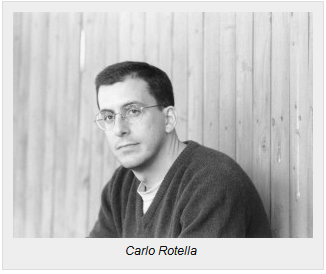
ScreenHunter_13 Feb. 07 11.46Carlo Rotella is one of the most exciting thinkers I’ve ever met. He’s a professor, writer, and public intellectual, and his mind ranges everywhere: from boxing to the blues and free play to fantasy novels.

A couple of weeks ago, Rotella wrote a brilliant column in the Boston Globe about the challenge of conveying nuanced ideas in media formats which value glib summaries above all else. (Even the title – “Why Academics Turn Into Robots on TV” – was great.)

I emailed Rotella, and he agreed to talk some more about his ideas. I called him a few days later, and I did my best to follow his fertile mind as it criss-crossed acres of political and cultural terrain.

MB: In a recent essay in the Boston Globe, you talked about the relative absence of experts on TV and radio who are capable of articulating complicated ideas in a digestible way. You suggested that there’s a “sweet spot between the eminent scholar who had so much to say but couldn’t find a way to say it and the media pro who didn’t have much to say but managed to get it said memorably in a few seconds of airtime.”

It sounds like you’re lamenting a lack of real public intellectuals. Who do you think of as the best occupants of that sweet spot right now?

CR: Well, at the risk of starting up by saying, “Well, Matt, it’s complicated,” let me just amend the first part of that. I think there are a lot of people who can do it on both sides. That is, there are a lot of academics who are able to talk to a general audience and who have an ambition to make things more complicated than they often come out in the press. And on the other side, there are a lot of people in the writing trades and journalists who are interested in what academics have to say, and are familiar with that world and want the academics to give them that material.

So, a lot of what I’m talking about is actually the technical difficulty of squeezing it in to the niches that are made available to do it. Even with goodwill on both sides, sometimes it’s hard to do, right? So I’m not lamenting the lack of people who can do this; I’m saying that it’s hard to do and it’s a very specific skill, separate from having something to say. And so, it often doesn’t work even when there are good intentions on all sides.

More here.

African American Women Who Changed the World: Zora Neale Hurston

From Webster:

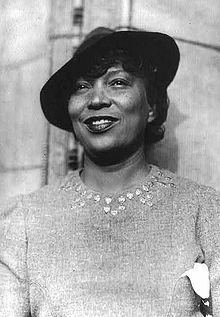
Zora2Hurston lived in New York during different times in her career from 1925 on, and joined the Harlem Renaissance. She was one of the shapers of the black literary and cultural movement of the twenties. Hurston received a lot of criticism in her time by other writers, some of whom were also involved in the Harlem Renaissance. Langston Hughes, an important black author of the period was supported early on by the same white woman as Hurston but still offered harsh criticism toward her, regarding her career. Darwin Turner was a critic of Hurston's work who tended to primarily base his critique of her work on his person views of her personality. He said she was a “quick-tempered woman, arrogant toward her peers, obsequious toward her supposed superiors, desperate for recognition and reassurance to assuage her feelings of inferiority” (1979). Darwin Turner states that all of Hurston's work must be looked at in regards to the above statement. When Darwin Turner critiques an African American male writer of that time period, Jean Toomer, he mentions nothing of Toomer's marriage to a white woman or that at one point in his career he refused to be identified with other blacks. Turner skirts this issue and says that Toomer's insisting that he wasn't a “Negro” or Caucasian- but a member of the “American” race is “philosophically viable and utterly sincere” (1979). Hurston's work came at a time when critics were both white and black, but were all men. Mary Helen Washington has said that “To a large extent, the attention focused on Zora Hurston's controversial personality and lifestyle has inhibited any objective critical analysis of her work. Few male critics have been able to resist sly innuendoes and outright attacks on Hurston's personal life, even when the work in question was not affected by her disposition or her private affairs” (1979).

Hurston was the first black scholar to research folklore on the level that she did. She researched songs, dances, tales, and sayings. Much of her book material revolves around issues of slavery and the time period immediately following it. She took her black rural culture and heritage and celebrated it at a time when most black scholars were trying hard to deny and forget it. Hurston also studied voodoo practices in Jamaica, Haiti, and the British West Indies. She took photographs and recorded their songs, dances, and rituals. She had a Guggenheim Fellowship to research in the Caribbean, where she stayed for two years. In the Caribbean, Zora Neale Hurston wrote the book she is probably most known for Their Eyes Were Watching God. It was written in 1937, after the ending of a love affair she had with a younger man. It took her seven weeks to complete. The book is about a woman named Janie who learns to find herself and accept an identity that society is not so fast to accept, as a fulfilled and autonomous black woman. Janie also finds love in this novel in a way untypical of other “love” stories of the time.

More here. (Note: In honor of African American History Month, we will be linking to at least one related post throughout February. The 2012 theme is Black Women in American Culture and History).

Exercise as Housecleaning for the Body

From The New York Times:

ExerciseWhen ticking off the benefits of physical activity, few of us would include intracellular housecleaning. But a new study suggests that the ability of exercise to speed the removal of garbage from inside our body’s cells may be one of its most valuable, if least visible, effects. In the new research, which was published last month in Nature, scientists at the University of Texas Southwestern Medical Center in Dallas gathered two groups of mice. One set was normal, with a finely tuned cellular scrubbing system. The other had been bred to have a blunted cleaning system. It’s long been known that cells accumulate flotsam from the wear and tear of everyday living. Broken or misshapen proteins, shreds of cellular membranes, invasive viruses or bacteria, and worn-out, broken-down cellular components, like aged mitochondria, the tiny organelles within cells that produce energy, form a kind of trash heap inside the cell.

In most instances, cells diligently sweep away this debris. They even recycle it for fuel. Through a process with the expressive name of autophagy, or “self-eating,” cells create specialized membranes that engulf junk in the cell’s cytoplasm and carry it to a part of the cell known as the lysosome, where the trash is broken apart and then burned by the cell for energy. Without this efficient system, cells could become choked with trash and malfunction or die. In recent years, some scientists have begun to suspect that faulty autophagy mechanisms contribute to the development of a range of diseases, including diabetes, muscular dystrophy, Alzheimer’s and cancer. The slowing of autophagy as we reach middle age is also believed to play a role in aging. Most metabolism researchers think that the process evolved in response to the stress of starvation; cells would round up and consume superfluous bits of themselves to keep the rest of the cell alive. In petri dishes, the rate of autophagy increases when cells are starved or otherwise placed under physiological stress. Exercise, of course, is physiological stress. But until recently, few researchers had thought to ask whether exercise might somehow affect the amount of autophagy within cells and, if so, whether that mattered to the body as a whole.

More here.

the defeated

StorySmallImageQHDVEVZThe-Defeated_sml

ON THE AFTERNOON OF 19 MAY 2009, at around 1:20 pm, a ration shop accountant named Sivarajan ran to the front of the winding lunch queue in the Anandakumaraswami Zone 3 refugee camp to serve rice and sodhi, a watery concoction of chillies and coconut milk. Swarna, a former militant, sat in her tent nearby, yelling at her mother for having told an army man from the morning shift that their family belonged to Mullaitivu, on the northeastern coast, where the war between the Sri Lankan Army and the separatists—“Tigers,” she called them—was still raging. At that moment, they got a text message on their mobile phones from the government’s information department. Addressed to all Sri Lankans, it proclaimed, in Sinhala—a language neither Sivarajan nor Swarna could read—that Velupillai Prabhakaran, the man who led a 26-year-long separatist battle for a Tamil Eelam (state), had been killed by the army in a lagoon just a two hours drive north of where they were. So when the news was announced in Tamil over a loudspeaker that evening, they did not believe it. When it finally sank in, they realised—neither with remorse nor relief, but mere wonder at its very possibility—that in an instant the war they had been born into had left their lives. Nothing would ever be the same again.

more from Anonymous at Caravan here.

glass

120213_r21847_p233

Philip Glass’s place in musical history is secure. His sprawling, churning, monumentally obsessive works of the nineteen-seventies—“Music with Changing Parts,” “Music in Twelve Parts,” “Einstein on the Beach,” “Satyagraha”—have fascinated several generations of listeners, demonstrating mesmeric properties that are as palpable as they are inexplicable. Twice in recent months, I’ve been gripped by the almost occult power of early Glass. Most memorably, I had my first live encounter with “Einstein,” his epic 1976 collaboration with Robert Wilson, which, twenty years after its last revival, is being prepared for a yearlong international tour. Three preview performances took place in Ann Arbor, Michigan, in mid-January; the official première will be in Montpellier, France, in March. Accounts of earlier stagings of “Einstein” primed me for transcendence; more than a few friends had told me that the work had changed their lives. For the first hour or so, though, I worried that the phenomenon might have faded. Each element of Glass and Wilson’s pop-absurdist fantasy on Einstein-ian themes came recognizably to life: the cool recitation of numbers, the frantic mathematical gesturing, the purring Gertrude Stein-like texts (“These are the days my friends / It could get some wind for the sailboat”), the locomotive inching across the stage, the violin-playing Einstein, the iconic beams of light, and, underneath it all, those moto-perpetuo arpeggios and churchlike drones.

more from Alex Ross at The New Yorker here.

looking back: the American and the Soviet century

2

The opening of McDonald’s on Moscow’s Pushkin Square in 1990 was a sensation. The Moscovites who were used to standing in line for an entire day to buy anything from cakes and school notebooks to vodka, cars or toilet paper, were quite happy to spend hours in an unmoving queue just to be there when the Soviet Union’s first fast-food restaurant opened its doors to the public. Consumerism, it seemed, had triumphed over communism. But it was not so much the taste of hamburgers and cola that drew in the people. It was something else they wanted to see: a service culture in which the guest was not treated as a pesky visitor or even enemy, but who had to be wooed as a customer. It suddenly became clear that a business would only flourish if customers got their money’s worth. Things had to happen fast, and friendliness was included in the price. The question in these late Soviet times was whether, under the rush of the crowds and the pressures of everyday Soviet life, the staff would be able to maintain the standards they proclaimed at the outset.

more from Karl Schlögel at Sign and Sight here.

Monday, February 6, 2012

Perceptions

ValleyofRocks1 Nightwalks series

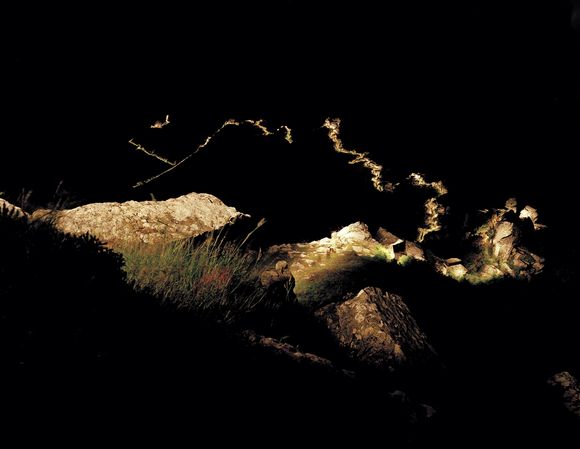
Tim Knowles. Valley of Rocks #1. Nightwalk Series. 2008.

C-type print mounted on Aluminium and framed with non-reflective glass.

Nightwalks are a series of illuminated walks that Tim Knowles created in the countryside during a new moon. Over the period of an hour, the artist walked away from the camera while carrying three wide-beam torches. His path, along a precarious rocky ridge in the darkness, was illuminated and captured using a long-exposure, large-format photograph.

More here and here.

Sunday, February 5, 2012

Superbowl Spleen

Justin E. H. Smith in his blog:

6a00d83453bcda69e20147e255274e970b-250wiLet's see, how should I spend my Sunday? Should I keep reading Herwig Wolfram's magisterial History of the Goths? Should I perhaps go a-hunting online for some whimsical new videos of cats doing unexpected things? Or should I check to see if there are any noteworthy athletic spectacles on television?

There has been a dull din, growing louder over the past few weeks, that suggests to me that some big sports event is in the offing. Distant memories from childhood cause me to associate this din, in this particular season, with football. These associations, in turn, conjure up others still: of Ronald Reagan, of high-school meatheads in letter jackets telling me not to stand too close to their girlfriends, of ROTC, of PromiseKeepers, of words like 'buddy', of a model of American masculinity that quite literally spit me out as indigestible.

More here.

Myth and Fiction at the Jaipur Literature Festival

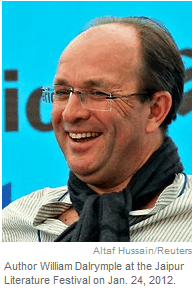
William Dalrymple in the New York Times:

ScreenHunter_10 Feb. 05 17.43While those journalists who actually attended the festival were able to write with accuracy about what happened, the further away journalists and columnists were from the event, the more distorted became their reports. Increasingly we have seen ourselves, and the festival we run, caricatured beyond all recognition.

The first myth I have watched developing after Salman cancelled his visit was that there was never any threat to his life. This is nonsense.

While we at the festival have no way finally to determine if the intelligence agencies really did exaggerate the threat perception to Salman—and that is certainly possible — what we do know is that there was a very real threat of violence at the venue if he did come. In a meeting held in Jaipur with representatives of 19 Muslim organizations on the 19th of January, the day before our opening, while the great majority of the groups were happy to pursue peaceful protests, we organizers were confronted by a few thugs who were hell bent on creating serious trouble and threatened large scale violence and personal harm to Salman and us.

They screamed threats and made it clear that they had no compunction about maiming or murdering to get their way. There were strong hints given that money had been offered to disrupt the event by any means possible. When Salman made the decision to cancel his visit, writing to us that “I can’t imperil the audience or my fellow writers or any of you,” I have no doubt that, sadly, he made the right call.

More here.