Remembering the Fatwa issued 23 years ago today

Nilanjana S Roy in India's Business Standard:
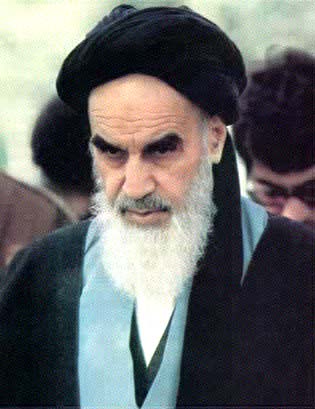
Khomeini-78Among the many things forgotten about the fatwa issued by Ayatollah Khomeini on Valentine’s Day 1989 is that it did not stop at naming Salman Rushdie for writing The Satanic Verses. The author was condemned to death “along with all the editors and publishers aware of its contents”.

In retrospect, this was a fascinating inclusion. There was the minor matter that by including Rushdie’s editors and publishers, the Ayatollah had effectively declared war against the publishing industry in general — the typesetters who laid the book out, the printers and proofreaders, all the innocent foot soldiers caught in a battle that they had not chosen. He had also declared war against those not of the faith — if mere awareness of the contents of the Verses was a crime, then arguing that one was not of the same religion and blasphemy or apostasy did not apply was no longer a defence.

More crucially, the Ayatollah’s argument was both a curiously modern and a vengefully medieval one. His recognition that awareness itself of the contents of a controversial work was a crime was both an acknowledgement that knowledge is dangerous, and stands as an indictment of readers along with writers.

More here.

Reacting to Reactionary Muslims

Jalees Rehman in the Huffington Post:

ScreenHunter_24 Feb. 14 15.30Last week, the Saudi writer and blogger Hamza Kashgari tweeted about Prophet Muhammad and his tweets caused an unanticipated fire-storm of outrage among many Saudis. They formed an “electronic lynch mob” and responded with hate-filled tweets, Face-book posts, comments, threats and YouTube videos, calling for the arrest and punishment of Kashgari.

A prominent Saudi cleric accused Kashgari of apostasy (“Ridda”), which could be punishable by death under Saudi law. Multiple sites reported that an arrest warrant was issued by the King of Saudi-Arabia, even though Kashgari deleted his tweets and apologized for them. Realizing that his life was in danger, Kashgari escaped from Saudi-Arabia. However, at the request of the Saudi authorities, Kashgari was detained mid-journey by the Malaysian police at the Kuala Lumpur airport, so that he was unable to reach his destination New Zealand, where he had intended to ask for political asylum.

The government of Malaysia is now in the process of deciding whether or not to extradite Kashgari back to Saudi-Arabia.

It is appalling that Saudi clerics and the Saudi government would resort to such measures in response to a few tweets by a 23-year old writer, who was merely expressing his personal views on his faith and Prophet Muhammad.

More here. [Photo shows Hamza Kashgari who has now been deported back to Saudi Arabia.]

the tyrant’s wife

Asma_assad_021312_620px

Dear Asma, It’s been five years since we last saw each other, but as your country has burned at the hands of your husband over the past year, I, along with the rest of the world, have wondered where you’ve been amid this madness. Then, late last week, I saw that you had finally broken your silence by emailing a British newspaper to express your support for your husband, Bashar al-Assad. As your countrymen are being tortured and murdered by the regime that bears your last name, I imagine the trips we took together are far from your mind. But I am writing to remind you of the experiences we shared—and of the Asma I once knew—when we, along with 300 other women, came together to promote peace in the Middle East by biking across the region. We first met in your palace in Damascus in 2005. You looked beautiful; as always, you were dressed in the most fashionable clothes. The last rays of the September sun streamed in from the balcony and onto your hair, perfectly styled, as you spoke to 300 women who were in Syria to “cycle for peace” on a trip run by a group called Follow the Women.

more from Parvaneh Vahidmanesh at Tablet here.

a paean to small science

Credit-Linda-Carter-12-e1328632742816

“Shut up and calculate!” As physics became more mathematical and abstract during the past century, that phrase—first uttered by physicist David Mermin—became its mantra. Indeed, the more that physicists stopped worrying about what their complicated equations meant and simply ran the numbers, the more progress they made. Some of their predictions have now been confirmed by experiments to 10 decimal places or more— the most accurate predictions in history. But the cost of this progress was striking: physics became more and more alienating as fewer and fewer people understood it. As Frank Close explains in The Infinity Puzzle, for a long time even physicists felt discontent at this state of affairs. The book brims with charming anecdotes about particle physics between the 1950s and 1980s, when breakthroughs came almost too fast to be comprehended and every scientist seemed to be maneuvering (and occasionally begging) for Nobel prizes. But the book also plumbs the origins of modern physics, especially troubles with the concept of infinity.

more from Sam Kean at The American Scholar here.

V S Pritchett: the short story comes of age

20120206_3335319_w

The origins of the short story in different regions of the world – where it came from and when, how it developed – vary from country to country. Although its birth was most often a natural transformation of what was there already, occasionally the change that occurred was more dramatic, coming from nowhere, without a pedigree of tradition or of anything else. The vitality of America’s first stories owes much to such newness, to an untrammelled purity that challenged, without being at odds with, the classicism of Russia’s vast contribution to the same literary development. In Europe – particularly perhaps in France and Germany – the influence of the antique continued, then slowly withered. “A child of our time,” Elizabeth Bowen called the modern story, irrespective of its source, and she was right. At the very heart of modernity, it belonged to a briskly different age and almost perfectly reflected it. Its matter-of-fact brevity did, its sense of urgency, its glimpsing manner, its stab of truth. Troubled Ireland took to it; Italy, too; in England it didn’t much appeal. Overshadowed by the riches and delights of the Victorian novel, it was regarded by literary England as little more than a poor relation living on the crumbs scattered by the popular success of fiction that flourished as fiction never had before. But these humbly gathered crumbs were more wholesome than they might have been. They nourished a modest art, and in modesty the English short story eventually found itself.

more from William Trevor at The New Statesman here.

Mae C. Jemison

From Biography:

Mae-Jemison-9542378-1-402Physician Mae C. Jemison was born October 17, 1956, in Decatur, Alabama. On June 4, 1987, she became the first African American woman ever admitted into the astronaut training program. On September 12, 1992, Jemison finally flew into space with six other astronauts aboard the Endeavour on mission STS47. In recognition of her accomplishments, Jemison received several awards and honorary doctorates.

When Jemison was chosen on June 4, 1987, she became the first African American woman ever admitted into the astronaut training program. After more than a year of training, she became an astronaut with the title of science mission specialist, a job which would make her responsible for conducting crew related scientific experiments on the space shuttle. On September 12, 1992, Jemison finally flew into space with six other astronauts aboard the Endeavour on mission STS47. During her eight days in space, she conducted experiments on weightlessness and motion sickness on the crew and herself. Altogether, she spent slightly over 190 hours in space before returning to Earth on September 20. Following her historic flight, Jemison noted that society should recognize how much both women and members of other minority groups can contribute if given the opportunity.

More here. (Note: In honor of African American History Month, we will be linking to at least one related post throughout February. The 2012 theme is Black Women in American Culture and History).

What’s New? Exuberance for Novelty Has Benefits

John Tierney in The New York Times:

NovelDo you make decisions quickly based on incomplete information? Do you lose your temper quickly? Are you easily bored? Do you thrive in conditions that seem chaotic to others, or do you like everything well organized?

Those are the kinds of questions used to measure novelty-seeking, a personality trait long associated with trouble. As researchers analyzed its genetic roots and relations to the brain’s dopamine system, they linked this trait with problems like attention deficit disorder, compulsive spending and gambling, alcoholism, drug abuse and criminal behavior. Now, though, after extensively tracking novelty-seekers, researchers are seeing the upside. In the right combination with other traits, it’s a crucial predictor of well-being. “Novelty-seeking is one of the traits that keeps you healthy and happy and fosters personality growth as you age,” says C. Robert Cloninger, the psychiatrist who developed personality tests for measuring this trait. The problems with novelty-seeking showed up in his early research in the 1990s; the advantages have become apparent after he and his colleagues tested and tracked thousands of people in the United States, Israel and Finland.

More here.

Tuesday Poem


The Wolf's Postscript to 'Little Red Riding Hood'
.

First, grant me my sense of history: I did it for posterity, for kindergarten teachers and a clear moral: Little girls shouldn't wander off in search of strange flowers, and they mustn't speak to strangers. And then grant me my generous sense of plot: Couldn't I have gobbled her up right there in the jungle? Why did I ask her where her grandma lived? As if I, a forest-dweller, didn't know of the cottage under the three oak trees and the old woman lived there all alone? As if I couldn't have swallowed her years before? And you may call me the Big Bad Wolf, now my only reputation. But I was no child-molester though you'll agree she was pretty. And the huntsman: Was I sleeping while he snipped my thick black fur and filled me with garbage and stones? I ran with that weight and fell down, simply so children could laugh at the noise of the stones cutting through my belly, at the garbage spilling out with a perfect sense of timing, just when the tale should have come to an end. .

by Agha Shahid Ali
from Through the Yellow Pages
publisher: Sun Gemini Press, 1987

Monday, February 13, 2012

Sunday, February 12, 2012

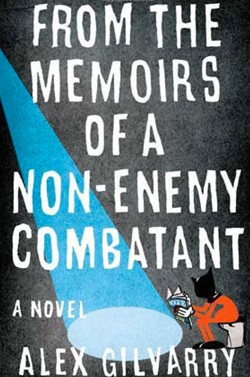
Alex Gilvarry’s From the Memoirs of a Non-Enemy Combatant

1328742337529Glenn Greenwald regularly does us a service by not only reminding us of the ongoing assault on civil liberties and human dignity in the Obama-directed war on terror but also pointing out the hypocisy of liberals and progressives in their support of the policy. Perhaps literature can move us more than reportage. Jacob Silverman on Alex Gilvarry's novel about Guantanamo, in The Daily Beast:

Novelists like to congratulate themselves for their research; time spent in Google’s far-flung quadrants is worn as a badge of authenticity. But some novels leave more to invention than others, often by necessity. Alex Gilvarry’s strange hybrid of a book is one.

“They don’t know allow novelists in Guantánamo Bay,” Gilvarry said, provoking laughter from the capacity crowd attending his book-release party last month at The Strand’s rare-books room.

Gilvarry, who is 30 and a few inches past six feet, is the author of From the Memoirs of a Non-Enemy Combatant. His debut novel tells the story of Boyet (“Boy”) Hernandez, a five-foot-one-inch Filipino immigrant who, after attaining an evanescent fame as a fashion designer in New York, is shipped off to Guantánamo Bay for his alleged connection to terrorists. The book is, unsurprisingly, a satire—no other genre could encompass two such divergent topics.

Combatant’s peculiar cocktail of themes—immigrant on the make, post-9/11 burlesque, sybaritic send-up of fashion and hipster Brooklyn—goes down smoothly because Gilvarry writes with authority, if often with tongue firmly in cheek. “I did as much research on fashion as I did on Guantánamo, which is ridiculous,” he said.

Indeed, while Boy’s tale runneth over with references to Diane von Furstenberg and Oscar de La Renta (whose “immigrant narratives” the fashion aspirant devoured while growing up in the Philippines), it’s equally replete with touchstones from the war on terrorism and the post-9/11 security state. A publicist named Ben Laden (no relation) is detained by airport police “because of ‘homophonic similarities,’ ” causing him to miss a runway show. The copy of the Quran that Boy receives in “No Man’s Land”—his word for Gitmo—was previously owned by David Hicks, an Australian detainee who was released to his home country in April 2007.

Other references come from forgotten annals of pop culture—there’s a Lou Diamond Phillips sighting—or appear as coded versions of familiar American archetypes. There’s a self-aggrandizing pop star named Chloë, whose music promotes a kind of aggressively sultry chastity (her album is called Blueballer). We encounter familiar political iconography, as when Sheriff Michaels—a Shepard Fairey-like artist—superimposes a leaked photo of the imprisoned Boy with “damp shades of red, white, and blue” and stamps the word “BEHAVE at the foot of the image.” The poster becomes a sensation, emblematizing Boy’s plight.

It’s this facility with pop culture and with deconstructing its avatars that adds a layer of piquancy to Gilvarry’s satire.

America’s Failed Promise of Equal Opportunity

Jefferson_lincoln_99-460x307Alex Gourevitch and Aziz Rana in Salon:

Americans are increasingly aware that the ideal of equal opportunity is a false promise, but neither party really seems to get it.

Republicans barely admit the problem exists, or if they do, they think tax cuts are the answer. All facts point in the opposite direction. Despite various tax cuts over the past 30 years, not only have income and wealth inequality dramatically increased, but the ability of individuals to rise out of their own class has declined. Social stagnation is increasingly the norm, with poverty rates the highest in 15 years, real wage gains worse even than during the decade of the Great Depression, average earnings barely above what they were 50 years ago, and more than 80 percent of the income growth of the past 25 years going to the top 1 percent. In fact, since 1983, the bottom 40 percent of households have seen real declines in their income and the same goes for the bottom 60 percent when it comes to wealth. We know what the economic status quo does: It redistributes upwards.

Despite the ambiguity of their goals, the Occupy protests have made one point abundantly clear: The mainstream Democratic alternative is paltry stuff. For the most part, Democrats disagree that tax cuts and deregulation are the solution, and instead argue that the state should be used to guarantee equal opportunity. For instance, cheap, publicly available education, job training and affirmative action are all justified on the grounds that each American should have the skills to compete and the labor market should treat everyone equally.

Sunday Poem

Señor

Señor, señor, can you tell me where we're headin ?
Lincoln County Road or Armageddon ?
Seems like I been down this way before
Is there any truth in that, señor ?

Señor, señor, do you know where she is hidin' ?
How long are we gonna be riding ?
How long must I keep my eyes glued to the door ?
Will there be any comfort there señor ?

There's a wicked wind still blowing on that upper deck
There's an iron cross still hanging down from around her neck
There's a marching band still playing in that vacant lot
Where's she held me in her arms one time and said, Forget me not.

Señor, señor, I can see that painted wagon
Smell the tail of the dragon
Can't stand the suspense anymore
Can you tell me who to contact here, señor ?

Well, the last thing I remember before I stripped and kneeled
Was that trainload of fools bogged down in a magnetic field
A gypsy with a broken flag and a flashing ring
He said, Son, this ain't a dream no more it's the real thing.

Señor, señor, you know their hearts is as hard as leather
Well, give me a minute, let me get it together
I just gotta pick myself up off the floor
I'm ready when you are, señor.

Señor, señor, let's overturn these tables
Disconnect these cables
This place don't make sense to me no more
Can you tell me what we're waiting for, señor ?

by Bob Dylan

Fighting for Scraps

Pankaj Mishra in The New York Times:

MishIn “The Drowned and the Saved,” Primo Levi describes an experience that fatally undermined many of his fellow condemned at Auschwitz. Entering the death camp, he had hoped, he wrote, “at least for the solidarity of one’s companions in misfortune.” Instead, there were “a thousand sealed-off monads, and between them a desperate covert and continuous struggle.” This was what Levi called the “Gray Zone,” where the “network of human relationships” “could not be reduced to the two blocs of victims and persecutors,” and where “the enemy was all around but also inside.”

It may seem grotesquely inappropriate to recall Levi’s struggles for survival in a Nazi camp while thinking of the apparently self-reliant individualists of a slum called Annawadi near Mumbai’s airport — the setting of Katherine Boo’s extraordinary first book, which describes a few months in the life of a young garbage trader, Abdul, and his friends and family. After all, these plucky “slumdogs” may be — in at least one recent fantasy — India’s next millionaires, part of the lucky 1 percent able to savor the five-star hotels that loom over Annawadi. Certainly, as noted by Boo — a staff writer at The New Yorker who was awarded the Pulitzer Prize for public service in 2000, when she was a journalist at The Washington Post — they are not considered poor by “official” Indian benchmarks; they are “among roughly 100 million Indians freed from poverty since 1991,” when the central government “embraced economic liberalization,” “part of one of the most stirring success narratives in the modern history of global market capitalism,” in which a self-propelling economic system is geared to reward motivated and resourceful individuals with personal wealth.

More here.

Phillis Wheatley: 1753 – 1784

From Progressive Eruptions:

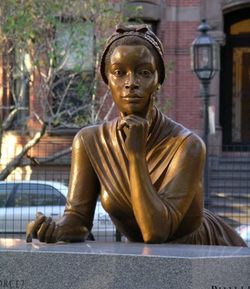
PhyllisWheatleyPhyllis Wheatley was America's first African-American poet. A bronze sculpture, by Meredith Bergmann, celebrating Ms. Wheatley is on the mall on Commonwealth Ave., Boston, Mass. Wheatley, a slave in colonial Boston, was our first published African-American poet. Her pose is derived from the only extant image of her. She represents youth and Imagination.

On Being Brought from Africa to America

'Twas mercy brought me from my Pagan land,
Taught my benighted soul to understand
That there's a God, that there's a Saviour too:
Once I redemption neither sought nor knew.
Some view our sable race with scornful eye,
“Their colour is a diabolic die.”
Remember, Christians, Negro's, black as Cain,
May be refin'd, and join th' angelic train.

I read this poem as supremely sarcastic in the poet's intent. “Twas mercy brought me from my “Pagan land…” Really? Mercy took her away from her “Pagan” land? And taught her “benighted soul?” Benighted by the white masters? The most heartbreaking lines are the last 3: “Their colour is a diabolic die.”/Remember, Christians, Negro's, black as Cain,/May be refine'd, and join th' angelic train.”

More here. (Note: In honor of African American History Month, we will be linking to at least one related post throughout February. The 2012 theme is Black Women in American Culture and History).

Two Men at Dickens World

Sam Anderson on Asad Raza in the New York Times:

ScreenHunter_23 Feb. 12 11.40A few words about Asad, who appears in the essay only as a shadowy figure: my anonymous “friend.” In reality, he was a huge part of my trip: driver, companion, interpreter, guinea pig, canary in the coal mine. Asad and I met 10 years ago in grad school, where I found him to be so intimidatingly smart — so effortlessly fluent about esoteric subjects that I’d never even heard of — that I almost dropped out of the program after two weeks. I stuck with it, though, and eventually Asad and I became friends. He’s still the most naturally critical person I know — not in the narrow sense of being negative about things, but in the large and exciting sense of taking things apart, analyzing them, concocting theories. Walking around with him feels like carrying a philosopher in your pocket.

Because we studied Dickens together at school, and because Asad lives in London now, it seemed only natural for me to bully him into coming to Dickens World. He agreed and, true to form, kept up a brilliant running commentary about everything we saw.

In my favorite picture from the trip, Asad stands on top of a very high railing in order to peer ecstatically over the wall of Miss Havisham’s garden, still discoursing.

Asad was on fire, interpretively, for the entire trip. Only Dickens World, it turned out, could make his critical motor grind to a halt. As soon as we entered the park, it was like he’d been shot by an arrow. You could feel the energy draining out of him.

More here.