Qatar Purchases Cézanne’s The Card Players for More Than $250 Million, Highest Price Ever for a Work of Art

Cn_image.size.cezanne

Alexandra Peers in Vanity Fair:

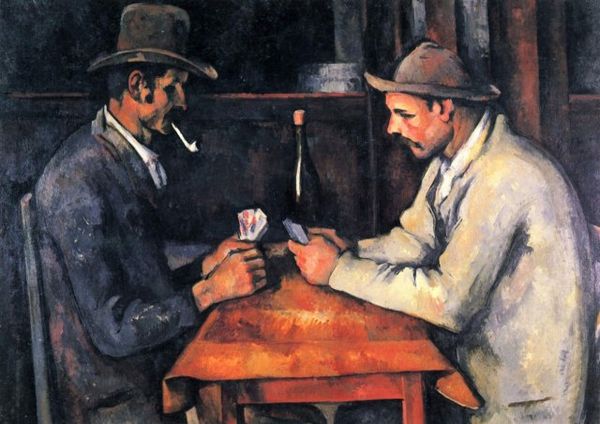
The tiny, oil-rich nation of Qatar has purchased a Paul Cézanne painting, The Card Players, for more than $250 million. The deal, in a single stroke, sets the highest price ever paid for a work of art and upends the modern art market.

If the price seems insane, it may well be, since it more than doubles the current auction record for a work of art. And this is no epic van Gogh landscape or Vermeer portrait, but an angular, moody representation of two Aix-en-Provence peasants in a card game. But, for its $250 million, Qatar gets more than a post-Impressionist masterpiece; it wins entry into an exclusive club. There are four other Cézanne Card Players in the series; and they are in the collections of the Metropolitan Museum of Art, the Musée d’Orsay, the Courtauld, and the Barnes Foundation. For a nation in the midst of building a museum empire, it’s instant cred.

Is the painting, created at the cusp of the 20th century, worth it? Well, Cézanne inspired Cubism and presaged abstract art, and Picasso called him “the father of us all.” That said, “$250 million is a fortune,” notes Victor Wiener, the fine-art appraiser called in by Lloyd’s of London when Steve Wynn put his elbow through a Picasso, in 2006. “But you take any art-history course, and a Card Players is likely in it. It’s a major, major image.” For months, he said, “its sale has been rumored. Now, everyone will use this price as a point of departure: it changes the whole art-market structure.”

More here.

Dear Super Bowl Advertisers: No Spoilers!

From The New Yorker:

Ferris-bueller-adSuper Bowl ads have been a major part of the game’s telecast since 1984, at least. That was the year that Apple débuted its “1984” spot, which was directed by Ridley Scott and showed a benumbed crowd herded into an auditorium before being liberated by an enlightened, hammer-throwing revolutionary. The commercial was a homage to George Orwell’s novel, of course, but also a suggestion that Apple Macintosh users might be more interested in individuality and energy than, say, P.C. users. It ran during the Super Bowl and only once more before it was removed from circulation; cult fame was instant.

There had been notable Super Bowl ads before “1984”: Joe Namath hawked Noxzema in 1973 and Xerox launched its famous monastery spot in 1977. But “1984” kicked things up a notch. Apple returned the following year with the “lemmings” ad, in which P.C. users marched off a cliff; it was considered a failure, but still generated tremendous interest in the week leading up to the game. In 1990, Ridley Scott directed a spot for Nissan that courted criticism for what some said was a glorification of street racing. In 1993, basketball dominated: Larry Bird and Michael Jordan played an increasingly Byzantine game of H-O-R-S-E, and Jordan was featured in a second ad that featured Looney Tunes characters and became the basis for the movie “Space Jam.” And then there was the post-9/11 Clydesdales ad of 2002, where the famed Budweiser horses crossed the Brooklyn Bridge and then bowed their heads in prayer.

More here.

Maya Angelou: Global Renaissance Woman

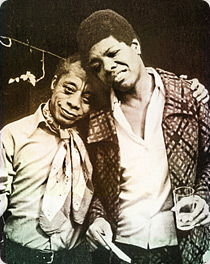
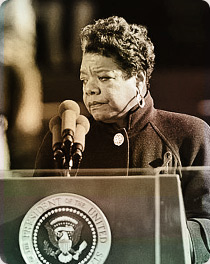
Bio6Dr. Maya Angelou is one of the most renowned and influential voices of our time. Hailed as a global renaissance woman, Dr. Angelou is a celebrated poet, memoirist, novelist, educator, dramatist, producer, actress, historian, filmmaker, and civil rights activist. Born on April 4th, 1928, in St. Louis, Missouri, Dr. Angelou was raised in St. Louis and Stamps, Arkansas. In Stamps, Dr. Angelou experienced the brutality of racial discrimination, but she also absorbed the unshakable faith and values of traditional African-American family, community, and culture. As a teenager, Dr. Angelou’s love for the arts won her a scholarship to study dance and drama at San Francisco’s Labor School. At 14, she dropped out to become San Francisco’s first African-American female cable car conductor. She later finished high school, giving birth to her son, Guy, a few weeks after graduation. As a young single mother, she supported her son by working as a waitress and cook, however her passion for music, dance, performance, and poetry would soon take center stage. In 1954 and 1955, Dr. Angelou toured Europe with a production of the opera Porgy and Bess. She studied modern dance with Martha Graham, danced with Alvin Ailey on television variety shows and, in 1957, recorded her first album, Calypso Lady. In 1958, she moved to New York, where she joined the Harlem Writers Guild, acted in the historic Off-Broadway production of Jean Genet's The Blacks and wrote and performed Cabaret for Bio5Freedom. In 1960, Dr. Angelou moved to Cairo, Egypt where she served as editor of the English language weekly The Arab Observer. The next year, she moved to Ghana where she taught at the University of Ghana's School of Music and Drama, worked as feature editor for The African Review and wrote for The Ghanaian Times.

During her years abroad, Dr. Angelou read and studied voraciously, mastering French, Spanish, Italian, Arabic and the West African language Fanti. While in Ghana, she met with Malcolm X and, in 1964, returned to America to help him build his new Organization of African American Unity. Shortly after her arrival in the United States, Malcolm X was assassinated, and the organization dissolved. Soon after X's assassination, Dr. Martin Luther King, Jr. asked Dr. Angelou to serve as Northern Coordinator for the Southern Christian Leadership Conference. King's assassination, falling on her birthday in 1968, left her devastated. With the guidance of her friend, the novelist James Baldwin, she began work on the book that would become I Know Why the Caged Bird Sings. Published in 1970, I Know Why the Caged Bird Sings was published to international acclaim and enormous popular success. The list of her published verse, non-fiction, and fiction now includes more than 30 bestselling titles.

More here. (Note: In honor of African American History Month, we will be linking to at least one related post throughout February. The 2012 theme is Black Women in American Culture and History).

Sunday Poem

One of the best leaves: Wislawa Szymborska, 1923-2012

Could Have

It could have happened.
It had to happen.
It happened earlier. Later.
Nearer. Farther off.
It happened, but not to you.

You were saved because you were the first.
You were saved because you were the last.
Alone. With others.
On the right. The left.
Because it was raining. Because of the shade.
Because the day was sunny.

You were in luck — there was a forest.
You were in luck — there were no trees.
You were in luck — a rake, a hook, a beam, a brake,
A jamb, a turn, a quarter-inch, an instant . . .

So you're here? Still dizzy from
another dodge, close shave, reprieve?
One hole in the net and you slipped through?
I couldn't be more shocked or
speechless.
Listen,
how your heart pounds inside me.

by Wislawa Szymborska
from View With a Grain of Sand
Harcourt, Brace, 1996)
translation: Stanislaw Baranczak and Clare Cavanagh

Saturday, February 4, 2012

Adonis: a life in writing

Maya Jaggi in The Guardian:

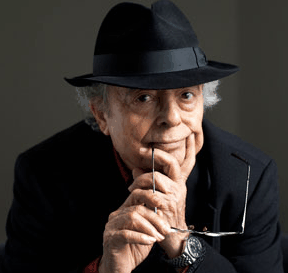
ScreenHunter_09 Feb. 05 16.47Adonis, the greatest living poet of the Arab world, ushers me down a labyrinthine corridor in a stately building in Paris, near the Champs Elysées. The plush offices belong to a benefactor, a Syrian-born businessman funding the poet's latest venture – a cultural journal in Arabic, which he edits. Fetching a bulky manuscript of the imminent third issue of the Other, Adonis hefts it excitedly on to a coffee table, listing the contributors “from west and east”, many of them of his grandchildren's generation. He turned 82 this month. His eyes spark: “We want new talents with new ideas.”

A Syrian-born poet, critic and essayist, and a staunch secularist who sees himself as a “pagan prophet”, Adonis has been writing poetry for 70 years. He led a modernist revolution in the second half of the 20th century, exerting a seismic influence on Arabic poetry comparable to TS Eliot's in the anglophone world. Aged 17, he adopted the name of the Greek fertility god (pronounced Adon-ees, with the stress on the last syllable) to alert napping editors to his precocious talent and his pre-Islamic, pan-Mediterranean muses. Since the death of the Palestinian poet Mahmoud Darwish in 2008, it would be hard to argue for a poet of greater stature in a literary culture where poetry is the most prestigious form as well as being popular.

He moved to Paris in 1985, and was named a commander of France's Order of Arts and Letters in 1997. Last year he was the first Arab writer to win the Goethe prize in Germany, and each autumn is credibly tipped for the Nobel in literature – the only Arab recipient of which to date was the Egyptian novelist Naguib Mahfouz in 1988.

More here.

What happened to Iraqi universities under US occupation?

Hugh Gusterson in the Bulletin of the Atomic Scientists:

Baghdad_university_tshirt-p235760504810379080zi7td_400As the last American soldiers left Iraq in December, so, too, did many of the journalists who had covered the war, leaving little in the way of media coverage of post-war Iraq. While there were some notable exceptions — including two fine articles by MIT's John Tirman that asked how many Iraqis had been killed as a result of the US invasion — overall the American press published few articles on the effects of the occupation, especially the consequences for Iraqis.

As a college professor, I have a special interest in what happened to Iraqi universities under US occupation. The story is not pretty.

Until the 1990s, Iraq had perhaps the best university system in the Middle East. Saddam Hussein's regime used oil revenues to underwrite free tuition for Iraqi university students — churning out doctors, scientists, and engineers who joined the country's burgeoning middle class and anchored development. Although political dissent was strictly off-limits, Iraqi universities were professional, secular institutions that were open to the West, and spaces where male and female, Sunni and Shia mingled. Also the schools pushed hard to educate women PDF, who constituted 30 percent of Iraqi university faculties by 1991. (This is, incidentally, better than Princeton was doing as late as 2009.) With a reputation for excellence, Iraqi universities attracted many students from surrounding countries — the same countries that are now sheltering the thousands of Iraqi professors who have fled US-occupied Iraq.

More here.

Modernism and the Curse of Talent: The Case of de Kooning

Rochelle Gurstein in The New Republic:

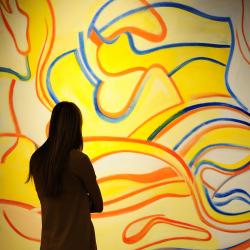
106354685For a moment, the crowd that was constantly amassing around the painting singled out by the organizers of the MOMA’s Willem de Kooning retrospective as the masterpiece of his early period—Excavation (1950)—had dispersed. So my husband and I positioned ourselves in front of it to take advantage of what we knew was a rare moment of unobstructed viewing. Excavation is strategically located to be the climactic experience in the room devoted to de Kooning’s “breakthrough” black-on-white enamel and oil paintings, which took letters from the alphabet as their starting point but through acts of concentrated painterly energy became something else—organic shapes, anthropomorphized figures, ambiguous forms, increasingly vibrant, rhythmical, and abstract, which I found thrilling to look at. Excavation, more pale yellowish-white than the black of the other paintings in the room, was de Kooning’s largest work yet—6’9” by 8’4”—and my husband pointed out that he no doubt felt compelled to work on this larger scale, given that it was the moment of the mural-scale paintings of Jackson Pollock et al. Nevertheless, it was still an “easel” painting—the distinction was Clement Greenberg’s—and if de Kooning was after the more experimental overall look and feel of a Pollock, my husband thought this painting fell short. He appreciated the psychic battle apparent in all the strenuous marks of doing and undoing that de Kooning was trying to orchestrate into a unity during the many months he worked on the painting, but the more time we spent looking, the more my husband questioned whether de Kooning’s “talent” was getting in his way: the tasteful dabs of bright color, no matter how many subversive techniques he invented in their application; his masterful line and contour, no matter how violently he worked to dislodge the figure from its own pictorial space; and most telling, his unconscious return to the center of the painting with an “x” to mark the spot, even as he tried to allow for more spontaneous composition. Such was de Kooning’s “talent” that no matter how radically he tried to break with line-bounding shapes, in Excavation, it feels like there is always a ghost of the figure about to reappear.

More here.

Illuminating the history of medicine

From Salon:

Art2

Sir Henry Solomon Wellcome died in 1936, but his curiosity about human understandings of “the preservation of health and life” — carried forward in the 21st century by the Wellcome Trust — is supremely infectious. Open “The Art of Medicine: Over 2,000 Years of Images and Imagination” (University of Chicago Press, out now), which spotlights works from London’s Wellcome Collection, and you’ll find illuminations from late medieval medical manuals; 18th-century anatomical waxworks with removable organs; leaves from hand-colored plant and herb guides; early-20th-century lithographs advertising gout remedies; astonishing close-ups of implanting human embryos; and much, much more. The collection is so wide-ranging and diverse as to defy a pithy explanation — but taken as a whole, it’s transfixing. Emma Shackleton, one of the book’s co-authors, answered a few of my questions over email; the accompanying slide show offers a whirlwind tour of the past few hundred years of medical imagery.

View the slide show

More here.

the origins of sex

Ac9455f2-4df0-11e1-b96c-00144feabdc0

Philip Larkin facetiously claimed that “Sexual intercourse began/ In nineteen-sixty-three … Between the end of the Chatterley ban/ And The Beatles’ first LP”. If perchance you thought that Larkin was being serious, Faramerz Dabhoiwala will put you right. The Oxford historian sets out to show that sex began in the 18th century – or, to be fair, that’s when people started thinking and talking about it in a recognisably modern way. Today we believe that women are less lustful than men – it was vice versa before 1800. Today we believe that everyone is entitled to be treated the same regardless of race or social class; certainly not so then. Today sex is a private matter, and what they get up to next door is nobody’s business but their own. However, if you suspected that your 17th-century neighbour was committing adultery, you could send her off to the church courts. There she might (at least theoretically) even lose her life just on the strength of your word. Is our modern obsession with the sex lives of celebrities some crude and vulgar 20th-century phenomenon? No, it actually kicked off in the 1660s.

more from Lucy Worsley at the FT here.

50 years cuckoo

67793609

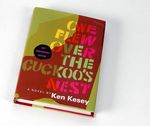
“Cuckoo’s Nest.” Sure, everyone’s heard of it. But is it worth reading? Before Jack Nicholson won his first Oscar, before there was a bus full of merry pranksters, there was a writing student with a swing-shift job in a mental ward. It’s the Ken Kesey of that era who stares from the jacket flap of the 50th anniversary edition of his debut novel, “One Flew Over the Cuckoo’s Nest”: His curly hair is cropped short, he wears a cotton work shirt and his gaze is steady. To someone of my generation — X-ish — he’s almost unrecognizable. The Kesey I knew, peripherally, was a spaced-out hippie spouting psychedelic lingo long past its expiration date. He was a former ’60s icon hauled into mainstream culture from time to time, more often than not playing the buffoon. Kesey’s novel was a rapid bestseller, but his fame came from what he did after: name a bus Further, paint it outrageous colors, fill it with counterculture friends he called the Merry Pranksters and take it on the road.

more from Carolyn Kellogg at the LA Times here.

a much more interesting figure

Fukuyama-img-articleInline

Judt’s story is in many ways very familiar: His forebears were Eastern European Jews who ended up in Britain, where they assimilated into English life. He was not brought up in a religious home — his father was a Marxist — but consciousness of the Holocaust was central to his identity; he was named after a cousin who died at Auschwitz. He attended Cambridge and began a career as a Marxist historian in the mold of his idols Eric Hobsbawm and E. P. Thompson, writing initially on obscure topics like French socialism in Provence. Intellectually, he was as French as he was English, participating in the événements of 1968 and spending a year at the École Normale Supérieure, where he befriended Marxist luminaries like the historians Annie Kriegel and Boris Souvarine. Whatever Judt’s initial ideological commitments, he later concerned himself with a stark and important question: “how so many smart people could have told themselves such stories with all the terrible consequences that ensued.” The story was that of Communism, which perpetrated “the intellectual sin of the century: passing judgment on the fate of others in the name of their future as you see it, . . . concerning which you claim exclusive and perfect information.” Looking back at the history of left-wing figures from the 1930s like the French socialist Léon Blum, he saw their central failing as the lack of “any appreciation of the possibility of evil as a constraining, much less a dominating, element in public affairs.” This was to become the theme of his 1992 book “Past Imperfect,” which chronicled French intellectuals like Jean-Paul Sartre who publicly supported Stalinism while remaining willfully blind to its horrors.

more from Francis Fukuyama at the NY Times here.

Friday, February 3, 2012

The New World of William Carlos Williams

Adam Kirsch in the New York Review of Books:

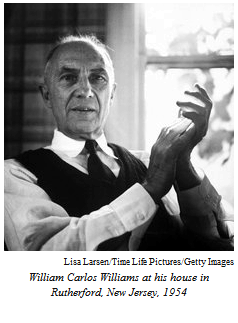
ScreenHunter_08 Feb. 03 19.47Today it would be hard to find a reader of poetry who would not acknowledge William Carlos Williams as one of the major American modernists, a peer of Wallace Stevens and Marianne Moore and Ezra Pound. His place in anthologies and on college reading lists is secure. Possibly no modern American poem is more widely known than Williams’s “The Red Wheelbarrow,” that tiny epiphany:

so much depends
upon

a red wheel
barrow

glazed with rain
water

beside the white
chickens.

This is not Williams’s best or most important poem, but it does illustrate some crucial aspects of his art. In his Autobiography (1951), Williams explains that his goal as a writer is to capture the “immediacy” of experience: “It is an identifiable thing, and its characteristic, its chief character is that it is sure, all of a piece and, as I have said, instant and perfect: it comes, it is there, and it vanishes. But I have seen it, clearly. I have seen it.” This is just what he does with the wheelbarrow, the rainwater, and the chickens: trivial in themselves, their sheer uninsistent presence strikes the reader as somehow disclosing the very essence of being. Williams himself, not given to making high claims for his own work, considered this poem “quite perfect”: “the sight impressed me as about the most important, the most integral that it had ever been my pleasure to gaze upon.”

What makes the poem work perfectly is, first, the artistry behind Williams’s apparent artlessness. “The Red Wheelbarrow,” like a number of Williams’s poems (but far from all), could easily be rewritten as prose. Yet the way Williams lays out the words on the page is central to the poem’s meaning.

More here.

The case for piracy

J. D. Hildebrand in Software Development Times:

Jdhildebrand_587026132SOPA and PIPA are dead. This doesn't mean that pirating software, music, games, and movies online is legal, but that the ability of copyright holders and government agencies to shut down the piracy supply chain remains limited.

The whole Internet community banded together to defeat SOPA and PIPA. We all felt good about protecting free speech in the face of the proposed measures. And it appears that we have won.

So we are left with the status quo. Piracy is still illegal, but it's still common. Copyright holders will continue their search for legal tools to shut down the pipeline. Pirates will continue to use ingenious methods to get their hands on copyrighted works.

What if we are looking at this the wrong way. What if, instead of expending their time and energy stopping piracy, copyright holders accepted the pirates as an inevitable, even helpful, part of the creative ecosystem?

A number of researchers, writers, and even copyright holders are starting to come around to this point of view. In increasing numbers, people are sharing their opinion that piracy is a good thing.

How could this be?

More here.

Steven Colbert v. the Supreme Court

Dahlia Lithwick in Slate:

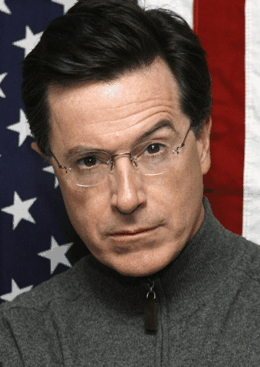
ScreenHunter_07 Feb. 03 18.54The line between entertainment and the court blurred even further late last month when Colbert had former Justice John Paul Stevens on his show to discuss his dissent in Citizens United. When a 91-year-old former justice is patiently explaining to a comedian that corporations are not people, it’s clear that everything about the majority opinion has been reduced to a punch line.

Colbert took the mainstream by storm in interview after interview that schooled Americans about the insanity of Citizens United and garnered blowback from NBC White House correspondent Chuck Todd, who complained that Colbert is “making a mockery of the system” and questioned whether the real agenda was to “educate the public about the dangers of money and politics … or simply to marginalize the Republican Party?” Then came the un-ironic defenses of the irony of Colbert and the obligatory navel-gazing about whether Colbert is in fact effecting real change or in peril of succumbing to “irony fatigue.”

At one level, this is all just comedy, and it’s hard to measure whether Colbert’s sustained attacks on the court’s campaign finance decisions are having any real impact, beyond making us laugh. On the other hand, when the New York Times declares that Colbert’s project is deadly serious, and it’s just the rest of politics that’s preposterous, something more than just theater is happening.

More here.

Solving the Scenario: Asad Raza, Art Producer

Eric J. Henderson in the Huffington Post:

2012-01-29-asad2smallOne way in which Hans Ulrich Obrist describes the art producer is: the person who “solves the scenario” surrounding a given work. But there are no regular media such as rolling credits or names in a program that would start us on a trail to finding out what that means. In fact, the job of art producer defies perfect definition when it is done well.

This is a motivating thing to unravel, since we don't often consider the inner workings of art, preferring to think of it as genius falling from the clouds. But there is a world behind each piece, and I would like to consider one part of it in order to expand our view of what makes art.

Among other things, Asad is an art producer. I met him while working as a participant in Tino Sehgal's exhibition, “This Progress,” at the Guggenheim Museum. He interviewed me for the job in a meticulous process that screened hundreds of people over, I guess, hundreds of cups of coffee. Then I watched closely as he trolled the exhibition for three months, consulting with Sehgal on everything from traffic flow to the conversations between the participants and the public. After it was over, I discovered that the intensely organized operation was the result of over a year of planning, and I even caught a glimpse of a monstrous Excel spreadsheet used to manage things all the way down to visitor flow.

More here.