putin’s dilemma

Vladimir-Putin-007

Making sense of Putin’s elections during the past decade is as important for getting his regime right as is making sense of the show trials in the 1930s for getting Stalin’s regime right. A major task of Stalin’s spin doctors seventy-five years ago was to use the trials’ pre-decided verdicts to showcase Stalin’s power – a demonstration that was all the more effective the more painfully innocent those were who, in a choreographed mise-en-scène, falsely confessed their betrayal of the Great Leader and were speedily executed for their compliance. Similarly, though much less cruelly, the show elections between 2000 and 2008 demonstrated the Putin government’s puppeteer power. The Kremlin not only manipulated those elections, it also insisted (contrary to what one might expect) that everyone be made vividly aware that it was directing the movements of every single player in the electoral charade and orchestrating every apparent crisis in the run-up to an election. The Kremlin did not play the czar, it played God. Until recently, the paradox of Putin’s Russia has been that elections, though blatantly unfree and unfair, have been at the very heart of both the regime’s popular appeal and its authoritarian credentials. Just as Stalin’s claim to power was based on his constant purging of the Party of never-ending internal enemies, Putin’s claim to power has been based on his ability to organize elections that, although obviously rigged, have excited almost no open protest.

more from Stephen Holmes and Ivan Krastev at Eurozine here.

Tuesday, April 3, 2012

Killing Babies

Km11Kenan Malik over at his site, originally in Goteborg-Posten:

Is there no moral distinction between killing a newborn baby and aborting a fetus? And should an academic paper that seemingly advocated the killing of newborns have ever been published?

Those are the questions at the heart of a controversy that has erupted after the publication of a paper entitled ‘After-birth abortion: Why should the baby live?’ in the Journal of Medical Ethics. Two Australian academics, Alberto Giubilini and Francesca Minerva, argued that the moral status of a newborn baby was identical to that of a fetus. Given that most people view abortion as morally acceptable so, they argued, there is no reason not to see infanticide as morally acceptable, too, even in ‘cases where the newborn has the potential to have an (at least) acceptable life, but the well-being of the family is at risk’. Indeed, Giubilini and Minerva reject the term ‘infanticide’, preferring to talk of ‘after-birth abortion’.

The paper, which would normally have been read only by a handful of moral philosophers, was picked by newspapers and websites and caused outrage worldwide. ‘Slaughter newborn kids, say academics’, read the headline in one British tabloid. Australian commentators, American chat show hosts and Catholic bishops weighed in, many claiming that infanticide was the logical consequence of the legalization of abortion. The two authors say that they have received death threats.

There is, in fact, little new in Giubilini and Minerva’s argument. Philosophers such as Peter Singer have long championed similar kinds of claims. Humans, Singer suggests, have no intrinsic claim to life. The interests of an individual, including their right to life, depend upon their cognitive abilities. ‘The fact that a being is a human being, in the sense of a member of the species Homo sapiens, is not relevant to the wrongness of killing it', he argues; 'it is, rather, characteristics like rationality, autonomy, and self-consciousness that make a difference. Infants lack these characteristics. Killing them, therefore, cannot be equated with killing normal human beings, or any other self-conscious beings.’

Since a newborn, unlike an adult, is incapable ‘of anticipating the future, of having wants and desires for the future’, Singer has written, so they do not suffer by being deprived of a life they could never have imagined anyway. ‘Killing a newborn baby is', in his view, 'never equivalent to killing a person, that is, a being who wants to go on living’.

A Local Approach to Continuing Higher-ed: Bar Room U

Intelpost120409_plato_560

Christopher Beha looks at a new approach to continuing higher education started by our friends over at The Brooklyn Institute for Social Research, in New York Magazine:

One recent Tuesday evening, nine twenty- and thirtysomethings gathered in the back room of Boerum Hill’s Building on Bond to discuss a crucial text for understanding our sociopolitical moment: Plato’s Republic. While a waitress brought dinner and $3 pints of Bud, their conversation meandered from the foundational treatise to related matters left unexplored by its author, like whether Ron Paul’s libertarianism is more deontological or consequentialist. (The consensus: probably deontological at heart, though voters demand consequentialist arguments.) Two hours in, the crowd migrated up to the bar, where the discussion continued in the same vein. They were still drinking and talking when the bartender announced last call.

What transpired that night just may represent the future of higher education—or at least one proudly low-tech vision of it. Politics of the City, the formal name for the somewhat informal gathering, is the first course offered by the new Brooklyn Institute for Social Research. Its instructor, Ajay Chaudhary, dreamed up the institute while teaching in Columbia’s famed Core Curriculum, in which every undergraduate reads the classics of Western civilization. “Whenever I talked with people outside the university about what I did,” Chaudhary said, “they would tell me, ‘I want to do that. I want to read Aristotle and Augustine.’ ”

Continuing-education programs tend to be bluntly functional (professional-development courses like computer programming or bookkeeping), less than rigorous (culture “appreciation” classes), or flat-out silly (see “Transformers Star Tyrese Gibson: How to Get Out of Your Own Way—Tips for Making It” at the Learning Annex). More serious academic fare is proliferating online, but those classes are primarily for quants not quals.

In addition to classes, they are raising money over at Kickstarter to develop a knowledge tool, ~Archive. Consider a donation:

The ~Archive is a tool to provide easy electronic access to out-of-print or hard to find texts.

Okay, it's a tool. How does it work?

It happens every day. Mostly to academics, journalists, and other knowledge professionals, but also to anyone who is conducting independent research or simply trying to figure out something that's just beyond the reach of Google, Wikipedia, or even the local library. You find a reference to an important but impossible to find text. It could be old. It could be out of print. It could be rare. All you know is that you need it and you can't have it. These are not the old books you can already get for free on your Kindle or iPad through Project Gutenberg, or what you can find, sometimes incomplete, on Google Books. We love these services and wonder how we ever lived without them. We are talking about a lot of other stuff. Stuff that fell through the cracks. Works that history forgot to record, except for a tiny reference in an essay or a newspaper review. Books that are crumbling in an archive or private collection, which normally couldn’t be reproduced without permanent damage. And that's where our ~Archive comes in.

Facebook: The Next Tool in Fighting STDs

Std_facebook-460x307Tracy Clark-Flory in Salon:

Imagine being able to download a Facebook app that would alert you to your sexually transmitted infection risk based on your friend’s status updates. This may sound far-fetched, and it still is, but as some researchers shift their focus to risk among friend groups, as opposed to just sexual partners, social networks are rapidly becoming a tool to prevent the spread of STIs.

Peter Leone, a professor of medicine at the University of North Carolina’s Center for Infectious Diseases, is one of those experts. Earlier this month, he spoke at an international health conference and underscored the importance of exploring such possibilities. Real-world social networks — in other words, a person’s circle of friends and sexual partners — have already proved to be strong predictors of STI risk, he says. It follows that sites like Facebook, which convene all of those real-world connections in one virtual setting, have huge potential in this arena.

Leone found that when sexual partners of patients newly diagnosed with HIV came in for testing, 20 percent turned up HIV-positive. It might seem counter-intuitive to extend the targeted test circle to those a newly diagnosed patient is merely friends with, but people in the same social circle often sleep with the same people, and might engage in similar risk-related behavior. Instead of looking at people within a particular at-risk demographic, this approach allows them to target known clusters of infection.

Makes you think of the people on your “Close Friends” list a bit differently, doesn’t it?

The art of staying alive

From The Independent:

TomTom was my husband. Writing was his life and work. But in September 2008 he was diagnosed with a 'grade four' brain tumour, situated in the left temporal lobe, the area responsible for speech and language. During his last year, articulate speech became an effort. He willed words into being as they vanished again. It was a transcendent time, volatile and strange; full of danger. Tom's work was to keep his illness and his life in clear sight. His task was, in his own words, “a lesson in imagination, in self-imagination”. The incredible thing was that he could write this down.

Our house had long been a word factory. Since 11am on 11 March 2010, when we noticed Tom's words skip their sense in a more radical way, we knew that we were really in trouble. Tom had a second craniotomy on 13 April. After this, we were focused on the making of meaning. The level of production was intense. Tom kept writing. He revised older texts, collated essays, worked on images for an exhibition and wrote new material.

More here.

A Little Device That’s Trying to Read Your Thoughts

From The New York Times:

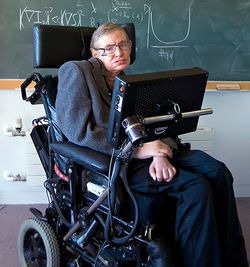
HawkSAN DIEGO — Already surrounded by machines that allow him, painstakingly, to communicate, the physicist Stephen Hawking last summer donned what looked like a rakish black headband that held a feather-light device the size of a small matchbox. Called the iBrain, this simple-looking contraption is part of an experiment that aims to allow Dr. Hawking — long paralyzed by amyotrophic lateral sclerosis, or Lou Gehrig’s disease — to communicate by merely thinking. The iBrain is part of a new generation of portable neural devices and algorithms intended to monitor and diagnose conditions like sleep apnea, depression and autism. Invented by a team led by Philip Low, a 32-year-old neuroscientist who is chief executive of NeuroVigil, a company based in San Diego, the iBrain is gaining attention as a possible alternative to expensive sleep labs that use rubber and plastic caps riddled with dozens of electrodes and usually require a patient to stay overnight. “The iBrain can collect data in real time in a person’s own bed, or when they’re watching TV, or doing just about anything,” Dr. Low said. The device uses a single channel to pick up waves of electrical brain signals, which change with different activities and thoughts, or with the pathologies that accompany brain disorders. But the raw waves are hard to read because they must pass through the many folds of the brain and then the skull, so they are interpreted with an algorithm that Dr. Low first created for his Ph.D., earned in 2007 at the University of California, San Diego. (The original research, published in The Proceedings of the National Academy of Sciences, was done on zebra finches.)

About the Hawking experiment, he said, “The idea is to see if Stephen can use his mind to create a consistent and repeatable pattern that a computer can translate into, say, a word or letter or a command for a computer.”

More here.

Tuesday Poem

Grammar

Maxine, back from a weekend with her boyfriend,
smiles like a big cat and says
that she's a conjugated verb.
She's been doing the direct object
with a second person pronoun named Phil,
and when she walks into the room,
everybody turns:

some kind of light is coming from her head.
Even the geraniums look curious,
and the bees, if they were here, would buzz
suspiciously around her hair, looking
for the door in her corona.
We're all attracted to the perfume
of fermenting joy,

we've all tried to start a fire,
and one day maybe it will blaze up on its own.
In the meantime, she is the one today among us
most able to bear the idea of her own beauty,
and when we see it, what we do is natural:
we take our burned hands
out of our pockets,
and clap

by Tony Hoagland
from Donkey Gospel, 1998
Graywolf Press, St. Paul, Minn.

The Wave Cry, the Wind Cry

Cover-sightlines

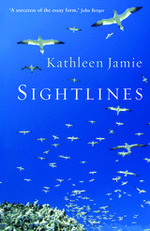
‘I sat there, as the others worked, and wished, as I so often do, that I could draw.’ Where the poet Kathleen Jamie sat was within the rib cage of a blue whale, in the hvalsalen (the whale hall) of the natural history museum in Bergen. Her wish was needless because her written words make readers see with a clarity bestowed by only a few most gifted writers. It was, however, an enlightening wish. It expressed the intensity of her own seeing, her gift. Only someone with obsessively hungry eyes can write as she does. It makes her, to borrow John Berger’s words quoted on the jacket of Sightlines, ‘a sorceress of the essay form’. It does not matter what she is describing, you see it with her. In the first of these essays she is on a ship threading its way between icebergs up the longest fjord in the world. In the morning sunlight an iceberg glows ‘marsh-mallow pink’, and ‘trinkets’ of white ice are scattered along the shores. In the next essay, she is in a hospital in Dundee: having concluded that nature ‘is not all primroses and otters’, she needs to get the feel of our own intimate inner natural world, the body’s shapes and forms. She has therefore found her way into a pathology lab, and then into a post-mortem. ‘I thought “we are just meat”, then called it back. Flesh, bodily substance, colons, livers and hearts, had taken on a new wonder.’

more from Diana Athill at Literary Review here.

notes on sontag

Cover00

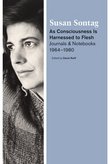
THE TITLE OF THE SECOND VOLUME of Susan Sontag’s private writings is taken from an entry dated May 22, 1965, when Sontag was thirty-two years old. “Novel about thinking—” it begins. “An artist thinking about his work.” In the margins, she adds, “A spiritual project—but tied to making an object (as consciousness is harnessed to flesh).” It’s a strange and spooky phrase, the richest image in the diary’s five hundred pages. There’s something sad about this emblem of captivity, the spirit being put under reins. There’s also something enabling and empowering—the inanimate being directed, gaining strength, driving forward. Being harnessed to flesh means being flexible enough to move. The animating force at the heart of everything Sontag wrote—the cultivation of aesthetic and intellectual experience—is not properly speaking an idea; it’s a stance, or an attitude. It is itself a way of moving. There is no magnum opus or theoretical treatise that we can point to as Sontag’s distinct contribution, no “takeaway” we can pierce under glass. So it may not be very surprising that since her death eight years ago, the many provocations of her thinking have drifted out of view to make room for the more obvious fact of her celebrity. Besides, she’s a woman; we make good icons.

more from Christine Smallwood at Bookforum here.

the wolf knife

Dvd_nakadate_150

By the time Laurel Nakadate’s The Wolf Knife premiered, in 2010, Nakadate was already known as one of the most provocative and ambitious video artists in New York. Her fearless short films of unglamorous, middle-aged bachelors and the youthful filmmaker herself dancing to Britney Spears, stripping, or singing over a birthday cake, were “incredibly twisted,” as Jerry Saltz put it in the Village Voice. The Wolf Knife, Nakadate’s second feature film, is the daughter of this early work, and inspires similar creepy feelings about desire, domination, and voyeurism. It is also a significant artistic leap forward. Unsurprisingly, the film received nominations for an Independent Spirit Award and a Gotham Independent Film Award for “Best Film Not Playing at a Theater Near You.” Also unsurprisingly, the film has provoked some viewers to walk out within the first fifteen minutes of a screening. Variety called her “an interesting, infuriating artist” and wondered whether many people would be “willing to withstand what she has to say,” but then grudgingly admitted the film was worthy of respect. At the very least, one might call the film “uncomfortable.” Or one might dub it, as the New Yorker did, “a neorealist version of a Lynchian nightmare.”

more from Deb Olin Unferth’s intro and a link to watch the trailer at The Believer here.

Monday, April 2, 2012

Sunday, April 1, 2012

In Defense of Peter Beinart

Israel_tank_rtr_img(1)Dana Goldstein in The Nation:

I write about Israel-Palestine issues only occasionally, because the onslaught of emails and comments calling me a self-hating Jew can be emotionally overwhelming. It’s also difficult to weather the respectful but strident disagreement from some friends and members of my family, who consider me insufficiently pro-Israel because I support the international community moving with deliberate speed to pressure the Netanyahu administration to end the occupation and create a viable Palestinian state. (This position, I might add, is a relatively centrist one common among Jewish Israeli writers and activists; many well-intentioned folks further to the left support a “single-state solution” that would soon make Jews a minority within Israel.)

This debate can get nasty. So I am somewhat in awe of my colleague* Peter Beinart, who seems to be made of stronger stuff than I am. I can only imagine what Beinart has experienced over the past few weeks, as the New York Times published his op-ed in favor of what he terms “Zionist BDS”—a boycott movement targeting Israel’s occupation of the West Bank; the Daily Beast launched Open Zion, Beinart’s new group blog featuring voices who oppose the occupation; and Times Books published his bracing new polemic, The Crisis of Zionism.

Beinart attends an Orthodox synagogue and sends his children to Jewish day school. Even the most cursory reading of his work reveals his critique of Israeli policy is motivated not by antipathy toward the Jewish state, but by an unwavering commitment to liberal Zionism: the belief that Israel should protect minority rights and conduct itself according to Jewish social justice values. Indeed, Beinart has been criticized from the left for opposing the occupation too much because it threatens Israel’s liberal, democratic character, and not being outraged enough about the displacement and subsequent statelessness of Palestinians. I disagree with this critique; Beinart writes unflinchingly about the massacres of Palestinian Arabs that accompanied Israel’s founding. His identification with Fadel Jaber, a Palestinian father unjustly arrested for “stealing water,” frames the entire book, and The Crisis of Zionism concludes with a call for liberal Jews to ally themselves with the Palestinian non-violence movement. But it’s worth noting Beinart is hearing pushback from all sides.

Neuroscientists: We Don’t Really Know What We Are Talking About, Either

Brain-dunce-cap-300x283Ferris Jabr over at the Scientific American blog:

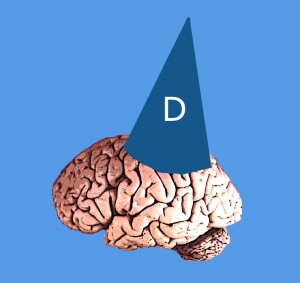
At a surprise April 1 press conference, a panel of neuroscientists confessed that they and most of their colleagues make up half of what they write in research journals and tell reporters. “We’re always qualifying our conclusions by reminding people that the brain is extremely complex and difficult to understand—and it is,” says Philip Tenyer of Harvard University, “but we’ve also been a little lazy. It is just easier to bluff our way through some of it. That’s one perk of being a respected neuroscientist—you can pretty much say whatever you want about the brain because so few people, including other neuroscientists, understand what you’re talking about in the first place. As long as you throw in enough jargon, it sounds science-y and legit and stuff.”

“It’s not just what we write in our studies,” explains Stephanie Sigma of Stanford University. “It’s a lot of the pretty pictures, too. You know those images with captions claiming that certain brain regions ‘light up’ like the fourth of July? I mean, come on. Most of the participants in these studies are college freshmen who only enrolled in Intro Psychology to satisfy a mandatory academic requirement. There is only one thing they know how to ‘light up’—and it’s not their brains. Frankly, we were just hoping that the colorful images would keep people’s attention. People like pretty pictures—that is something we’ve shown in our studies. Although I can’t quite remember if that was one of the findings we made up or not…”

People who read a lot of neuroscience news have probably noticed several consistent contradictions, says Laura Sulcus of Dartmouth College. “Some studies say that different brain regions work in concert to perform a single complex task, whereas other studies argue that a particular cognitive function—such as recognizing faces—is basically the sole domain of one region. The thing is, just because one part of the brain shows more activity than another, it doesn’t mean that it is the only piece involved. But it is just so easy to pick a neglected area, dress it up with some colorful fMRI studies and present it to the world as a distinct, functional region of the brain. How can we resist?…”

White Until Proven Black: Imagining Race in Hunger Games

Rue-hunger-gamesAnna Holmes in The New Yorker [h/t: Linta Varghese]:

On Tuesday, February 28th, a twenty-nine-year-old Canadian male fan of Suzanne Collins’s dystopian young adult trilogy, “The Hunger Games,” logged onto the popular blogging platform Tumblr for the first time and created a site he called Hunger Games Tweets. The young man, whom I’ll call Adam, had been tracking a disturbing trend among Hunger Games enthusiasts: readers who could not believe—or accept—that Rue and Thresh, two of the most prominent and beloved characters in the book, were black, had been posting vulgar racial remarks.

Adam, who read and fell in love with the trilogy last year, initially encountered these sorts of sentiments in the summer of 2011, when he began visiting Web sites, forums, and message boards frequented by the series’s fans, who were abuzz with news about the film version of the book. (The movie, released a week ago today, made a staggering $152.5 million during its first three days of release.) After an argument broke out in the comments section of an Entertainment Weekly post that suggested the young black actress Willow Smith be cast as the character of Rue, he realized that racially insensitive remarks by “Hunger Games” fans were features, not bugs. He soon began poking around on Twitter, looking at tweets that incorporated hashtags—#hungergames—used by the book’s devotees. Like the conversations found on message boards, some of the opinions were vitriolic, if not blatantly racist; unlike the postings on fan forums, however, the Twitter comments were usually attached to real identities.

“Naturally Thresh would be a black man,” tweeted someone who called herself @lovelyplease.

“I was pumped about the Hunger Games. Until I learned that a black girl was playing Rue,” wrote @JohnnyKnoxIV.

“Why is Rue a little black girl?” @FrankeeFresh demanded to know. (she amended her tweet with the hashtag admonishment #sticktothebookDUDE.)

Adam was shocked—Suzanne Collins had been fairly explicit about the appearance, if not the ethnicity, of Rue and Thresh, who, along with twenty-two other kids, are thrown into the life-or-death, Lord of the Flies-esque battle that the book is named for.

The Mastery of Non-Mastery

Tumblr_m1omardgY11qhwx0oJennifer Wallace on Michael Taussig’s I Swear I Saw This, in the Los Angeles Review of Books:

There are two types of anthropologists: One models himself on the scientist, treating the world as his laboratory, people as his raw data. He mounts surveys, crunches numbers, and, crucially, remains detached and dispassionate throughout the process. He applies for big research grants with “expected outcomes” and “anticipated impact” carefully delineated long before he has gone out into the field. The other kind of anthropologist is more like a religious initiate, participating fully in the culture in which he is placed and intimating that he is then the possessor of some secret knowledge. Like an initiate, he cannot anticipate any “outcomes” before they happen but must simply live in the moment and immerse himself in the local customs and values.

It is this latter tradition of which Michael Taussig, an eminent professor at Columbia University, is one of the greatest exponents. The New York Times has called his work “gonzo anthropology.” He has drunk hallucinatory yagé on the sandy banks of the Putumayo River. He’s cured the sick with the aid of spirits. He’s escaped from guerrillas in a dugout canoe at dawn. Above all, he is interested in individual stories and experiences, unique tales that cannot be reduced to rational explanation or bland report. To read Taussig is to have an adventure in which one can move from Walter Benjamin’s experiments with hashish to American kids’ drawings to that dawn-lit canoe without skipping a beat. His narrative is lyrical, mesmeric.

At the center of Taussig’s method is the anthropologist’s desire to bear witness to what he cannot understand. Meditating on his sketch and notes, Taussig imbues the event with the magical aura of a collector’s gem. Was it chance or fate that brought them together in that tunnel? And was it chance or fate that transfigured the relatively common scene into something haunting and extraordinary?

The Center of the Rebellion

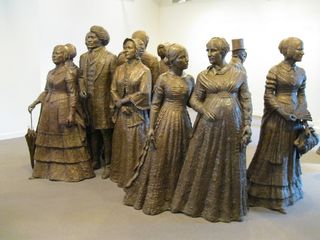
Seneca Falls NY May 2011_Womens Rights Natl Hist Park early supportter statues 2Lynne Weiss over at the always interesting “Dispatches” section of The Common:

Seneca Falls has a much bigger place in history than it does in geography. It is usually mentioned only as the location of the 1848 Women’s Rights Convention, famously organized by women’s rights crusader, Elizabeth Cady Stanton. So rarely is it mentioned in any other context that one might think it did not exist before or after that event. It’s a small town, much like many other old mill towns in New England and upstate New York, and seems an unlikely setting for, as Stanton called her farmhouse home, “The Center of the Rebellion.” (Stanton was proud of having kept her birth name–Cady–after she married, but for purposes of brevity I call her Stanton here.)

Ironically, it was because Seneca Falls was so humdrum that Stanton was driven to organize a convention. Before they moved to Seneca Falls in 1847, Stanton lived in Boston, where she and her husband Henry entertained leading thinkers and writers—William Lloyd Garrison, Lydia Maria Child, Frederick Douglass, Bronson Alcott, John Greenleaf Whittier, Margaret Fuller, Ralph Waldo Emerson, and Nathaniel Hawthorne. Stanton attended plays, concerts, and lectures. She had maids and nurses to help care for her seven children. She and Henry moved to Seneca Falls for the sake of Henry’s political career, but when he failed to win elected office, he became a political journalist, spending nearly all his time in Albany and Washington, D.C., leaving Stanton to her own devices.

Gershwin Writ Small

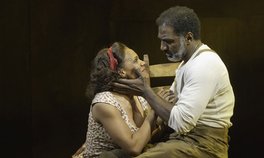
Horowitz_247524hJoseph Horowitz on the controversial production of Porgy and Bess now on Broadway, in the TLS:

Porgy and Bess – with music by George Gershwin, a book by DuBose Heyward, and lyrics by Heyward and Ira Gershwin – split opinion when it opened on Broadway in 1935. No American could respond without prejudice to a black opera by a Brooklyn Jew with roots in Tin Pan Alley. Only immigrants and foreigners found it possible to acclaim Gershwin without patronizing him. A Broadway revival in 1942, recasting the opera as a musical, was more successful. In the 1950s and 60s, Porgy and Bess was little performed in the United States; its depiction of an impoverished African American courtyard community was considered demeaning. From 1976, a widely seen Houston Grand Opera production revalidated Porgy and Bess and proved its operatic mettle. A production at the Metropolitan Opera in 1985 was a ponderous failure.

The new Porgy and Bess is nothing if not boldly conceived. In 1942, five years after Gershwin’s death, his recitatives were replaced by dialogue, and cast and orchestra were greatly reduced in strength. Paulus and company have done that and more. We have new speeches, new harmonies, new accompaniments, even virtually new numbers. “Summertime” is a duet. “It take a long pull to get there” is a male vocal quartet distending Gershwin’s pithy fisherman’s tune. Both pit and stage are substantially amplified.

There can be no such thing as a Gershwin purist. It is part of his genius that he cannot be categorized. The cultural fluidity of Porgy and Bess – of Gershwin, generally – is such that he is also interpretively fluid. Stravinsky insisted that his music should not be interpreted, whereas with Gershwin, interpretation is both necessary and irresistible. Rhapsody in Blue has no definitive score or length. The Concerto in F can be sentimental or sec, “Russian” or “French”. The first recordings of Porgy’s songs range in style from the operatic largesse of Lawrence Tibbett’s humbling “Oh Bess, oh where’s my Bess?” (1935) to Avon Long’s swinging “I got plenty o’ nuttin’” with the Leo Reisman Orchestra (1942). There will never be an “authentic” Porgy and Bess.

AQuantum Theory of Mitt Romney

01QUANTUM2-popupDavid Javerbaum in the NYT:

Before Mitt Romney, those seeking the presidency operated under the laws of so-called classical politics, laws still followed by traditional campaigners like Newt Gingrich. Under these Newtonian principles, a candidate’s position on an issue tends to stay at rest until an outside force — the Tea Party, say, or a six-figure credit line at Tiffany — compels him to alter his stance, at a speed commensurate with the size of the force (usually large) and in inverse proportion to the depth of his beliefs (invariably negligible). This alteration, framed as a positive by the candidate, then provokes an equal but opposite reaction among his rivals.

But the Romney candidacy represents literally a quantum leap forward. It is governed by rules that are bizarre and appear to go against everyday experience and common sense. To be honest, even people like Mr. Fehrnstrom who are experts in Mitt Romney’s reality, or “Romneality,” seem bewildered by its implications; and any person who tells you he or she truly “understands” Mitt Romney is either lying or a corporation.

Nevertheless, close and repeated study of his campaign in real-world situations has yielded a standard model that has proved eerily accurate in predicting Mitt Romney’s behavior in debate after debate, speech after speech, awkward look-at-me-I’m-a-regular-guy moment after awkward look-at-me-I’m-a-regular-guy moment, and every other event in his face-time continuum.

The basic concepts behind this model are:

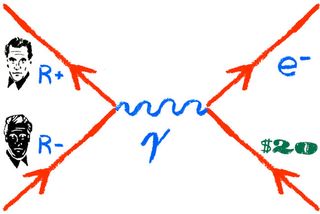
Complementarity. In much the same way that light is both a particle and a wave, Mitt Romney is both a moderate and a conservative, depending on the situation (Fig. 1). It is not that he is one or the other; it is not that he is one and then the other. He is both at the same time.

Probability. Mitt Romney’s political viewpoints can be expressed only in terms of likelihood, not certainty. While some views are obviously far less likely than others, no view can be thought of as absolutely impossible. Thus, for instance, there is at any given moment a nonzero chance that Mitt Romney supports child slavery.