The Failure of European Intellectuals?

Benda_225wJan-Werner Müller in Eurozine:

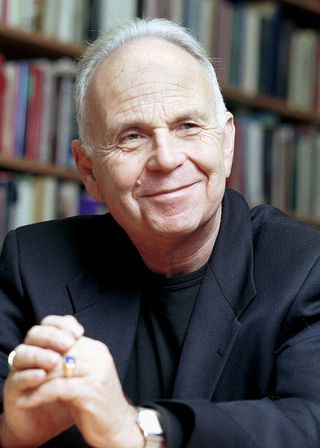
Towards the end of last year, as the Eurozone crisis was reaching (yet another) climax, a number of journalists in the German quality press alerted their readers to an aspect of the crisis which had received scant attention so far: the euro crisis marked not only the failure of Europe's central bankers, or Greek bureaucrats, or Italian non-taxpayers, or Angela Merkel (all depending on one's perspective) – it also signified a comprehensive failure of intellectuals. Why were they not defending the great achievements of European integration? Why were they not putting forward appealing visions of the continent's future, instead squandering a great legacy of mutual trust and understanding among Europeans which had been nurtured over many decades? Were they simply sleeping through a crisis that might eventually usher in the return of ugly nationalisms? Or even military conflict, as elder European statesmen like Helmut Kohl never tire of warning?

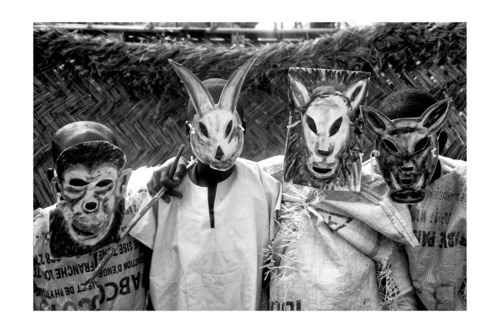
The idea of a distinctive “failure” or even “betrayal” of the intellectuals originated in the twentieth century. The latter was commonly understood as an “age of ideologies”: ideas not only mattered in some vague general manner, they could be directly translated into politics and turn into deadly forces. Just think of Czeslaw Milosz's famous observation that in mid-twentieth-century Europe “the inhabitants of many European countries came, in general unpleasantly, to the realization that their fate could be influenced directly by intricate and abstruse books of philosophy”. Intellectuals acted on the world-historical stage, taking part in the bloody drama of the battle between liberal democracy, fascism, and Soviet communism.

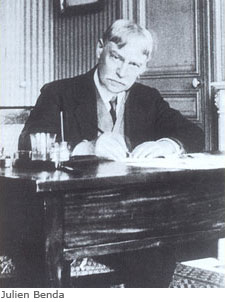
Given this role, what constituted “failure”? Not speaking one's ideologically prescribed lines correctly? In 1927 the French essayist and moraliste Julien Benda accused fellow writers and philosophers of betraying their vocation by advocating nationalist positions: proper intellectuals would speak (universal and timeless) truth to power, he argued, instead of being in the business of advancing the national interest.

Wednesday Poem

Riverbend Subdivision

Before all these houses and their shrubs,
at the end of the stretch of hardwoods,
there was a stand of white pines
edging the big bottom field by the river.
I would save going there,
wait until the morning had warmed a little,
until the sun had worked all the way to the forest floor,
until the frost-latch on the dead leaves,
those brown oak leaves still clinging,
had released and the ones that were going to fall that day
had fallen.
Then I’d walk to the chapel of the pines,
carpeted with years of the blonde needles
that silenced my walking.
Their trunks were grey, green, blue, lichen-pocked,
or maybe it was a moss.
There were long white tear streaks of resin
from the knot holes.
At the base of a few trunks were swirled nests
that looked like something had slept there.
I would stand silent in that vestibule
to the flat, corn-growing bottom land,
the workland of corn planting and corn cutting,
that earning, feeding land
outside the shade of the quiet, quiet trees
in the river’s bend.

by Michael Chitwood
from Drafthorse

Lessons From Ants to Grasp Humanity

From The New York Times:

AntsTo the biologist Edward O. Wilson, the Metropolitan Museum of Art encapsulates some of the conflicting impulses natural selection has instilled in humans: the innate drive for expression that spurs some of us to make art, the selfishness that motivates others to earn the riches needed to collect it, and the altruism that compels the donation of collections for the public good — as long as the donors’ names are inscribed on the walls too. But asked to imagine the museum from the perspective of ants, whose intricate social world he has built a towering reputation by studying, Dr. Wilson painted a scene that was less a lesson in evolution than a chaotic free-for-all. “To them the crowds would just be a flank-to-flank herd of enormous elephants you have to dodge around,” he said with a boyish giggle from the museum’s teeming steps during a recent visit to New York to promote his 27th book, “The Social Conquest of Earth,” which is being published Monday by Liveright. “I don’t think ants would have any aesthetic or intellectual interest in the museum, though they would certainly find a happy home in Central Park.”

An ant’s-eye view of an art museum may seem odd. But Dr. Wilson, 82, has made a grand scientific and literary career by bringing Homo sapiens and the natural world we emerged from closer together, uniting phenomena great and small under the grand perspective of evolution. “Human history makes no sense without prehistory, and prehistory makes no sense without biology,” he said, echoing a line from the new book, which offers a sweeping account of the human rise to domination of the biosphere, rounded out with broad reflections on art, ethics, language and religion.

More here.

Tuesday, April 10, 2012

Geometry, Topology and Destiny

Mark Trodden in Cosmic Variance:

When we apply GR to cosmology, we make use of the simplifying assumptions, backed up by observations, that there exists a definition of time such that at a fixed value of time, the universe is spatially homogeneous (looks the same wherever the observer is) and isotropic (looks the same in all directions around a point). We then specialize to the most general metric compatible with these assumptions, and write down the resulting Einstein equations with appropriate sources (regular matter, dark matter, radiation, a cosmological constant, etc.). The solutions to these equations are the famous Friedmann, Robertson-Walker spacetimes, describing the expansion (or contraction) of the universe.

It is important to take a moment to emphasize what we have done here. GR is indeed a beautiful geometric theory describing curved spacetime. But practically, we are solving differential equations, subject to (in this case) the condition that the universe look the way it does today. Differential equations describe the local behavior of a system and so, in GR, they describe the local geometry in the neighborhood of a spacetime point.

Because homogeneity and isotropy are quite restrictive assumptions, there are only three possible answers for the local geometry of space at any fixed point in time – it can be spatially positively curved (locally like a 3-dimensional sphere), flat (locally like a 3-dimensional version of a flat plane) or negatively spatially curved (locally like a 3-dimensional hyperboloid). A given cosmological solution to GR tells you one of these answers around a spacetime point, and homogeneity then tells you that this is the same answer around every spacetime point. This is what we mean when we say that GR tells us about geometry – the shape of the universe – as depicted in the NASA graphic below.

This raises a very different question that is often confused with the one above. If our solution tells us that the universe is locally a 3-sphere (or flat space, or a hyperboloid) around every point, then does that mean it is a 3-sphere, or an infinite flat 3-dimensional space, or an infinite hyperboloid. This is really a question of topology – how is it connected up – which also answers the question of whether the universe is finite or infinite.

Storm Over Young Goethe

Coetzee_1-042612_jpg_470x488_q85J. M. Coetzee on Goethe's The Sufferings of Young Werther, in the NYRB:

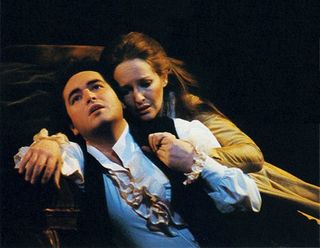
In the spring of 1771 Werther (no first name), a young man of good education and comfortable means, arrives in the small German town of Wahlheim. He is there to attend to family business (an inheritance) but also to escape an unhappy love affair. To his friend Wilhelm back home he writes long letters telling of the joys of living close to nature as well as of his meeting with a local belle, Charlotte (Lotte), who shares his tastes in literature.

Unfortunately for Werther, Lotte is betrothed to Albert, an up-and-coming young bureaucrat. Albert and Lotte treat Werther with the utmost friendliness, but he finds the frustration of his undeclared love for Lotte increasingly hard to bear. He quits Wahlheim to take up a diplomatic post in a principality some distance away. Here he suffers a humiliating snub when, as a person of middle-class origin, he is asked to leave a reception for the diplomatic corps. He resigns, and for months drifts around before fatalistically returning to Wahlheim.

Lotte and Albert are now married; there is no hope for Werther. His letters to Wilhelm break off, and an unnamed editor appears on the scene, undertaking to put together a record of Werther’s last days from his diaries and private papers. For, it emerges, having decided that there is no way out, Werther has borrowed Albert’s dueling pistols and, after a last, stormy meeting with Lotte, shot himself.

The Sufferings of Young Werther (otherwise known as The Sorrows of Young Werther) appeared in 1774. Goethe sent a synopsis to a friend:

I present a young person gifted with deep, pure feeling and true penetration, who loses himself in rapturous dreams, buries himself in speculation, until at last, ruined by unhappy passions that supervene, in particular an unfulfilled love, puts a bullet in his head.

This synopsis is notable for the distance Goethe seems to be putting between himself and a hero whose story was in important respects his own.

Is Some Homophobia Self-Phobia?

Over at Science Daily, a report on a study that suggests that the answer is yes:

Homophobia is more pronounced in individuals with an unacknowledged attraction to the same sex and who grew up with authoritarian parents who forbade such desires, a series of psychology studies demonstrates.

The study is the first to document the role that both parenting and sexual orientation play in the formation of intense and visceral fear of homosexuals, including self-reported homophobic attitudes, discriminatory bias, implicit hostility towards gays, and endorsement of anti-gay policies. Conducted by a team from the University of Rochester, the University of Essex, England, and the University of California in Santa Barbara, the research will be published the April issue of the Journal of Personality and Social Psychology.

“Individuals who identify as straight but in psychological tests show a strong attraction to the same sex may be threatened by gays and lesbians because homosexuals remind them of similar tendencies within themselves,” explains Netta Weinstein, a lecturer at the University of Essex and the study's lead author.

Evidence in Science and Religion, Part Two

Stanley-fishStanley Fish follows up on his earlier piece about authority and knowledge in science and religion, in the NYT's Opinionator:

In the post previous to this one, I revisited the question of the place of evidence in the discourses and practices of science and religion. I was prompted by a discussion on the the show “Up w/ Chris Hayes” (MSNBC, March 25) in which Steven Pinker and Richard Dawkins stated with great force and confidence that a key difference between science and religion is that the conclusions of the former are based on evidence that has emerged in the course of rigorous rational inquiry publicly conducted, while the conclusions of the latter are based on dogma, faith, unexamined authority, subjectivity and mere trust.

In response, Hayes observed that as laypersons, with respect to most areas of science we must take on trust what practitioners tell us. I took Hayes’s point further than he might be willing to take it, and suggested that because trust is common to both enterprises, the distinction between them, at least as it is asserted by Pinker and Dawkins, cannot be maintained.

Readers responded by pouring the proverbial ton of bricks on my head. The chief objection, repeated by many posters, was to the positing of an “equivalence” (a word that appeared often) between science and religion.

Michael K. declares that “the equivalence between the methodological premises of scientific inquiry and those of religious doctrine is simply false.” I agree, but I do not assert it. Neither do I assert that because there are no “impersonal standards and impartial procedures … all standards and procedures are equivalent” (E.). What I do assert is that with respect to a single demand — the demand that the methodological procedures of an enterprise be tethered to the world of fact in a manner unmediated by assumptions — science and religion are in the same condition of not being able to meet it (as are history, anthropology, political science, sociology, psychology and all the rest).

This means that all standards are equivalently mediated, not that all standards are equivalent in every respect.

Tuesday Poem

Lead
.

Here is a story
to break your heart.
Are you willing?
This winter
the loons came to our harbor
and died, one by one,
of nothing we could see.
A friend told me
of one on the shore
that lifted its head and opened
the elegant beak and cried out
in the long, sweet savoring of its life
which, if you have heard it,
you know is a sacred thing,
and for which, if you have not heard it,
you had better hurry to where
they still sing.
And, believe me, tell no one
just where that is.
The next morning
this loon, speckled
and iridescent and with a plan
to fly home
to some hidden lake,
was dead on the shore.
I tell you this
to break your heart,
by which I mean only
that it break open and never close again
to the rest of the world.
.
by Mary Oliver
from New and Selected Poems Volume Two

The Chocolate-and-Radish Experiment That Birthed the Modern Conception of Willpower

Psychologist Roy Baumeister reflects on his groundbreaking 1998 research on self-control and shares how it became the dominant theory despite its unpopular Freudian roots.

Hans Villarica in The Atlantic:

ScreenHunter_07 Apr. 10 12.05In the first part of the trial, Baumeister kept the 67 study participants in a room that smelled of freshly baked chocolate cookies and then teased them further by showing them the actual treats alongside other chocolate-flavored confections. While some did get to indulge their sweet tooth, the subjects in the experimental condition, whose resolves were being tested, were asked to eat radishes instead. And they weren't happy about it. As the scientists noted in their eventual Journal of Personality and Social Psychology paper (PDF), many of the radish-eaters “exhibit[ed] clear interest in the chocolates, to the point of looking longingly at the chocolate display and in a few cases even picking up the cookies to sniff at them.”

After the food bait-and-switch, Baumeister's team gave the participants a second, supposedly unrelated exercise, a persistence-testing puzzle. The effect of the manipulation was immediate and undeniable. Those who ate radishes made far fewer attempts and devoted less than half the time solving the puzzle compared to the chocolate-eating participants and a control group that only joined this latter phase of the study. In other words, those who had to resist the sweets and force themselves to eat pungent vegetables could no longer find the will to fully engage in another torturous task. They were already too tired.

In the psychology world, the key finding of this seemingly silly study was a breakthrough: self-control is a general strength that's used across different sorts of tasks — and it could be depleted. This proved that self-regulation is not a skill to be mastered or a rote function that can be performed with little consequence. It's like using a muscle: After exercising it, it loses its strength, gets fatigued, and becomes ineffectual, at least in the short-term. Perhaps more importantly, this research would go on to serve as the foundation for at least 1,282 other studies involving everything from consumer to criminal behavior.

More here.

Years After Acid Horror, Suicide Stirs Pakistan

Declan Walsh in the New York Times:

ScreenHunter_06 Apr. 10 11.55Fakhra Younas went under the surgeon’s knife 38 times, hoping to repair the gruesome damage inflicted by a vengeful Pakistani man who had doused her face in acid a decade earlier, virtually melting her mouth, nose and ears.

The painful medical marathon took place in Rome, a distant city that offered Ms. Younas refuge, the generosity of strangers and a modicum of healing. She found an outlet in writing a memoir and making fearless public appearances.

But while Italian doctors worked on her facial scars, some wounds refused to close.

On March 17, after a decade of pining for Pakistan, a country she loved even though its justice system had failed her terribly, Ms. Younas climbed to the sixth-floor balcony of her apartment building in the southern suburbs of Rome and jumped. She was reported to be 33 years old.

More here.

Just how big are porn sites?

Sebastian Anthony in Extreme Tech:

The-planet-data-center-messy-348x196According to Google’s DoubleClick Ad Planner, which tracks users across the web with a cookie, dozens of adult destinations populate the top 500 websites. Xvideos, the largest porn site on the web with 4.4 billion page views per month, is three times the size of CNN or ESPN, and twice the size of Reddit. LiveJasmin isn’t much smaller. YouPorn, Tube8, and Pornhub — they’re all vast, vast sites that dwarf almost everything except the Googles and Facebooks of the internet.

While page views are a fine starting point, they only tell you that X porn site is more popular than Y non-porn site. Four billion page views sure sounds like a lot, but it’s only when you factor in what those porn surfers are actually doing that the size and scale of adult websites truly comes into focus.

More here.

Monday, April 9, 2012

Sunday, April 8, 2012

Muddy Waters and Mozart: On the Late Great Townes Van Zandt

Tumblr_lwuhncl3mz1qhwx0o

Aretha Sills in the LA Review of Books:

What I remember most about the AP obituary that ran fifteen years ago tomorrow was its brevity — given that it was written for one of the most influential songwriters of our time — and a quote from Katie Belle, Townes Van Zandt’s five-year-old daughter who was with him: “Daddy’s having a fight with his heart.”

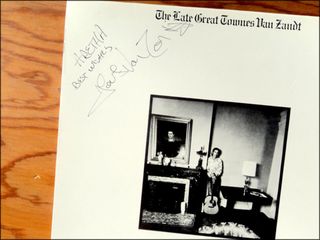
When he died at age 52 on New Year’s Day 1997, fans of the legendary Texas singer-songwriter were saddened but not surprised. He had, after all, named his 1972 album The Late Great Townes Van Zandt — possibly a joke about his perpetual obscurity, or possibly because he and everyone who knew him thought he would die young like Hank Williams (who also died on January 1st). As his friend Guy Clark said at the memorial, “I booked this gig thirty-something years ago.” Townes’s seemingly brief turn on this plane was characterized by staggeringly self-annihilating behavior — behavior that had in many ways defined that turn, and has often overshadowed the powerful and transcendent body of work he left behind.

If I had a nickel I’d find a game.
If I won a dollar I’d make it rain.
If it rained an ocean I’d drink it dry

And lay me down dissatisfied.

— from “Rex’s Blues”

Townes’s obituary offered just enough room to recap a few basic facts: that his songs were recorded by singers more famous than he would ever be, including Emmylou Harris, Merle Haggard, and Willie Nelson; that though he sang about prostitutes and bums and emulated Lightnin’ Hopkins, he was the scion of a prominent Texas oil family; and, the often-told tale, that Steve Earle once threatened to jump on Bob Dylan’s coffee table to proclaim just who was the better songwriter. The obituary politely left it to Van Zandt’s lyrics (from “A Song For”) to hint at his lifelong struggles with mental illness and addiction: “There’s nowhere left in this world where to go. My arms, my legs they’re a tremblin’. Thoughts both clouded and blue as the sky, not even worth the rememberin’.”

The day after New Year’s 1997, I was working at Streetlight Records in San Francisco. A co-worker gingerly handed me the newspaper, fearing I’d be crushed.

Is Serfdom an Executive Order Away?: The dangers of National Defense Resources Preparedness

13337579539510Sheldon Richman in Reason:

Sometimes a step back helps to provide perspective on a matter. President Obama provided such a step with his March 16 Executive Order—National Defense Resources Preparedness. In it we see in detail how completely the government may control our lives—euphemistically called the “industrial and technological base”—if the president were to declare a national emergency. It is instructive, if tedious, reading.

President Obama claims this authority under the Constitution and, vaguely, “the laws of the United States,” but it specifically names the Defense Production Act of 1950. As Robert Higgs of the Independent Institute and a Freeman columnist observed, the government’s authority to commandeer the economy, which was “abandoned” after World War II then substantially reinstated with the Korean War,

was retained afterward in the form of statutory authority for its reinstatement whenever the president might so order under the authority of the Defense Production Act of 1950, as amended. . . . Under this statute, the president has lawful authority to control virtually the whole of the U.S. economy whenever he chooses to do so and states that the national defense requires such a government takeover.

No Academic Exercise

The Executive Order, which requires no additional congressional approval, details who within the executive branch has what precise authority in the event the President invokes his emergency powers. We shouldn’t assume this is merely an academic exercise or that a third world war would need to break out. In the last decade, under circumstances representing no “existential threat” to our society, the executive branch has exercised extraordinary powers.

Jacques Rancière, For Dummies

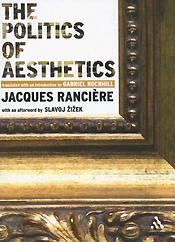
Davis8-17-1sBen Davis reviews Rancière's The Politics of Aesthetics, in artnet:

The Politics of Aesthetics is a quick and dirty tour of a number of these themes. It features five short meditations on various conjunctions of art and politics, plus a lengthy interview with Rancière by his translator Gabriel Rockhill titled “The Janus-Face of Politicized Art,” an introduction by Rockhill and a concluding essay by the art world’s other favorite quirky philosopher, Slavoj Zizek. It is a short but serious book and, in keeping with French intellectual practice, sensuously impenetrable, coming equipped with a glossary of terms for the uninitiated.

Politically, Rancière favors the concept of equality. “Politics exists when the figure of a specific subject is constituted, a supernumerary subject in relation to the calculated number of groups, places, and functions in a society” (p. 51). Translated into layman’s English, Rancière is saying that politics is the struggle of an unrecognized party for equal recognition in the established order. Esthetics is bound up in this battle, Rancière argues, because the battle takes place over the image of society — what it is permissible to say or to show.

Back-to-back with this “esthetics of politics,” in Rancière’s thinking, is a “politics of esthetics” itself. To unlock its nature, much time is spent picking over the idea of modernism and placing it within Rancière’s tripartite scheme of art “regimes.” This complex intellectual equation can be simplified substantially if one realizes that what he is doing is combining, in a clever way, art history with labor history.

Sunday Poem

Prayer

The sea engulfed a sailor in its depths.
Unaware, his mother goes and lights
a tall candle before the ikon of our Lady,
praying for him to come back quickly, for the weather to be good—
her ear cocked always to the wind.
While she prays and supplicates,
the ikon listens, solemn, sad,
knowing the son she waits for never will come back.

by C.P. Cavafy
from Collected Poems

translated by Edmund Keeley and Philip Sherrard
Edited by George Savidis
Revised Edition. Princeton University Press, 1992