The Last Trumpet

From The New York Times:

Martin-popupMany people mistakenly call the last book of the Christian Bible “Revelations.” It is actually the (one) Revelation to John. Elaine Pagels may be playing on that common error with the title of her latest book, “Revelations,” though in this case it is accurate: she ­places the biblical Book of Revelation in the context of other ancient narratives of visions and prophecy. Her account highlights several prophetic works and visionaries, from Ezekiel to Paul to the ancient sect of prophesying Christians called the Montanists, and others. Pagels also discusses the afterlife of Revelation in the Christianity of late antiquity through the fourth century. Her thesis is that apocalyptic literature — visions, prophecies, predictions of cataclysm — has always carried political ramifications, both revolutionary and

“Revelation” is from the Latin translation of the Greek word apocalypsis, which can designate any unveiling or revealing, fantastic or ordinary. Scholars also refer to the document as the Apocalypse of John. And that same Greek word provides the label for all sorts of ancient literature that scholars call “apocalyptic.” The biblical text purports to relate a real vision experienced by an otherwise unknown Jew named John — not the Apostle John, nor the same person as the anonymous author of what we call the Gospel of John. But we have no reason to doubt that his name was really John. It wasn’t an unusual name for a Jew.

More here.

The High-Tech Minimalist Sock-Shoe

From Smithsonian:

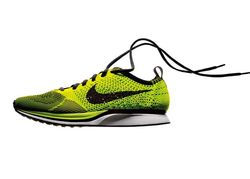
NikeflyknitEvery afternoon, a young man runs barefoot down the middle of our street. He’s one of those paleo-fitness people—the ones who believe we should go shoeless like the cavemen when we exercise. I’m not necessarily a detractor—as a runner myself, I think about things like long-term impact on my joints, heel strike and arch support, all of which are purported to be better when barefoot—but given that our environs are now covered in asphalt, broken glass, and worse, I’m also not eager to take up this practice.

The barefoot approach is just one among a variety within a movement known as minimalist running. Going shoeless is both the most extreme and the most low-tech of the options for “reducing your shoes.” For those who prefer an intermediary between their skin and the street, there is barefoot-inspired footwear, like the ever more prevalent Vibram 5 Fingers (I’ll reserve my opinion on the aesthetic consequences of this trend). Recently, Nike announced a new shoe for the lightweight category that responds to many of the desires of minimalist runners, and then‚ since Nike likes to push the innovation envelope, goes further, tackling some of the bigger challenges inherent to mass-manufacturing shoes. The Nike Flyknit takes its cues not so much from bare feet as from socks. The company had heard from runners that the ideal fit for a shoe would be the snug feeling of knit material. “But all the features that make a sock desirable,” Nike says, “have proven to make them a bad choice for a running upper [the part of the shoe that is not the sole or the tongue]. An inherently dynamic material like yarn generally has no structure or durability.”

More here.

Saturday, April 7, 2012

Why We Love Sociopaths

Why-we-love-sociopaths-cover-174x268

An excerpt from Adam Kotsko’s Why We Love Sociopaths: A Guide To Late Capitalist Television in The New Inquiry:

My greatest regret is that I’m not a sociopath. I suspect I’m not alone. I have written before that we live in the age of awkwardness, but a strong case could be made that we live in the age of the sociopath. They are dominant figures on television, for example, and within essentially every television genre. Cartoon shows have been fascinated by sociopathic fathers (with varying degrees of sanity) ever since the writers of The Simpsons realized that Homer was a better central character than Bart. Showing that cartoon children are capable of radical evil as well, Eric Cartman of South Park has been spouting racial invective and hatching evil plots for well over a decade at this point. On the other end of the spectrum, the flagships of high-brow cable drama have almost all been sociopaths of varying stripes: the mafioso Tony Soprano of The Sopranos, the gangsters Stringer Bell and Marlo of The Wire, the seductive imposter Don Draper of Mad Men, and even the serial-killer title character of Dexter. In between, one might name the various reality show contestants betraying each other in their attempt to avoid being “voted off the island”; Dr. House, who seeks a diagnosis with complete indifference and even hostility toward his patients’ feelings; the womanizing character played by Charlie Sheen on the sitcom Two and a Half Men; Glenn Close’s evil, plotting lawyer in Damages; the invincible badass Jack Bauer who will stop at nothing in his sociopathic devotion to stopping terrorism in 24—and of course the various sociopathic pursuers of profit, whether in business or in politics, who populate the evening news.

On a certain level, this trend may not seem like anything new. It seems as though most cultures have lionized ruthless individuals who make their own rules, even if they ultimately feel constrained to punish them for their self-assertion as well. Yet there is something new going on in this entertainment trend that goes beyond the understandable desire to fantasize about living without the restrictions of society. The fantasy sociopath is somehow outside social norms—largely bereft of human sympathy, for instance, and generally amoral—and yet is simultaneously a master manipulator, who can instrumentalize social norms to get what he or she wants.

Philosophy Is Not a Science

256940ae6a3a0e6999b15c83549467efJulian Friedland responds to Colin McGinn in the NYT's The Stone:

[W]hat objective knowledge can philosophy bring that is not already determinable by science? This is a question that has become increasingly fashionable — even in philosophy — to answer with a defiant “none.” For numerous philosophers have come to believe, in concert with the prejudices of our age, that only science holds the potential to solve persistent philosophical mysteries as the nature of truth, life, mind, meaning, justice, the good and the beautiful.

Thus, myriad contemporary philosophers are perfectly willing to offer themselves up as intellectual servants or ushers of scientific progress. Their research largely functions as a spearhead for scientific exploration and as a balm for making those pursuits more palpable and palatable to the wider population. The philosopher S.M. Liao, for example, argued recently in The Atlantic that we begin voluntarily bioengineering ourselves to lower our carbon footprints and to become generally more virtuous. And Prof. Colin McGinn, writing recently in The Stone, claimed to be so tired of philosophy being disrespected and misunderstood that he urged that philosophers begin referring to themselves as “ontic scientists.”

McGinn takes the moniker of science as broad enough to include philosophy since the dictionary defines it as “any systematically organized body of knowledge on any subject.” But this definition is so vague that it betrays a widespread confusion as to what science actually is. And McGinn’s reminder that its etymology comes from “scientia,” the ancient Latin word for “knowledge,” only adds to the muddle. For by this definition we might well brand every academic discipline as science. “Literary studies” then become “literary sciences” — sounds much more respectable. “Fine arts” become “aesthetic sciences” — that would surely get more parents to let their kids major in art. While we’re at it, let’s replace the Bachelor of Arts degree with the Bachelor of Science. (I hesitate to even mention such options lest enterprising deans get any ideas.) Authors and artists aren’t engaged primarily in any kind of science, as their disciplines have more to do with subjective and qualitative standards than objective and quantitative ones. And that’s of course not to say that only science can bring objective and quantitative knowledge. Philosophy can too.

What Books Make You Cringe To Remember?

Atlas-shrugged-e1333630955708Nadia Chaudhury “asked an assortment of literary-inclined people to revisit the books they loved back in the day, the ones that make them absolutely cringe today” in The Awl:

Sam Anderson, New York Times Magazine

Oh man, I suspect you're going to be hearing this answer a lot, but: the complete works of Ayn Rand. I discovered them toward the end of high school and walked around for a couple of years giving Howard Roark-like speeches to everyone about “the highest blazing good of selfish free-market epistemology” or something. In retrospect, it seems pretty clear that my Objectivist phase had more to do with the subjective agonies of post-adolescence (insecurity, narcissism) than it did with pure reason. (And you could argue the same thing about Ayn Rand's relationship to it.)

Alexander Chee, author of Edinburgh: A Novel

In high school I read a brisk mix of science fiction, fantasy and gay potboilers (Mass Effect 3 now is perhaps the best way to imagine my brain then). So, the novels of Marion Zimmer Bradley—I still can't look at Mists of Avalon—plus the Darkover novels, which all had some gay potboiler action, now that I think of it. And hello Gordon Merrick, famous for The Lord Won't Mind but I am thinking of The Great Urge Downward.

Yes, that is the title.

The Hard Problem

J9398Over at the LSE, Maurice Bloch reviews Nicholas Humphrey's Soul Dust: The Magic of Consciousness (you can find the first chapter of the book here at Princeton University Press):

This is an extraordinary book as it attempts to explain all the most distinctive things about human beings in a few hundred pages. It is written by a swashbuckling character who clearly does not hesitate to take up the most daring challenges. Perhaps such characterisation will be enough to put off the majority of social and cultural anthropologists who have grown weary of grand generalisations about our species made by scholars from the natural sciences who have very little understanding of why our subject has abandoned making such grandiose pronouncements. So often these proposals seem mere repeats of older theories which have subsequently been found wanting for reasons of which their new advocates are unaware. At least in this case such condemnation would be somewhat unfair as it is clear that the author is well acquainted with what many anthropologists write and have written and he is not unsympathetic as so many natural scientists are. Another reason why anthropologists might reject this book out of hand is less admirable; it may simply be a manifestation of the sad theoretical timidity which has recently characterised much of the subject.

Whatever the causes for reluctance, such dismissal would be a pity. The book is written in a fun manner which will both delight and annoy but will never bore. I believe the discussion it contains, or at least parts of it, can prove excitingly thought provoking to all practitioners of social and cultural anthropology. What I therefore say to my anthropological colleagues is: “Prepare to be infuriated but read the book all the same”. Darwinian evolutionary theory frames the thesis. The argument is about the vexed question of the nature of human consciousness and what it implies. It thus attempts to explain the least obviously useful aspects of human beings as adaptations which account for their presence and survival. This however is not the usual ignorant reductionist stuff that we have all come to fear.

Google’s ‘Project Glass’ Augmented Reality Glasses Are Real And In Testing

Chris Velazco in TechCrunch:

After weeks of speculation and rumors, Google has officially pulled back the curtain on what they have come to call Project Glass — a pair of augmented reality glasses that seek to provide users real-time information right in front of their eyes.

“We think technology should work for you — to be there when you need it and get out of your way when you don’t,” wrote Babak Parviz, Steve Lee, and Sebastian Thrun, three Google employees who are part of the Google X skunkworks. “We’re sharing this information now because we want to start a conversation and learn from your valuable input.”

Something tells me that they won’t be hurting for feedback.

To call these things glasses may be a bit of a stretch — early rumors noted that glasses bore a striking resemblance to a pair of Oakley Thumps, but the demo images on Project Glass’s Google+ page (one of which can be seen above) don’t look a thing like them. Rather, they appear to be constructed of a solid metal band that runs across the brow line, with a small heads-up display mounted on the right side.

Also see this post by Joseph Stromberg in the Smithsonian blog.

Our Experiments with Fasting: Satyagraha to Knavery and Everything in Between

9717.protest-fastHartosh Singh Bal in Open the Magazine:

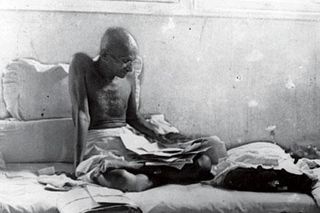
A dharna, Wikipedia informs us, ‘is a fast undertaken at the door of an offender, especially a debtor, as a means of obtaining compliance with a demand for justice, such as payment of debt.’ Clearly then, at the very root of our most potent symbol of political protest, lies the fast.

But in its original form, the idea is not a modern or medieval invention, it is part of a much older Indo-European tradition. To turn to Wikipedia again, ‘Fasting was used as a method of protesting injustice in pre-Christian Ireland, where it was known as Troscadh or Cealachan. It was detailed in the contemporary civic codes, and had specific rules by which it could be used. The fast was often carried out on the doorstep of the home of the offender.’

For an idea to be shared between Aryavarta and Ireland, it must have had roots deep in the Indo-European past. Vinay Lal, in a fascinating piece on this shared idea, delves into the Indian evidence for this practice:

There can scarcely be as dramatic a text for insights into traditions of political fasting in India as Kalhana’s 12th century ‘Chronicle of the Kings of Kashmir’ known as the Rajatarangini. This book by a Kashmiri Brahmin furnishes incontrovertible evidence of the widespread recourse to fasting. King Chandrapida himself fasted as a form of penance, in atonement for his inability to bring to justice the murderer of a man whose widow sought death by starvation unless punishment were inflicted on the guilty man (IV:82-99). The remedy of fasting, however, appears generally to have been available only to Brahmins, and Kalhana was not averse to passing sharp remarks on the ease with which members of his community would, singly or collectively, stage a hunger strike to safeguard their interests. As an illustration, Kalhana describes the events of the year 1143, in the reign of Jayasimha. Enraged by a plot to overthrow the king, in which they suspected the hand of the ministers Trillaka and Jayaraja, ‘and anxious to safeguard the country’, the Brahmins commenced a hunger strike ‘directed against’, notes Kalhana, ‘the king’—the king because he had, through his weakness and inaction, permitted the kingdom to fall into ruin. Kalhana suggests that the Brahmins may at first have been moved by noble intentions; but, ‘intoxicated with their own knavery’, they ‘obstinately persisted in their perfidious course’ until they had prevailed upon the king to dismiss his honest minister Alamkara and promise them that he would ‘uproot Trillaka after he had disposed of the pretenders to the crown’ (VIII:2737).

Brahmins may have been the source of many of these hunger strikes, at least in Kashmir, but clearly their aims were as political as they were religious.

the american decline meme

08cover-articleInline

Last fall, television stations carried a 60-second ad for Audi’s A6 car. The opening images showed a pitted, potholed American road while the voice-over gloomily intoned, “Across the nation, over 100,000 miles of highways and bridges are in disrepair.” Fear not, said the voice; Audi’s smart gizmos would help. The spot’s message was clear: Roads in the United States are now so bad, you need a foreign car to negotiate them. The Audi ad was seized upon as evidence of American decline, now such a regular meme that the Foreign Policy magazine Web site runs a dedicated blog, “Decline Watch.” Books have been in plentiful supply, and now come two more, helpfully approaching the subject from left and right, as if to demonstrate declinism’s bipartisan credentials. The authors are big hitters in the geopolitics genre. Robert Kagan coined what passes for a catchphrase in the international relations field when he declared a decade ago that “Americans are from Mars and Europeans are from Venus.” At the time, Kagan, a veteran of Ronald Reagan’s State Department, was one of the leading advocates of military action against Iraq. Zbigniew Brzezinski, still best known for his service as national security adviser to Jimmy Carter, has filled the three intervening decades with a throng of books on the same terrain: what America should do in the world.

more from Jonathan Freedland at the NY Times here.

the past is never even past

950

“The past is never dead,” Faulkner famously wrote in “Requiem for a Nun.” “It’s not even past” — and nothing demonstrates that maxim better than the discovery of a “new” painting by a revered, long-dead artist. Suddenly, it is as if that person is alive and well again and walking among us. Art collector Peter Silverman had such a jolting recognition concerning a painting he saw in the late 1990s and again at a New York City auction in 2007. He was convinced it must have been executed by the one and only Renaissance master from Vinci — a story he relates, with Catherine Whitney, in “Leonardo’s Lost Princess: One Man’s Quest to Authenticate an Unknown Portrait by Leonardo da Vinci” (Wiley: 256 pp., $25.95). The painting that beguiled him — a 9-by-13-inch drawing in chalk and pen and ink — seems hardly dramatic: A young woman in profile, her brown hair bound in ribbons. Simple. Plain. Leonardo? Really?

more from Nick Owchar at the LA Times here.

a nation of lies

Johnson1

In a nation of lies, sometimes only fiction tells the truth. So Adam Johnson‘s new novel, The Orphan Master’s Son, already a New York Times bestseller, may offer new insights about North Korea, the country he says is too often dismissed as a mélange of “buffoonery, madness or evil.” With the launch of a long-range rocket scheduled around April 15, the world is turning its eyes again on North Korea. An outraged world clamors to know what can be done to contain a dangerous pariah state. Johnson’s prediction? “They’re going to send up a big-ass rocket and whatever happens, the North Koreans will call it a startling success.” “It’s not about science,” the Stanford associate professor of English explained. “It’s about the consolidation of power so Kim Jong Un doesn’t get murdered in the night.” Johnson suggests we look to the country’s new leader, the third generation in a totalitarian dynasty, to explain the newest flare-up of celestial ambitions. “In North Korea, everything is a message. Often, it’s a message about survival. Even if it appears malicious, it’s just a message.”

more from Cynthia Haven at The Book Haven here.

Friday, April 6, 2012

Greater Expectations

Cover00

Christine Smallwood reviews Susan Sontag's journals in Bookforum:

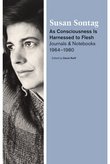
THE TITLE OF THE SECOND VOLUME of Susan Sontag’s private writings is taken from an entry dated May 22, 1965, when Sontag was thirty-two years old. “Novel about thinking—” it begins. “An artist thinking about his work.” In the margins, she adds, “A spiritual project—but tied to making an object (as consciousness is harnessed to flesh).”

It’s a strange and spooky phrase, the richest image in the diary’s five hundred pages. There’s something sad about this emblem of captivity, the spirit being put under reins. There’s also something enabling and empowering—the inanimate being directed, gaining strength, driving forward. Being harnessed to flesh means being flexible enough to move.

The animating force at the heart of everything Sontag wrote—the cultivation of aesthetic and intellectual experience—is not properly speaking an idea; it’s a stance, or an attitude. It is itself a way of moving. There is no magnum opus or theoretical treatise that we can point to as Sontag’s distinct contribution, no “takeaway” we can pierce under glass. So it may not be very surprising that since her death eight years ago, the many provocations of her thinking have drifted out of view to make room for the more obvious fact of her celebrity. Besides, she’s a woman; we make good icons.

As a personality, Sontag just keeps giving—the famous marriage, the semi-closeted sexuality, the reenacted dodging from sniper fire—and so we have been treated to many biographies in miniature, memoirs and readings of her reinventions, her snobbishness, her grandeur, her condescension, her streak. But to focus on the persona instead of the work is to miss the point. They go together. Sontag knew very well that thinking is the person bent into form, the consciousness harnessed to flesh. To hate or love someone’s writing is to hate or love that person’s soul. There is no great life apart from great work. In my mind, that means what matters about Sontag is already in her criticism and her fiction. Her private writings do not expose personal secrets that explain her work; the opposite is true. We need her work to understand her notebooks.

Michael Harrington on Poverty

60720

First, Barbara Ehrenreich in The Nation:

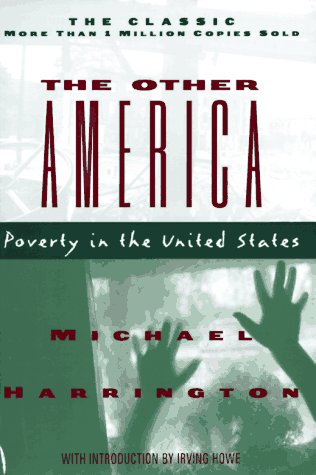
It’s been exactly fifty years since Americans, or at least the nonpoor among them, “discovered” poverty, thanks to Michael Harrington’s engaging book The Other America. If this discovery now seems a little overstated, like Columbus’s “discovery” of America, it was because the poor, according to Harrington, were so “hidden” and “invisible” that it took a crusading left-wing journalist to ferret them out.

Harrington’s book jolted a nation that prided itself on its classlessness and even fretted about the spirit-sapping effects of “too much affluence.” He estimated that one-quarter of the population lived in poverty—inner-city blacks, Appalachian whites, farmworkers and elderly Americans among them. We could no longer boast, as President Nixon had done in his “kitchen debate” with Soviet leader Nikita Khrushchev in Moscow just three years earlier, about the splendors of American capitalism.

At the same time that it delivered its gut punch, The Other America also offered a view of poverty that seemed designed to comfort the already comfortable. The poor were different from the rest of us, it argued, radically different, and not just in the sense that they were deprived, disadvantaged, poorly housed or poorly fed. They felt different, too, thought differently and led lives characterized by shortsightedness and intemperance. As Harrington wrote, “There is…a language of the poor, a psychology of the poor, a worldview of the poor. To be impoverished is to be an internal alien, to grow up in a culture that is radically different from the one that dominates the society.”

Alexander Harrington responds in Dissent:

Barbara Ehrenreich has published an article in the Nation titled, “Michael Harrington and the ‘Culture of Poverty.’” In it, she quotes a passage from my father’s book The Other America in order to argue that he “offered a view of poverty that seemed designed to comfort the already comfortable.” “‘We’—the always presumably affluent readers—needed to find some way to help the poor,” writes Ehrenreich, “but we also needed to understand that there was something wrong with them.”

This is the passage Ehrenreich cites: “There is…a language of the poor, a psychology of the poor, a worldview of the poor. To be impoverished is to be an internal alien, to grow up in a culture that is radically different from the one that dominates the society.” This has been taken out of the context of the subchapter in which it appeared, and the context of the book as a whole. My father introduced the idea that economic circumstances make a class of people different from others by retelling the famous (and apocryphal) exchange between F. Scott Fitzgerald and Ernest Hemingway. “The rich are different than you and me,” said Fitzgerald. Hemingway replied, “Yes, they have more money.” My father then wrote:

Fitzgerald had the much better of the exchange. He understood that being rich was not a simple fact of life, like a large bank account, but a way of looking at reality, a series of attitudes, a special type of life. If this is true of the rich, it is ten times truer of the poor…And this is sometimes a hard idea for a Hemingway-like middle-class America to comprehend.

He was not arguing that economic circumstances have made the poor alone different from and inferior to a virtuous middle class, but that economic circumstances shape every aspect of the lives of every member of every social class. And the reason, according to The Other America, why Fitzgerald’s assertion is “ten times truer for the poor” is that their circumstances are so brutal.

Kerala’s Cochini Jews Meld Into Israel

4-kerala2-Indiaink-blog480Debra Kamin in the NYT:

On Moshav Nevatim, a dust-blown, palm-tree studded community on the northern edge of Israel’s Negev desert stands a humble little synagogue with an enormous past. The Kerala Synagogue, as it is called, was built in the style of the synagogues of India’s Cochini Jews, a hardy handful of whom settled Nevatim in the 1950s after emigrating from the Indian state of Kerala.

The synagogue has two reader platforms – a unique trademark of Cochini worshipers – as well as traditional wooden benches and electric lights meant to resemble the oil lamps of the synagogues the Cochini Jews left behind.

Some say the Cochini Jews, who were India’s first established Jewish community, came to the subcontinent 2,000 years ago, during the time of King Solomon. Others claim they settled in Kerala after reaching India’s fertile Malabar coast as pepper traders. Today, most Cochini Jews live in Israel, cherishing the relics of their tradition even as each generation grows more and more assimilated.

Three Cups of Tea author pays $1m for misusing charity he set up

From The Guardian:

Gregg-Mortenson-near-the--007Three Cups of Tea author Greg Mortenson has agreed to pay $1m (£630,000) to compensate his Montana-based charity, which he used to promote and pay for copies of his books, according to the state attorney general. The settlement between Mortenson, leaders of the Central Asia Institute (CAI) charity he founded and Montana officials allows it to continue educational work in Pakistan and Afghanistan. The agreement calls for a new board to run CAI, based on a finding that it failed to meet its responsibilities in handling the relationship between the charity and Mortenson. The case is another setback for an author and philanthropist once widely celebrated for his work.

Montana began investigating in April 2011 after a 60 Minutes report suggested Mortenson fabricated parts of his Three Cups of Tea and took benefits for himself from the charity. The Guardian interviewed people who disputed Mortenson's accounts of his dealings with them, including tribesmen who threatened to sue. Steve Bullock, the Montana attorney general, said CAI had spent nearly $4m since 2006 buying copies of Three Cups of Tea and a sequel, Stones Into Schools.

More here.

Brain imaging

From Nature:

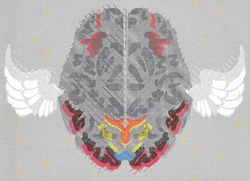
Fmri1The blobs appeared 20 years ago. Two teams, one led by Seiji Ogawa at Bell Laboratories in Murray Hill, New Jersey, the other by Kenneth Kwong at Massachusetts General Hospital in Charlestown, slid a handful of volunteers into giant magnets. With their heads held still, the volunteers watched flashing lights or tensed their hands, while the research teams built the data flowing from the machines into grainy images showing parts of the brain illuminated as multicoloured blobs.

The results showed that a technique called functional magnetic resonance imaging (fMRI) could use blood as a proxy for measuring the activity of neurons — without the injection of a signal-boosting compound1, 2. It was the first demonstration of fMRI as it is commonly used today, and came just months after the technique debuted — using a contrast agent — in humans3. Sensitive to the distinctive magnetic properties of blood that is rich in oxygen, the method shows oxygenated blood flowing to active brain regions. Unlike scanning techniques such as electroencephalography (EEG), which detects electrical activity at the skull's surface, fMRI produces measurements from deep inside the brain. It is also non-invasive, which makes it safer and more comfortable than positron emission tomography (PET), in which radioactive compounds are injected and traced as they flow around the body.

More here.

the difference of value persists

432px-VirginiaWoolf

Watching the outpouring of grief and reflection over the death of Adrienne Rich last week, I admit, to my shame, that I was surprised. Surprised not because of any judgment about Rich’s poetry, which I barely know, but because I had thought of her as an icon of another era. That era, of course, was the era of the women’s movement, of which Rich was a brash troubadour, asserting the value and distinctiveness of women’s experience and lamenting their—our—submission to patriarchy. But when I came of age intellectually, in the 1990s, this mode of expression had fallen out of fashion. In my undergraduate and graduate studies, I was mentored by male and female professors alike who encouraged me to take my place as a student of the literary canon. But I was never directed to read a poem by Adrienne Rich. There are two distinct types of equality, I realize now, and women of my generation had achieved only the first. We had gained admission to the world of men. (This was literally true at Columbia University, where I went to college, which had gone co-ed less than ten years before I enrolled.) But there is another type of equality, the type that Rich alludes to in her great poem “Diving Into the Wreck,” in which she imagines plumbing the depths of the ocean as both mermaid and merman, exploring a past that hasn’t bothered to record her presence, “a book of myths / in which / our names do not appear.” That type of equality involves remaking the landscape itself, redefining the terms on which value is assessed, rewriting the book of myths. At this type of equality we have yet to make significant progress, which is why Rich’s poem, nearly 40 years later, retains its immediacy and its longing.

more from Ruth Franklin at TNR here.

why Judy Garland Still Matters

Judygarland120409_1_560

If Judy Garland were just her mannerisms, a thousand drag queens would be stars. But the centrifugal limbs, semaphore poses, and vibrato so broad it seems to have swallowed another vibrato are necessary, not sufficient, conditions. So it’s merely a good start that Tracie Bennett nails the externals as late-stage Garland in End of the Rainbow, Peter Quilter’s drama with songs, opening this week on Broadway. Indee­d, backstage at the Belasco, a small industry and several rooms are devoted to helping her maintain the illusion, with chestnut wigs, spangled shoes, and racks of costumes copied from Garland’s outfits of the period, including the vermilion beaded pantsuit and chartreuse scarf she legendarily nicked from the studio after getting canned from Valley of the Dolls. But while all this makes for a great impersonation, what Bennett, a British stage actress, is doing is deeper, more dangerous, and, to some of us watching, therefore more disturbing. She’s playing a diva as an actual dramatic character, a kind of Hedda Gabler with pills instead of a gun. As such, she’s more real than any mere mimicry could make her, never more so than when belting “Come Rain or Come Shine” in the second act. Holding onto the melody for dear life, her Garland seems as if she might otherwise fly apart like an IED. “You’re gonna love me like nobody’s loved me,” she pleads, looking straight at the audience.

more from Jesse Green at New York Magazine here.

the lanzmann

Shtz01_3407_01

The life of Claude Lanzmann, Claude Lanzmann declares at the beginning of his memoir, has been ‘a rich, multifaceted and unique story’. Self-flattery is characteristically Lanzmannian, but its truth in this case can hardly be denied. He has lived on a grand scale. A teenage fighter in the Resistance, he became Sartre’s protégé in the early 1950s as an editor at Les Temps modernes. He also became – with Sartre’s blessing – Beauvoir’s lover, ‘the only man with whom Simone de Beauvoir lived a quasi-marital existence’. He marched with the left against the wars in Algeria and Vietnam; moonlighted in Beijing as an unofficial conduit between Mao and de Gaulle; and fell under the spell of Frantz Fanon in Tunis. Writing for the glossies at the height of the Nouvelle Vague, he interviewed Bardot, Moreau, Deneuve, Belmondo and Gainsbourg: ‘I met them all … and, I can say without vanity, I helped some of them make a qualitative leap in their careers.’ He had a brief, stormy marriage to the actress Judith Magne, and was Michel Piccoli’s best man at his marriage to Juliette Gréco. He knew how to woo his subjects off and on the page. ‘You are the only one who talked about me as I would have wished,’ the novelist Albert Cohen told him.

more from Adam Shatz at the LRB here.