In the Shadow of Things

From Lensculture:

This is a strange book about a difficult subject: Obsessive Compulsive Disorder (OCD). Yet it is profoundly effective in conveying the confusion, frustration and mystery that permeates the lives of everyone touched by this type of overwhelming psychological condition, including the afflicted and their family members, lovers and friends.

For over a decade, Bron, the mother of photographer Léonie Hampton, found it impossible to empty the packing boxes which had filled her new home since the collapse of her first marriage. The boxes, along with stuffed plastic bags and accumulated artifacts from her former life, were a constant physical reminder to her family of Bron’s long-running battle with OCD and depression.
In 2007, a deal was struck: Hampton would help her mother empty the boxes and organize the house on the condition that she be allowed to document that process. (This in itself presents another sort of compulsive behavior — that driven nature of the photographer herself.)

More here.

Your Breasts Are Trying To Kill You

Lindy West in Slate:

Williams' journey begins when, alarmed by a news article about toxins in breast milk, she decides to get her own milk tested. And, surprise! It's packed with toxins—specifically, chemical flame retardants—that Williams is funneling directly into her baby. (“Well, at least your breasts won't spontaneously ignite!” her husband jokes, because that's exactly what you want to hear when adjusting to the news that you're a human baby-poison factory.) This sends her down a rabbit hole in search of deeper understanding of her own anatomy— into the evolutionary history of mammals, to Peru to investigate nursing and weaning, back to the first breast augmentation surgery, and all over the world to interview more boob experts than you can shake a pasty at. And she discovers that breasts are complicated. Impossibly so. She learns that it’s the breast’s permeability that make it such an evolutionary powerhouse (lots and lots of estrogen receptors help human puberty occur at the optimal time; nutrient-rich breast milk makes for giant brains)—but that same permeability is also, partially, what causes one in eight women to develop breast cancer. Our breasts make us great but they also make us vulnerable, and you can’t help but come away from Williams’ book feeling a bit helpless. (Self-examinations! Self-examinations are key!) While she makes the story as dynamic as possible, there’s no escaping that this is science journalism—there are lots of PBDE levels and octa-203 and penta-47 and dioxin and “lobule type 4” and other such enemies of lively prose. But that’s OK—there are enough surprises and genuinely horrifying learning moments to keep a reader (especially a lady-reader), uh, latched on.

Five Things I Learned About Breasts From Florence Williams' Breasts

1. Women: Your boobs are trying to murder you. Right now. All the time. The day you were born, your boobs took one look at you and were like, “Oh, no. No. Absolutely not. Hey, does anyone know where I can get some poison?” Turns out, everywhere! Breasts are largely made up of fatty tissue, and chemicals looooooooooove to accumulate in fatty tissue. Here’s a partial list from Williams: “paint thinners, dry-cleaning fluids, wood preservatives, toilet deodorizers, cosmetic additives, gasoline by-products, rocket fuel, termite poisons, fungicides, and flame-retardants.” So what can you do to keep your chest-sponges safe from marauding chemicals? Nothing, pretty much, short of becoming a trillionaire and taking over literally every drug company and industry on earth. So get on it, concerned citizens! Step one: CoinStar.

More here.

Sunday Poem

The Madwoman of Cork

Today
Is the feast day of Saint Anne
Pray for me
I am the madwoman of Cork.

Yesterday
In Castle street
I saw two goblins at my feet
I saw a horse without a head
Carrying the dead
To the graveyard
Near Turner’s Cross.

I am the madwoman of Cork
No one talks to me.

When I walk in the rain
The children throw stones at me
Old men persecute me
And women close their doors.
When I die
Believe me
They’ll set me on fire.

I am the madwoman of Cork
I have no sense.

Sometimes
With an eagle in my brain
I can see a train
Crashing at the station
If I told people that
They’d choke me.
Then where would I be?

Read more »

Saturday, May 5, 2012

Behold The Forbidden Flu: A Loom Explainer

Carl Zimmer in his excellent blog, The Loom:

ScreenHunter_13 May. 05 18.23Here, for your viewing pleasure, is a very important part of a very special flu virus. It may look like an ordinary protein, but in fact it’s been at the center of a blazing debate about whether our increasing power to experiment on life could lead to a disaster. Not that long ago, in fact, a national security advisory board didn’t even want you to see this. So feast your eyes.

For those who are new to this story let me start back at the beginning, in 1997.

In that year, a child in Hong Kong died of the flu. Doctors shipped a sample of his blood to virus experts in Europe, but they didn’t bother taking a look at it for months. When they did, they were startled to discover that it was unlike any flu they’d seen in a human being before.

Each year, several different flu strains circulate from person to person around the world. They’re known by the initials of the proteins that cover their surface–H3N2, for example, is one common strain. The H stands for haemagglutinin, a protein that latches to a host cell so that the virus can invade. The N stands for neuraminidase, which newly produced viruses then use to hack their way out of the cell.

Birds are the source of all our flu strains. Our feathered friends are hosts to a huge variety of H and N type viruses, which typically infect their guts and cause a mild infection. From time to time, bird flu viruses have crossed the species barrier and adapted to human hosts, infecting our airways and then spreading in air droplets. Since flu spreads so fast around the world, a fair amount of the planet’s population has had some exposure–and thus some immunity–to the flu strains in circulation today. But if a new bird flu should manage to make the leap, we could face a very grim situation–a situation that some scientists worry could rival the 1918 pandemic, which killed some 50 million people.

More here.

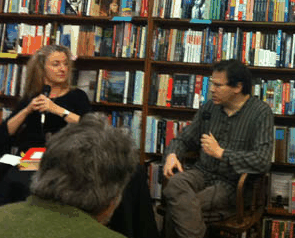
David Graeber in conversation with Rebecca Solnit

From Guernica:

ScreenHunter_12 May. 05 18.08In Debt: The First 5,000 Years, author and Occupy Wall Street intellectual founder David Graeber debunks myths that have shaped the general discourse on debt for centuries. The assumptions, myths, and outright falsities permeating our conceptions of debt and money—and why the latter is superior to bartering—blend history and fiction in ways that usually fail to see. Who is constructing these narratives about our preoccupation with money, and why do we insist on believing them? Is there a better alternative that can break the myths of history, shatter their latent presumptions, and build a brighter and equitable future?

In discussing topics ranging from the origins of free market capitalism (Islam) to the virtues of anarchism, Graeber and his conversation partner, Rebecca Solnit, make the case that we do not need to satisfy ourselves with the politico-socioeconomic status quo. To raise the level of discourse on these issues, terms need redefining and social dynamics reconfiguring. Graeber maintains that by thinking of “capitalism as a really bad way of organizing communism,” we can improve cooperation among exchanging parties and the quality of human social relations. For Solnit, the Occupy movement has heralded a radical revolution toward this effort: “It turns out that we’re actually capable of something other than neoliberalism and actually we’re really capable of enjoying ourselves more than we do under neoliberalism. It feels that if neoliberalism is first about privatizing desire and imagination before the economy, then we’re in this process of publicizing it again.”

More here.

Some equations touch all our lives–whereas others, well, not so much

Steve Mirsky in Scientific American:

ScreenHunter_11 May. 05 17.57In his new book, In Pursuit of the Unknown: 17 Equations That Changed the World, Ian Stewart recounts one of the worst jokes in the history of science. You can develop your own setup from first principles once you know the punch line: “The squaw on the hippopotamus is equal to the sum of the squaws on the other two hides.” Never mind how Native Americans were in possession of a hippopotamus—the important thing is that the Pythagorean theorem is so well known that comedy writers consider it fair game even if that game couldn’t possibly be found on the correct continent.

Stewart, who formerly wrote the Mathematical Recreations column for Scientific American, takes the reader on an engaging tour of vital math for a modern world. We go from Pythagoras’ right triangle (a2 + b2 = c2)—nice—to Newton’s law of gravity (F = G)—good—to Einstein’s special theory of relativity (E = mc2)—still with you—to the Navier-Stokes equation governing the movement of fluids——which pretty much convinced me to change my career trajectory from science to science journalism.

I highly recommend Stewart’s wonderfully accessible book and now share with you some additional equations not in its pages but of importance to me, personally.

More here.

A Few of Our Favorite Author vs. Critic Dustups

From Flavorwire:

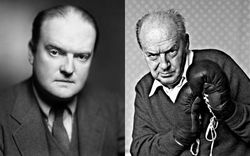
Edmund Wilson vs Vladimir Nabokov

NabNabokov and Wilson (or Volodya and Bunny, as they called each other in letters during their years-long friendship) fell out over Wilson’s negative review of Nabokov’s translation of Alexander Pushkin’s Eugene Onegin. Their relationship, already bruised from Wilson’s chilly response to Lolita (“I like it less than anything else of yours I have read,” Wilson had written to Nabokov. “Nasty subjects may make fine books; but I don’t feel you have got away with this… The various goings-on and the climax at the end…become too absurd or horrible to be tragic, yet remain too unpleasant to be funny.”), hit a wall, as Nabokov struck back, writing that Wilson was a “commonsensical, artless, average reader with a natural vocabulary of, say six hundred basic words.” They didn’t speak again for years.

Richard Ford vs Colson Whitehead

FordwhiteheadA full two years after Whitehead panned Ford’s A Multitude of Sins in the New York Times, Ford spat on him at a Poets & Writers party. Oh yes. Apparently, Ford approached Whitehead and exclaimed, “I’ve waited two years for this! You spat on my book.” The he proceeded to spit on Whitehead, and, rather ironically, call him a kid who needed to grow up. Later, Whitehead quipped, “This wasn’t the first time some old coot had drooled on me, and it probably won’t be the last. But I would like to warn the many other people who panned the book that they might want to get a rain poncho, in case of inclement Ford.”

More here.

The Arab Awakening, By Tariq Ramadan

From The Independent:

ArabWhat is happening in the Middle East? Tariq Ramadan, one of the foremost Muslim intellectuals, calls the events “uprisings”, more permanent than “revolts” but still short of thoroughgoing “revolutions”. So far, Tunisia is the only clear democratising success, and there it remains unclear if the new dispensation will be fundamentally more just than the last. Half of this slim volume is spent examining whether the uprisings were staged or spontaneous. Ramadan counsels against both the naive view that outside powers are passive observers of events, and the contrary belief that Arab revolutionaries have been mere pawns in the hands of cunning foreign players. Certainly the US and its allies helped to guide events by collaborating with the military hierarchies which removed presidents in Tunisia and Egypt, and by full-scale intervention in Libya – for a variety of obvious reasons. An agreement signed by Libya's NTC last year, for instance, guaranteed France 3 per cent of future oil exports.

More here.

Saturday Poem

Those are not saints in the political undergrowth
those are badgers who think they're saints
—Artis Merril

Worst Nightmare

There were days when you’d shove
your hand into a cupboard in search of a cabbage
and come upon the head of Alfredo Garcia

others when you’d thread a needle
and imagine you were darning a hole
out of which the evil of the world could escape

and times when you’d press a knob on the oven
and conjure the six million
naked, shorn in the shower.

But at night the curtains drawn,
the door locked and bolted
you felt safe, yourself and your care.

No matter how many horror stories
you sidled into your mind
you never imagined this nightmare –

you lived in a democracy, yourself
and your care, under an elected government,
who cherished each citizen

far from the laboratories of jackbooted men.
.

by Celia de Freine
from Fiacha Fola
publisher: Cló Iar-Chonnachta, 2005
translation: Celia de Freine

Adam Yauch, MCA (1964-2012)

Mca

Yauch died today, at the age of forty-seven. In 2009, he was diagnosed with a cancerous tumor he described at the time, in this interview with The Stool Pigeon, as “located in the perotic gland and the neighbouring lymph node.” He fought back, ebbing and strengthening and dimming, as the disease progressed. Friends exchanged messages. “Adam’s doing O.K.” “He’s kinda tired.” Minimizing the situation by using simple language felt like the least hysterical trick you could play on yourself. Sometimes, it felt like a memory might work. “Your remember when Tom and Adam went under the bridge with that car and they almost went into the river?” Nope. Just made it worse, recalling the skinny, loopy kid who took any dare and inflated it until it was beyond foolish. The kid who would think the only problem with cancer is that it wasn’t a good enough punchline. The ideal memorial is written from distance, a generous calculation of merit that proceeds honorably without abandoning accuracy. I have to apologize right now for being unable to give you that—Adam Yauch was a part of my childhood, an ambassador to America from our New York, which is now gone, as is he.

more from Sasha Frere-Jones at The New Yorker here.

eusociality

9ec76b88-9578-11e1-8faf-00144feab49a

“Where do we come from? What are we? Where are we going?” Those famous questions, inscribed by Paul Gauguin in his giant Tahitian painting of 1897, introduce The Social Conquest of Earth. Their choice proclaims Edward O Wilson’s ambitions for his splendid book, in which he sums up 60 distinguished years of research into the evolution of human beings and social insects. Wilson has focused on the biology of behaviour since joining Harvard University as a junior research fellow in 1953. He also has a passion for writing, with 25 books to his credit (including two Pulitzer Prize-winners). The Social Conquest of Earth fully maintains the elegant and informative style of its predecessors. His most influential book, Sociobiology (1975), defined a new discipline, with the message that social behaviour could only be understood through the lens of evolution. At that time the idea that genes and natural selection play such an important role in human society outraged many social scientists and people on the political left. By now the main messages of sociobiology and its offspring, evolutionary psychology, have been absorbed into the intellectual mainstream, though the nature-nurture debate rumbles on as scientists investigate the relative contribution of genes and the environment to various aspects of life.

more from Clive Cookson at the FT here.

bill clinton on Robert Caro

0506-CLINTON-cover-articleInline-v2

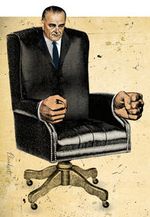
You don’t have to be a policy wonk to marvel at the political skill L.B.J. wielded to resuscitate a bill that seemed doomed to never get a vote on the floor of either chamber. Southern Democrats were masters at bottling up legislation they hated, particularly bills expanding civil rights for black Americans. Their skills at obstruction were so admired that the newly sworn-in Johnson was firmly counseled by an ally against using the political capital he’d inherited as a result of the assassination on such a hopeless cause. According to Caro, Johnson responded, “Well, what the hell’s the presidency for?” This is the question every president must ask and answer. For Lyndon Johnson in the final weeks of 1963, the presidency was for two things: passing a civil rights bill with teeth, to replace the much weaker 1957 law he’d helped to pass as Senate majority leader, and launching the War on Poverty.

more from Bill CLinton at the NY Times here.

Friday, May 4, 2012

Interview with Jonathan Safran Foer

Jacques Testard in The White Review:

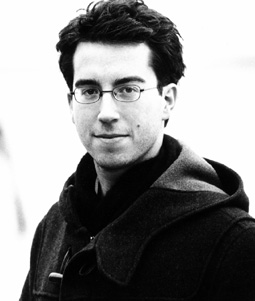
JonathanSafranFoerMuch has been written about the precocity and talent of Jonathan Safran Foer, whose debut novel Everything is Illuminated (2002) commanded a $500,000 advance and was released when its author was barely 25. Originating in a creative writing thesis written under the guidance of Joyce Carol Oates when he was an undergraduate at Princeton, it tells the story of one Jonathan Safran Foer, a young American Jew in search of the Ukrainian woman who saved his grandfather from the Nazis.

Hailed by The Times as a ‘work of genius’ after which ‘things will never be the same’, it won the Guardian First Book award and was – unfortunately, disastrously – made into a film starring Elijah Wood in 2005. The praise wasn’t universal, with the book also facing charges of preciousness and factual inaccuracy.

His second novel, Extremely Loud and Incredibly Close (2005), is narrated by a 9-year-old boy who has lost his father in the 9/11 attacks. Ending in a flipbook showing a figure falling from the Twin Towers – or ascending, depending how one decides to flip the pages – it also divided opinion. Salman Rushdie called it ‘ambitious, pyrotechnic, riddling, and above all … extremely moving’; influential New York Times critic Michiko Kakutani described it as ‘cloying’. ‘While it contains moments of shattering emotion and stunning virtuosity that attest to Mr Foer’s myriad gifts as a writer,’ she added, ‘the novel as a whole feels simultaneously contrived and improvisatory, schematic and haphazard.’ Meanwhile, the film adaptation, released earlier this year, was ‘almost universally reviled’, according to the Guardian’s Xan Brooks, but made the author himself cry.

This is the way it has been for Safran Foer ever since his extremely successful and unnervingly mature debut: he is the only contemporary writer, with perhaps the current exception of Jonathan Franzen, to command such extreme reactions from the reading public.

More here.

Lawrence Krauss clarifies view of philosophy after hearing from Dan Dennett

Lawrence M. Krauss in Scientific American:

ScreenHunter_10 May. 04 18.28Recently, as a result of my most recent book, A Universe from Nothing, I participated in a wide-ranging and in-depth interview for The Atlantic on questions ranging from the nature of nothing to the best way to encourage people to learn about the fascinating new results in cosmology. The interview was based on the transcript of a recorded conversation and was hard hitting (and, from my point of view, the interviewer was impressive in his depth), but my friend Dan Dennett recently wrote to me to say that it has been interpreted (probably because it included some verbal off-the-cuff remarks, rather than carefully crafted written responses) by a number of his colleagues and readers as implying a blanket condemnation of philosophy as a discipline, something I had not intended.

Out of respect for Dan and those whom I may have unjustly offended, and because the relationship between physics and philosophy seems to be an area which has drawn some attention of late, I thought I would take the opportunity to write down, as coherently as possible, my own views on several of these issues, as a physicist and cosmologist. As I should also make clear (and as numerous individuals have not hesitated to comment upon already), I am not a philosopher, nor do I claim to be an expert on philosophy. Because of a lifetime of activity in the field of theoretical physics, ranging from particle physics to general relativity to astrophysics, I do claim however to have some expertise in the impact of philosophy on my own field. In any case, the level of my knowledge, and ignorance, will undoubtedly become clearer in what follows.

More here.