
Category: Recommended Reading
Anna Quindlen talks about her new memoir ‘Lots of Candles, Plenty of Cake’
From The Christian Science Monitor:
Anna Quindlen — whose new memoir, Lots of Candles, Plenty of Cake, was published by Random House last week — is a woman of many accomplishments. Pulitzer Prize-winning journalist. Beloved novelist. Sought-after public speaker. The only author to ever have books on The New York Times' fiction, nonfiction, and self-help bestseller lists. She's also my mother, which she'd tell you is her greatest accomplishment (along with being the mother of my younger siblings, Chris and Maria). I thought, since her new book is filled with reflections on motherhood and family, who better to ask the right questions than someone who's been around for much of the journey her memoir describes? So I asked if I could interview her about the book and the stories behind it, and she said yes (of course). But as we sat down to talk, she was the one with the first question: “Isn't this so weird for you? I mean, did you ever imagine that someday we'd be sitting here at the dining room table, talking about my life?” In truth, the experience was a little surreal — and nerve-wracking. We've had plenty of conversations about her work before, but this was different; I felt the pressure any interviewer feels, to ask the right questions to get the interviewee talking. But it turned out to be so much fun that we both quickly forgot about the unusual occasion and the tape recorder between us. I thought we'd start with the title because I know you had a lot of difficulty arriving at a title for this book. I was hoping you could talk about the different titles you went through prior to Lots of Candles, Plenty of Cake.
Anna Quindlen: I'm not sure that any one title had traction for more than an hour when I first started writing this memoir. The problem is that the book is about so many different things. About motherhood, about friendship, about how we grow older, about how we care for ourselves and our families while we grow older. There wasn't one title that covered the waterfront. And what I realized at a certain point was that I wanted a title that communicated, for lack of a better word, the joyfulness of the book. The exuberance. I was walking across town to have dinner with my friend, the mystery writer Linda Fairstein, and Lots of Candles, Plenty of Cake just popped into my head. Full bore. I immediately e-mailed it to my agent. She loved it. She forwarded it to my editor. She loved it. We all felt that it really captured something about the book. It captured the age aspect, but also the joyfulness. And that was the duality that we really wanted to get front and center.
More here.
Manto: Curator of a hollowed conscience
Ayesha Jalal in The Hindu:
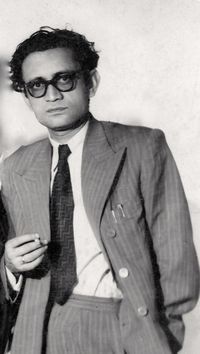
For the master of the Urdu short story this was not a value judgment. It was a statement of what he had come to believe after keen observation and extended introspection. Shaken by the repercussions of the decision to break up the unity of the subcontinent, Manto wondered if people who only recently were friends, neighbours and compatriots had lost all sense of their humanity. He too was a human being, ‘the same human being who raped mankind, who indulged in killing' and had ‘all those weaknesses and qualities that other human beings have.' Yet human depravity, however pervasive and deplorable, could not kill all sense of humanity. With faith in that kind of humanity, Manto wrote riveting short stories about the human tragedy of 1947 that are internationally acknowledged for representing the plight of displaced and terrorised humanity with exemplary impartiality and empathy.
Manto's partition stories are a must read for anyone interested in the personal dimensions of India's division and the creation of Pakistan. Pieced together from close observations of the experiences of ordinary people at the moment of a traumatic rupture, his stories are not only unsurpassable in literary quality but records of rare historical significance. Unlike journalistic and partisan accounts of those unsettled times, Manto's transcended the limitations of the communitarian narratives underpinning the nationalist self-projections of both Pakistan and India. He did not create demons out of other communities to try and absolve himself of responsibility for the moral crisis posed by the violence of partition.
More here.
Study links genes to melanoma development
From Nature:
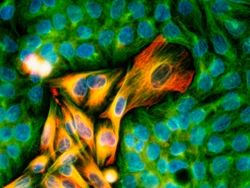
Berger and his colleagues also found potentially damaging PREX2 mutations in 14% of 107 tumours that were not part of the initial study. And when they transplanted human skin cells containing PREX2 mutations into mice that had been engineered to develop skin cancer, four of the six different PREX2 mutations accelerated development of the tumours in mice. This led the researchers to suggest that PREX2 might have a similar role in human skin cancers. Their work is published in Nature today1. The team also confirmed some findings from earlier studies2, including the effect that sun exposure can have on the mutation rate of tumour DNA. Tumours from areas of the body that are not frequently exposed to sunlight had around 3 to 14 mutations every million base pairs, whereas one patient who was known to have had high levels of sun exposure had 111 mutations every million base pairs.
More here.
Thursday, May 10, 2012
Lions in Winter, Part One

In March 2008, the New York Public Library announced a $100 million gift from private equity billionaire Stephen Schwarzman and a sweeping plan to radically remake its landmark main building on 42nd Street. Six months later, Lehman Brothers collapsed; the plan, to no one’s surprise, was put on hold. Now, the administration has announced that the renovation, its budget increased from $250 to $350 million, is back on track. The proposed designs developed by British architect Norman Foster have not yet been made public, but the basic scheme remains the same: to tear out the steel stacks that occupy almost half of the main building—and that literally hold up the famed Rose Reading Room on the top floor—and replace them with a new circulating library. This library will offer plenty of books, DVDs, and other materials, which any patron will be allowed to take out of the building, unlike the current research collection. The plan will be financed through the sale of two of the library’s nearby branches—the Mid-Manhattan Library across the street and the Science, Industry, and Business Library (SIBL) at Madison and 34th—and through a $150 million grant from the City of New York. The new super-library will also be designed for a time when the idea of physically circulating books becomes a thing of the past and practically all library “materials” will be available exclusively through digital devices.
That, however, is in the future. What the present will bring is the removal of the majority of the library’s outstanding collection of research-level books, which for most of the past century have rarely if ever been allowed out of the building. These books will be moved to a storage facility in Princeton, New Jersey. Some will remain in the stacks beneath Bryant Park, but the rest of the books in the library’s core collection will be available only by putting in a request and waiting for them to be brought back to New York.
walk like a roman
When the ancient geographer Strabo described the native inhabitants of the Iberian Peninsula, he listed – with a predictable combination of relish, horror and exaggeration – all kinds of aspects of their weird barbarity. Some of the Spanish tribesmen, he insisted, stored vintage urine in cisterns and then bathed in it, or used it to clean their teeth. Others dressed their women up with iron rods around their necks rather than jewellery. Others, still stranger, appeared to have no gods. No less remarkable, for Strabo, was the bafflement some of these poor Spaniards felt at the day-to-day habits of their new Roman allies or conquerors. One group of tribesmen, he explained, visiting a Roman camp and seeing some generals taking a stroll, “walking up and down the road”, thought they were “mad and tried to take them back into their tents”, either to sit down and rest, or get up and fight. Despite Strabo’s patronizing tone, it’s one of those rare occasions where we can catch a glimpse of the barbarian point of view on the Romans. The Spaniards presumably thought that walking was something that got a person from A to B (or from tent to battleground). What on earth then were these Roman generals doing as they ambled around, chatting, but not actually going anywhere?
more from Mary Beard at the TLS here.
where’s she going?
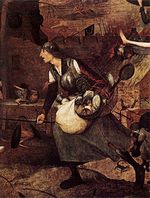
It’s been 450 years since Pieter Breugel the Elder painted the famous “Dulle Griet,” and still no one can agree what the painting is about. In the center of the mad surreal Boschian landscape is Dulle Griet — in English, “Mad Meg” — a homely peasant woman from Flemish folklore, wearing the armor of a soldier. In her left hand she carries a cloth bag and a couple of baskets filled to spilling with kitchen items; tucked under her armpit is a small chest. In her free hand, she holds a long sword pointed at the mouth of Hell. All around Dulle Griet, hellfires burn through the landscape, a city in ruin. There is an infestation of egg-shaped little creatures. One such creature is dancing merrily on a burning rooftop in the background. In front of Dulle Griet is another egg-shaped creature with, I believe, a spoon inserted handle-first into its anus, which is also, possibly, its mouth. Behind Dulle Griet, an army of peasant women beat away invaders (demons? soldiers?). There’s a story here, with a moral. There’s always a moral amidst hellfire. But what is it?
more from Stefany Anne Golberg at The Smart Set here.
President Obama’s Moment
From The New York Times:
It has always taken strong national leadership to expand equal rights in this country, and it has long been obvious that marriage rights are no exception. President Obama offered some of that leadership on Wednesday. “I think same-sex couples should be able to get married,” Mr. Obama said in an interview with ABC News that the White House arranged for the purpose of giving Mr. Obama a forum to say just that. With those 10 words, Mr. Obama finally stopped temporizing and “evolving” his position on same-sex marriage and took the moral high ground on what may be the great civil rights struggle of our time. His words will not end the bitter fight over marriage rights, which we fear will continue for years to come. But they were of great symbolic value, and perhaps more. As Mayor Michael Bloomberg noted, no expansion of rights embraced by a president has failed to become the law of the land.
This is a president and a White House that has not always been unwavering in taking positions of principle, including on this issue. Mr. Obama’s statement followed days of unseemly equivocation by the White House after Vice President Joseph Biden Jr. announced his support for same-sex marriage on Sunday. It also came one day after North Carolina voters approved a constitutional amendment forbidding same-sex marriage and civil unions, which threatens all unmarried couples, health coverage for their children and domestic violence laws. Still, the contrast was sharp between Mr. Obama and Mitt Romney, who took a hard-line position on Wednesday against same-sex marriage and civil unions with similar rights. He has said he favors a national constitutional amendment enshrining this particular bigotry.
More here.
Carnivorous plants employ services of bodyguard ants
From MSNBC:

In return, the ants apparently provide a host of services for the pitcher plants. They clean the pitcher mouth to keep it slippery enough to help catch prey. They attack weevils that would otherwise munch on the plant. They cart off the remains of large prey from the pitchers that would otherwise rot. They lie in ambush under pitcher rims and systematically attack any of the plant's prey that attempt to escape the traps. And their droppings fertilize the plants. [Amazing Photos of Carnivorous Plants] Still, while it seemed that both pitcher plants and ants benefited from this alliance, investigators lacked hard evidence. It could be the case that only the ants profited. Now scientists have compared both ant-inhabited and uninhabited plants, finding those with ants fared much better than ones without. “The symbiotic ants are shown to be crucial for the nutrition and survival of their host plant,” said researcher Vincent Bazile, an ecologist at University Montpellier 2 in France.
More here.
Thursday Poem
White Spine
Liar, I thought, kneeling with the others,
how can He love me and hate what I am?
The dome of St. Peter's shone yellowish
gold, like butter and eggs. My God, I prayed
anyhow, as if made in the image
and likeness of Him. Nearby, a handsome
priest looked at me like a stone; I looked back,
not desiring to go it alone.
The college of cardinals wore punitive red.
The white spine waved to me from his white throne.
Being in a place not my own, much less
myself, I climbed out, a beast in a crib.
Somewhere a terrorist rolled a cigarette.
Reason, not faith, would change him.
by Henri Cole
from The Visible Man
Knopf, 1998
The brain… it makes you think. Doesn’t it? David Eagleman vs Raymond Tallis
Are we governed by unconscious processes? Neuroscience believes so – but isn't the human condition more complicated than that? Two experts offer different views.
David Eagleman and Raymond Tallis in The Guardian:
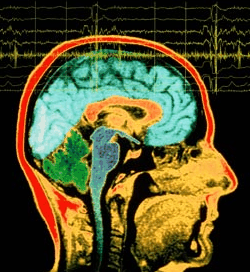
This clarifies some aspects of our existence while deepening the mystery and the awe of others.
For example, take the vast, unconscious, automated processes that run under the hood of conscious awareness. We have discovered that the large majority of the brain's activity takes place at this low level: the conscious part – the “me” that flickers to life when you wake up in the morning – is only a tiny bit of the operations. This understanding has given us a better understanding of the complex multiplicity that makes a person. A person is not a single entity of a single mind: a human is built of several parts, all of which compete to steer the ship of state. As a consequence, people are nuanced, complicated, contradictory. We act in ways that are sometimes difficult to detect by simple introspection. To know ourselves increasingly requires careful studies of the neural substrate of which we are composed.
More here.
Giant Black Hole Shreds and Swallows Helpless Star
Ken Croswell in Science:

Giant black holes occupy the centers of most large galaxies, including our own, whose central black hole is 4 million times as massive as the sun and swallows a star once every 10,000 to 100,000 years. Astronomers have recently seen black holes in several other galaxies rip stars apart. But the new drama is unique. “This is the first time where we're really seeing one of these events from start to finish,” says astronomer Suvi Gezari of Johns Hopkins University in Baltimore, Maryland. “What was so spectacular was the fact that we actually could figure out what type of star was disrupted.”
Astronomers first picked up a signal from the constellation Draco in May 2010, when the Pan-STARRS 1 telescope in Hawaii spotted a flare at visible and near-infrared wavelengths. The scientists calculate that the black hole's gravity had torn the star apart a month earlier by pulling harder on one side of the star than the other. As stellar debris funneled into the black hole, gravity and friction roasted the star's remains until they emitted ultraviolet radiation, which NASA's GALEX satellite detected in June. The flare peaked in July 2010, outshining all the stars in the galaxy put together, and then faded, but was still aglow a year later.
More here.
Venice in a Day
Saudi Arabia Exports Salafism to War-Torn Kashmir
Tariq Mir in the Boston Review:

Historically, Kashmir has been dominated by Sufi Islam, a mystical branch of the faith that the puritanically minded abhor. But Al Kindi plans to change all that. In a region already wracked by internal division and foreign pressure, he represents yet another potentially destabilizing force: orthodox Salafism, aggressively expansionist and imported from Saudi Arabia.
After the sermon, we drove to Al Kindi’s rented apartment. He lived in a prosperous area with large houses and fenced-in compounds stretching along the barbed wire–topped wall of a sprawling Indian army camp. The ragged three-room flat was a temporary accommodation for his family; he was putting the finishing touches on a house in a new suburb. Constructing even a modest house in Srinagar is out of reach for most, but Al Kindi, an alumnus of the Saudi-backed Islamic University of Medina, managed thanks to a hefty monthly stipend from his alma mater.
More here.
Wednesday, May 9, 2012
Arab Spring has washed the region’s appalling racism out of the news
Robert Fisk in The Independent:
Yet in the Arab Gulf, the treatment of migrant labour – male as well as female – has long been a scandal. Men from the subcontinent often live eight to a room in slums – even in the billionaires' paradise of Kuwait – and are consistently harassed, treated as third-class citizens, and arrested on the meanest of charges.
Saudi Arabia long ago fell into the habit of chopping off the heads of migrant workers who were accused of assault or murder or drug-running, after trials that bore no relation to international justice. In 1993, for example, a Christian Filipino woman accused of killing her employer and his family was dragged into a public square in Dammam and forced to kneel on the ground where her executioner pulled her scarf from her head before decapitating her with a sword.
More here.
Losing Your Religion: Analytic Thinking Can Undermine Belief
Marina Krakovski in Scientific American:
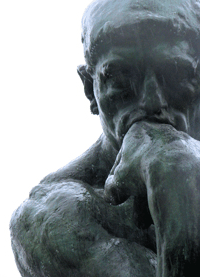
The research, conducted by University of British Columbia psychologists Will Gervais and Ara Norenzayan, does not take sides in the debate between religion and atheism, but aims instead to illuminate one of the origins of belief and disbelief. “To understand religion in humans,” Gervais says, “you need to accommodate for the fact that there are many millions of believers and nonbelievers.”
One of their studies correlated measures of religious belief with people's scores on a popular test of analytic thinking. The test poses three deceptively simple math problems. One asks: “If it takes five machines five minutes to make five widgets, how long would it take 100 machines to make 100 widgets?” The first answer that comes to mind—100 minutes—turns out to be wrong. People who take the time to reason out the correct answer (five minutes) are, by definition, more analytical—and these analytical types tend to score lower on the researchers' tests of religious belief.
But the researchers went beyond this interesting link, running four experiments showing that analytic thinking actually causes disbelief.
More here.
The Loneliness Scare

Headlines in America’s newspaper of record imply that if you’re not feeling lonely, you may be the lonely exception: “Sad, Lonely World Discovered in Cyberspace”; “Alone in the Vast Wasteland”; and “The Lonely American Just Got a Bit Lonelier.” Add books such as Bowling Alone, The Lonely American, and Alone Together, and you might think that there is an epidemic of loneliness.
An endemic epidemic, perhaps, because we have received such diagnoses for generations. The 1950s—the era of large families, crowded churches, and schmoozing suburbanites—brought us hand-wringing books such as Man Alone: Alienation in Modern Society and the best-selling The Lonely Crowd, which landed author David Reisman on the cover of Time magazine. About a half-century before that, policymakers were worrying about the loneliness of America’s farmers, and observers were attributing a rising suicide rate to the loneliness of immigrants or to modernity in general. And so on, ever back in time. Noted historian Page Smith described colonial Americans’ “cosmic loneliness” and the upset stomachs and alcoholism that resulted. Americans have either been getting lonelier since time immemorial or worrying about it since then.
The latter is more likely. Social scientists have more precisely tracked Americans’ isolation and reports of loneliness over the last several decades. The real news, they have discovered, is that there is no such epidemic; there isn’t even a meaningful trend.
Political Neuroscience
Democracy and Education: On Andrew Delbanco
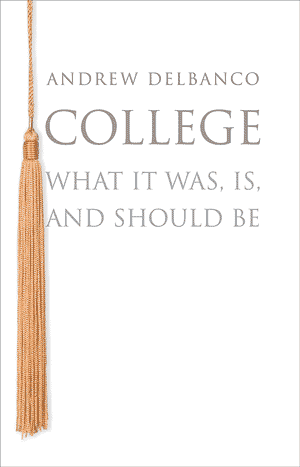
Delbanco is a professor of American Studies at Columbia University and a noted authority on the work of Herman Melville. Although the “savage inequalities” of American higher education are not the primary focus of College, he confronts them head-on in the book’s opening pages. He notes that whereas the child of a family earning at least $90,000 a year stands a 50 percent chance of receiving a BA by the time he or she turns 24, for a child whose annual family income is in the range of $60,000 to $90,000, the odds diminish to one in four. For someone from a household with an annual income of $35,000 or less, they plummet to one in seventeen. These disparities also have ramifications after graduation: Over a lifetime, someone with a bachelor’s degree will earn an average of $2.1 million, nearly twice as much as someone with only a high school diploma.
Delbanco explains further that the children of affluent families are four times more likely to be admitted to a prestigious, highly selective university than students with comparable grades and test scores from families of more modest means. And because elite colleges and universities function as conduits to high-ranking positions in government, business and other walks of life, it becomes impossible to deny that top universities perpetuate the perquisites of privilege rather than ameliorate them in a democratic manner. As Delbanco asserts, “An American college is only true to itself when it opens its doors to all—rich, middling, and poor—who have the capacity to embrace the precious chance to think and reflect before life engulfs them. If we are serious about democracy, that means everyone.” Because in most other OECD nations higher education is largely government subsidized, the persistence of structural inequities of access to higher education has become a distinctly American badge of shame.
Delbanco performs an invaluable public service by deftly dissecting the notion of “meritocracy,” which he aptly characterizes as the reigning ideology of class privilege. The idea of meritocracy suggests that those who have acceded to positions of prominence have arrived there by their own talents and abilities—they have bested their peers on a level playing field and are therefore entitled to success. But with what justification can one speak of a “level playing field” when wealthy parents spend exorbitant sums on SAT prep courses and college admissions gurus?
A Million Little Pieces: The sculptural maelstroms of Sarah Sze
From The New Yorker:

More here.