Deciphering the Tools of Nature’s Zombies

Carl Zimmer in the New York Times:

11parasite-1354743797360-popupIn the rain forests of Costa Rica lives Anelosimus octavius, a species of spider that sometimes displays a strange and ghoulish habit.

From time to time these spiders abandon their own web and build a radically different one, a home not for the spider but for a parasitic wasp that has been living inside it. Then the spider dies — a zombie architect, its brain hijacked by its parasitic invader — and out of its body crawls the wasp’s larva, which has been growing inside it all this time.

The current issue of the prestigious Journal of Experimental Biology is entirely dedicated to such examples of zombies in nature. They are far from rare. Viruses, fungi, protozoans, wasps, tapeworms and a vast number of other parasites can control the brains of their hosts and get them to do their bidding. But only recently have scientists started to work out the sophisticated biochemistry that the parasites use.

“The knowledge that parasites can manipulate their hosts is old. The new part is how they do it,” said Shelley Adamo of Dalhousie University in Nova Scotia, a co-editor of the new issue. “The last 5 to 10 years have really been exciting.”

In the case of the Costa Rican spider, the new web is splendidly suited to its wasp invader. Unlike the spider’s normal web, mostly a tangle of threads, this one has a platform topped by a thick sheet that protects it from the rain. The wasp larva crawls to the edge of the platform and spins a cocoon that hangs down through an opening that the spider has kindly provided for the parasite.

More here.
Syria loads chemical weapons into bombs; military awaits Assad’s order

Jim Miklaszewski and M. Alex Johnson at NBC News:

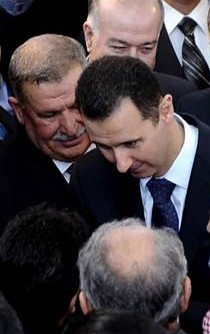
ScreenHunter_62 Dec. 06 13.29The Syrian military is prepared to use chemical weapons against its own people and is awaiting final orders from President Bashar Assad, U.S. officials told NBC News on Wednesday.

The military has loaded the precursor chemicals for sarin, a deadly nerve gas, into aerial bombs that could be dropped onto the Syrian people from dozens of fighter-bombers, the officials said.

As recently as Tuesday, officials had said there was as yet no evidence that the process of mixing the “precursor” chemicals had begun. But Wednesday, they said their worst fears had been confirmed: The nerve agents were locked and loaded inside the bombs.

Sarin is an extraordinarily lethal agent. Iraqi President Saddam Hussein's forces killed 5,000 Kurds with a single sarin attack on Halabja in 1988.

U.S. officials stressed that as of now, the sarin bombs hadn't been loaded onto planes and that Assad hadn't issued a final order to use them. But if he does, one of the officials said, “there's little the outside world can do to stop it.”

Secretary of State Hillary Rodham Clinton reiterated U.S. warnings to Assad not to use chemical weapons, saying he would be crossing “a red line” if he did so.

More here.

Our Hillary Problem

From The New Yorker:

Ahill“Hello again,” Hillary Clinton said last week. “It’s so good to see you again. And my husband sends you his very best regards.” She was talking to the King of Thailand, on what was meant to be one of her final trips as Secretary of State, after which she will make some gesture toward retirement. But one wonders if the whole American electorate might, before too long, be treated to the same sort of greeting the King got. Hillary Clinton may be leaving the State Department, but is she really leaving the stage? The idea of her running for President in 2016 may seem fanciful, based on her denials and a dozen other barriers, or unavoidable, given the number of people who seem to think that she’s better positioned than any other Democrat. But if not the New Hampshire primary and Iowa caucus, then where? Do Clintons ever truly go away?

Some of the contradictions in Hillary Clinton’s career can be seen in the talk of, or rather hysteria about, who her successor at the State Department might be. One of the candidates is Susan Rice, who is now the United Nations Ambassador (another is John Kerry). Rice has been browbeaten and vilified in the past couple of weeks in a way that seems completely out of proportion. Rice went on Sunday-morning talk shows four days after the attack and repeated talking points, cleared by the intelligence community, that turned out to be off (although even on that point the gray area may be larger than the Republicans have presented it). For this, she has been talked about as something close to a criminal. After Rice met privately with Senators John McCain, Lindsay Graham, and Kelly Ayotte yesterday, the three came out looking and sounding like they’d just been listening to hours of crude and vicious mob wiretaps.

More here.

Thursday Poem

The Beautiful Sandwich

She could always make
the most beautiful sandwich.
Laced swiss cheese: sliced
crossways, folded once.
Ham in rolls like sleeping bags.
Turkey piled like shirts.
Tarragon. Oregano. Pepper.
Herb dill mayonnaise the color of
skin. On top: the thin, wandering line of
mustard
like a contour on a map
in a thin, flat drawer.
Or a single, lost vein.
The poppyseeds hold on,
for now.

Placed on a plate like isolated
driftwood
or a large, solemn head.
The spilled chips in yellow piles
are like the strange coins
of tall, awkward islanders.
The thin dill pickle: their boat
slides into
the green-sour sea.

by Brad Ricca
from American Mastodon
Black Lawrence Press, 2011

Heart cells coaxed to divide and conquer

From Nature:

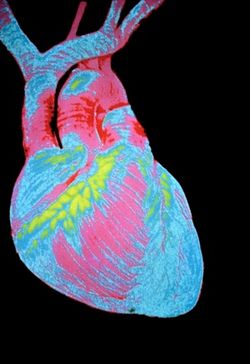
AheartCan heart cells renew themselves, and can scientists help them do so? Two papers published online in Nature today suggest that heart muscle cells can make copies of themselves at a very low rate1, but that a genetic trick can prompt them to do a better job2. Those results give hope that hearts damaged by cardiovascular disease — which causes the deaths of almost 17 million people a year — could be coaxed to regenerate themselves. Heart muscle cannot renew itself very well. Researchers would like to help that process by finding populations of cells in the heart that can do so, and then boosting that capacity. But it has not been easy to find evidence of these regenerating cells, or to assess the extent of their powers.

The two Nature papers aim to get to the heart of the matter. In one, a team led by Richard Lee at the Brigham and Women’s Hospital and Harvard Medical School, both in Boston, Massachusetts, traced the birth and fate of heart muscle cells in mice. Lee and his colleagues found that a small proportion of heart cells — less than 1% — can regenerate themselves normally. After a heart attack that proportion goes up, but only to 3%. “These studies dispel any notion of the heart having a robust ability to regenerate,” says Charles (Chuck) Murry, who studies heart regeneration at the University of Washington in Seattle. That those cells exist at all is heartening, however. “If there is some capacity for the heart to produce new heart muscle cells, that’s a foothold that we can work with,” says Matthew Steinhauser, a co-author on the paper1 and a member of Lee’s lab. Then, he says, the team can ask: “Can we make it work better?”. A second group has done just that.

More here.

Wednesday, December 5, 2012

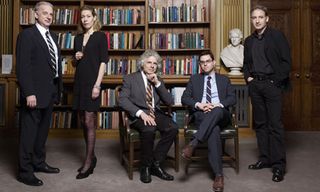
Steven Pinker, James Gleick, Brian Greene, Lone Frank, and Joshua Foer debate what makes good science writing

Ian Tucker in The Observer:

Science-authors-Gleick-Fr-009Ian Tucker: Why is popular science reporting important?

Joshua Foer: When the Royal Society was founded in 1660, it was still possible for an educated person, a polymath, actually to know something about everything. Today, that is not possible. Steven Pinker might be a great cognitive scientist but I bet he can't explain how they discovered the Higgs boson.
Brian Greene: He just explained it to me earlier and he did quite a good job.
JF: That speaks to why we need great interpreters more than ever. And what we do becomes more and more important because as science becomes more esoteric it requires people to help the rest of us to understand it.

When you are writing where do you set the difficulty dial? Do you want your readers to finish your book in one sitting or work hard at every sentence to glean some insight from it?

Steven Pinker: Before I wrote my first cognitive book, I got a bit of advice from an editor, which was probably the best advice I ever received. She said that the problem many scientists and academics have when they write for a broad audience is that they condescend; they assume that their target audience isn't too bright, consists of truck drivers, chicken pluckers and grannies knitting dollies, and so they write in motherese, they talk down. She said: “You should assume your readers are as smart as you are, as curious as you are, but they don't know what you know and you're there to tell them what they don't know.” I'm willing to make a reader do some work as long as I do the work of giving them all the material they need to make sense of an idea.

More here.

Jeff Hawkins Develops a Brainy Big Data Company

Quentin Hardy in the New York Times:

28bits-hawkins-articleInlineJeff Hawkins has been a pioneer of mobile devices, a distinguished lecturer in neuroscience, and a published author of a revolutionary theory of how the brain works. If he’s right about Big Data, a lot of people are going to wish he’d never gone into that field.

Mr. Hawkins, who helped develop the technology in Palm, an early and successful mobile device, is a co-founder of Numenta, a predictive software company. Numenta’s technology is based on Mr. Hawkins’s theories of how the brain works, a subject he has studied and published on intensively. Perhaps most important for the technology industry, the product works off streams of real-time information from sensors, not the trillions of bytes of data that companies are amassing.

“It only makes sense to look at old data if you think the world doesn’t change,” said Mr. Hawkins. “You don’t remember the specific muscles you just used to pick up a coffee cup, or all the words you heard this morning; you might remember some of the ideas.”

If no data needs to be saved over a long term and real-time data can stream in all the information that is needed, a big part of the tech industry has a problem.

More here.

forgotten poets

Samuel-greenberg-sketch

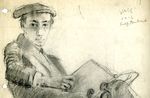
Some writers leave only traces, contrails across the literary firmament. They expire with few or no publications to their names, their legacies left as much to chance as to the efforts of the occasional passionate admirer. Contemporaries offer testimonies of superlative talent unfulfilled, of death robbing posterity of a name that, given time and circumstance, surely would have been added to the rolls of the great. And while some work might survive, appearing in the occasional anthology, it is shrouded in the pall of its author’s biography. Samuel Greenberg belongs in the pantheon of literary manqués. He’s not totally forgotten—a few hundred poems survive; some were published in posthumous editions. In the 95 years since his death at the age of 23, he has endured as the prototypical “cult writer,” his works passed around like samizdat and occasionally earning an ardent, powerful admirer.

more from Jacob Silverman at Poetry here.

a radical idealist

20121203-bendigo

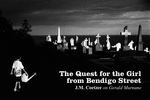
How the male gets into the female is only one of the many mysteries faced by the boy child. In his naive cosmology, God the Father is at best a remote presence. Presiding over his destiny instead is a figure he calls the Patroness, a composite of the Virgin Mary and his own mother in her youth. “The very purpose of her existence was to remain aloof from me and so to provide me with a task worthy of a lifetime of effort: the simple but baffling task of gaining admission to her presence.” A need to offer up to the female principle some strenuous act of penance becomes one of the deeper motives in Murnane’s writing, animating his novel Inland in particular. As a writer, Murnane is anything but a naive, straightforward realist. Putting down on paper what an Irish Catholic upbringing was like in Australia circa 1950 is not the limit of his ambition.

more from J.M. Coetzee at the NYRB here.

the hunger artist

JO_ANTHO_HUNGE_AP_001

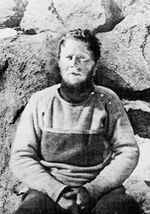
Antarctica, as it turned out, was more emptiness than facts. And a particularly empty emptiness, in the form of a deep crevasse, awaited Mawson and his comrades. After the saga that followed, from which a ruined Mawson would emerge as the sole survivor, he noted that, in the midst of his deprivation, “cocoa was almost intoxicating and even plain beef suet, such as we had in fragments in our hoosh mixture, had acquired a sweet and aromatic taste scarcely to be described… as different as chalk is from the richest chocolate cream.” Are we Mawson’s descendants or his antithesis? Either way, our lunchtime banter is trapped within an inescapable vanity: We take pride in occupying this rare and hallowed ground, but we do it by reveling in a cozy existence on a continent that could sponsor raptures over the benefits of starvation.

more from Jason Anthony at The Smart Set here.

Paul Krugman: Asimov’s Foundation novels grounded my economics

From The Guardian:

Asimov-Foundation-012There are certain novels that can shape a teenage boy's life. For some, it's Ayn Rand's Atlas Shrugged; for others it's Tolkien's The Lord of the Rings. As a widely quoted internet meme says, the unrealistic fantasy world portrayed in one of those books can warp a young man's character forever; the other book is about orcs. But for me, of course, it was neither. My Book – the one that has stayed with me for four-and-a-half decades – is Isaac Asimov's Foundation Trilogy, written when Asimov was barely out of his teens himself. I didn't grow up wanting to be a square-jawed individualist or join a heroic quest; I grew up wanting to be Hari Seldon, using my understanding of the mathematics of human behaviour to save civilisation. OK, economics is a pretty poor substitute; I don't expect to be making recorded appearances in the Time Vault a century or two from now. But I tried. So how do the Foundation novels look to me now that I have, as my immigrant grandmother used to say, grown to mature adultery? Better than ever. The trilogy really is a unique masterpiece; there has never been anything quite like it. By the way, spoilers follow, so stop reading if you want to encounter the whole thing fresh.

Maybe the first thing to say about Foundation is that it's not exactly science fiction – not really.

More here.

‘Smart’ genes put us at risk of mental illness

From PhysOrg:

Data from new research, published today in the journal Nature Neuroscience, was analysed by Dr Richard Emes, a bioinformatics expert from the School of Veterinary Medicine and Science at The University of Nottingham. The results showed that disease-causing mutations occur in the genes that evolved to make us smarter than our fellow animals. Dr Emes, Director of The University of Nottingham's Advanced Data Analysis Centre, conducted an analysis of the evolutionary history of the Discs Large homolog (Dlg) family of genes which make some of the essential building blocks of the synapse—the connection between nerve cells in the brain. He said: “This study highlights the importance of the synapse proteome—the proteins involved in the brains signalling processes—in the understanding of cognition and the power of comparative studies to investigate human disease.”

The study involved scientists from The University of Edinburgh, The Wellcome Trust Sanger Institute, the University of Aberdeen, The University of Nottingham and the University of Cambridge. This cross-disciplinary team of experts carried out what they believe to be the first genetic dissection of the vertebrate's ability to perform complex forms of learning, attention and function. They focussed on Dlg—a family of genes that humans shared with the ancestor of all backboned animals some 550 million years ago. Gene families like the Dlgs arose by duplication of DNA, changed by mutation over millions of years and now contribute to the complex cognitive processes we have today. However, this redundancy and subsequent accumulation of changes in the DNA may have led to increased susceptibility to some diseases.

More here.

Wednesday Poem

Pentatina for Five Vowels
.
Today is a trumpet to set the hounds baying.
The past is a fox the hunters are flaying.
Nothing unspoken goes without saying.
Love’s a casino where lovers risk playing.
The future’s a marker our hearts are prepaying.

The future’s a promise there’s no guaranteeing.
Today is a fire the field mice are fleeing.
Love is a marriage of feeling and being.
The past is a mirror for wishful sightseeing.
Nothing goes missing without absenteeing.

Nothing gets cloven except by dividing.
The future is chosen by atoms colliding.
The past’s an elision forever eliding.
Today is a fog bank in which I am hiding.
Love is a burn forever debriding.

Love’s an ascent forever plateauing.
Nothing is granted except by bestowing.
Today is an anthem the cuckoos are crowing.
The future’s a convolute river onflowing.
The past is a lawn the neighbor is mowing.

The past is an answer not worth pursuing,
Nothing gets done except by the doing.
The future’s a climax forever ensuing.
Love is only won by wooing.
Today is a truce between reaping and rueing.

by Campbell McGrath
from Poetry, Vol. 201, No. 1, October, 2012

Tuesday, December 4, 2012

Threat Level

Image

Richard Beck in n+1:

American liberals spent the last decade complaining about the “paranoid” style of their conservative opponents. With each new dire warning, each shift in the Department of Homeland Security’s now defunct color-coded “threat level” indicator (which never once dropped below yellow in nine years of operation), liberal commentators took the stage as level-headed counterparts to the prevailing Republican psychosis. George W. Bush, everyone knew, governed by fear. Liberals wanted something better, or believed they did.

Homeland, now in its second season on premium cable, suggests that liberals may have been fooling themselves. What they really wanted was not to eradicate Republican paranoia, but to overcome what made Republican paranoia so potent: the widespread impression that Democrats were too weak and too plagued by self-loathing to defend us from our enemies. Under Obama, our shared fears have been inflected with the rhetoric of tolerance, and torture has been repudiated (at least in its most egregious forms). But the terrorists, on Homeland and in real life, are still supposedly out there, still capable of anything, still ready to strike at a moment’s notice. Homeland works by acclimating its Democratic fans to a permanent political mood of suspicion and imminent catastrophe. President Obama, whose drone strikes have killed scores more than Bush’s torturers—and have done so with much less fuss from the left—has called it his favorite show.

Homeland is produced by Howard Gordon and Alex Gansa, former writers for the network hit 24, a war-on-terror action thriller in which patriot-hero Jack Bauer rushed around the world, dodging bazooka rounds and shooting or smashing or stabbing kneecaps, always in a desperate attempt to stop a terrorist attack. In interviews, Gordon and Gansa like to describe their new project as confessing the sins of its fascistic pro-torture predecessor (their New York Times interview was headlined “The Creators of ‘Homeland’ Exorcise the Ghost of ‘24’”). In practice, however, Homeland indulges many of the same fantasies. It promotes the old myths about al Qaeda’s omnipresence, wags its finger at Arab societies and the things they do to “their” women, and generates the same charge from scenes of mayhem and destruction. In the show’s fifth episode, a CIA agent asks a Marine sergeant to assist in interrogating an al Qaeda operative. “One question,” the Marine asks, hesitating. “Will he be tortured?” “We don’t do that here,” the agent replies, and the Marine breathes a sigh of relief. In Homeland‘s moral universe, strong opposition to torture provides cover for the very fears and myths that made torture possible in the first place.

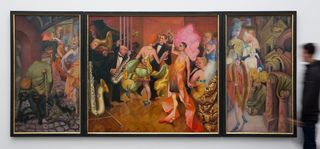
Berlin in the Golden Twenties

Image-424039-galleryV9-uuoq

Mathias Schreiber in Spiegel:

The expression “infernally haunting reality” neatly sums up the cultural environment in the German capital in the 1920s. One of Grosz's drawings depicts a disillusioned soldier in a steel helmet who wants to relax by the riverside in a large city, only to find a bloated corpse there, apparently a former comrade who had lost his desire to live.

The sarcastic title “Feierabend” or, quitting time, is a reference to both the death of the drowned suicide victim and the end-of-day feeling of the man looking at the corpse. The title — perverted into a negative take on the original meaning of the expression, which actually refers to the pleasant feeling of reaching the end of the workday — is sharp-edged, shocking and direct, exhibiting a keen view of real contradictions.

From this time on, this cold view of what writer Bertolt Brecht called the “asphalt city,” and its sinister agents, became established in the most important branches of art and hastened by the new mediums of photography, radio, poster advertising, records, the daily press, cabaret and film. Raw truth replaced expressively blissful beauty. “Art is boring; one wants facts,” author Alfred Döblin (1878-1957) wrote in defining this wave of reality-based art.

europe’s long shadow

201_arts_beevor1

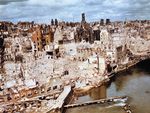
The memory of the second world war hangs over Europe, an inescapable and irresistible point of reference. Historical parallels are usually misleading and dangerous. The threat of economic collapse now is not the same as the threat of Nazism and war. But the current crisis still poses a threat to parliamentary democracy in Europe. It may awaken the nationalist monsters which the European ideal had tried to consign to history. Today it is very hard to appreciate the huge historical forces that killed some 60m to 70m people, or even more. Chinese historians now claim that more than 40m of their countrymen died, double the number that had been assumed earlier. And when counting the war dead, we could add to these figures all the victims of famine and illness brought on by malnutrition. It is almost impossible to distinguish between categories of suffering. When we dwell on the enormity of the second world war and its victims, we try to absorb all those statistics of national and ethnic tragedy. But, as a result, there is a tendency to overlook the way the war changed even the survivors’ lives in ways impossible to predict.

more from Antony Beevor at Prospect Magazine here.

the anarchists

Cover00

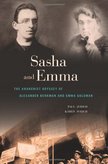
Still, one greets this larger-than-life study of the modern revolutionary’s vocation with a certain puzzlement—a kind of variation on the age-old radical quandary “What is to be done?” While reading Avrich’s excellent chronicle of Berkman and Goldman’s lives and times, I was once again moved by the depth of their idealism and commitment—but I was also repeatedly struck by how different our current situation is from theirs. Their experience of injustice and inequality was tangible. It meant something to speak, as Goldman and Berkman did, of “parasitic capitalists,” “capitalistic thieves and idlers,” in a world where labor truly was “the creator of all the wealth in the world,” where “everything in this city was created by our hands or the hands of our brothers and sisters.” Amid the present-day polarization of wealth, however, such evocations of a shared historical plight among the dispossessed, rare as they are, have little resonance. Thanks to the steady financialization of the economy and the export of manufacturing jobs to the impoverished developing world, fewer and fewer of us make anything—and certainly not under the exploitative conditions of the nineteenth-century factory. And this radical change in our everyday lives appears to have sharply weakened, if not altogether severed, our direct relationship to the rich.

more from Rochelle Gurstein at Bookforum here.