First road map of human sex-cell development

From Nature:

EggThe causes of infertility, which affects around 10% of couples, are often unknown, but may in some cases result from the body's inability to produce viable gametes — also known as sperm and egg cells. The first study of the development of such 'germ cells' from humans could help scientists to learn how to create them in the laboratory instead. Even though the reproductive age for humans is around 15–45 years old, the precursor cells that go on to produce human eggs or sperm are formed much earlier, when the fertilized egg grows into a tiny ball of cells in the mother’s womb. This ball of cells contains ‘pluripotent stem cells’ — blank slates that can be programmed into any type of cell in the body — and researchers are hoping to use these stem cells to treat various conditions, including infertility. But little is known about the early developmental stages of human gametes — owing to the sensitivity of working with human tissue — and most work in this area has been conducted using mice. In a Nature Cell Biology paper today1, researchers from the University of California, Los Angeles, trace the development of early germ cells in human fetuses of between 6 to 20 weeks and analysed when genes were turned on or off.

The DNA within these early germ cells carries 'epigenetic modifications' — structural changes that do not affect the DNA sequence itself but do affect the way that genes are expressed. These changes may have accumulated during the parents’ lives, and need to be erased during the fetal stage. The study found two major events that wipe out, or reprogram, epigenetic modifications. Most of this reprogramming happened before 6 weeks, but the authors found a second event that completes the reprogramming after 6 weeks. “This is an important and fundamental paper for understanding human germ-line cells and finding the basic information about human germ-cell biology,” says reproductive biologist Evelyn Telfer of the University of Edinburgh, UK. “The researchers are clearly working in an uncharted area.”

More here.
In Gun debate, a misguided focus on mental illness

Richard Friedman, M.D. in The New York Times:

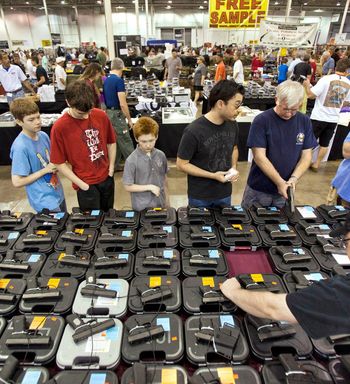
MIND-popupIn the wake of the terrible shooting at an elementary school in Newtown, Conn., national attention has turned again to the complex links between violence, mental illness and gun control. The gunman, Adam Lanza, 20, has been described as a loner who was intelligent and socially awkward. And while no official diagnosis has been made public, armchair diagnosticians have been quick to assert that keeping guns from getting into the hands of people with mental illness would help solve the problem of gun homicides. Arguing against stricter gun-control measures, Representative Mike Rogers, Republican of Michigan and a former F.B.I. agent, said, “What the more realistic discussion is, ‘How do we target people with mental illness who use firearms?’ ” Robert A. Levy, chairman of the Cato Institute, told The New York Times: “To reduce the risk of multivictim violence, we would be better advised to focus on early detection and treatment of mental illness.”

But there is overwhelming epidemiological evidence that the vast majority of people with psychiatric disorders do not commit violent acts. Only about 4 percent of violence in the United States can be attributed to people with mental illness.

…Perhaps more significant, we are not very good at predicting who is likely to be dangerous in the future. According to Dr. Michael Stone, professor of clinical psychiatry at Columbia and an expert on mass murderers, “Most of these killers are young men who are not floridly psychotic. They tend to be paranoid loners who hold a grudge and are full of rage.”

More here.

Salman Rushdie vs. Pankaj Mishra on Mo Yan

Mo-Yan-010

First, Pankaj Mishra in the Guardian:

The possibility of friction with either the authoritarian state or non-state actors (political and religious extremists) often makes for a degree of self-censorship. At the same time, the need for obliqueness can also make the literary imagination more resourceful.

Such is the case with Mo Yan's deeply interesting fiction. His writing, however, has hardly been mentioned, let alone assessed, by his most severe western critics; it is his political choices for which he stands condemned. They are indeed deplorable, but do we ever expose the political preferences of Mo Yan's counterparts in the west to such harsh scrutiny?

In fact, we almost never judge British and American writers on their politics alone. It would seem absurd to us if the Somali, Yemeni or Pakistani victims of Barack Obama's drone assaults, miraculously empowered with a voice in the international arena, accused the US president's many literary fans of trying to put a human face on his unmanned killing machines; or if they denounced Ian McEwan, who once had tea with Laura Bush and Cherie Blair at 10 Downing Street, as a patsy for the Anglo-American nexus that is responsible for the deaths of hundreds of thousands of people and the displacement of millions more.

Nevertheless, they would not be wrong to detect an unexamined assumption lurking in the western scorn for Mo Yan's proximity to the Chinese regime: that Anglo-American writers, naturally possessed of loftier virtue, stand along with their governments on the right side of history.

Rushdie responds, also in the Guardian:

Pankaj Mishra (Why Salman Rushdie should pause before condemning Mo Yan on censorship, Review, 15 December) makes a series of confused, dishonest and wrong-headed assertions. He misreads John Updike's “blue mailboxes” speech at the Pen congress of 1986. Updike was not talking selfishly about sending away his writing and receiving cheques in return. He was using the mailboxes as a metaphor of the easy, free exchange of ideas and information in an open society. One presumes Mishra is in favour of such a society.

He also misrepresents me. I have never made the claim that the Bush administration was resolved “to bring democracy through war in Afghanistan”. I did say that, in the immediate aftermath of the 9/11 attacks, the reprisal attack against the al-Qaida-Taliban axis was justifiable, not to “bring democracy”, but to respond to an act of war. In Afghanistan a terrorist group had taken over the levers of a nation state and used that state as a base from which to attack the United States. For all I know, Mishra may feel that instead of fighting back, America should have apologized to al-Qaida for its foreign policy misdeeds and accepted that those killed in the Trade Centre towers deserved to die. I do not accuse him of that. Neither should he accuse me of what I did not say.

But Mishra has stranger fish to fry. Not content with attacking Nabokov, Bellow, Updike, Martin Amis and myself for “selective humanism”, he states: “Of course, violence and exploitation underpin all nation states, democratic or not.” This – what shall I call it? – this satanic view of human society as invariably founded upon evil is his reason for proposing the existence of a moral equivalence between powerful democracies and powerful tyrannies, and between writers' responses to living in free and unfree societies.

In the People’s Liberation Army

NYC112090_jpg_470x440_q85

Mo Yan in the NYRB blog:

Getting into the People’s Liberation Army was hard, but not as hard as getting into college. So, starting in 1973, I sent in my application and took a physical exam at the commune every year, and every year I was rejected. But then, in February 1976, with the help of some important people, my persistence paid off—I received my enlistment notice. Soon after that, on a cold, snowy day, I walked some fifteen miles to the county town. There I put on an army uniform and climbed into the back of a military truck for the trip to Huang County, where I moved into the famous “Ding Family Compound” barracks and began basic training. (I would not revisit the site until the fall of 1999, after Huang County had evolved into the city of Longkou and Ding Family Compound had been converted into a museum. What had originally impressed me as the magnificent home of a wealthy landlord I now saw was little more than a squat building, proof that my horizons had broadened.)

After getting through basic training, I was sent, along with three other recruits, to a so-called Intelligence Unit of the Ministry of Defense. People back home complimented me on my good luck of having been assigned to such a fine unit, but it actually turned out to be a major disappointment—it was only a radio-monitoring station that was about to be phased out.

Monday, December 17, 2012

Sunday, December 16, 2012

IT’S OFFICIAL: AUSTERITY ECONOMICS DOESN’T WORK

John Cassidy in The New Yorker:

Cassidy-austerity-commentIn making his annual Autumn Statement to the House of Commons on Wednesday, George Osborne, the Chancellor of the Exchequer, was forced to admit that his government has failed to meet a series of targets it set for itself back in June of 2010, when it slashed the budgets of various government departments by up to thirty per cent. Back then, Osborne said that his austerity policies would cut his country’s budget deficit to zero within four years, enable Britain to begin relieving itself of its public debt, and generate healthy economic growth. None of these things have happened. Britain’s deficit remains stubbornly high, its people have been suffering through a double-dip recession, and many observers now expect the country to lose its “AAA” credit rating.

One of the frustrations of economics is that it is hard to carry out scientific experiments and prove things beyond reasonable doubt. But not in this case. Thanks to Osborne’s stubborn refusal to change course—“Turning back would be a disaster,” he told Parliament—what has been happening in Britain amounts to a “natural experiment” to test the efficacy of austerity economics. For the sixty-odd million inhabitants of the U.K., living through it hasn’t been a pleasant experience—no university institutional-review board would have allowed this kind of brutal human experimentation. But from a historical and scientific perspective, it is an invaluable case study.

At every stage of the experiment, critics (myself included) have warned that Osborne’s austerity policies would prove self-defeating. Any decent economics textbook will tell you that, other things being equal, cutting government spending causes the economy’s overall output to fall, tax revenues to decrease, and spending on benefits to increase. Almost invariably, the end result is slower growth (or a recession) and high budget deficits. Osborne, relying on arguments about restoring the confidence of investors and businessmen that his forebears at the U.K. Treasury used during the early nineteen-thirties against Keynes, insisted (and continues to insist) otherwise, but he has been proven wrong.

More here.

Sex, lies and slaughter

Basharat Peer interviews William Dalrymple about his new book in the Hindustan Times:

67787_475842595801110_207152332_nWilliam Dalrymple can be deceptive. He cultivates an image of nonchalance. It is rare to see him pontificate about the difficulties of research across languages, and the art of popular history in a social setting. He is most likely to speak about a hike or a trip to Istanbul. Then, a few years pass and he has produced another tome of meticulously researched history. Dalrymple's gregarious exterior hides a disciplined writer, who disappears from public view for months, looking for unused manuscripts, finding the right translators, and typing for hours on a wooden desk in a hut in a corner of the garden of his house in Mehrauli. For his new book, Return of a King: The Battle for Afghanistan 1839-42, Dalrymple worked in archives in Delhi, Lahore, and Kabul, and found the most important Afghan accounts of the first British-Afghan war in an old Kabul bookshop. Here are excerpts from an interview:

What made you write this book?

There are a lot of books about Afghanistan, but few about Afghan history. What brought me to write this book was thinking about Afghan history after rereading Peter Hopkirk's classic The Great Game. It is a bit dated and features a lot of “treacherous Orientals”. Return of a King is the first book about the first Afghan war using Afghan sources, telling the stories from an Afghan point of view as well. It is the defining conflict that the Afghans remember as the source of their independence that they alone in this region never succumbed to colonial rule. 18,000 soldiers of the East India Company marched into Afghanistan in 1839 and, according to legend, one man returns alive from this debacle. The British army is destroyed at the peak of the British Empire.

More here.

At home: Steven Pinker

Annie Maccoby Berglof in the Financial Times:

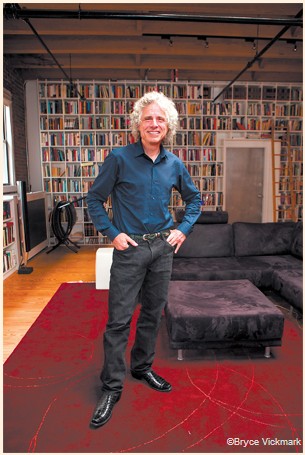
ScreenHunter_87 Dec. 16 15.39Armed with a mug of tea, Pinker seats himself on a contemporary, Danish-designed sofa in the middle of his open-plan loft to discuss his most recent book, The Better Angels of Our Nature , which makes surprising claims about our species: that we’ve become gentler and less aggressive than our ancestors. The proof, argues Pinker, is in comparative statistics on violence so convincing that not even two world wars can dent the evidence. “Conventional wisdom is that we’re living in violent times. The data sets say otherwise. Contrary to stereotyping – and I’ve confirmed the stereotype in a survey – the Middle Ages were much bloodier.”

The apartment, a converted leather warehouse where Pinker lives with his third wife, the novelist and philosopher Rebecca Goldstein, is located a few blocks from Boston’s financial district. “This was once an industrial space. There were tanneries in the area,” says Pinker. Divided into three rooms, it has 14ft-high ceilings and exposed brick walls. The supporting beams in the main room are from the original 19th-century construction. “They are nine inches across. You would be unlikely to see construction like this today,” he adds.

The building has an intriguing past. Pinker’s former sister-in-law once lived here. “She was here illegally,” Pinker says. “She was a painter and her partner was a sculptor. They put in their own plumbing. At some point the developers came in, young urban professionals started pricing them out and by sheer coincidence, decades later, we bought an apartment here, by which point all the artists had been driven out. This is a common urban sequence.”

More here.

Why Obama Will Ignore Israel

From Newsweek:

IsraelConsider the view from 1600 Pennsylvania Avenue. On the one hand, Benjamin Netanyahu keeps doing things—like expanding settlements and refusing to accept the 1967 lines as the parameters for peace talks—that U.S. officials consider bad for America and catastrophic for Israel. On the other, every time President Obama has tried to make Netanyahu change course—in 2009 when he demanded a settlement freeze and in 2011 when he set parameters for peace talks—the White House has been politically clobbered. Administration officials might like to orchestrate Netanyahu’s defeat in next month’s Israeli elections, as Bill Clinton did when he sent political consultants to convince Israelis to replace Netanyahu with Ehud Barak in 1999. But they can’t because Netanyahu has no serious rivals for power. Former prime minister Ehud Olmert isn’t running; the centrist party he once led, Kadima, has largely collapsed, and the head of the center-left Labor Party is advertising her willingness to be a junior partner in another Netanyahu government.

So instead of confronting Netanyahu directly, Team Obama has hit upon a different strategy: stand back and let the rest of the world do the confronting. Once America stops trying to save Israel from the consequences of its actions, the logic goes, and once Israel feels the full brunt of its mounting international isolation, its leaders will be scared into changing course. “The tide of global opinion is moving [against Israel],” notes one senior administration official. And in that environment, America’s “standing back” is actually “doing something.”

More here.

Have Scientists Found Two Different Higgs Bosons?

From Scientific American:

BosonA month ago scientists at the Large Hadron Collider released the latest Higgs boson results. And although the data held few obvious surprises, most intriguing were the results that scientists didn’t share.

The original Higgs data from back in July had shown that the Higgs seemed to be decaying into two photons more often than it should—an enticing though faint hint of something new, some sort of physics beyond our understanding. In November, scientists at the Atlas and LHC experiments updated everything except the two-photon data. This week we learned why. Yesterday researchers at the Atlas experiment finally updated the two-photon results. What they seem to have found is bizarre—so bizarre, in fact, that physicists assume something must be wrong with it. Instead of one clean peak in the data, they have found two. There seems to be a Higgs boson with a mass of 123.5 GeV (gigaelectron volts, the measuring unit that particle physicists most often use for mass), and another Higgs boson at 126.6 GeV—a statistically significant difference of nearly 3 GeV. Apparently, the Atlas scientists have spent the past month trying to figure out if they could be making a mistake in the data analysis, to little avail. Might there be two Higgs bosons?

More here.

Sunday Poem

This is Where we Were Born (#1)

The gaze adjusts itself to
the walls, the political commentators
in the newspapers
portrayed in dresses
with cats
and lovers
and the three-day stubble
intact

the tv news is a man
he says: everything is rags
he measures steps with herbs
lines with lines
water with lilies

we are called nothing
maybe we are called scream
or shot

we work on slogans
some people
think irony is the only thing power understands
others
want to know what exactly is meant by power
others again
sit still and fiddle with an old spoon
they later use to open cans of paint

the tv news is a man
he says: flood
he says: white knives don’t exist
he says: the arrests are nothing but propaganda
nothing happened
the day, on the other hand, was warm
bright, the parks were open
the population grilled salmon
kids climbed trees

our future: children who climb trees

power is invisible
a skinny middle-aged man says
power isn’t worth a scream
says another, oblivion
sleeps in the mouth of man

oblivion sits hunched over a small map
the city looks like plastic bags
cardboard and newspapers
two hundred thousand women remove their makeup
and get ready for their men
of glass in a bed
of glass

no one screams

the transport industry celebrates agreements
and shows the first steam aeroplanes
famous captains and pilots
from an era no one remembers

until now

Christ is a little chain
youth is Delphic

those who aren’t killed are shot
like cats
indifferent
and persistent

the white knives start to shine at midnight
corpses drift ashore

everything is rags

we are called nothing
we try to eat
sleep
under the moon
under the tv sets

Pedro Carmona-Alvarez
from Varmestafetten
publisher: Gyldendal, Oslo, 2009

Read more »

Inequality is Killing Capitalism

3029613a2ba36138c4e7d09d94fe9f3d.portrait

Robert Skidelsky in Project Syndicate:

Impaired banks that do not want to lend must somehow be “made whole.” This has been the purpose of the vast bank bailouts in the US and Europe, followed by several rounds of “quantitative easing,” by which central banks print money and pump it into the banking system through a variety of unorthodox channels. (Hayekians object to this, arguing that, because the crisis was caused by excessive credit, it cannot be overcome with more.)

At the same time, regulatory regimes have been toughened everywhere to prevent banks from jeopardizing the financial system again. For example, in addition to its price-stability mandate, the Bank of England has been given the new task of maintaining “the stability of the financial system.”

This analysis, while seemingly plausible, depends on the belief that it is the supply of credit that is essential to economic health: too much money ruins it, while too little destroys it.

But one can take another view, which is that demand for credit, rather than supply, is the crucial economic driver. After all, banks are bound to lend on adequate collateral; and, in the run-up to the crisis, rising house prices provided it. The supply of credit, in other words, resulted from the demand for credit.

This puts the question of the origins of the crisis in a somewhat different light. It was not so much predatory lenders as it was imprudent, or deluded, borrowers, who bear the blame. So the question arises: Why did people want to borrow so much? Why did the ratio of household debt to income soar to unprecedented heights in the pre-recession days?

Let us agree that people are greedy, and that they always want more than they can afford. Why, then, did this “greed” manifest itself so manically?

To answer that, we must look at what was happening to the distribution of income.

Thinking the Unthinkable

Zoo 059

Anarchist soccer mom on having a violent, mentally ill son (via Corey Robin):

Three days before 20 year-old Adam Lanza killed his mother, then opened fire on a classroom full of Connecticut kindergartners, my 13-year old son Michael (name changed) missed his bus because he was wearing the wrong color pants.

“I can wear these pants,” he said, his tone increasingly belligerent, the black-hole pupils of his eyes swallowing the blue irises.

“They are navy blue,” I told him. “Your school’s dress code says black or khaki pants only.”

“They told me I could wear these,” he insisted. “You’re a stupid bitch. I can wear whatever pants I want to. This is America. I have rights!”

“You can’t wear whatever pants you want to,” I said, my tone affable, reasonable. “And you definitely cannot call me a stupid bitch. You’re grounded from electronics for the rest of the day. Now get in the car, and I will take you to school.”

I live with a son who is mentally ill. I love my son. But he terrifies me.

A few weeks ago, Michael pulled a knife and threatened to kill me and then himself after I asked him to return his overdue library books. His 7 and 9 year old siblings knew the safety plan—they ran to the car and locked the doors before I even asked them to. I managed to get the knife from Michael, then methodically collected all the sharp objects in the house into a single Tupperware container that now travels with me.

Through it all, he continued to scream insults at me and threaten to kill or hurt me.

That conflict ended with three burly police officers and a paramedic wrestling my son onto a gurney for an expensive ambulance ride to the local emergency room. The mental hospital didn’t have any beds that day, and Michael calmed down nicely in the ER, so they sent us home with a prescription for Zyprexa and a follow-up visit with a local pediatric psychiatrist.

We still don’t know what’s wrong with Michael. Autism spectrum, ADHD, Oppositional Defiant or Intermittent Explosive Disorder have all been tossed around at various meetings with probation officers and social workers and counselors and teachers and school administrators. He’s been on a slew of antipsychotic and mood altering pharmaceuticals, a Russian novel of behavioral plans. Nothing seems to work.

Saturday, December 15, 2012

NEWTOWN AND THE MADNESS OF GUNS

Adam Gopnik in The New Yorker:

ScreenHunter_86 Dec. 15 19.56After the mass gun murders at Virginia Tech, I wrote about the unfathomable image of cell phones ringing in the pockets of the dead kids, and of the parents trying desperately to reach them. And I said (as did many others), This will go on, if no one stops it, in this manner and to this degree in this country alone—alone among all the industrialized, wealthy, and so-called civilized countries in the world. There would be another, for certain.

Then there were—many more, in fact—and when the latest and worst one happened, in Aurora, I (and many others) said, this time in a tone of despair, that nothing had changed. And I (and many others) predicted that it would happen again, soon. And that once again, the same twisted voices would say, Oh, this had nothing to do with gun laws or the misuse of the Second Amendment or anything except some singular madman, of whom America for some reason seems to have a particularly dense sample.

And now it has happened again, bang, like clockwork, one might say: Twenty dead children—babies, really—in a kindergarten in a prosperous town in Connecticut. And a mother screaming. And twenty families told that their grade-schooler had died.

More here. And here is a petition to the White House to sign if you are so inclined.

Interview: Howard Goldblatt, translator of Mo Yan

Sophia Efthimiatou in Granta:

SE: Were you familiar with Mo Yan’s work before you started translating him?

ScreenHunter_85 Dec. 15 17.30HG: Yes, I was. In 1985 I spent the year in Manchuria, in Hardin, writing on literature during the Japanese occupation, and it was getting really boring. So I started reading a book of stories that had just been published, calledChinese Fiction in 1985. It was badly done. There were six or eight stories in there by writers that subsequently became well known, and his was one. It was only a few years after the Cultural Revolution so writers were still trying to feel their way. Mo Yan’s was a terrific story, really unusual, quite revolutionary. Then two or three years later, after I had come back to Colorado, a friend of mine in Hong Kong sent me a literary quarterly from China. The Garlic Ballads appeared in that issue in its entirety. I was absolutely knocked out. I had never been so stunned by a piece of literature. So I immediately wrote to Mo Yan, introduced myself, and told him I wanted to translate it in English. He said, ‘Sure.’

More here.

How We Became Israel

Andrew J. Bacevich in The American Conservative:

ScreenHunter_84 Dec. 15 17.22In the absence of actually existing peace, a nation’s reigning definition of peace shapes its proclivity to use force. A nation committed to peace-as-harmony will tend to employ force as a last resort. The United States once subscribed to this view. Or beyond the confines of the Western Hemisphere, it at least pretended to do so.

A nation seeking peace-as-dominion will use force more freely. This has long been an Israeli predilection. Since the end of the Cold War and especially since 9/11, however, it has become America’s as well. As a consequence, U.S. national-security policy increasingly conforms to patterns of behavior pioneered by the Jewish state. This “Israelification” of U.S. policy may prove beneficial for Israel. Based on the available evidence, it’s not likely to be good for the United States.

Here is Israeli Prime Minister Benjamin Netanyahu describing what he calls his “vision of peace” in June 2009: “If we get a guarantee of demilitarization … we are ready to agree to a real peace agreement, a demilitarized Palestinian state side by side with the Jewish state.” The inhabitants of Gaza and the West Bank, if armed and sufficiently angry, can certainly annoy Israel. But they cannot destroy it or do it serious harm. By any measure, the Israel Defense Forces (IDF) wield vastly greater power than the Palestinians can possibly muster. Still, from Netanyahu’s perspective, “real peace” becomes possible only if Palestinians guarantee that their putative state will forego even the most meager military capabilities. Your side disarms, our side stays armed to the teeth: that’s Netanyahu’s vision of peace in a nutshell.

More here.