wave

3113-list.jpg_full_600

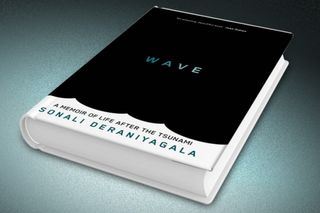
Deep into Sonali Deraniyagala’s Wave, she describes herself as a “shocking story, a wild statistical outlier.” A chatty woman on a plane tries to draw her out: Is she married? Does she have children? She cannot answer these questions. In 2004, she was holidaying with her family on the southeast coast of Sri Lanka when the Indian Ocean tsunami came ashore. Her husband, her two sons and her parents all died in the wave. At the end of Moby-Dick, the narrator explains in a brief epilogue how he alone came to be rescued from the water, to recount his ship’s fateful voyage. It is as though even a tale of epic proportion cannot contain that last part of the story. Sonali Deraniyagala’s book is all epilogue. It is a meditation through grief and a meditation on grief. It is courageous, truthful and, above all, generous. In the first place, it dares to tell an impossibly difficult story.

more from Sunila Galappatti at The Globe and Mail here.
the incident behind moby dick

382px-Moby_Dick_p510_illustration1-318x500

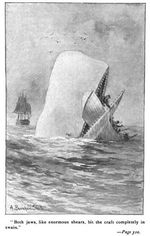
By November of 1820, after months of a prosperous voyage and a thousand miles from the nearest land, whaleboats from the Essex had harpooned whales that dragged them out toward the horizon in what the crew called “Nantucket sleigh rides.” Owen Chase, the 23-year-old first mate, had stayed aboard the Essex to make repairs while Pollard went whaling. It was Chase who spotted a very big whale—85 feet in length, he estimated—lying quietly in the distance, its head facing the ship. Then, after two or three spouts, the giant made straight for the Essex, “coming down for us at great celerity,” Chase would recall—at about three knots. The whale smashed head-on into the ship with “such an appalling and tremendous jar, as nearly threw us all on our faces.” The whale passed underneath the ship and began thrashing in the water. “I could distinctly see him smite his jaws together, as if distracted with rage and fury,” Chase recalled. Then the whale disappeared.

more from Smithsonian here.

Encapsulated Universes: A Conversation with Lera Boroditsky

Leraboroditsky_0

Over at Edge:

I'm interested in how the languages we speak shape the way we think. The reason I got interested in this question is that languages differ from one another so much. There are about 7,000 languages around the world, and each one differs from the next in innumerable ways. Obviously, languages have different words, but they also require very different things from their speakers grammatically.

Let me give you an example. Suppose you want to say even the simplest thing, like “Humpty Dumpty sat on a …” Well, even with a snippet of a nursery rhyme, if you try to translate it to other languages, you'd immediately run into trouble. Let's focus on the verb for a moment. Sat. To say this in English, if this was something that happened in the past, then you'd have to say “sat.” You wouldn’t say, “will sit” or “sitting.” You have to mark tense. In some languages like in Indonesian you couldn't change the verb. The verb would always stay the same regardless of whether this is a past or future event. In some languages, like in Russian, my native language, you would have to change the verb for tense, but you would also have to include gender. So if this was Mrs. Dumpty that sat on the wall, you'd use a different form of the verb than if it was Mr. Dumpty.

In Russian, quite inconveniently, you have to mark the verb for whether the event was completed or not. So if Humpty Dumpty sat on the wall for the entire amount of time that he was meant to sit on it, that would be one form of the verb. But if he were to say “have a great fall” that would be a different form of the verb.

In Turkish, and this is one of my favorite examples, you have to change the verb depending on how you came to know this information. If you actually witnessed this event with your own eyes, you were walking along and you saw this chubby, ovoid character sitting on a wall, that would be one form of the verb. But if this was something you just heard about, or you inferred, from say broken Humpty Dumpty pieces, then you would have to use a different form of the verb.

fiery lightning bolts and a black square

Images

How would Malevich, who was fascinated by the discoveries of physics about the incorporeal energy of the universe (gravitation, electricity and radioactivity), have regarded the recent x-ray of his iconic canvas, which revealed that Black Square was painted at urgent speed over another composition made up of polychromatic geometric forms? With time, these underlying colours have begun to show through the craquelures on the square’s surface. The artist had been working on another abstract canvas when he had an overwhelming vision of the black plane. The verbal leitmotif ‘partial eclipse’, which appears in his Fevralist canvases Englishman in Moscow and Composition with Mona Lisa and which had been nagging at him for months, was suddenly transformed into a ‘total eclipse’, the world as nonobjectivity. Although this was a solitary moment of creative intuition, Malevich worked among other artists. Shatskikh analyses his collaborations with avant-garde poets and artists in theatrical productions, exhibitions and the Supremus project, which incorporated a journal (Supremus) and a creative society. Malevich’s legacy is caught up in the chaos of the 20th century, which scattered and erased so much historical treasure.

more from Rachel Polonsky at Literary Review here.

Daphne du Maurier and Her Sisters

From The Telegraph:

Shakespeare_main_2495276b‘There never were sisters who wished so ardently to eat cake and have it,” wrote Angela, the eldest of Gerald du Maurier’s three daughters. Her siblings were Daphne and Jeanne. They grew up in a literary and theatrical background in London, being reminded that they were special. Their grandfather was the Punch cartoonist and novelist George du Maurier who promoted in his fiction the idea of “dreaming true”, whereby with imagination and sheer will you can make things happen. The girls’ father – who passed on this philosophy to his children – was an actor/producer and thundering homophobe, to whom all three were in thrall, almost as fatally as they were to the play in which the narcissistic Gerald achieved his fame, as Captain Hook in Peter Pan.

According to Jane Dunn in this compelling biography of the du Maurier sisters, J M Barrie’s play, with its dream of child rebellion against the grown-up world, “set the template for their lives”. Barrie himself would come and watch them perform it in their nursery. He had taken the inspiration of Peter Pan from their sensitive cousin Michael Llewelyn Davies, who later drowned in the arms of his best friend in a pool outside Oxford. Fertilised in the three sisters’ minds early on were the themes of death, forbidden love and incest. Plus a growing realisation of their father’s disappointment that they were not his longed-for boys. “Sisters, they should have been brothers. They would have made splendid boys,” wrote Noël Welch, the cool and fastidious lesbian poet who became Jeanne’s partner.

More here.

The Age of Enhancement

From Slate:

SuperheroessmallTen years ago, Slate editor David Plotz wrote a series of stories examining the ways in which scientists believed humans could better their vision, strength, memory, alertness, and hearing, primarily through drugs or surgery. His “Superman” series examined emerging technologies ranging from retinal implants and prosthetic ears to gene therapies and memory drugs. Today, many of those possibilities remain frustratingly just over the horizon. In some cases, we’re hardly any closer to realizing them than we were in 2003. And some technologies that were newly available then, like the alertness drug modafinil, have grown in popularity even as they’ve proved less revolutionary than their most ardent supporters (and critics) had hoped or feared. In the meantime, a new crop of enhancement technologies has captured the attention of the media, the dollars of investors, and the scrutiny of ethicists. Some of the potentially most transformative achieve their effects not through biochemistry but by means of electronic devices that connect our brains to external sources of knowledge, sensory data, or physical power. We may not have gotten any closer to being able to put memory chips in our brains, but who needs those when we’re all walking around with the entire contents of the global Internet in our pockets—or on our faces?

The story of the Eiger reminds us that wearable technology isn’t an entirely new trend. But it’s taking off today in more ways than you might think. Muscle suits, long elusive, are starting to look more plausible, at least for specific purposes such as lifting a hospital patient out of bed. The military is working on “Spider-Man suits” that let the wearer scale vertical walls. We may never get our hoverboards, but jetpacks are already starting to give certain daredevils a superpower that humans have coveted since Icarus. But perhaps the most astounding enhancement technologies that have begun to enter the realm of reality in recent years are devices that interact directly with the human brain. Products now on the market can use things like your skin conductance, facial expressions, and perhaps even brain waves to detect your emotions and intentions, albeit crudely. In the medical realm, cochlear implants can restore some hearing to the deaf. Future neural implants could allow humans to manipulate real-world objects with their minds—a power some have likened to telekinesis. Incredibly, this may already be happening. In North Carolina in 2008, researchers got a monkey thinking hard about walking—and in Japan, a pair of robotic legs began to do just that, controlled by the monkey’s brain activity via the Internet. And last December, a quadriplegic woman in Pittsburgh used electrodes implanted in her motor cortex to feed herself chocolate with a robotic arm.

More here.

Tuesday Poem

Going Home

He came home. Said nothing.
It was clear, though, that something had gone wrong.
He lay down fully dressed.
He pulled the blanket over his head.
Tucked up his knees.
He’s nearly forty, but not at the moment.
He exists as he did inside his mother’s womb,
clad in seven walls of skin, in sheltered darkness.
Tomorrow he’ll give a lecture
on homeostasis in megagalactic cosmonautics.
For now, though, he has curled up and gone to sleep.

by Wislawa Szymborska
from Poems New and Collected
Harcourt, 1998

The Brain-Chilling, Shrimp-Caressing, Lamppost-Sized, NSFW Organ Hiding In A Whale’s Mouth

Carl Zimmer in his excellent blog, The Loom:

CCM-diagramThis is a story about the discovery of an organ that measures twelve feet long and four inches wide. You might well assume that this is old news. After all, how could something the size of a lamppost go unnoticed by anatomists? And yet, in fact, it’s only just come to light.

The discovery emerged out of a blood-drenched confusion. Alexander Werth, an anatomist, was standing on an ice sheet miles off the coast of Alaska’s North Slope. He was watching Inupiat whale hunters dismember bowhead whales they had caught in the Bering Sea. This government-sanctioned hunt is one of the best opportunities for whale anatomists to get hold of fresh tissue from the animals.

To take apart the head of a whale, the hunters would slice off the lower jaws and the tongue, which could be as big as a minivan. They would then climb onto the roof of the whale’s mouth and cut away the baleen–the hair-like growths that the whale used in life to filter small animals from the water. On the roof of the mouths of bowhead whales, Werth and his colleagues noticed something strange: a peculiar rod-like organ stretching down the midline of the palate.

It had never been described in the bowhead before. What made the organ particularly peculiar was that, as the Inupiat cut the whales apart, it poured forth huge amounts of blood. Why, the scientists wondered, should a bowhead whale have an organ in the roof of their mouth? And why should it be so bloody?

More here.

A Review of Sonali Deraniyagala’s Wave

Wave_wtr1-620x412

Laura Miller in Salon:

Deraniyagala had been vacationing with her family in a seaside hotel near a national park when, through a terrace window, she saw the sea rising rapidly past its familiar bounds. With her husband, Steve, she grabbed Vikram, 8, and Malli, 5, and rushed out the door and up the drive. They jumped in a passing jeep, but soon the wave overwhelmed even that. The last time Deraniyagala saw her husband’s face, he was looking in horror at something over her shoulder. Then the jeep overturned, and for Deraniyagala the next few hours were chaos, violence and filthy water, the tsunami tossing her miles inland and then sucking her out again. Just before she would have been swept out to sea, she grabbed an overhanging branch and felt the ground materialize under her feet. She never saw her family again.

“Wave” is Deraniyagala’s account of this nightmare, but the tsunami itself only takes up a handful of this spare, radiant book’s pages. The rest is what came after, months in that darkened room contemplating suicide, then a period of getting drunk every day and conducting a demented campaign of harassment against the Dutch family to whom her brother rented her parents’ house. Deraniyagala, an economist at the University of London and Columbia University, had been living with Steve and the boys in London, but she wasn’t able to set foot in their English house for two years.

The extremity of Deraniyagala’s story seizes the attention, but it’s the beauty of how she expresses it that makes it indelible. Who knew that the ranks of academic economics harbored a writer of such extraordinary gifts? Deraniyagala grasps that seemingly unteachable truth: just how much you can (and should) leave out when you have given your reader the one detail that will make your world real to her. “Wave” is a small, slender book, but it is enormous on the inside.

The narrative arc of “Wave” follows the evolution of Deraniyagala’s grief. At first, she alternates between rage and numbness. In the hospital where victims gathered after the wave receded, she turns away from a weeping boy, silently fuming, “You stayed alive in that water because you are so fucking fat. Vik and Malli didn’t have a chance. Just shut up.” At her aunt’s house, she recalls “pieces of me hovered in a murky netherworld, timeless day after timeless day.”

Once she crawled out of bed, Deraniyagala initially recoiled from anything likely to remind her of the past: “I panicked if I saw a flower. Malli would have stuck it in my hair. I couldn’t tolerate a blade of grass. That’s where Vik would have stamped.” On an errand with a friend, she looks at the hundred-rupee note in his hand and thinks, “The last time I saw one of those, I had a world.”

Was Wittgenstein Right?

03stone-img-articleInline

Paul Horwich over at the NYT's The Stone:

The singular achievement of the controversial early 20th century philosopher Ludwig Wittgenstein was to have discerned the true nature of Western philosophy — what is special about its problems, where they come from, how they should and should not be addressed, and what can and cannot be accomplished by grappling with them. The uniquely insightful answers provided to these meta-questions are what give his treatments of specific issues within the subject — concerning language, experience, knowledge, mathematics, art and religion among them — a power of illumination that cannot be found in the work of others.

Admittedly, few would agree with this rosy assessment — certainly not many professional philosophers. Apart from a small and ignored clique of hard-core supporters the usual view these days is that his writing is self-indulgently obscure and that behind the catchy slogans there is little of intellectual value. But this dismissal disguises what is pretty clearly the real cause of Wittgenstein’s unpopularity within departments of philosophy: namely, his thoroughgoing rejection of the subject as traditionally and currently practiced; his insistence that it can’t give us the kind of knowledge generally regarded as its raison d’être.

Wittgenstein claims that there are no realms of phenomena whose study is the special business of a philosopher, and about which he or she should devise profound a priori theories and sophisticated supporting arguments. There are no startling discoveries to be made of facts, not open to the methods of science, yet accessible “from the armchair” through some blend of intuition, pure reason and conceptual analysis. Indeed the whole idea of a subject that could yield such results is based on confusion and wishful thinking.

Monday, March 4, 2013

Sunday, March 3, 2013

Foreign reporters armed and ready to attack Kenya

Kenyans have in the last few weeks been outraged by the flood of negative coverage the country has received ahead of the elections. Veteran reporter Michael Holman offers this satirical examination of the activities of foreign correspondents in the country.

Michael Holman in Kenya's Nation:

BrownKenya was braced at the crossroads on Saturday amidst growing concern that the demand for clichés is outstripping supply.

Critical elections loom, say senior diplomats, and there is a pressing need not only for clichés, but for colourful phrases, authentic quotes and fresh sources. Without urgent action, warned a senior taxi driver, this strategic east African nation with close ties to the West, risks being driven to the brink of an uncertain future.

Analysts and observers, however, joined diplomats in dismissing fears that coverage of the forthcoming poll will be threatened by a shortage of clichés.

“Lessons have been learnt,” said a UN spokesman, and a strategic stockpile has been built up since the last time Kenyans went to the ballot box. With the help of an emergency airlift, which includes consignments of anecdotes and first person accounts, both chilling and inspiring, reporters will be able to do justice to a crucial test of democracy/a slow motion tragedy/a land gripped by tension.

“We are now prepared for any eventuality,” said the spokesman. “Our monitors have registered an early demand for 'fears rising', 'key ally', 'strategic partner' and 'ethnic violence', and fresh deliveries will arrive within days.”

“Tribal rivalries’, and ‘ethnic violence’ is also proving popular, the UN official added, as are ‘bloodstained machetes’, ‘pangas and rungus’, and ‘mindless violence’ ‘Bitter memories’ is also in great demand.

More here.

The Perils of Perfection

03MOROZOVJP-articleInline

Evgeny Morozov in the NYT:

“WHEN your heart stops beating, you’ll keep tweeting” is the reassuring slogan greeting visitors at the Web site for LivesOn, a soon-to-launch service that promises to tweet on your behalf even after you die. By analyzing your earlier tweets, the service would learn “about your likes, tastes, syntax” and add a personal touch to all those automatically composed scribblings from the world beyond.

LivesOn may yet prove to be a parody, or it may fizzle for any number of reasons, but as an idea it highlights the dominant ideology of Silicon Valley today: what could be disrupted should be disrupted — even death.

Barriers and constraints — anything that imposes artificial limits on the human condition — are being destroyed with particular gusto. Superhuman, another mysterious start-up that could enliven any comedy show, promises to offer, as its co-founder recently put it, an unspecified service that “helps people be superhuman.” Well, at least they had the decency not to call it The Übermensch.

Recent debates about Twitter revolutions or the Internet’s impact on cognition have mostly glossed over the fact that Silicon Valley’s technophilic gurus and futurists have embarked on a quest to develop the ultimate patch to the nasty bugs of humanity. If they have their way, no individual foibles would go unpunished — ideally, technology would even make such foibles obsolete.

Even boredom seems to be in its last throes: designers in Japan have found a way to make our train trips perpetually fun-filled. With the help of an iPhone, a projector, a GPS module and Microsoft’s Kinect motion sensor, their contrivance allows riders to add new objects to what they see “outside,” thus enlivening the bleak landscape in their train windows. This could be a big hit in North Korea — and not just on trains.

The world’s fastest-growing continent: Aspiring Africa

From The Economist:

ScreenHunter_129 Mar. 03 16.02Celebrations are in order on the poorest continent. Never in the half-century since it won independence from the colonial powers has Africa been in such good shape. Its economy is flourishing. Most countries are at peace. Ever fewer children bear arms and record numbers go to school. Mobile phones are as ubiquitous as they are in India and, in the worst-affected countries, HIV infections have fallen by up to three-quarters. Life expectancy rose by a tenth in the past decade and foreign direct investment has tripled. Consumer spending will almost double in the next ten years; the number of countries with average incomes above $1,000 per person a year will grow from less than half of Africa’s 55 states to three-quarters.

Africans deserve the credit. Western aid agencies, Chinese mining companies and UN peacekeepers have done their bit, but the continent’s main saviours are its own people. They are embracing modern technology, voting in ever more elections and pressing their leaders to do better. A sense of hope abounds. Africans rightly take pride in conferences packed with Western bankers keen to invest in their capital markets (see article). Within the next few months MasterCard will have issued South Africans with 10m debit cards. Even the continent’s politicians are doing a bit better, especially in economic management and striking peace deals. Average GDP growth is humming along, at about 6%. Governance is improving: our correspondent visited 23 countries to research this week’s special report and was not once asked for a bribe—inconceivable only ten years ago.

More here.

What lies behind religious homophobia

Mark Dowd in The Guardian:

Former-cardinal-Keith-OBr-008I approached a director at Channel 4 back in 2000 with a proposal for a documentary on homosexuality and the Roman Catholic church. I had a simple pitch. “I want to show why my church is so anti-gay.”

“And why is your church so anti-gay?,” came back the obvious question. “Because it is so gay,” I replied.

A furrowed brow invited further exposition. I then spelt out the logic. We interviewed clerics and ex-seminarians in the UK, US and Rome and uncovered a huge irony: the very institution that teaches that the homosexual orientation is “intrinsically disordered” attracts gay candidates for the priesthood in numbers way in excess of what one would expect, based on numbers in society at large. One seminary rector based on his own experience told me the number was at least 50%.

Gay Catholics like me will appreciate another irony with the news of Cardinal Keith O'Brien's resignation: that the very man whose trenchant rhetoric on the subjects of gay adoption and marriage has been brought down by accusations of improper same-sex behaviour from no less than four men who crossed his path in the 1980s, either as a seminary rector or as archbishop of Edinburgh. His decision not to participate in the papal conclave is not to be taken as an admission of guilt and he contests the accusations made against him. Nevertheless, it does raise some general questions about a possible relationship between the tone of anti-gay rhetoric and the identities of those who engage in such high-octane language on same sex attraction.

More here.

The Mommy Worry Wars

From Slate:

The punishing epicenter of anxiety obsession is women’s fertility and pregnancy. Women who have trouble conceiving often believe that their own distress is making it harder to conceive. And who can blame them, when even fertility centers urge them to create a “stress-free environment.” And of course, with pregnancy, the worry doesn’t end—it’s just beginning. Scattershot reports link anxiety to miscarriage or preterm birth with random speculation, as in: Will Kim Kardashian’s divorce stress hasten the birth of her baby? Will emotional symptoms during pregnancy cause developmental delays? A finding here, an anecdote there—women can easily get the wrong idea.

And the reigning impression is wrong: The weight of evidence suggests that moderate levels of stress and anxiety do none of the things we fear. They seem not to affect whether women are able to conceive, whether they carry the fetus to term, or whether their kids reach normal developmental milestones. (If anything, some maternal stress during pregnancy seems to make kids mature a little faster.) This doesn’t mean, of course, that women with anxiety shouldn’t seek care and support. But they should do so for their own sakes—not because distress will ruin their shot at motherhood or somehow damage their fetuses.Take fertility. In 2011, British psychologists pulled together data from 14 studies of in vitro fertilization. In each study, researchers asked women to assess their emotional distress, anxiety, or depression. Then they followed them through a single cycle of fertility treatment to see whether they got pregnant or not. The smaller individual studies arrived at disparate results, but the meta-analysis rolling up all the findings, which included over 3,500 women and appeared in the BMJ, was fairly definitive: Women’s emotional state before IVF bore no relationship to whether the treatment worked. In other words, women with more extreme levels of anxiety or depression were just as likely to get pregnant after a single cycle as women with milder levels. “It was a great relief,” said psychologist Jacky Boivin, who has counseled women struggling with infertility for years and who led the meta-analysis team.

More here.

Finally! A nuanced look at hookup culture

From Salon:

Leslie_bell-620x412Leslie C. Bell’s “Hard to Get: Twenty-Something Women and the Paradox of Sexual Freedom” argues that despite being the most liberated generation of women to date, today’s 20-somethings face wildly contradictory cultural messages about love and sex that can make it extremely difficult to freely and fully realize their desires.

…Bell’s main argument is that these women are bombarded with “vying cultural” messages: “Be assertive, but not aggressive. Be feminine, but not too passive. Be sexually adventurous, but don’t alienate men with your sexual prowess” — and so on. At the same time that they are encouraged to “live it up,” they “spend their twenties hearing gloomy forecasts about their chances of marriage if they don’t marry before thirty, and their chances of conceiving a baby if they don’t get pregnant before thirty-five.”

As a result of this, many young women seek to “resolve the internal conflicts they feel about their desires,” Bell argues, by developing a black-and-white, all-or-nothing view of sex and relationships. If a woman feels conflicted about her sexual desires, that typically manifests in a committed but perhaps sexually neutered relationship, she says: “They felt conflicted about having and expressing sexual desire and so gave it up.” If a woman feels more conflicted about her desire for a relationship, she’s likely to focus on no-strings sex over relationships: These twenty-somethings “feared losing their identities and independence through being in an intimate relationship,” writes Bell. But she also observed a middle-of-the-road approach in which women “used their conflicts to inform how they could pursue their desires; they were comfortable with and expressed their desires for sex and a relationship” — as well as an education and career. Many young women start out in either one of the first scenarios but grow into the third, which is how I’ve come to see my growing impatience with hookup culture. (Of course, this sort of framework only makes sense for those who do desire relationships. For those who don’t, that would actually be a regression.)

More here.