the courage and selflessness with which Siân Busby battled cancer

Robert Peston in The Telegraph:

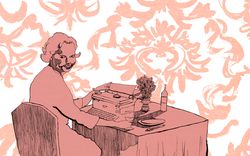
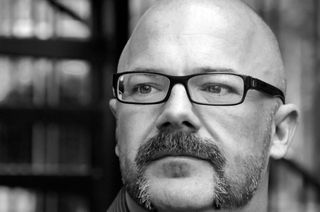
Siân Elizabeth Busby died on September 4 2012 after a long illness. A few days later I transcribed her handwritten manuscript for the end of A Commonplace Killing, her final novel. My motive was selfish: I wanted to keep talking to her. I still do.
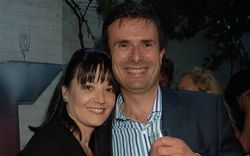
Robert-peston_2550669b…For the proud spouse it matters that she finished the book after she had received her death sentence. On August 3 2012, the consultant oncologist at the Royal Marsden, Sanjay Popat, a compassionate, assiduous and expert physician whom we came to think of as a friend during the years he was in charge of Siân’s treatment, gave us the latest in a succession of scan results. Medical science could no longer help Siân, except – perhaps – to take the edge off acute and constant pain. “This is where I say goodbye,” he said. It was almost exactly five years to the day after Siân – who is probably the only person I know who never smoked a cigarette – was diagnosed with lung cancer. In the ensuing years, she never despaired or resorted to self-pity, even as the cancer spread, on a couple of occasions to the brain, later to the liver and spine. The cycle of surgery, body-racking chemicals and radiation was relentless. Life became punctuated by terrible shocks and emergencies. Yet those who met her at pretty much any point in this ordeal encountered the Siân they had always known: solicitous, supportive, witty, insightful, unselfish. Through the sheer force of her will, Siân remained poised and beautiful. She eschewed drama.

Most of our friends had no idea how ill she really was. Siân did not wish to be seen by others as someone who was suffering from a lethal cancer. She did not want to be classified as infirm and she did not need maudlin sympathy. The priority was that our boys, Max and Simon, should not be constantly bothered and worried by friends and neighbours asking for the latest prognosis on her health. Siân just got on with living. Her huge, magnificent novel, McNaughten – which for me is the last great Victorian novel, a symphony of fantastical stories, rich in disquisitions on the absurdity of life – was written when Siân’s illness had become for us just one of those things. I know this may seem odd, but these were wonderful years for Siân, Max, Simon and me. The cancer did not haunt us. If anything, it helped us to understand what matters in life: family, first and foremost; work that fulfils; friends, beauty and fun. By the time Siân was completing A Commonplace Killing, the cancer could no longer be confined to the background. It was a monster laying waste to our family.

More here.
Video reveals cancer cells’ Achilles’ heel

From Manchester:

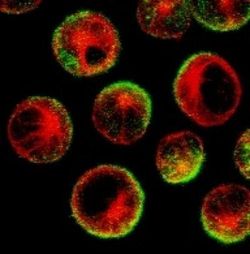
Rituximab_cancer_cellsProfessor Daniel Davis and his team used high quality video imaging to investigate why the drug rituximab is so effective at killing cancerous B cells. It is widely used in the treatment of B cell malignancies, such as lymphoma and leukaemia – as well as in autoimmune diseases like rheumatoid arthritis. Using high-powered laser-based microscopes, researchers made videos of the process by which rituximab binds to a diseased cell and then attracts white blood cells known as natural killer (NK) cells to attack. They discovered that rituximab tended to stick to one side of the cancer cell, forming a cap and drawing a number of proteins over to that side. It effectively created a front and back to the cell – with a cluster of protein molecules massed on one side. But what surprised the scientists most was how this changed the effectiveness of natural killer cells in destroying these diseased cells. When the NK cell latched onto the rituximab cap on the B cell, it had an 80% success rate at killing the cell. In contrast, when the B cell lacked this cluster of proteins on one side, it was killed only 40% of the time.

Professor Davis says: “These results were really unexpected. It was only possible for us to unravel the mystery of why this drug was so effective, through the use of video microscopy. By watching what happened within the cells we could clearly identify just why rituximab is such an effective drug – because it tended to reorganise the cancerous cell and make it especially prone to being killed.” He continues: “What our findings demonstrate is that this ability to polarise a cell by moving proteins within it should be taken into consideration when new antibodies are being tested as potential treatments for cancer cells. It appears that they can be up to twice as effective if they bind to a cell and reorganise it.”

More here.

Wednesday Poem

Child

Your clear eye is the one absolutely beautiful thing.
I want to fill it with color and ducks,
The zoo of the new

Whose names you meditate —
April snowdrop, Indian pipe,
Little

Stalk without wrinkle,
Pool in which images
Should be grand and classical

Not this troublous
Wringing of hands, this dark
Ceiling without a star.
.

by Silvia Plath,
from Collected Poems of Silvia Plath
publisher: Harper Collins

One week, no food

My wife and I did this crazy little experiment in February. The excellent new magazine Aeon has published an account I wrote of it:

ScreenHunter_175 May. 01 11.43The plan was to go a full week without eating or drinking anything except water. Lest our bodies react to this insult by trying to slow down our metabolisms, and we end up just lying around and not getting anything useful done all week, we also planned to stay energetic by engaging in vigorous physical exercise for at least a couple of hours daily during the fast. Neither one of us had ever done anything of the sort before.

Since my wife had a week’s break in February from her work as a schoolteacher, we decided to try our fast then. Our preparation was pretty minimal. I would keep a journal in which I would record my weight, blood pressure, activities and, several times a day, just note how I was feeling. We bought some emergency supplies in case one or both of us ended up feeling ill or fainting: some energy drinks, a couple of bars of Swiss milk chocolate, some fruit, and some bread and cheese, and put them in the refrigerator. My wife also told me to stop locking the bathroom door from the inside, just in case she needed to rescue me.

On our final day before beginning, we measured our weight, blood pressure, pulse rate, and waist size. My wife and I don’t normally eat breakfast (she has a cup of coffee and I drink a Coke Zero — yes, yes, I know it’s bad) but that day we had a light lunch and in the evening we had an early dinner of chicken, potatoes, broccoli, cauliflower, and brown rice. And some chocolate pudding. And then we stopped eating.

More here.

Tuesday, April 30, 2013

An Interview with Sadiq Jalal Al-Azm: The Syrian Revolution and the Role of the Intellectual

Thumb

Over at The Republic:

As opposed to many leftists and Marxists in Syria today and in the world, Sadiq Jalal al-Azm’s position is clear and unequivocal in its support for the Syrian revolution. What are the roots of this leftist ambiguity towards the revolution? And what consequence will this have for the future of the left in Syria?

Due to the nature of this question, I will begin briefly with an introduction about myself. Many ask me if the popular Intifada in Syria against the tyrannical regime, its corrupt government, surprised me or not. My answer is yes and no at the same time. Yes, I was surprised by the timing of the outbreak of the Intifada, with a lot of apprehensiveness at the beginning due to the possibility of quick repression, which I knew was a possibility due to the institutionalized rigidity of the security apparatus in Syria, as well as its repressive ferocity, penetration of the pores of the Syrian body, and its continuous control of nearly all its movements. This reality constituted a type of inferiority complex (in me and in others) due to my impotence in the face of this military regime’s overall power, as well as due to the impossibility of pronouncing a possible “no” against it (individually or collectively). I dealt with this inferiority complex by adapting slowly to this stressful tyrannical reality, and through the careful introspection of the rules and principles of interacting with it, with all that’s required of hypocrisy and pretending to believe and accept, secrecy, word manipulation and circumvention of the regime’s brute force. Otherwise, I wouldn’t have been able to either continue with my normal life and do my routine work and daily errands, or preserve my mental and physical health.

So, why would I not align with this overwhelming popular revolution against this form of tyranny and oppression, regardless of the nature of the convictions that I hold whether they be leftist, Marxist, moderate, or even right-wing?

Bangladesh Needs Strong Unions, Not Outside Pressure

Bangladesh-building-collapse

In the wake of the building collapse in Bangladesh, Fazle Hasan Abed in the NYT [h/t: Meghant Sudan]:

I appreciate the unease a Westerner might feel knowing that the clothes on his or her back were stitched together by people working long hours in dangerous conditions. It is natural that people in richer countries are now asking how they can put pressure on Bangladesh and its manufacturers to improve the country’s dismal safety record.

But ceasing the purchase of Bangladeshi-manufactured goods, as some have suggested, would not be the compassionate course of action. Economic opportunities from the garment industry have played an important role in making social change possible in my country, with about three million women now working in the garment sector. I have dedicated my life to alleviating entrenched poverty, and I know that boycotting brands that do business in Bangladesh might only further impoverish those who most need to put food on their tables, since the foreign brands would simply take their manufacturing contracts to other countries.

The rise of manufacturing here has had good effects. In the past, for example, a poor family’s vision for a newborn daughter’s future was often to marry her off as young as possible, since the dowry paid to a husband’s family grows as a daughter gets older. Even after the dowry was outlawed in 1980, the practice continued. A girl would often be married off as young as 13, and would never leave her village, never know a brighter future for herself or her children.

Partly because many women and their daughters now take garment industry jobs — even in factories where workers’ rights are virtually nonexistent — families living in poverty have changed their vision of the future.

Daniel Dennett’s new book: “Intuition Pumps and Other Tools for Thinking”

Jennifer Schuessler in the New York Times:

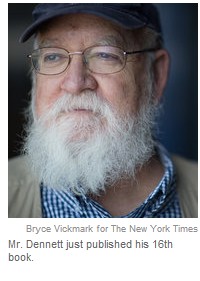
ScreenHunter_173 Apr. 30 14.51The new book, largely adapted from previous writings, is also a lively primer on the radical answers Mr. Dennett has elaborated to the big questions in his nearly five decades in philosophy, delivered to a popular audience in books like “Consciousness Explained”(1991), “Darwin’s Dangerous Idea” (1995) and “Freedom Evolves.”

The mind? A collection of computerlike information processes, which happen to take place in carbon-based rather than silicon-based hardware.

The self? Simply a “center of narrative gravity,” a convenient fiction that allows us to integrate various neuronal data streams.

The elusive subjective conscious experience — the redness of red, the painfulness of pain — that philosophers call qualia? Sheer illusion.

Human beings, Mr. Dennett said, quoting a favorite pop philosopher, Dilbert, are “moist robots.”

“I’m a robot, and you’re a robot, but that doesn’t make us any less dignified or wonderful or lovable or responsible for our actions,” he said. “Why does our dignity depend on our being scientifically inexplicable?”

More here.

The Terror of Capitalism

Vijay Prashad in CounterPunch:

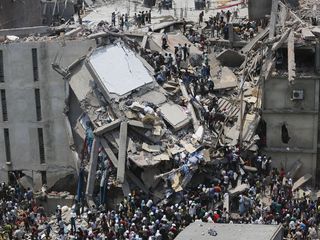
On Wednesday, April 24, a day after Bangladeshi authorities asked the owners to evacuate their garment factory that employed almost three thousand workers, the building collapsed. The building, Rana Plaza, located in the Dhaka suburb of Savar, produced garments for the commodity chain that stretches from the cotton fields of South Asia through Bangladesh’s machines and workers to the retail houses in the Atlantic world. Famous name brands were stitched here, as are clothes that hang on the satanic shelves of Wal-Mart. Rescue workers were able to save two thousand people as of this writing, with confirmation that over three hundred are dead. The numbers for the latter are fated to rise. It is well worth mentioning that the death toll in the Triangle Shirtwaist Factory fire in New York City of 1911 was one hundred and forty six. The death toll here is already twice that. This “accident” comes five months (November 24, 2012) after the Tazreen garment factory fire that killed at least one hundred and twelve workers.

The list of “accidents” is long and painful. In April 2005, a garment factory in Savar collapsed, killing seventy-five workers. In February 2006, another factory collapsed in Dhaka, killing eighteen. In June 2010, a building collapsed in Dhaka, killing twenty-five. These are the “factories” of twenty-first century globalization – poorly built shelters for a production process geared toward long working days, third rate machines, and workers whose own lives are submitted to the imperatives of just-in-time production.

More here.

Why All This Maternal Sympathy for Dzhokhar?

Hanna Rosin in Slate:

TT_130426_JURIS_CITIZEN.jpg.CROP.rectangle2-mediumsmallIn the past week and a half I have not been to a school pickup, birthday, book party, or dinner where one of my mom friends has not said some version of “I feel sorry for that poor kid.” This group includes mothers of infants and grandmothers and generally pretty reasonable intelligent types, including one who is an expert on Middle Eastern extremist groups.

Many of them mention that ubiquitous photo of Dzhokhar with his hair tousled and too few hairs on his chin to shave. Some bring up the prom photo with the red carnation or the goofy video of him wrestling with his friends.* Some mention the “I love you, bro” tweets from his many friends. Some just seem anguished by the vision of that “poor kid” alone in the boat by himself, bleeding for all those hours. All of this sympathy stems of course from the storyline that coalesced early: a hapless genial pothead being coerced into killing by his sadistic older brother. As with such storylines, all evidence to the contrary gets suppressed.

Probably the correct moral response to this misplaced maternal sympathy is the one mySlate colleague had, which is to say: “People, please. Cut that shit out. He's an adult and a mass-murderer.” There is evidence that he was not just a pot smoker but a dealer, and also like his brother, he was a fan of jihad. Also the photos of him at the actual bombing site are not so heartwarming, as they show him surveying the crowd he is about to blow up.

More here.

Eat, drink, write

Suman Bolar in Himal Southasian:

Eat%20drink%20write%20illustrationWhen I tell people that I write about food, I unfailingly receive one of three responses (and sometimes, all three): a) “Oh! You’re a food critic”; b) “You’re so lucky!”; and c) “You’re a foodie! So am I!”
Wrong on all three counts.

First, I am a food writer, not a food critic. Food is meant to nourish and enrich our lives; it exists for our sustenance and pleasure. Food is perfect in and of itself and does not need to be criticised. Cooks, chefs, and restaurants – now those are a different matter entirely. So restaurant critic, yes; food critic, no. Second, I am not 'lucky'. Like any other professional, I have worked hard and spent big to be able to do what I do – I have travelled the world and sampled various cuisines on my own dime, spent time and money tracking down interesting foodstuffs and experiences, attended writing and food-related classes and workshops, and often gone out on a limb with an unpopular opinion and paid the price for my candour. And last, you may be a 'foodie', but I am not. In fact, I don’t even know what that means. Does it mean you’re addicted to food, like a druggie is addicted to drugs? Or does it mean you are a trained cook, in the same way that a techie is trained to work with technology? Or wait! Could it mean that you eat a lot of food? In which case, 'glutton' would probably be a better word to use. If, however, you enjoy trying different kinds of food and learning as much as you can about every aspect of whatever you are eating – if you are, shall we say, hungry to develop an intimate knowledge of everything you consume – then you, like me, are an epicure. Call yourself one.

And now that I have that off my chest: Yes, I love what I do.

More here.

Variations on a Gene, and Tools to Find Them

From The New York Times:

CANCERS were once named strictly for the tissue where they originated in the breast, prostate or other part of the body. Now, in the age of genetically informed medicine, cancers may also come with a more specific lexicon: the names of mutated genes deep within tumors that cause cells to become cancerous. Most of these gene flaws — there are scores of them, and they have names like BRAF V600E — are relative newcomers to medical terminology, as are most of the anticancer drugs, still in early testing, that are aimed at them. Development of the new drugs has been spurred by the falling cost of decoding DNA and the prospects of premium prices for drugs that specifically attack the molecular drivers of cancer. Even medical oncologists can be daunted by the complexity of these genes and the therapies intended to fight them, said Dr. William Pao, a physician and scientist at Vanderbilt University who studies cancer mutations in addition to seeing patients. “There are so many genes and so many mutations,” he said. “The human brain can’t memorize all those permutations.”

To guide doctors and their patients, many tools are on the market, including one created by Dr. Pao and colleagues: the Web site My Cancer Genome. The site, which started two years ago, is maintained by 51 contributors from 20 institutions. It lists mutations in different types of cancer, as well as drug therapies that may or may not be of benefit. Most of the drugs are in clinical trials; a few have been approved by the Food and Drug Administration. The typical user of this information is an oncologist, Dr. Pao said. At the Web site, the doctor can select “melanoma” and “BRAF,” for instance, or “lung cancer” and “BRAF,” and see all types of mutations in the BRAF gene that occur in those instances. The doctor can then check for national and international drug trials aimed at these alterations. Different treatments may work in different molecular subsets of cancer, depending on the mutation. More than 700 oncology drugs are now in development, many aimed at DNA defects, Dr. Pao said, “and the number will only accelerate.” “We are moving away from the tissue of origin to the molecular basis of the cancer, using the mutation to search for a treatment,” he said.

More here.

Tuesday Poem

Self Introduction

I am an old man, short and bald
For over half a century
I have spent my life grappling with words:
nouns, verbs, postpositional particles, question marks and the like
Now I rather prefer silence

I do not dislike mechanical tools
Though I love trees, too, including shrubs
I am not good at remembering their names
I am somewhat indifferent to dates in the past
I harbor antipathy against so-called authority

I am cross-eyed, astigmatic and presbyopic
My house has no Buddhist altar or Shinto shrine, but
I have a gigantic mail box that connects directly to my room
Sleep is a sort of pleasure for me
If I dream, I do not remember it when I awake

All the above are facts, but
once I put them down in words like this, somehow they do not ring true
I have two independent children and four grandchildren, do not keep a cat or a dog
In summer I am in T-shirts most of the time
A price may be paid for the words I write
.

by Shuntaro Tanikawa
from Watashi (I Myself)
publisher, Shichosha, Tokyo, 2007
translation, 2011, Takako Lento
from The Art of Being Alone: Poems 1952-2009
publisher, Cornell Univ. East Asia Program, 2011

Monday, April 29, 2013

Perceptions

Realistic-drawing-550x652
Diego Fazo (aka: Diegokoi). Sensazioni. (Model: Federica Ferragine)

Pencil drawing on paper!!

“… Diego is a self-taught pencil master whose technique has matured. He started out as a tattoo artist, and developed a passion for creating photo-realistic drawings. Inspired by the works of Japanese artists from the Edo period, like Katsushika Hokusai, he captures people’s imaginations with his precise lines and oriental drawing techniques.”

More here and here.

Thanks to Abbas Raza.

Andrew Sullivan Gives the Brothers Tsarnaev Too Much Credit

by Zujaja Tauqeer

Andrew-sullivan-why-i-blog-wideOver on his blog, Andrew Sullivan has been pondering the motives behind the horrific Boston bombing. His conclusion: Of Course It Was Jihad.

After reading all of his posts, I reached a different conclusion: by calling this act of terror “jihad”, Sullivan is imbuing Tamerlan Tsarnaev with too much representational power over Islam and giving Tsarnaev too much credit by accepting his (unsaid) claims of carrying out actual Islamic injunctions.

Sullivan maintains that Tamerlan was so far gone in his religiosity that one must conclude that his primary motive for acting was religion. Unlike the Obama administration, Sullivan doesn’t conclude that the religious sanction was all in Tamerlan’s head. He cites Rod Dreher, from The American Conservative, who notes that Muslims like Tsarnaev, when they kill, are sometimes carrying out Allah and the Prophet Muhammad's (pbuh) orders, such that Islam, when taken to its logical extreme, is a spur for violent expression. Islam’s violent and fundamentalist strains derive from the fact that it is a religion whose founder practiced violence. According to Sullivan there are concrete reasons why Muslims exhibit a unique proclivity to violence, post-18th century—modernity has exacerbated the inability of extremely religious Muslim loners to find meaning. Hence, killing of civilians.

Playing up Tsarnaev as a staunch, observant Muslim is made possible solely because of Sullivan’s claim that Tamerlan was acting in obedience to actual religious teachings. While there is in fact ample proof to the contrary in the history and scripture of Islam, Sullivan chooses to ignore that mountain of evidence. Instead he wants us to take the word of a 19th century Roman Catholic, Alexis de Tocqueville, for Tamerlan's jihadism. When it comes to talking about Islam, Sullivan sets aside customary rigor in investigating claims or citing sources.

In assigning jihad as the motive, Sullivan makes the ballsy and dangerous move of taking a term of holy war, imbued with much meaning and carrying with it many stipulations, and grants it just like that to the Tsarnaevs. Terming this act “jihad” is a grave mistake because it grants moral legitimacy to terrorism and accepts the rhetoric of terrorists that their acts are in fact exactly the kind of holy acts they say they are. This argument is nothing new. But I maintain that to describe the Brothers Tsarnaev as jihadis and simultaneously invest them with a reputation as devout Muslims, even though they were in fact acting in direct contravention to Islamic teachings, leads to the offensive and fallacious conclusion that a murderer is a model of what Muslims in their full devoutness would be. It gives undeserved power to the most egregiously insincere and disobedient Muslims who cause suffering to innocents to define the meaning of this religion.

Read more »

Sunday, April 28, 2013

Physicist Proposes New Way To Think About Intelligence

Chris Gorski in Physics Central:

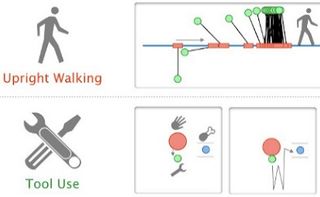
ScreenHunter_172 Apr. 28 22.25Alexander Wissner-Gross, a physicist at Harvard University and the Massachusetts Institute of Technology, and Cameron Freer, a mathematician at the University of Hawaii at Manoa, developed an equation that they say describes many intelligent or cognitive behaviors, such as upright walking and tool use.

The researchers suggest that intelligent behavior stems from the impulse to seize control of future events in the environment. This is the exact opposite of the classic science-fiction scenario in which computers or robots become intelligent, then set their sights on taking over the world.

The findings describe a mathematical relationship that can “spontaneously induce remarkably sophisticated behaviors associated with the human 'cognitive niche,' including tool use and social cooperation, in simple physical systems,” the researchers wrote in a paper published today in the journal Physical Review Letters.

“It's a provocative paper,” said Simon DeDeo, a research fellow at the Santa Fe Institute, who studies biological and social systems. “It's not science as usual.”

Wissner-Gross, a physicist, said the research was “very ambitious” and cited developments in multiple fields as the major inspirations.

The mathematics behind the research comes from the theory of how heat energy can do work and diffuse over time, called thermodynamics. One of the core concepts in physics is called entropy, which refers to the tendency of systems to evolve toward larger amounts of disorder. The second law of thermodynamics explains how in any isolated system, the amount of entropy tends to increase. A mirror can shatter into many pieces, but a collection of broken pieces will not reassemble into a mirror.

The new research proposes that entropy is directly connected to intelligent behavior.

“[The paper] is basically an attempt to describe intelligence as a fundamentally thermodynamic process,” said Wissner-Gross.

More here.

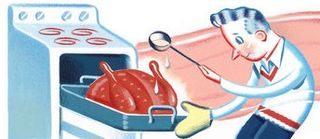
Bee Wilson reviews ‘Cooked,’ by Michael Pollan

Bee Wilson in the New York Times:

ScreenHunter_171 Apr. 28 18.47In each of the sections — neatly themed as “Fire,” “Water,” “Air” and “Earth” — Pollan seeks wisdom from masters who will teach him one of the four basic elements of cooking. In “Fire,” he learns barbecue from a “slow-moving bear of a man.” In “Water,” he is taught pot cookery — casseroles and braises — by a lively ­Iranian-American woman who once worked at Chez Panisse. “Air” refers to the rising of bread as he trains himself in the magic of sourdough. Finally, “Earth” is devoted to fermentation, following sauerkraut gurus, cheese makers and craft beer enthusiasts to find out what microbes really do for us, whether in our guts or in our food.

A life involving no home cooking, Pollan convincingly argues, is a life diminished. It’s not just that you probably eat food that’s of worse quality (in Pollan’s world, cooks seldom burn things or give their guests food poisoning). It’s also because the noncook suffers a loss of engagement “with the material world.” And cooking may be the best line of defense against obesity: Pollan cites a 2003 Harvard study that correlated the increase of obesity in America with the decline of home cooking.

If such an absence is indeed disastrous, you might expect that “Cooked” would examine how to get more people to change their habits. Now, Pollan notes, the typical American household devotes “a scant 27 minutes a day” to food preparation. Pollan rounds up the usual enemies of home cooking: “longer workdays and overscheduled children,” and, of course, convenience foods. But instead of considering ways to make cooking easier to fit into time-pressed lives, he sets off on a personal quest — albeit written with all his trademark lyricism — to master techniques that are perversely slow and difficult, from cheese making to kimchi fermentation.

More here.

Interpreting Tino Sehgal

Justin E. H. Smith in his blog:

6a00d83453bcda69e2017d432cbeb9970c-350wiI recently worked as an 'interpreter', to use the term of art, in This Situation, a work by Tino Sehgal on exhibit at the Musée d'Art Contemporain in Montreal throughout most of March and April, 2013. My reasons for signing on to this project are several, including some having to do with the commitments that ensue from friendship, and some, I'll confess, with my seemingly constitutional inability to get my financial situation in order (peers in a similar stage of their careers are using words like 'refinance' and 'diversify'; I'm out in the moonlight scraping together a security deposit for a short-term sublet in Paris). More importantly, I went into it in the hope that I would come out the other end with a properly informed critical judgment about the work and about the state of contemporary art. When I was a lad I enthused about every new thing that came along. I would shell out for CDs with recordings of HVAC sounds in office buildings, and would go to the Pompidou and look at Joseph Beuys' rolled-up carpets or whatever and think some inarticulate thought along the lines of: Fuck you, stuffy old people. In more recent years I have come to feel that modernity was already bad enough, let alone whatever is supposed to have come after it, and I spend most of my time thinking about things one could just as easily have thought about when Oedipus Rex first realized what he'd done. I'm not nearly as contemporary as this thing I've just been involved in, I mean to say, and this necessarily constrains what sort of things I shall be able to say about it.

More here.