Over at the BBC, “A new drama by Sir Tom Stoppard to celebrate the 40th anniversary of Pink Floyd's The Dark Side of the Moon,” incorporating the music into the radio play (h/t: Ajay Chaudhary):

Over at the BBC, “A new drama by Sir Tom Stoppard to celebrate the 40th anniversary of Pink Floyd's The Dark Side of the Moon,” incorporating the music into the radio play (h/t: Ajay Chaudhary):
A Boston Review forum with Neta C. Crawford, Mary Kaldor, Tod Lindberg, Greg Grandin, James D. Fearon, John Tirman and Joanne Landy all responding to Alexander B. Downes:
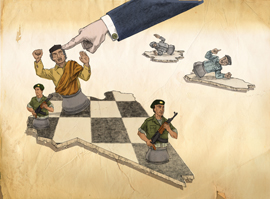
Obama’s reasons for confronting Qaddafi are more like Clinton’s in Bosnia and Kosovo than Bush’s in Iraq and Afghanistan, but several enduring factors trump changes in administration and provide a powerful impetus for continuing efforts at regime change spearheaded by the U.S. military.
First, there are few external constraints on the exercise of American power: the United States spends nearly as much on defense as the rest of the world combined and dwarfs most potential adversaries in military capability. Because the United States is so powerful, defines its international interests so broadly, and is so accustomed to intervening militarily on behalf of those interests, only a radical realignment of strategy would enable American leaders to forswear regime change. As long as the United States is committed to providing stability in most of the world, rooting out terrorism, stopping the spread of weapons of mass destruction, curbing human rights abuses, spreading democracy, and pursuing global primacy, frequent intervention is unavoidable.
Second, U.S. leaders face few hurdles to initiating military action abroad. Even though regime changes are costly and can result in prolonged occupations and insurgencies, U.S. leaders can successfully downplay or lie about the potential costs in order to obtain public approval. This was amply demonstrated by the Iraq invasion: long before the war began, widely available information showed that the Bush administration’s liberate-and-leave story was flawed. Yet the president and his advisors insisted that taking out Saddam Hussein would be cheap and easy, and the administration won the support it needed. Even after this story proved false, Bush was not held accountable, winning reelection in 2004. Leaders in democracies such as the United States focus on manufacturing consent for regime change rather than planning realistically for the fallout. As Afghanistan and Iraq show, it is easier to get the troops in than to get them out, even if public opinion turns against the mission.
Finally, Americans tend to personalize their conflicts. Almost every target of U.S. intervention in the post–Cold War world has been labeled another Hitler. It is enticing to believe that removing one person from power will fix a problem. This “evil leader” syndrome is one reason why it is so difficult for the United States to fight limited wars: the temptation to “go to Baghdad” rather than make peace with a dictator is strong, and, historically, killing the leader has meant defeating his army. Decapitation by airpower and targeted killing have become popular because they supposedly enable the United States to oust leaders without a ground invasion, thereby obviating the need for a costly war.
Before the 1970s, the discussion of how to make economics a science was left mostly to economists. But like war, which is too important to be left to the generals, economics was too important to be left to the Nobel-winning members of the University of Chicago faculty. Over time, the question of why economics has not (yet) qualified as a science has become an obsession among theorists, including philosophers of science like us.
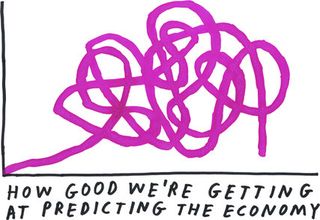
It’s easy to understand why economics might be mistaken for science. It uses quantitative expression in mathematics and the succinct statement of its theories in axioms and derived “theorems,” so economics looks a lot like the models of science we are familiar with from physics. Its approach to economic outcomes — determined from the choices of a large number of “atomic” individuals — recalls the way atomic theory explains chemical reactions. Economics employs partial differential equations like those in a Black-Scholes account of derivatives markets, equations that look remarkably like ones familiar from physics. The trouble with economics is that it lacks the most important of science’s characteristics — a record of improvement in predictive range and accuracy.
This is what makes economics a subject of special interest among philosophers of science. None of our models of science really fit economics at all.
The irony is that for a long time economists announced a semiofficial allegiance to Karl Popper’s demand for falsifiability as the litmus test for science, and adopted Milton Friedman’s thesis that the only thing that mattered in science was predictive power. Mr. Friedman was reacting to a criticism made by Marxist economists and historical economists that mathematical economics was useless because it made so many idealized assumptions about economic processes: perfect rationality, infinite divisibility of commodities, constant returns to scale, complete information, no price setting.
David Berreby in Aeon Magazine:
[T]he scientists who study the biochemistry of fat and the epidemiologists who track weight trends are not nearly as unanimous as Bloomberg makes out. In fact, many researchers believe that personal gluttony and laziness cannot be the entire explanation for humanity’s global weight gain. Which means, of course, that they think at least some of the official focus on personal conduct is a waste of time and money. As Richard L Atkinson, Emeritus Professor of Medicine and Nutritional Sciences at the University of Wisconsin and editor of the International Journal of Obesity, put it in 2005: ‘The previous belief of many lay people and health professionals that obesity is simply the result of a lack of willpower and an inability to discipline eating habits is no longer defensible.’
Consider, for example, this troublesome fact, reported in 2010 by the biostatistician David B Allison and his co-authors at the University of Alabama in Birmingham: over the past 20 years or more, as the American people were getting fatter, so were America’s marmosets. As were laboratory macaques, chimpanzees, vervet monkeys and mice, as well as domestic dogs, domestic cats, and domestic and feral rats from both rural and urban areas. In fact, the researchers examined records on those eight species and found that average weight for every one had increased. The marmosets gained an average of nine per cent per decade. Lab mice gained about 11 per cent per decade. Chimps, for some reason, are doing especially badly: their average body weight had risen 35 per cent per decade. Allison, who had been hearing about an unexplained rise in the average weight of lab animals, was nonetheless surprised by the consistency across so many species. ‘Virtually in every population of animals we looked at, that met our criteria, there was the same upward trend,’ he told me.
It isn’t hard to imagine that people who are eating more themselves are giving more to their spoiled pets, or leaving sweeter, fattier garbage for street cats and rodents. But such results don’t explain why the weight gain is also occurring in species that human beings don’t pamper, such as animals in labs, whose diets are strictly controlled.
In 1835, at the height of the Southern cotton boom, the master class of the Mississipi Delta region had an attack of its worst phobia: fear of slave rebellion. One slaveholder in the countryside saw some of her slaves acting unusually, seeming defiant, appearing to plot. She began to eavesdrop and overheard one slave fantasize about being “her own mistress.” In another conversation, she caught the word “kill.” Her son squeezed a slave for information and drew out details of a coming insurrection. The masters sounded the alarm: patrols were instituted, investigators fanned out, the countryside came alive with tipsters. Evidence invariably consisted of seeing slaves where they oughtn’t to have been—in the slaveholder phrase, “skulking around.” The suspects gave up under torture, confessing plans for securing arms, robbing banks, butchering masters. As the investigation wore on, the ruling class created an ad hoc executive committee, which generated, piece by piece, its own worst nightmare. Although “circumstantial” is too kind a word for the evidence, and the investigators enjoyed no formal legal status, they nonetheless executed twenty-three suspects without controversy.
more from Gabriel Winant at n+1 here.
Every night, at the same point in the show, Eddie appears onstage in living, breathing form: a man on stilts in a tricorne hat and tailcoat, who would not look out of place at a Cornish folk parade. “I am hard of hearing,” says Dickinson. “With all due respect, that was such bullshit: scream for me again, London!” He has that brilliant, old-fashioned accent that all rock stars from Mick Jagger to Rod Stewart seem to have – a cheeky, Ealing-comedy London you don’t hear much any more. He was born in Worksop, Nottinghamshire, to a working-class family and was raised by his grandfather, a miner, who died of black lung. By the time he was a teenager, his parents had raised enough money doing up property to send him to Oundle public school, where he became the president of the war games society and handled real firearms – and from which he was later expelled. Britain’s rock stars moved up quickly in the world, fraternised with the titled, bought castles and suits of armour, colonised Mustique and appeared in Tatler’s society pages. They helped usher in the only kind of patriotism with which we are comfortable today: self-mocking, cartoonish, ridiculous, loose.
more from Kate Mossman at The New Statesman here.
When he was asked by Michael Albus to characterize the difference between his own approach and Karl Rahner’s, Hans Urs von Balthasar famously said, “Rahner has chosen Kant, or if you will, Fichte, the transcendental approach. And I have chosen Goethe, my field being German literature.” For Kant, and the moderns in general, the notion that the unifying center of a thing really does appear in the individual thing was denied. When I see this particular tree, therefore, all I see is the appearance of this particular tree. If any generalizations are to be made about it, they will have to come from the side of the subject. This means that the classical transcendental properties of Being—unity, truth, goodness, and beauty—must no longer be conceived as properties of Being, but as characteristics attributed to Being from the side of universal subjectivity. All postmodernity has to do to achieve nihilism, it would seem, is to deny any universal subjectivity. Postmodernism is not so much an alternative to modernism as its reductio.
more from Rodney Howsare at Front Porch Republic here.
Note: (This week is the sixth death anniversary of the great Urdu writer and my dear friend Qurratulain Hyder.)
From The New York Times:

…Mr. Johnson’s wife, Nancy, was a trim, exercising, vegetable- and fiber-chomping nonsmoker in her early 40s when she felt a lump in her groin. It proved to be a metastasis from a malevolent form of uterine cancer, one whose cells are atypically aggressive and prone to spreading. Her situation and her terrible prognosis reminded Mr. Johnson of nothing more than his New Mexico backyard, with headstrong wildflowers blooming where they choose and intractable weeds exploding by night.
More here.
Thin
by Kay Ryan
From Poetry, April 2005
PZ Myers responds to Jerry Coyne on evolutionary psychology, in Pharyngula:
I detest evolutionary psychology, not because I dislike the answers it gives, but on purely methodological and empirical grounds: it is a grandiose exercise in leaping to conclusions on inadequate evidence, it is built on premises that simply don’t work, and it’s a field that seems to do a very poor job of training and policing its practitioners, so that it primarily serves as a dump for bad research that then supplies tabloids with a feast of garbage science that discredits the rest of us. I’d like to see the evolutionary psychologists who propose that there is a high quality core to their discipline spending more effort ripping into their less savory colleagues than on the indignant sniffing at critics of evolutionary psychology. I’d have more respect for the field if there was more principled internal striving.
There is also a tactic I really dislike; I call it the Dignified Retreat. When criticized, evolutionary psychologists love to run away from their discipline and hide in the safer confines of more solidly founded ideas. Here’s a perfect example:
…the notion that “the fundamental premises of evo psych are false” seems deeply misguided. After all, those premises boil down to this statement: some behaviors of modern humans reflect their evolutionary history. That is palpably uncontroversial, since many of our behaviors are clearly a product of evolution, including eating, avoiding dangers, and the pursuit of sex. And since our bodies reflect their evolutionary history, often in nonadaptive ways (e.g., wisdom teeth, bad backs, the coat of hair we produce as a transitory feature in fetuses), why not our brains, which are, after all, just bits of morphology whose structure affects our behaviors?
You know what? I agree entirely with that. The brain is a material product of evolution, and behavior is a product of the brain. There are natural causes for everything all the way down. And further, I have great respect for psychology, evolutionary biology, ethology, physiology, anthropology, anatomy, comparative biology — and I consider all of those disciplines to have strong integrative ties to evolutionary biology. Does Coyne really believe that I am critiquing the evolved nature of the human brain? Because otherwise, this is a completely irrelevant statement.
First, Laurie Penny in the Guardian:
[n]on-monogamy is stereotyped as a bad deal for women and girls, all of whom actually just want a white wedding, because we women are all the same, simple creatures with simple desires. When abuse happens within polyamorous relationships, outsiders often assume that the non-traditional relationship structure is to blame – but the same assumptions are rarely made when a “traditional” marriage turns violent, despite the fact that the practice historically treated women as property and until recently made it legal for men to rape their wives. For plenty of women, that's reason enough to consider other options.
Of course, polyamory isn't always political. People do it for all sorts of reasons, from grand ethical statements to boredom – managing the drama of multiple relationships is a great way to kill time on a Sunday afternoon. Personally, I started practising non-monogamy in my early 20s as a statement against the tyranny of the heterosexual couple form and the patriarchal nuclear family – but then again, I did a lot of silly things for similar reasons in my early 20s. If you'd asked 21-year-old me why precisely I was hanging half-naked out of a fourth-floor window on Holloway Road, I'd probably also have answered “as a statement against the tyranny of the heterosexual couple form”. Nowadays, from the wise and serious vantage point of my mid-20s, I practice non-monogamy because it works for me. It doesn't work for everyone, and I might not choose it forever.
Julie Bindel responds, also in The Guardian:
Polyamory is the latest subversive and a la mode sexual practice toreceive extensive media coverage. It appeals as a subject for to those interested in alternative lifestyles, but also attracts commentary from some deeply unpleasant folk who have trashed it alongside gay marriage. “What next?” ask the bigoted opponents of equal marriage. “Polygamy and marriage to your brother/cat/hedge trimmer?”
It is neither my business or concern as to how many sexual partners anyone has at any one time, and I genuinely could not care less how folk organise their relationships. But the co-opting and rebranding of polygamy, so that it loses its nasty association with the oppression of the most disadvantaged women, is as irresponsible as suggesting that because some women chose to enter high-end prostitution as a social experiment, all prostitution is radical and harmless.
Caroline Humphrey, a professor of collaborative anthropology at Cambridge University, has argued in favour of the legalisation of polygamy because, according to a number of women in polygamous marriages in Russia, “half a good man is better than none at all”.
Analee Newitz in io9:
One of the outstanding questions for scientists and historians who study the Incas is why this wealthy, sophisticated culture developed scientifically and culturally without ever inventing markets. One possibility is that life was so difficult to sustain in their environment that all their innovations revolved around agriculture rather than economics. In other words, the Inca Empire was optimized to prevent starvation rather than to foster trade.
A few years ago, a group of archeologists took core samples in Cuzco valley in Peru, and found evidence for thousands of years of agriculture in the area, including animal husbandry, most likely of llamas. In a paper summarizing their findings, archaeologist A.J. Chepstow-Lusty and his team suggested that the Incas focused their technological and cultural institutions around food production and land management, rather than market economies. This may have been necessary in a region where droughts had likely wiped out a previous civilization (the Wari), and where climate fluctuations were a constant hazard. The rise of the Inca Empire coincided with a period of relative climate stability, but the peoples in the area would be well aware that this temperate spell could end at any time…
So how do you become a continent-dominating empire without cash? In the case of the Incas, it's likely that the technologies that granted them agricultural surplus (extra food and textile materials) helped them with their expansive empire-building. Food was their coin; pure labor structured their economy.
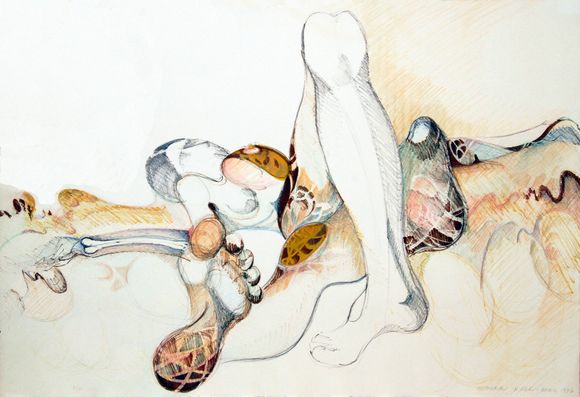
Sughra Raza. Untitled. 1976.
Etching with color pencil embellishment.
by Evert Cilliers aka Adam Ash
Our system had prevailed. In the end, we had won the Cold War. Communism had been defeated. Even China turned to capitalism. We had been right all along. And with our insistence on freedom and human rights, we were morally respectable (forget for a moment that we were propping up despots everywhere).
Today things look very different. Because of Bin Laden, we got involved in two unnecessary wars, tortured people, and ended up with a hugely expensive surveillance state.
Bin Laden brought fear into our lives, and turned the United States into a parody of Big Brother, spying big-time on its own citizens.
Think of America before 9/11: the world's undisputed and admired leader. Think of America just after 9/11: the world sympathized with us. Even in Iran, where we had installed the torturous regime of the Shah before he was overthrown in 1979, folks held candle-lit vigils for us.
Then think of us a few years later, when the biggest protests in human history took place all over the world against our imminent invasion of Iraq.
Over a million people in Rome marched against our proposed war with Iraq: that's just one example. And were they ever right to protest. Our war of aggression against an innocent nation that was not threatening us in any way, ended up with over 100,000 Iraqis murdered. And the scandals and atrocities of Abu Ghraib and Guantanamo Bay brought our moral superiority into disrepute forever. Moreover, the Iraq War became an ideal recruitment tool for Al Qaeda, and multiplied the number of terrorists in the world by the thousands. We ended up creating terrorists instead of diminishing their number.
Of course, Bin Laden also got lucky, because he struck us when two of the biggest idiots serving in government since Caligula appointed his horse as a Roman Senator, were running the country: the mediocre C-student George W. Bush and the eternally paranoid bird-killer Dick Cheney. If Al Gore had been president during and after 9/11, we certainly would not have started a war with Iraq, and might have made a deal with Afghanistan's Taliban for them to hand over Bin Laden, as they were apparently prepared to do, except that Bush/Cheney were so bent on war, they were in no mood to make a deal with the Taliban, even though they used to make deals with the Taliban before 9/11.
Robert Pinsky at the website of the Poetry Foundation:
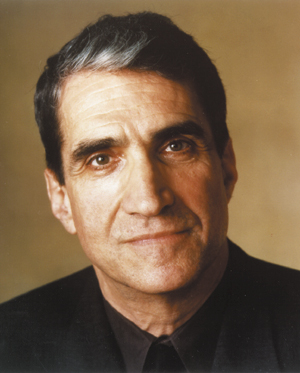
A reigning style can feel tyrannical: the assumptions behind it so well-established that there seem to be no alternatives. But there are always alternatives. How might a resourceful, ambitious artist get past or around a perceived tyranny? European painters early in the twentieth century, challenging the academic norm, found something useful in Japanese cigarette papers and African masks.
The past can offer a useful way of rebelling against the orthodoxies of the present. The early modernist poets revived interest in John Donne and Andrew Marvell, not because they wanted to correct the academic reading lists—that was a side effect—but because they were impatient with late-late Romantic, post-Victorian softness. They craved models of hard-edged intelligence and lightning wit.
In the 1970s, a young poet I knew described the manner most prevalent in the magazines and writing workshops of those days as “just grooving on images.” I remember that poet—now a considerable and innovative figure—introducing me toJames Shirley’s “The Glories of Our Blood and State,” praising the poem for the force of its statement and idiom, the cogency of its propositions, and its cadences.
More here.
Carl Zimmer in his excellent blog, The Loom:

The human genome contains about 3.2 billion base pairs. Last year,scientists at the University of Leceister printed the sequence out in 130 massive reference-book-sized volumes for a museum exhibit. From start to finish, they would take nearly a century to read.
A typical gene is made up of a few thousand bases. The human genome contains about 21,000 genes that encode proteins. There are other genes in the human genome that encode molecules known as RNA, but how many of those RNA molecules actually do anything useful in the cell is a matter of intense debate. A lot of the human genome is made of neither protein- or RNA-coding genes. Much (maybe most) of it is made up of dead genes and parasite-like stretches of DNA that do little more than making copies of themselves.
As I wrote recently in the New York Times, 3.2 billion base pairs and 21,000 genes are not essential requirements for something to stay alive. E. coli is doing very well, thank you, with a genome about 4.6 million base pairs. That’s .14% the size of our genome. Depending on the strain, the microbe has around 4100 protein-genes. That’s about a fifth the number of protein-coding genes that we carry. The high ratio of genes to genome size in E. coli is the result of its stripped-down, efficient genetics. Mutations that chop out non-functional DNA spread a lot faster in microbes than in animals.
E. coli, in turn, has proven to be positively gargantuan, genetically speaking, compared to some other species.
More here.
From NewStatesman:
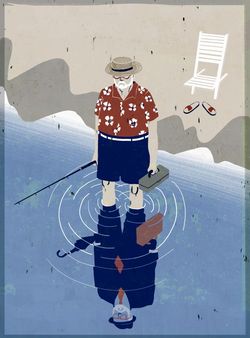
…There is an argument to be made against the prototypical life of hard work as the inevitable lot of humanity. In 1974 the Chicago anthropologist Marshall Sahlins published Stone Age Economics. He proposed the idea that individuals in many “simple” societies, far from working themselves to death merely to exist in their nasty, brutish and short lives, were actually members of the “original affluent society”. He suggested that, in those parts of the world where co-operation and social exchange were paramount, once people had done the few days’ hard work of felling a tree and carving out a canoe, there were large amounts of free time to lie about daydreaming, exploring, telling stories: doing “culture” or just skiving. You’d fish in the canoe you’d made, and by preserving and sharing the catch with others, who also shared theirs with you, you could then take a few days off before you needed to get any more. Decent members of those communities did what they needed to do and then when they didn’t need to do it, they stopped. Only when you worship the idea of accumulation and status based on its perceived wealth-giving properties do you have to work hard all the time. Accumulation was hampering; you had to carry it about with you when you moved from camp to camp, or find ways of storing and securing it if you were sedentary. Without the idea of surplus as a value beyond its use value, when you needed/wanted something you got it, and when you had it, you enjoyed it until it was time to get some more.
More here.
An attack on the renowned atheist as anti-Muslim is really designed to squelch honest conversation about religion.
Jeffrey Tayler in Salon:

Lean would do well to stiffen up, however. In tapping out a risible parody of a reasoned critique, he unwittingly both beclowns himself and lends credence to the very scientist and arguments he seeks to discredit. His piece is full of wrongheaded thinking and blundering jabs at Dawkins for pointing out uncomfortable truths about the state of science, or, rather, the lack of it, in Muslim countries. Lean purports to “expose” the “ugly underbelly of [Dawkins’] rational atheistic disguise,” but has authored a tract consisting almost wholly of politically correct shibboleths and befuddled assertions that insult his readers’ intelligence and aim to squelch honest debate about Islam and its role in the world today. If one believes in free speech, one cannot let what he wrote go unchallenged.
More here.