From Bible-Belt Pastor to Atheist Leader

26atheist-articleLarge

Robert Worth in the NYT Magazine:

Late one night in early May 2011, a preacher named Jerry DeWitt was lying in bed in DeRidder, La., when his phone rang. He picked it up and heard an anguished, familiar voice. It was Natosha Davis, a friend and parishioner in a church where DeWitt had preached for more than five years. Her brother had been in a bad motorcycle accident, she said, and he might not survive.

DeWitt knew what she wanted: for him to pray for her brother. It was the kind of call he had taken many times during his 25 years in the ministry. But now he found that the words would not come. He comforted her as best he could, but he couldn’t bring himself to invoke God’s help. Sensing her disappointment, he put the phone down and found himself sobbing. He was 41 and had spent almost his entire life in or near DeRidder, a small town in the heart of the Bible Belt. All he had ever wanted was to be a comfort and a support to the people he grew up with, but now a divide stood between him and them. He could no longer hide his disbelief. He walked into the bathroom and stared at himself in the mirror. “I remember thinking, Who on this planet has any idea what I’m going through?” DeWitt told me.

As his wife slept, he fumbled through the darkness for his laptop. After a few quick searches with the terms “pastor” and “atheist,” he discovered that a cottage industry of atheist outreach groups had grown up in the past few years. Within days, he joined an online network called the Clergy Project, created for clerics who no longer believe in God and want to communicate anonymously through a secure Web site.

DeWitt began e-mailing with dozens of fellow apostates every day and eventually joined another new network called Recovering From Religion, intended to help people extricate themselves from evangelical Christianity. Atheists, he discovered, were starting to reach out to one another not just in the urban North but also in states across the South and West, in the kinds of places­ DeWitt had spent much of his career as a traveling preacher.

What Is Nostalgia Good For? Quite a Bit, Research Shows

John Tierney in The New York Times:

NostalgiaAfter a decade of study, nostalgia isn’t what it used to be — it’s looking a lot better. Nostalgia has been shown to counteract loneliness, boredom and anxiety. It makes people more generous to strangers and more tolerant of outsiders. Couples feel closer and look happier when they’re sharing nostalgic memories. On cold days, or in cold rooms, people use nostalgia to literally feel warmer. Nostalgia does have its painful side — it’s a bittersweet emotion — but the net effect is to make life seem more meaningful and death less frightening. When people speak wistfully of the past, they typically become more optimistic and inspired about the future.

“Nostalgia makes us a bit more human,” Dr. Sedikides says. He considers the first great nostalgist to be Odysseus, an itinerant who used memories of his family and home to get through hard times, but Dr. Sedikides emphasizes that nostalgia is not the same as homesickness. It’s not just for those away from home, and it’s not a sickness, despite its historical reputation. Nostalgia was originally described as a “neurological disease of essentially demonic cause” by Johannes Hoffer, the Swiss doctor who coined the term in 1688. Military physicians speculated that its prevalence among Swiss mercenaries abroad was due to earlier damage to the soldiers’ ear drums and brain cells by the unremitting clanging of cowbells in the Alps.

More here.

Tuesday Poem

Down to Sleep

When it thundered Papa
turned a mild eye to
the skyand counted: one thousand
and one, one thousand
and two . . .
The dog whimpered.
Blue light skewed down the sky,
corkscrews of energy and burnt
air, nosefuls of ozone.
Half an oak peeled back
like lilac bark. The current
slurred in the walls and the radio
lowered its voice. Bedtime,
I thought it said, and down the shaft
of sleep I lowered my crackling
body, past the jagged seams.
Silt replaced my marrow.
The last light I knew
grew in fern of blood inside
my eyelids.
Into the slime my dark flame
spiraled and I was
spent, absent,
mine.


by William Matthews
from Sleek for the Long Flight
White Pine Press, 1988

On Philosophers, Violence, Humour & Tragedy

Critchely

Qalandar Bux Memon and Asif Akhtar interview Simon Critchley in Naked Punch:

QM – I want to ask you something that is rarely asked of a western philosopher (by which I mean someone who reads predominantly ‘white writers’). What effect do you think European colonialism has had on the tradition of philosophy and on philosophers of the European tradition? We are often told about the fracturing effect of the Holocaust on western philosophy and of the grand role of 1968, but what about colonialism?

SC: For me the history of colonialism is absolutely fundamental for understanding philosophy, for understanding what philosophy might do. Philosophical modernity from the 17th Century onwards is the history of European colonial expansion. To isolate philosophy from colonialism is simply to engage in a form of historical amnesia. Certain philosophers, like Locke, were bound up with the invention of the colonial project. Locke was involved in the writing of the fundamental constitutions of the Carolinas and invested heavily in plantation slavery. And we find many other examples. Modern philosophy has to be understood in relationship to the colonial and imperial projects of European modernity. To turn to the last part of the question—which is for me even more important—I don’t buy into the idea of the Holocaust as a novelty or a breaking of history. The Holocaust is the extension of the logic and practices of European colonialism—specifically French and British colonialism—into the European territory. The techniques of the Holocaust, such as the use of concentration camps, were picked up by the Germans in colonial wars, the Spanish Cuban war of 1896 and the British Boer Wars in South Africa in the early 20th Century. The ambition that Germany had in the 1930s was for their own space, what they called “Lebensraum” (‘habitat’ or, literally, ‘living space’). They wanted their own colonial space just like the French and the British. Africa had already been carved up, North America had been carved up and Asia had been carved up, so the Germans decided that Eastern Europe would become the German colonial domain. I see the Holocaust as simply the extension of the logic of European colonialism and we therefore have to understand the Holocaust as an event in the history of colonialism and to eradicate the idea of it being unique or exemplary just because it took place in Europe. I think this is nonsense, historical nonsense. There is a fantastic book by Sven Lindqvist called “Exterminate All the Brutes”: One man’s Odyssey into the heart of darkness and the Origins of European Genocide, which demonstrates this point in great detail, showing how the Germans picked up and appropriated the military hardware of the colonial project. German anti-Semitism is also peculiar: if any country was going to become a really anti-Semitic regime in the early 20th Century you would have put your money on France rather than the Germany.

On Sheep and Infidels

Mada team-10

Sarah Carr in Mada Masr (with some interesting discussions that follow in the comments) [h/t: Yogesh Chandrani]:

I voted for Mohamed Morsi in the second round of the presidential elections (to keep Ahmed Shafiq out).

I am one of the administrators of a blog called “MB in English” that features English translations of awful statements of a sectarian, conspiratorial or bonkers nature that the Muslim Brotherhood (MB) intends for domestic consumption only.

I am against army intervention in politics.

I state all this because Egyptian politics and society in general are currently split along identity lines in a way that they have never been over the last three years. This problem is so chronic that the merits or flaws of an argument are almost entirely determined by who is making the argument, considered through a haze of fury and suspicion.

For the past week, I have been trundling between the pro- and anti-Morsi protests. It is like traveling between two planets. The pro-camp has significantly more men than woman — although there are women and children there — and it lacks the social diversity of the anti-camp. I have never seen one unveiled woman who is not a journalist there. I have never met a Christian or encountered any other journalist who has met one there (it is important to note that pro-Morsi protesters and pro-Morsi media have often claimed that there are Christians attending their sit-in). At the same time, they also allege that the church was behind the former Mubarak regime-US-Zionist plot to oust Morsi.

The point is that the pro-Morsi crowd is largely homogenous. Their opponents use this homogeneity as evidence that the MB is, at best, an organization that has failed to market itself to non-supporters; and, at worst, a closed group unconcerned with non-members.

While the MB’s opposition might be correct in this assertion, many go one step further. They suggest that Morsi supporters are all members of the Muslim Brotherhood, and all unthinking androids programmed by the Supreme Guide. The popular derogatory term for them is khirfan (sheep). The aim here is to dehumanize and deny agency, much in the same way the Muslim Brotherhood dismiss their opponents as kuffar (infidels) or feloul (Mubarak regime beneficiaries or loyalists).

Monday, July 8, 2013

Sunday, July 7, 2013

Punish the Jester: A Note on Political Correctness

Justin E. H. Smith in his blog:

ScreenHunter_238-Jul.-07-19

Justin is telling me a joke. I think.
Photo by Margit Oberrauch

I consider myself politically progressive, but there are a few major sticking points that keep me perpetually at odds with my would-be allies. I hold in utter contempt anyone who would attempt to dictate to me a list of things I am forbidden to say, and it is generally more from the left than from other quarters that such dictation comes. I am part of that minority that continues to consider political correctness a real threat, and not a momentary excess of the early 1990s, when we heard all that reactionary huffing about how soon enough they'll be making us say 'vertically challenged' instead of 'short' and so on. I speak not with Rush Limbaugh but with Vladimir Nabokov when I say that I am horrified by the limitation of free expression, by which I don't mean the usual 'expression of unpopular ideas' beloved of 'card-carrying members of the ACLU', but rather the creative use of language where a Schillerian free play of the imagination is the only source of regulation. I believe the desire to regulate externally stems not just from a misunderstanding of how political progress is made, but also of how language functions.

When I write about this stuff, I know in advance I'm going to get a positive response from free-spirited avuncular types who to be perfectly honest are rather embarrassing to me, those 60-something men in Hawaiian shirts who remember when women liked to be complimented on their 'gams' and who are wary of that stuff they're teaching the kids in the colleges these days; and I know in advance I'm going to get silence from my peers. But what can I do? The principle of parrhesia cannot be grounded on prior calculations about who one would like to hang out with.

More here.

Christopher Hitchens is not a liar

A new book says the famed atheist thinker's writing on religion is intellectually sloppy. It gets Hitch wrong.

Carlo Dellora in Salon:

ScreenHunter_237 Jul. 07 19.45Of all the criticisms that could be leveled at Christopher Hitchens – and there are many – a boring style is not one of them. Despite some controversial positions and persuasions, his writing was always exciting, entertaining and engaging. Regrettably, the same cannot be said for Curtis White. In an excerpt from his recent book “The Science Delusion: Asking the Big Questions in a Culture of Easy Answers” published in Salon last week, White accuses the “notorious” Hitchens of some of journalism’s worst crimes – lying, dishonesty, shamefulness and an all-round lack of “decency.” However, while running through a litany of examples apparently highlighting Hitchens’ intellectual turpitude, White manages something remarkable. Rather than convicting Hitch of “telling less than he knew or ought to have known’,”White shows how it is in fact he who is literarily lazy, inconsistent and mendacious.

White begins with some concessions, curiously feeling the need to acknowledge his own qualified atheism by rejecting the notion of a “CEO God” – whatever that means – he then concedes that religious extremism is “still very much a problem politically” and across the globe. Yet, after admitting that the “religious right is real, and international fundamentalism is dangerous and frightening,” White goes on to admonish Hitchens for reducing religion down “to a series of criminal anecdotes” – presumably ignoring all the good stuff it has done for the world.

In this way, White rehashes a well-worn criticism of the new breed of atheists – that they do not recognize the positive, progressive aspects of organized religion and instead focus only on the negative. This is neither new nor compelling.

More here.

Love’s Labors and Costs

From Seed Magazine:

Spent_INLINEWhy do some people pay a 100,000 percent premium for a Rolex when a Timex is such a sleek and efficient timepiece? Why do others kill themselves at work just so they can get there in a Lexus? Why do we pay 1,000 times more for designer bottles of water when the stuff that gushes from our taps is safer (because it’s more regulated), often tastier, and better for the planet? And how do we convince ourselves that more stuff equals more happiness, when all the research shows that it doesn’t? In Spent, University of New Mexico evolutionary psychologist Geoffrey Miller contends that marketing—the jet fuel of unrestrained consumerism—“is the most dominant force in human culture,” and thus the most powerful shaper of life on Earth. Using vivid, evocative language, Miller suggests that consumerism is the sea of modern life and we are the plankton—helplessly tumbled and swirled by forces we can feel but not understand. Miller aims to penetrate to the evolutionary wellsprings of consumerist mania, and to show how it is possible to live lives that are more sustainable, more sane, and more satisfying.

…Critically, Miller’s point is that the human urge to put on a show is biologically inevitable—consumerist culture is not. By changing the way we display, we can reduce the high individual, societal, and planetary costs of rampant consumerism. Miller offers suggestions for modifying social norms to stigmatize crass consumerism, along with sensible, though unoriginal, advice about resisting the consumerist urge (“just don’t get it”). More boldly, he proposes tax reform that would inhibit, rather than promote, the impulse to consume—rendering unto Caesar as money leaves the wallet (a consumption tax) rather than as money enters the wallet (the current system of income taxation).

More here.

Visualizing Carbon

From Conservation Magazine:

Nyc-carbon-one-day1For Antony Turner, pictures make a story come alive—and in the climate change story, one of the main characters is invisible. In 2009, together with artist/scientist Adam Nieman, he founded Carbon Visuals to help people “see” the carbon dioxide that’s trapping heat in Earth’s atmosphere. Their strategy: Transform the mass (tons and gigatons) of carbon dioxide emissions we hear about so much into volumetric representations and then show them as 3-D shapes in familiar landscapes. Carbon Visuals has worked with governments, schools, corporations, and others to help them make sense of carbon footprints, comparisons, and sequestration targets. Changing the trajectory of the climate story, Turner believes, starts with getting the antagonist in our sights.

Picture: In 2010, New York City emitted 54 million metric tons of carbon dioxide. With a single day’s CO2 emissions, the city “buries” the Empire State Building with 149,903 ten-meter-diameter spheres, each containing one metric ton of the gas.

More here.

Homeland

NewDealNRA

Perry Anderson in New Left Review:

The American political scene since 2000 is conventionally depicted in high colour. For much native—not to speak of foreign—opinion, the country has cartwheeled from brutish reaction under one ruler, presiding over disaster at home and abroad, to the most inspiring hope of progress since the New Deal under another, personifying all that is finest in the nation; to others, a spectre not even American. For still others, the polarization of opinion they represent is cause for despair, or alternatively comfort in the awakening of hitherto marginalized identities to the threshold of a new majority. The tints change by the light in which they are seen.

For a steadier view of US politics, line is more reliable than colour. It is the parameters of the system of which its episodes are features that require consideration. These compose a set of four determinants. The first, and far the most fundamental, of these, is the historical regime of accumulation in question, governing the returns on capital and rate of growth of the economy. The second are structural shifts in the sociology of the electorate distributed between the two political parties. The third are cultural mutations in the value-system at large within the society. Fourth and last—the residual—are the aims of the active minorities in the voter-base of each party. The political upshot at any given point of time can be described, short-hand, as a resultant of this unequal quartet of forces in motion.

What remains unchanging, on the other hand, is the monochrome ideological universe in which the system is plunged: an all-capitalist order, without a hint of social-democratic weakness or independent political organization by labour. The two parties that inhabit it, Republican and Democratic, have exchanged social and regional bases more than once since the Civil War, without either ever questioning the rule of capital. Since the 1930s there has been a general, if not invariable, tendency for those at the bottom of the income pyramid—should they cast a ballot, which large numbers do not—to vote Democrat, and those at the top, Republican. Such preferences reflect the policies by and large pursued by the two parties: Democratic administrations have typically been more redistributive downwards than Republican, in an alignment shadowing, without exactly reproducing, divisions between left and right elsewhere. But these are rarely differences of principle. A salient feature of the consensus on which the system rests is the flexibility of relative positions it allows. Policies associated with one party can migrate to the other, not infrequently assuming forms in the cross-over more radical than they possessed in their original habitat. A glance at the history of the past half-century is a reminder of these eddies within the system.

Transnational Gender Vertigo

Kim-2

Kimberly Kay Hoang in Contexts:

I first met Tram in 2006 in a tiny bar on Pham Ngu Lao Street in Ho Chi Minh City (formerly Saigon), in a neighborhood frequented by backpackers from abroad.

Tram and other sex workers in the bar, disguised as bartenders, catered to Western budget travelers seeking brief encounters or longer relationships-for-hire. They were the bar’s key attraction, but the women received no wages from the owner; they were independent entrepreneurs in a niche of the sex trade.

Tram, 27 years old and adorned with bracelet, rings, and a diamond necklace, was a model of success and economic mobility. She lived in a brand-new luxury condo with two servants, a full-time housecleaner and a cook who prepared Western foods for her new American husband. Tram had come from a poor village, she told me, where the only jobs were in the rice fields. In Ho Chi Minh City, she worked first as a maid and then in a clothing factory. But after two years of earning no more than the equivalent of US$70 a month, Tram had saved no money, could barely cover food and rent, and saw no hope for improvement. “Life in the city is so expensive,’’ she said. She saw sex work as her best route out of poverty.

Tram met William, 70, as a client, and quickly began to develop a more intimate relationship with him, hoping that her emotional labor might lead to ongoing economic support—in a remittance relationship, or marriage. Many Western men come to Vietnam seeking wives, or they become attached to women they hired once there, sympathizing with their plight, and wanting to take them out of the sex trade and care for them. Six months after they met, William asked Tram to marry him and move to North America. They were married in 2007.

In 2009, I reconnected with Tram, along with William and their three children at an airport outside of Montreal, Canada. As we drove the three hours to their home, passing lumber farms, acres of undeveloped land, and pastures sprinkled with sheep, I commented on its beauty and tranquility. But Tram expressed no such sentiments. She had never intended to escape small town Vietnam, she said, only to end up in another small town in rural Canada. She had hoped to move to the United States, and had dreamed of living in Los Angeles or New York, “a big city, like the movies.”

Instead, she found herself isolated, in a cold climate and working long hours.

The Evolutionary Ethics of E. O. Wilson

705px-Plos_wilson

Whitley Kaufman in The New Atlantis (image form wikimedia commons):

In his new book The Social Conquest of Earth (2012), naturalist E. O. Wilson argues that our best chance at understanding and advancing morality will come when we “explain the origin of religion and morality as special events in the evolutionary history of humanity driven by natural selection.” This is a bold claim, yet a familiar one for Wilson, who has been advocating something like this approach to human morality ever since his landmark 1975 work Sociobiology.

In that book, Wilson provocatively argued that “scientists and humanists should consider together the possibility that the time has come for ethics to be removed temporarily from the hands of the philosophers” and that ethics should instead be “biologicized”: questions once debated seemingly without end by philosophers will be settled by biologists using the same methods by which they have explained digestion, reproduction, and all of the other evolved drives and functions of the body.

The unification of science and morality, on Wilson’s count, would be a much-needed revolution for ethics. But it has also long been one of the desiderata of the Enlightenment project — which has been so successful in fulfilling its promise of advancing our scientific knowledge and our material wellbeing, yet seems to have made so little progress in settling debates over ethics. The consilience of the human and natural sciences that Wilson’s sociobiological project promises would carry on the scientific method’s “unrelenting application of reason” to the field of ethics, and finally begin to establish a stable, wise, and enduring ethical code for the future.

Wilson’s vision has earned him the title of prophet from social psychologist Jonathan Haidt, and his work has been seminal in the field of evolutionary ethics — the study of the evolutionary origins of our moral beliefs and practices. Yet, though Wilson can be considered one of the most articulate proponents of the project to biologicize ethics, his work also, in spite of itself, reveals the greatest barriers to carrying it out.

Saturday, July 6, 2013

INTERVIEW WITH PAUL MULDOON

Alice Whitwham in The White Review:

THE WHITE REVIEW — Let’s talk about your most recent book, The Word on the Street. When did you start making music and playing songs?

ScreenHunter_236 Jul. 06 20.01PAUL MULDOON — Strictly speaking, the first person I worked with who really got me started on it was Warren Zevon. He’s unfortunately nowhere near as well-known as he should be. But I think he was a truly amazing songwriter, really. He met Stravinsky when he was a kid, and then he played piano with the Everly Brothers on tour. And he was involved with Jackson Browne, and the Eagles, and all that crowd. He was a songwriter I admired for a long time, and as it happened I had the opportunity to write something for him. And that was really how it started.

THE WHITE REVIEW — How did the opportunity come about?

PAUL MULDOON — It came about because I wrote him a fan letter. Out of the blue. He was writing an album with various other people, which is something he’d done right the way through. I learned a great deal from him, insofar as one learns anything about anything. Of course one does, one has to believe one learns. Particularly as a teacher, I have to believe that I can teach somebody something, otherwise I shouldn’t be doing it. On the other hand, it’s actually doubtful how much one learns oneself. I realise as I get older how little I know about anything. That’s a truism but it’s true. In all areas of life.

More here.

Demoting Democracy in Egypt

Shadi Hamid in the New York Times:

ScreenHunter_236 Jul. 06 19.02When Mohamed Morsi became Egypt’s first democratically elected president last year, it was an especially sweet victory for the Muslim Brotherhood, the region’s oldest and most influential Islamist movement. After a long history of repression, the Brotherhood had finally tasted triumph. But their short-lived rule ended Wednesday when Egypt’s army deposed Mr. Morsi.

The Brotherhood’s fall will have profound implications for the future of political Islam, reverberating across the region in potentially dangerous ways. One of the most important political developments of recent years was the decision of Islamist parties to make peace with democracy and commit to playing by the rules of the political game. Leaders counseled patience to their followers. Their time would come, they were told.

Now supporters of the Brotherhood will ask, with good reason, whether democracy still has anything to offer them. Mr. Morsi’s removal will breathe new life into the ideological claims of radicals. Al Qaeda and its followers have long argued that change can’t come through the democracy of “unbelievers”; violence is the only path. As the Qaeda leader Ayman al-Zawahri once said, “What is truly regrettable is the rallying of thousands of duped Muslim youth in voter queues before ballot boxes instead of lining them up to fight in the cause of Allah.”

More here.

House Party: Much Ado About Nothing

Amanda Shubert in Critics at Large:

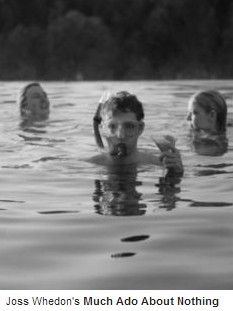
ScreenHunter_235 Jul. 06 18.56Joss Whedon’s Much Ado About Nothing evolved out of the parties Whedon used to throw for the casts of his television show Buffy the Vampire Slayer and its spin-off Angel: he got his actors together for Shakespeare readings, which he would cast and direct. To make Much Ado About Nothing, Whedon reserved his week off – the twelve days in between wrapping his horror movie Cabin in the Woods and starting production on the Marvel Comics flick Avengers – and invited his company from past projects to rehearse and film the picture, using his house and grounds as the location. (He gives the play a modern day setting.) The product is a Joss Whedon home movie – two scenes were shot during real house parties – and it has the cheerful desperation of a lot of talented people winging it while trying to hide from one another what their gut tells them: that they’re not going to pull this thing off.

The material is not the problem. Much Ado About Nothing is one of Shakespeare’s most loveable comedies, and it’s also completely within Whedon’s range. It may not have vampires and demons (Buffy the Vampire Slayer; Angel) or space-age cowboys and aliens (Firefly; Serenity), but it distills the qualities that make Whedon’s supernatural and extraterrestrial epics such compelling mythographies of real life experience. It’s a comedy that brings romantic happiness to the brink of disaster and back again, where erotic desire can be the source of complete wreckage as well as matrimonial union, and jealousy, hatred and rage are the shadow-presences of the profoundest love. That’s the attitude Whedon took towards high school in Buffy the Vampire Slayer, where the emotions of the teenage characters were so volatile they combusted into paranormal activity.

More here.

Eye to Eye: Taher Shah, Unlikely Overnight Pop Sensation

Celebrating the overdue arrival of this summer's unrepentantly vapid icon.

James Hamblin in The Atlantic:

I have actually not yet met this summer's international pop sensation-in-the-making. I requested an interview but am still waiting. Maybe it's all part of the mystique.

Taher Shah's digital tail is short, almost eating itself. The most credible Twitter account in his name (Or is it this one? There are impostors) was just opened at the end of April, and it is little more than an exaltation of the human eye.

The one thing we know for sure about the self-described singer/lyricist/writer/model/actor/producer/director/businessman is that he has a super-hot single. Despite YouTube being banned in his home country, his recently released debut “classic epic song and video” has already been viewed half a million times around the world.

If you haven't seen it, here it is. I don't think there's really anything I can say to prepare you.

The single is entitled “Eye to Eye” (“Ankhon he Ankhon Mei” in Urdu). Yes, a good amount of it is him looking pretty longingly at another incarnation of himself. He also lays claim to your heart without regard for your perspective on the matter. (“Your heart is mine because I love you.”) But let's not get on him about syntax; any effort at working multilingually is a noble one.

The Internet adores it. Or adores hating on it, or ironically adoring it. However the Internet feels about things it makes popular; that new emotionless amalgamation of emotions. It's doing that.

More here.