Can a marriage between man and machine solve the world’s problems?

From The Globe and Mail:

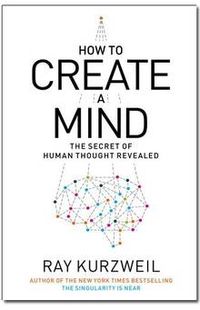
HowToCreateAMindHow do you know when your new book is a success? When Google promptly offers you a plum job as soon as the book is on the stands. That's the pleasant turn of events that Ray Kurzweil, 64, is enjoying. His most recent book, his sixth, is How to Create a Mind: The Secret of Human Thought Revealed. His new job at Google is director of engineering. Google made the announcement in December. Kurzweil has many fans. The Wall Street Journal once described him as “the restless genius” and Fortune said he was “a legendary inventor with a history of mind-blowing ideas.” Time put him on its cover, and Forbes called him “the ultimate thinking machine.”

…The thesis of How to Create a Mind is that the human brain itself is the most powerful thinking machine available today, so it is logical that we look to the brain for guidance on how to make devices smarter. He outlines a theory he calls “the pattern recognition theory of mind (PRTM),” which he says “describes the basic algorithm of the neocortex (the region of the brain responsible for perception, memory and critical thinking).” By reverse-engineering the human brain, we will be able to “to vastly extend the power of our own intelligence.” What will we do with this new intelligence? First, we will better understand the brain itself and develop superior treatments for the brain's ailments, such as psychiatric disorders. Second, we will use our expanded intelligence to solve the many problems that confront mankind. Finally, we will use the intelligence to teach us how to be smarter.

More here.

A Brazilian Autumn?

9097435128_19a982c454

Miguel Borba de Sa in Jacobin:

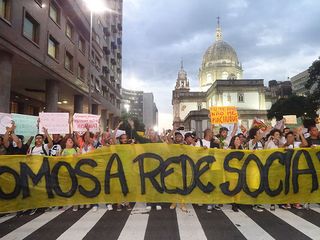
Mark Bergfeld: How could a twenty-cent increase in bus fares spark protests in more than 100 towns and cities across Brazil?

Miguel Borba de Sa: In his book, The Road To Serfdom the Austrian economist Friedrich Hayek wrote that there are two areas that one cannot leave to the competitive principle: transport and the environment. Brazil’s bourgeoisie consistently fails to understand this.

In the last ten years transportation has become a lucrative business for the Brazilian elite and local government officials. Enterprises and corporations bid for local routes and lines. Local government officials cosy up to the bus companies for benefits.

Here in Brazil, transport costs cut into workers’ wages far more than other utilities such as electricity or water. Fares have risen faster than inflation. An average workers’ wage is 650 Brazilian real. A bus ticket is 2 real. This private-public relationship has broken down.

The movement we see on the streets today actually started in Porto Alegre. People protested the fare increase two months ago. The police turned violent. Public outrage followed and the hike was halted. Was it a victory? No! The money for the bus company was raised by exempting the local bus company from future tax payments. In Rio, for every real I pay for a ticket the local authorities adds the same amount in subsidies or tax exemption.

At the same time the huge infrastructure projects like the Confederation Cup, the Pope’s visit later this year, the FIFA World Cup have displaced poor people from the city center and, in many cases, even cut them off from public transport. Dissatisfaction and “unfairness” have been simmering on Facebook, in the popular neighbourhoods and among working class youths. Radicalization and marginalisation have gone hand in hand. Now there is collective rage.

5 Surprising Fourth of July Facts

From LiveScience:

Statue-liberty-fireworks1. John Adams thought Americans would celebrate July 2

The Continental Congress officially declared its freedom from British rule on July 2, 1776, the day that John Adams wrongly thought would be commemorated by future generations. July Fourth, meanwhile, marks the day Congress adopted the Declaration of Independence. As copies of the declaration spread across the colonies, celebrations kicked off. Americans lit bonfires, fired celebratory shots from their guns, rang bells, and took down symbols of the British monarchy. At that point, the Boston Tea Party and the Battles of Lexington and Concord had already happened, but the American Revolutionary War wouldn't end until the Treaty of Paris was signed in 1783.

2. Three presidents died on the Fourth of July

John Adams and Thomas Jefferson passed away within hours of each other on July 4, 1826. The two had been political rivals and then friends later in life, and both signed the Declaration of Independence. James Monroe, the nation's fifth president, was the next U.S. leader to die, and he passed away on July 4, 1831. Calvin Coolidge, the 30th president, is the only U.S. chief to have been born on the Fourth of July.

More here.

A difficult way forward in Egypt

From the website of the International Crisis Group:

20130704_EGYPT-slide-XTKM-hpLargeAs Egypt teeters on the verge of a catastrophic confrontation, it is difficult to discern who has been more short-sighted: an arrogant Muslim Brotherhood that misread electoral gains for a political blank-check or a reckless opposition that has appeared ready to sink the country in order to bring down the Islamists and whose criteria for ousting the president – generalised incompetence and wide unpopularity – could send many presidents packing. The priority today must be to avoid further bloodshed. It is, too, to ensure that the next chapter in Egypt’s troubled transition, unlike the last, is inclusive and consensual. The alternative is to continue with exclusionary, confrontational politics, albeit with greater violence with only a change of characters at the helm.

Egypt’s profound divisions rarely have been on starker display than these past days. Millions took to the streets on 30 June to demand President Mohammed Morsi’s departure; smaller, yet still large numbers responded to insist on his remaining in office. From all sides has come talk of blood and martyrdom – from the Brotherhood, the youth-initiated Tamarrud (Rebellion) and the army itself. The forceful removal of the nation’s first democratically-elected civilian president risks sending a message to Islamists that they have no place in the political order; sowing fears among them that they will suffer yet another bloody crackdown; and thus potentially prompting violent, even desperate resistance by Morsi’s followers.

The current crisis to a large extent is the product of a fundamentally flawed political transition. Political actors were unable to reach basic agreement on rules of the game or the desired political system, instead proceeding with a winner-take-all mentality that was sure to alienate – and frighten –losers.

More here.

Thursday Poem

Father

Last night
I dreamt about you,
father.
You came
into my dream
as a deer
and stood astride
a grassy
mound.

I called you
by your name,
father.
I called you
by the word: father
I said:

Look,
my eyes are
two wet flowers
by the mountain
stream.
Come,
let your warm
deer tongue
dry the dew
that fell upon
my eyes.

And you stood
as in another
world,
as in another
dream,
on a mound,
overgrown with grass.

You shook your
mighty
antlers
and vanished in the white
cloud
of no one’s
dreams.

.
by Peter Semolic
from Bizantinske rože
publisher: DZS, Ljubljana, 1994
translation: 2004, Ana Jelnikar
.

Read more »

Show Trials and Sympathy

Image (2)

Sophie Pinkham in n+1:

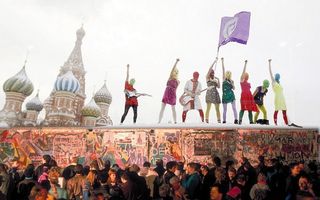
Last week, a new documentary about Pussy Riot aired on HBO. Two anonymous Pussy Riot members attended the premiere in New York, bumping shoulders with Salman Rushdie and Patti Smith but skipping the “Riotinis” at the Russian-themed SoHo afterparty. One year after the trial, the world is still on a first name basis with Nadya Tolokonnikova, Masha Alyokhina, and Katya Samutsevich, the “Pussy Riot girls,” the ones who got caught.

The Pussy Riot trial was only the first in a string of pseudo-legal proceedings meant to punish the opposition and teach the public a lesson, but it’s still the one that’s made the biggest splash abroad. The prosecutions of Aleksei Navalny, one of the Russian opposition’s strongest leaders, and of twenty-seven people arrested in connection with the political demonstrations on Moscow’s Bolotnaya Square have been equally absurd, hollow, and unfair. But they haven’t become pop culture phenomena in the way the Pussy Riot trial did; they don’t have the same simple hook or punk rock appeal.

Any trial that exists only to justify punishment is a kind of “show trial,” a performance rather than a judgment. Such trials have a long history in Russia. In the 19th century, Russia’s greatest lexicographer recorded proverbs and sayings that included, “Where there’s a court, there is falsehood,” and “Go before God with the truth, but before the courts with money.” Show trials come in many flavors, though Stalin’s are the ones we remember best. The stakes in the recent trials have been far lower than those in Stalinist trials: fortunately, no one was ever at risk of being shot. Putin doesn’t have Stalin’s iron grip, and in all of the politically motivated trials of the last year there have been plenty of loud, dissenting voices, both inside and outside the courtroom. In fact, these modern show trials have more in common with the lesser-known trials of the Brezhnev era and late imperial Russia, periods that saw authoritarian governments losing control of their narrative, upstaged by another, more compelling show—the defense.

How Austerity Has Failed

Wolf_1-071113_jpg_470x633_q85

Martin Wolf in the NYRB:

Austerity came to Europe in the first half of 2010, with the Greek crisis, the coalition government in the UK, and above all, in June of that year, the Toronto summit of the group of twenty leading countries. This meeting prematurely reversed the successful stimulus launched at the previous summits and declared, roundly, that “advanced economies have committed to fiscal plans that will at least halve deficits by 2013.”

This was clearly an attempt at austerity, which I define as a reduction in the structural, or cyclically adjusted, fiscal balance—i.e., the budget deficit or surplus that would exist after adjustments are made for the ups and downs of the business cycle. It was an attempt prematurely and unwisely made. The cuts in these structural deficits, a mix of tax increases and government spending cuts between 2010 and 2013, will be around 11.8 percent of potential GDP in Greece, 6.1 percent in Portugal, 3.5 percent in Spain, and 3.4 percent in Italy. One might argue that these countries have had little choice. But the UK did, yet its cut in the structural deficit over these three years will be 4.3 percent of GDP.

What was the consequence? In a word, “dire.”

In 2010, as a result of heroic interventions by the monetary and fiscal authorities, many countries hit by the crisis enjoyed surprisingly good recoveries from the “great recession” of 2008–2009. This then stopped (see figure 1). The International Monetary Fund now thinks, perhaps optimistically, that the British economy will expand by 1.8 percent between 2010 and 2013. But it expanded by 1.8 percent between 2009 and 2010 alone. The economy has now stagnated for almost three years. Even if the IMF is right about a recovery this year, it will be 2015 before the economy reaches the size it was before the crisis began.

Wednesday, July 3, 2013

3:am salutes sian s. rathore

Max Dunbar in 3:am Magazine:

Sian-300x225In the autumn of 2010 a beautiful, exasperating young woman appeared in Manchester: Sian Rathore. A singer-songwriter, critic and poet, her inventive approach to the spoken word made her a hit at the poetry nights there, and in terms of content her work eclipsed the more established mediocrities of that city. Sian is very much a poet of the digital age with a lively presence on Twitter, a plethora of blogs and tumblrs, an occasional column for the Huffington Post and a passion for something called ‘flarf poetry’ which I am too old to pretend to understand. So in Sian’s collection there is a poem about bereavement, called ‘She Sometimes Still Emails Him’ – where the narrator has just bought a smartphone and is messaging a dead friend, while still struggling to work out the keypad. (‘Youd; have really lvoed one/Apple make there own Phones now’). Another poem lists the bizarre search terms people have used to find Sian’s blog. The rhythms are like electronica and the locale is contemporary, abounds with references to Blackberry messaging, Spotify and Made in Chelsea. Yet the poetry comes from a traditional place. Sian is better read than most of her peers and her favourite book is Wuthering Heights.

Sian has a somewhat turbulent romantic life, suffers from bipolar disorder and, as a person, can be fairly scattershot and disorganised. So it’s always a double take when you read her stuff and realise quite how disciplined she is as a writer. Every word has been put on trial for its life. That discipline is coupled with a cold, caustic, Parker-style sense of humour. A few lines from her poem ‘The Last Stand of the World’s Most Famous Observational Comedian’, a satire on male dominated stand up, recall even Eliot at his most vitriolic:

The great observer overflows from the seat at the strip club
With white foam collecting at the corners of his mouth
Like small clouds precipitating the sweat on his upper lip
With one hand in his pocket and one between her breasts
Before she forces it back
God, it’s mad in’t it, this so-called ‘women’s lib’
The exotic dancer who had the recent abortion
Notices his failed erection
And sniggers with unsubtle laughter.

More here.

How Egypt’s Michele Bachmann Became President and Plunged the Country Into Chaos

Juan Cole in Truth Dig:

ScreenHunter_231 Jul. 03 13.47Egyptian President Mohamed Morsi may or may not survive Sunday’s massive protests, organized by the youth Rebellion (Tamarrud) Movement. They are, nevertheless, a milestone in modern Egyptian history and a warning to him about his arrogant and highhanded style of governing from his fundamentalist base. Morsi, from the Muslim Brotherhood, represents the equivalent of the American tea party in Egyptian politics—captive to the religious right, invested in austerity and smaller government, and contemptuous of workers and the political left. In his first year in office, the nation’s first freely elected head of state has squandered Egyptians’ willingness to give him the benefit of the doubt. He has acted like the president of the somewhat cultish Muslim Brotherhood, rather than like the president of the whole country. Here are the major errors he has made, which have polarized Egypt and created a severe crisis that some observers worry could turn into a civil war.

On taking office in summer 2012, Morsi did not appoint a government of national unity. He named no politicians from other major parties to important cabinet posts, nor did he reach out to the revolutionary youth. Although he made a neutral technocrat, Hisham Qandil, his prime minister, he put members of the Brotherhood’s Freedom and Justice Party in charge of key cabinet posts. He thus created the impression that he was trying for a “Brotherization” of the government.

Despite Egypt’s sagging economy, Morsi did not make stimulating it his first priority, and instead tried to please the International Monetary Fund with austerity policies, rather on the model of the Mariano Rajoy government in Spain.

More here.

Why Does the Higgs Particle Matter?

It has been one year since scientists announced the discovery of a particle believed to be Higgs. Read this essay by a Nobel prize winner in physics.

Frank Wilczek in Big Questions Online:

Templeton-higgs_0Imagine a planet encrusted with ice, beneath which a vast ocean lies. (Imagine Europa.)

Within that ocean a species of brilliant fish evolved. Those fish were so intelligent that they took up physics, and formulated the laws that govern motion. At first they derived quite complicated laws, because the motion of bodies within water is complicated.

One day, however, a genius among fish, call her Fish Newton, had a startling new idea. She proposed fundamental laws of motion––Newton's laws––that are simpler and more beautiful than the laws the fish had derived directly from experience. She demonstrated mathematically that you could reproduce the observed motions from the new, simpler laws, if you assume that there is a space-filling medium that complicates things. She called it Ocean.

Of course our fish had been immersed in Ocean for eons, but without knowing it. Since it was ever-present, they took it for granted. They regarded it as an aspect of space itself––as mere emptiness. But Fish Newton invited them to consider that they might be immersed in a material medium.

Thus inspired, fish scientists set out to find the atoms of Fish Newton's hypothetical medium. And soon they did!

That story is our own. We humans, like those fish, have been living within a material medium for millennia, without being consciously aware of it.

More here.

Pedestrian Archeology

ID_WT_CURTI_SKYWA_CO_001

Fair warning: I’m about to use a short phrase, consisting of two words, each of which are so excruciatingly dull that reading either one could very well cause you fall into an extended slumber, like Dorothy approaching Oz. Combined, they may induce a coma. Proceed at your own risk. To wit: Pedestrian infrastructure. Also, I will be writing about Cincinnati. Still with me? Good, because Cincinnati is a pretty fascinating place if your interests run to the history of walking in America in general, or, say, pedestrian infrastructure in particular. It’s home to a couple of groupings of artifacts that bookend the highs and lows of American walking culture over the past century and a half. Let’s start the tour at City View Place, at the edge of the Clifton Heights neighborhood, which I visited a couple of weeks ago. The most interesting thing about this short block is that it wholly lacks a city view. It’s actually at the bottom of a hill. But it ends at a long set of concrete steps that ascend a steep hill. These steps rise through a dense wood — I didn’t realize how shady and dark it was until a cardinal flew past, startling me with its sudden brightness. A few steps later — presto! — I was in another old neighborhood atop a hill filled with elaborately mansarded houses.

more from Wayne Curtis at The Smart Set here.

the self-made man

Ahlt_0001_0002_0_img0153

These have not been good days for the self-made man. The very phraseology offends: in an age when even corporate titans ritualistically affirm the value of teamwork, “self-made” sounds unseemly. “What’s wrong with the ‘self-made’ theory? Everything,” says Mike Myatt, a prominent CEO consultant, in a 2011 article in Forbes, a publication where one might expect to see such a figure affirmed. “If your pride, ego, arrogance, insecurity, or ignorance keeps you from recognizing the contributions of others, then it’s time for a wake-up call,” he admonishes.1 In the 2012 book The Self-Made Myth, authors Brian Miller and Mike Lapham define the phrase as “the false assertion that individual and business success are entirely the result of the hard work, creativity, and sacrifice of the individual with little outside assistance.”2 Such objections do not even begin to broach the difficulties of a phrase like “self-made man” in a postfeminist era, when any generic citation of “man” is at best a faux pas. Given the institutional, much less biological, realities that govern our lives, the very idea of the self-made man sounds like a contradiction in terms. No man is “unaided” because every man is some mother’s son.

more from Jim Cullen at Hedgehog Review here.

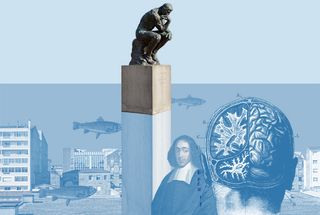
What Spinoza Knew and Neuroscience Is Discovering: ‘Free Will’ Doesn’t Exist

Over at Tablet, a podcast:

Ravven_freewill_062813_620pxQuestions of character shape public discourse. From Paula Deen to Edward Snowden—the choices people make and actions people take raise questions about free will, personal responsibility, and morality. And yet, researchers in sociology, psychology, and neuroscience are increasingly asserting that the independent self that we are all so attached to doesn’t really exist. What’s more, there are philosophical traditions dating back to Aristotle,Maimonides, and Spinoza that may offer more useful ways of thinking about how to foster ethical behavior and moral societies.

In The Self Beyond Itself: An Alternative History of Ethics, the New Brain Sciences, and the Myth of Free Will, Heidi Ravven, a professor of religious studies at Hamilton College, examines these questions. She joins Vox Tablet host Sara Ivry on the podcast to discuss how the myth of free will took hold, what Spinoza had to say about it, and why if you want to be a moral person, the last thing you should do is surround yourself with like-minded people. [Running time: 24:52.]

India at Rest

Dhruv Malhotra in The Morning News:

India's prevailing image is one of noisy animation—development, overcrowding, and horrible traffic. In comparison, Dhruv Malhotra's night-scapes of urban India capture the life, or lack thereof, that darkness conceals.

Rest

The Morning News: Who are the sleepers?

Dhruv Malhotra: The sleeping human figure, in the context of the larger urban landscape surrounding it, is the metaphor I use to address my own self and the world around me. Usually intentionally obscured, the sleepers are the people in my images who choose to sleep outdoors, for a variety of reasons, and are often guards, migrants, and construction workers, amongst others. The specific person doesn’t much concern me, as my intention is to use the human figure as a metaphor and a point to explore my concerns about the urban landscape.

TMN: If sleepers awaken while you’re photographing, how do you react?

DM: Usually I just speak to them. Some are a bit surprised at being photographed sleeping, but most go right back to sleep after minimal persuasion, once their sense of threat and alarm is allayed.Many of these moments of awakening have translated onto film as ghostly shapes emerging from sleeping bodies—moments of awakening glimpsed along with the dormant potential of the sleeper.

More here.

Wednesday Poem

The Entertainment of War

I saw the garden where my aunt had died

And her two children and a woman from next door;
It was like a burst pod filled with clay.
A mile away in the night I had heard the bombs
Sing and then burst themselves between cramped houses
With bright soft flashes and sounds like banging doors;
The last of them crushed the four bodies into the ground,
Scattered the shelter, and blasted my uncle’s corpse
Over the housetop and into the street beyond.
Now the garden lay stripped and stale; the iron shelter
Spread out its separate petals around a smooth clay saucer.
Small, and so tidy it seemed nobody had ever been there.
When I saw it, the house was blown clean by blast and care.
Relations had already torn out the new fireplaces;
My cousin’s pencils lasted me several years.
And in his office notepad that was given me
I found solemn drawings in crayon of blondes without dresses.
In his lifetime I had not known him well.
These were the things I noticed at ten years of age:
Those, and the four hearses outside our house,
The chocolate cakes, and my classmates’ half-shocked envy.
But my grandfather went home from the mortuary
And for five years tried to share the noises in his skull,
Then he walked out and lay under a furze-bush to die.
When my father came back from identifying the daughter
He asked us to remind him of her mouth.
We tried. He said ‘I think it was the one’.
These were marginal people I had met only rarely
And the end of the whole household meant that no grief was seen;
Never have people seemed so absent from their own deaths.
This bloody episode of four whom I could understand better dead
Gave me something I needed to keep a long story moving;
I had no pain of it; can find no scar even now.
But had my belief in the fiction not been thus buoyed up
I might, in the sigh and strike of the next night’s bombs
Have realized a little what they meant, and for the first time been afraid.
.
.
by Roy Fisher
from The Long and the Short of It: Poems 1955-2010
Bloodaxe Books, Tarset, 2012

Gut Microbes Spur Liver Cancer in Obese Mice

From Scientific American:

Gut-microbes-spur-liver-cancer-in-obese-mice_1The gut bacteria of obese mice unleash high levels of an acid that promotes liver cancer, reveals one of the first studies to uncover a mechanism for the link between obesity and cancer. The research is published today in Nature.

Obesity in general has many different types of cancer associated with it,” says Eiji Hara, a cancer biologist at the Japanese Foundation for Cancer Research in Tokyo and one of the study authors. But in the case of liver cancer, he says, “I never expected the microbiome was linked.” Hara and his colleagues initially set out to study how dying cells influence obesity-linked cancers. Cells that are irreparably damaged or pre-cancerous can become senescent — meaning that they stop dividing for overall health of the organism. But before senescent cells die, they can spew out chemicals that may cause inflammation and promote cancer development. To examine whether senescent cells are involved in obesity-induced cancers, Hara and his colleagues worked with genetically engineered mice whose cells emit light upon becoming senescent. They then primed the mice by exposing them to a carcinogenic chemical, a process that Hara says may be similar to humans’ exposure to environmental toxins, such as air pollution. Researchers then fed the mice either a normal diet or a high-fat diet. After 30 weeks, only 5% of the lean mice developed cancer — in their lungs — whereas all the obese mice developed liver cancer.

More here.

Room for Sex

Cite-Radieuse-Final

Richard J Williams in Aeon Magazine:

Morningside, a late-Victorian suburb on the south side of Edinburgh is an extremely good-looking place, possessing an architectural integrity rare in Britain today. Never threatened by wartime bombs, post-war developers, or the vicissitudes of the housing market, this suburb has a direct line to the ‘Victorian city’ — and its morality. Its moral character is there for anyone to see: in the bay windows watching over every inch of street, the church on every corner, and the sheer solidity of the stone. Morningside is propriety in built form.

The suburb’s respectability was a huge attraction for me at the anxious moment of buying a flat. But after a few years of living there, that same respectability had become a bore. Then it became oppressive. The buildings began to represent a desiccated social life, defined by emotional reserve and obligation. Patrolled by curtain-twitching killjoys, Morningside seemed determined to put a stop to fun of any kind.

In retrospect, Morningside itself probably had little to do with it. Moving there coincided with the moment at which my wife and I became fully grown adults. It was a structural problem. With two careers, two kids and no money, there was little time for pleasures, sex included. Of course, we bore it all stoically and, after a while, we learned together that this was simply what adult life was like, a mess of contradictory demands, with neither the time nor the space in which they might all be satisfied. We were hardly alone: every other couple we knew seemed to find themselves in the same situation. Still, our feelings were real enough, and being an academic, I set to reading about them.

Dostoevsky, Inequality, and Tsarnaev’s Humanity

1372458713

Elizabeth Stoker in the LA Review of Books:

IT BEGINS with a once-promising student and a number of contributing factors that could perhaps have been tolerated in isolation, but in their confluence bring about horrific crimes.

The student is “a strikingly handsome young man, with fine dark eyes, brown hair, and a slender well-knit figure, taller than the average.” He lives alone in a city of thousands, and unbeknownst to his distantly located but eminently involved mother, he has abandoned his schoolwork. His ideological commitments have become increasingly extreme and convoluted, and despite evidently having maintained at one time a rational, moderate worldview, he has “recently become superstitious.”

He is poor, disenfranchised, and angry, and he is planning cold-blooded murder. The target is a matter of concentrated rage and coincidental opportunity. Though he has meditated upon murder for some time, his plans are expedited when it becomes clear to him that the perfect set of circumstances have arisen for him to carry out his attack without detection.

His reasons are in equal measures strange and sober. They represent grotesquely extreme incarnations of “the most usual and ordinary youth talk and ideas”: a distaste for greed, a disgust with the tyranny of the powerful over the oppressed, and a general sense of personal obligation to defend the world from its infectious elements.

In a tiny apartment lodged in a building of low-income housing units, he prepares himself and his instruments to carry out murder. It is a painstaking process that he approaches meticulously, but is nonetheless sped along by chance. With all of his materials and nerve mustered, he merely awaits his chosen hour.

Tuesday, July 2, 2013

The Barrel of the Apartheid Gun

The Nobel laureate on Ruth First and Joe Slovo in the War Against Apartheid, a new biography of South Africa’s revolutionary couple.

Nadine Gordimer in Guernica:

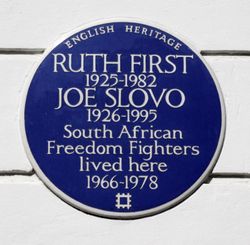
Gordimer-1Joe Slovo and Ruth First. We are entering their paths.

Both grew up unbelievers in Jewish or any religious faith. They met when Ruth was at the University of the Witwatersrand, Joe just returned from the South African Army in the war against Nazi Germany. His motivation for volunteering, eighteen years old, unemployed, lying about being underage for military call-up—his early alliance with communism, and so to the Soviet Union under attack—was decisive in the act. But there remained the devastating racial dilemma in South Africa. He wrote: “How do you tell a black man to make his peace with General Smuts—butcher of Bulhoek and the Bondelswarts? ‘Save civilization and democracy—must have sounded a cruel parody. And fight with what? No black man was allowed to bear arms…if you want to serve democracy, wield a knobkerrie [wooden club] as a uniformed servant of a white soldier.”

Joe Slovo’s appetite for the pleasures of life is brought face-to-face with his political humanitarian drive when at the end of the war he took a holiday. From Turin to Cairo he went, and with other decommissioned soldiers somehow got to Palestine although travel was restricted because of Zionist resistance to British occupation; on to a kibbutz where “looked at in isolation, the kibbutz seemed to be the very epitome of socialist lifestyle… it was populated in the main by young people with the passion and belief that by the mere exercise of will and humanism you could build socialism as one factory or one kibbutz and the power of example will sweep the imagination of all… worker or capitalist.”

More here.