
Abhrajyoti Chakraborty in The Guardian:
 In October 2014, five months after Narendra Modi was first elected as the prime minister of India, he claimed that the legend of the Hindu god Ganesha – whose elephant head was affixed to a human body – proved that cosmetic surgery existed in ancient India. Not long after, a retired pilot instructor, Anand Bodas, presented a joint research paper at the Indian Science Congress in Mumbai asserting that the repeated mentions of chariots and flying machines in ancient Sanskrit epics proved that aircrafts and drones were being developed in the Indian subcontinent 7,000 years ago.
Over the past decade of Modi’s rule, the country’s history has been embellished with visions of a fantastic, and technologically advanced, Hindu past. For the ruling Bharatiya Janata party (BJP), history and mythology are one and the same: the land south of the Himalayas was once a prelapsarian Hindu arcadia, which led the world in economic growth and scientific research. Our temples were apparently awash with gold; and 20th-century breakthroughs of western science such as stem-cell research and nuclear fission were all pioneered in India millennia ago. This fabled paradise was inevitably sullied by the arrival of “outsiders”: Hindu supremacists have consistently maintained that bloodthirsty Muslim invaders ran riot across the country from the 11th century onwards, massacring millions, destroying temples and universities.
More here.
Enjoying the content on 3QD? Help keep us going by donating now.
 T
T Around Christmas Eve 1955,
  Genetic analysis of a Neanderthal fossil found in France reveals that it was from a previously unknown lineage, a remnant of an ancient population that had remained in extreme isolation for more than 50,000 years. This finding sheds new light on the final phase of the species’ existence.
 I have difficulty interpreting the nature of my own life, a thing I feel intimately and continuously, so it’s not surprising that we can’t all agree on the nature of herons.
 Love ’em or hate ’em, there’s a reason sarcasm quotes are all over the internet. Like funny sayings, sarcasm quotes play with the interpretation of words and tone in a way that can stretch your brain if you’re not expecting it. To use sarcasm, you have to say something that’s the opposite of what you mean (kind of like uttering a
 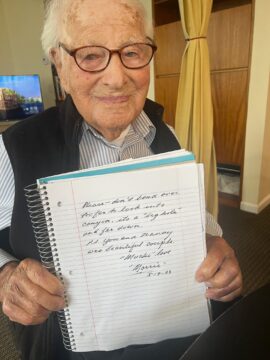 About a month ago, Judith Hansen popped awake in the predawn hours, thinking about her father’s brain.
 The French philosopher Simone Weil was a soul at odds with herself and with a world of affliction. The causes she espoused as a social activist and the faith she professed as a mystic were urgent to her and, as she saw it, to humanity. Little of her work was published in her lifetime, but since her death, at thirty-four, in 1943, it has inspired an almost cultlike following among readers who share her hunger for grace, and for what she called “decreation”—deliverance from enthrallment to the self.
 When history is about to take an abrupt turn, is there something in people’s eyes or in their secret longings that pre-announces it somehow—and that minds of a particular cast (poets and visionaries or perhaps psychiatrists) can read clearly and even put into words? If the world were to end next year, who would know about it today, and how? When we look back on the past, we say sometimes that there were “clear signs” that this or that event would happen, that the “writing was on the wall.” But how many of these signs were really there, and how many are projected back by hindsight? The problem is of special importance to historians. How can the historian single out a past event, focus on it exclusively, and pretend not to know what came after? How can a scholar fake ignorance?
 In 2016, Nate Silver was panned in the press and on social media for his presidential election forecast. His model