
Category: Recommended Reading
Wednesday Poem
Sergei Krikalev on the Space Station Mir
this is for those people
that hover and hover
and die in the ether peripheries
–Michael Ondaatje, “White Dwarfs”
My name is Sergei and
my body is a balloon.
I want to come down. I
tie myself to things.
My eyes try to describe your
face, they have forgotten.
My ears echo your voice.
I am a star, you can
see me skating on
the dome of night. My blades
catch sun from
the other side of earth.
Days last an hour and a half.
No one else lives here.
My country has disappeared,
I do not know where home is.
I am a painter standing back.
I watch clouds heave like cream
spilled in tea, I see
the burning parrot feathers
of the Amazon forests,
ranges of mountains are
scales along the hide
of the planet, the oceans
are my only sky.
This is my refuge. There is
no one else near me.
Do you understand what that means?
Elena, I am
cold up here.
I hang over Moscow and
imagine you in our flat
feeding little Olga
in a messy chair.
When I drift out of signal range
I do things you
don't want to hear about.
These feet do not know
my weight. A slow
balloon bounces off the walls.
I do not feel like I am flying.
I want to come back and
swim in your hair.
I want to smell you.
I want to arrive in the world
and know my place.
Think of me. I am yours adrift.
Let me describe
my universe: I can see for years.
by Jay Ruzesky
from Painting The Yellow House Blue
House of Anansi Press, Concord, Ontario: 1994
.
Are Men the Weaker Sex?
Alice Shabecoff in Scientific American:

Boys are also more than two-thirds more likely than girls to be born prematurely – before the 37th week of pregnancy. And, despite advances in public health, boys in the 1970s faced a 30 percent higher chance of death by their first birthday than girls; in contrast, back in the 1750s, they were 10 per cent more likely than girls to die so early in their lives. Once they make it to childhood, boys face other challenges. They are more prone to a range of neurological disorders. Autism is notoriously higher among boys than girls: now nearly five times more likely, as tallied by the U.S. Centers for Disease Control and Prevention. They are more susceptible than girls to damage from very low-level exposure to lead. Yet another problem: Boys also suffer from asthma at higher rates. There’s also a stronger link between air pollution and autism in boys. What is up here? Why do boys face such a burden of physical challenges?
The answer is that the male’s problems start in the womb: from his more complicated fetal development, to his genetic makeup, to how his hormones work.
More here.
Eyewitness to Terror: The Lynching of a Black Man
From BlackPast.org:
In 1931 twelve year old Thomas J. Pressley witnessed the lynching of George Smith in Union City, the county seat of Obion County, Tennessee. Now a University of Washington historian and Professor Emeritus, Dr. Pressley describes that lynching in the article below.

We were told by people in the crowd that the lynched man was in his early twenties, and that on the previous night, he had entered the bedroom and clutched the neck of a young lady prominent as a singer and pianist, the main entertainer at the new radio station recently established in Union City as the first station in Obion County. The young lady said she had fought off her attacker and severely scratched his face before he fled from her house. Within hours the sheriff and his deputy, using bloodhounds, had tracked down a black man who had scratches on his face. They then brought him before the young woman who identified him as her assailant. Convinced he had the attacker, the sheriff put him in the jail, which occupied the top floor of the Court House. Before long, however, a mob of whites gathered, broke into the jail, overpowered the sheriff and deputy, and hung the victim from the limb of the tree near the jail. I did not know the name of the black man who died that day. I was later told that he was a high school graduate which was unusual for blacks or whites in my county in that period, and that he knew the family of the woman attacked.
More here. (Note: One post throughout February will be dedicated to Black History Month.)
Tuesday, February 18, 2014
Review of ‘The Accidental Universe’ by Alan Lightman
Emily Rapp in the Boston Globe:
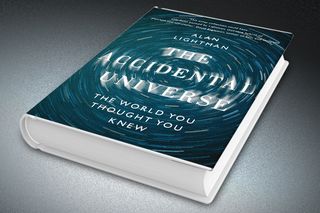
Can science prove the existence of God? Is this universe we inhabit the only one? Can a religious experience be scientifically proven? Lightman ponders these timeless, unanswerable questions using his training as both a scientist and a novelist, always careful to include historical and contemporary perspectives on each argument or idea. Lightman’s style is wonderfully readable; he writes about quantum physics and religious philosophical traditions with equal grace and enthusiasm. He delicately probes the emotional questions raised by genetics, molecular biology, and other scientific disciplines, maintaining that despite a preponderance of scientific advancement and evidence about specific aspects of the world, “we must believe in what we cannot prove.”
More here.
Is the Universe a Simulation?
Edward Frenkel in the New York Times:

But there is one area of human endeavor that comes close to exemplifying the maxim “manuscripts don’t burn.” That area is mathematics. If Pythagoras had not lived, or if his work had been destroyed, someone else eventually would have discovered the same Pythagorean theorem. Moreover, this theorem means the same thing to everyone today as it meant 2,500 years ago, and will mean the same thing to everyone a thousand years from now — no matter what advances occur in technology or what new evidence emerges. Mathematical knowledge is unlike any other knowledge. Its truths are objective, necessary and timeless.
What kinds of things are mathematical entities and theorems, that they are knowable in this way? Do they exist somewhere, a set of immaterial objects in the enchanted gardens of the Platonic world, waiting to be discovered? Or are they mere creations of the human mind?
More here.
What goes on in our minds when we see someone naked? The more we see of a person’s body the stupider they seem

In one experiment, subjects saw a photograph and a short description of a man or a woman. The photo showed either just the head or also the shirtless torso. When presented shirtless, targets were seen as having less competence. This is just what you might expect from research on objectification: we’re easily induced to see others as mere objects, pieces of meat without thoughts of their own. But it wasn’t that simple. Shirtless targets weren’t seen as devoid of all thought. They were actually seen as being more capable of emotions and sensations than their less exposed selves. They didn’t have less mental life but a different mental life.
More here.
On the power of silence, submission to force-feeding, and the first suicides in Guantánamo
Mario Kaiser in Guernica:
They were three proud Arab men, and they despised the America they came to know in Guantánamo. They didn’t smile like the man at the end of the chain. They didn’t offer themselves as spies, hoping that America would let them go.
At some point during their captivity, these three men began to retreat. They no longer touched the food the guards pushed through the holes in the doors of their cells. Their bodies dwindled. Their lives hung on thin yellow tubes shoved down their nostrils each morning to let a nutrient fluid drip into their stomachs. In their minds, nothing changed. They didn’t want to stay, and one night, on June 9, 2006, they decided to leave Guantánamo. They climbed on top of the sinks in their cells and hanged themselves.
In the Pentagon’s view, the men hanging from the walls of their cells were assassins whose suicides were attacks on America. The Pentagon struck back.
The story of the lives and deaths of these prisoners is an odyssey of three young men who left for Afghanistan and ended up in Cuba. It is the story of a war against a terror that is difficult to define, a war that the United States government wages even in the cells of its prisoners. It is about a place, Camp Delta, that exposes the asymmetry of this war, and it leads to the front lines—and the American lawyers standing between them, struggling to defend presumed enemies of their country. It is the story of the internal and external battle over Guantánamo.
More here.
Notes from Far Muscovy
Justin E. H. Smith in his personal blog:

In real life I had shared a taxi from Moscow to Sheremetyevo, earlier that same day, with a kind, gentle, architect from Berlin. By 'architect' I mean one of those people from Berlin who talks about 'space' a lot and who participates in panels with philosophers. He has probably never built any buildings, but nor has he blown any up, which is why I am wondering why he got replaced by Putin in my dream.
We had been, earlier in the day, on a panel in front of a few hundred people and a number of angry journalists. We were a motley crew of philosophers and political activists, and to be perfectly honest my reason for accepting the invitation was somewhat disingenuous: it meant an opportunity to go back to Russia after what seems like a lifetime away.
More here.
Political Hatred in Argentina: An Interview with Uki Goñi
Jessica Sequeira in the Boston Review:

Jessica Sequeira: Why did you come to Buenos Aires?
Uki Goñi: My life story is way complicated. I was born in the States, where I lived until I was fourteen, then my family moved to Ireland, where I lived until I was twenty-one, then I came here. But my family background is Argentine and my parents were Argentine. I wanted to stay in Ireland very much. Very much. But there was tremendous family pressure on me to come here. I am an Argentine citizen, and when I turned twenty-one—no, eighteen—the military service was still obligatory, so I had to come for that. I tried staying on in Ireland, enrolling at Trinity College. But basically I ran out of money, and they wouldn’t give me a scholarship because they said my father was an ambassador and I didn’t need it. I couldn’t really work because I wasn’t Irish either; I could be there as a student but I couldn’t work. I had like 300 pounds or something, that was all.
More here.
Quantum Entanglement Animated
Algebra-cadabra! Here’s a classic magic trick, and the mathematical secret behind it
Alex Bellos in The Guardian:

Here's one that's in the book.
The good thing about this trick is that you need an attractive assistant, which is one of the best things about being a magician.
Okay, the assistant doesn't need to be attractive. But I like to aim high, and will assume that she is for the remainder of this post.
The trick was invented by William Fitch Cheney Jr, a US mathematics professor, in 1951. It was originally called Telephone Stud since it could be done over the phone. Mulcahy calls it Fitch Cheney's Five-Card Twist.
First the magician leaves the room, leaving the attractive assistant with the audience. She gives a full deck of cards to an audience member, and asks him or her to shuffle it and then to choose any five cards.
The assistant takes the cards, looks at them, places one face down, and places the four others face up and side by side.
The magician is allowed back in. He glances at the table and – abracadabra – names the hidden card. The audience gasps in awe, since there was no way he knew which cards had been chosen.
So how did he do it?
More here. [Thanks to Jennifer Oullette.]
The Loving v. Virginia Case in Historical Perspective
From BlackPast.org:
Mildred Loving always insisted she was no civil rights pioneer, but Loving. v. Virginia, the 1967 Supreme Court case that bears her name, established the legal right to interracial marriage across the United States. In memory of Mildred Loving, who died on May 2, 2008, University of Oregon historian Peggy Pascoe, author of the new book, What Comes Naturally: Miscegenation Law and the Making of Race in America , discusses the many meanings of Loving v. Virginia.
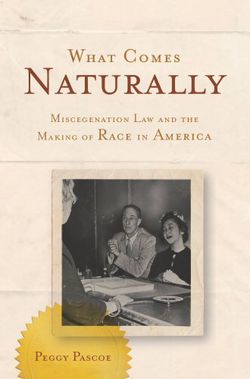
Richard knew they had no hope of getting a license in Virginia, so the pair traveled toWashington, D.C. to get married, returning with a marriage certificate that they framed and placed on a wall of the home they shared with Mildred's parents. Most of their Central Point neighbors paid little attention to the marriage, but someone told the Caroline County sheriff, who vowed to put a stop to it. The newlyweds had lived together for a little more than a month when they were awakened in the middle of the night by the sheriff and his deputies, who walked through the unlocked door of the house and right into the Lovings' bedroom to arrest them.
More here. (Note: One post throughout February will be dedicated to Black History Month.)
Phantom Melodies Yield Real Clues to Brain’s Workings
Carl Zimmer in The New York Times:
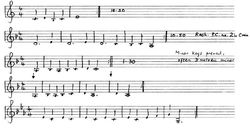
…For their experiment, Sylvia put on earphones and sat with her head in a scanner that detects the magnetic field produced by the brain. On the day of the study, she was hearing selections from Gilbert and Sullivan’s “H.M.S. Pinafore.” Every few minutes the scientists would switch to Bach for 30 seconds, to tamp down the hallucination. When the real music stopped, Sylvia pressed numbers on a keyboard to rate the strength of her hallucinations while the scanner recorded her brain activity. Dr. Kumar and his colleagues later pored over the data. They compared Sylvia’s brain activity when the hallucinations were strongest with when they were at their weakest. They found that a few regions consistently produced stronger brain waves when the hallucinations were louder. It turned out that they are regions that we all use when we listen to music. One region becomes active when we perceive pitch, for example. Another region becomes active when we recall a piece of music. Dr. Kumar argues that these results support a theory developed by Karl Friston of the Wellcome Trust Center for Neuroimaging. (Dr. Friston is a co-author of the new study.) Dr. Friston has proposed that our brains are prediction-generating machines. Our brains, Dr. Friston argues, generate predictions about what is going to happen next, using past experiences as a guide. When we hear a sound, for example — particularly music — our brains guess at what it is and predict what it will sound like in the next instant. If the prediction is wrong — if we mistook a teakettle for an opera singer — our brains quickly recognize that we are hearing something else and make a new prediction to minimize the error.
More here. (Note: Could this explain deja vu?)
Monday, February 17, 2014
perceptions
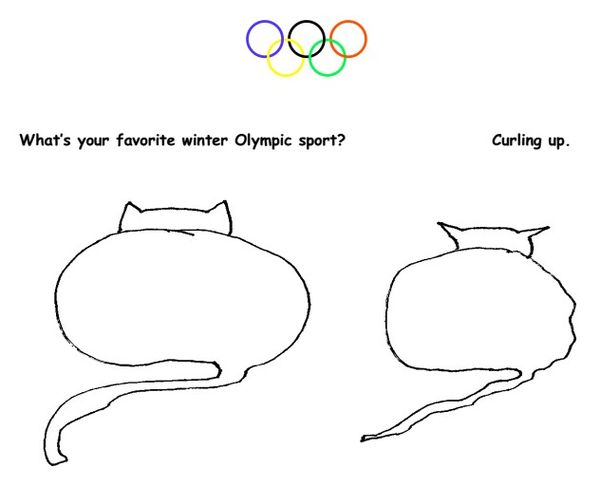
CATSPEAK
by Brooks Riley
Synesthesia is Not a Reason for Good Design
by Caitlin Gianniny

Due to the higher prevalence of synesthesia amongst people working in the arts (Vladimir Nabokov, David Hockney and Pharrell Williams, to name a few), the question as to whether synaesthesia may predispose individuals to be creative has been raised by synesthetes and researchers alike. Winter highlights “enhancing creativity and innovation” as a “professionally beneficial side effect” of some types of synesthesia, citing a 2004 study from the University of California at San Diego in which synesthetes scored twice as high as controls on Torrance Tests of Creative Thinking.
However, a 2008 study conducted by Jamie Ward et al. at the University of Sussex that explicitly examined links between synesthesia, art and creativity concluded that while synesthetes outperformed controls on some measures of creativity these findings do not translate into the cognitive flexibility necessary for creativity per se. “The cardinal feature of creativity is to think beyond the boundaries of existing associative knowledge” and “there is no convincing evidence that synaesthetes are more capable of doing this than other individuals.” Ward et al. suggest that the atypical experience of synaesthesia may bias synesthetes “towards the creative arts” and that this “artistic bias” is confused with creativity.
Sunday, February 16, 2014
A Conservative Who Was Right About Occupy
Nathan Schneider in Waging Non-Violence:
In the heady early days of Occupy Wall Street, there was a lot of talk about whether this thing was really a movement or something else, something presumably less worthy of attention. In an early Room for Debate discussion at The New York Times, for instance, the eminent social movement scholar Stephen Zunes stressed that “protests are not a movement”; I insisted, in the same discussion, on calling Occupy an “occupation-turned-movement.” To me, the evidence was this: Occupy was confounding the normal political spectrum. It wasn’t just people aligned with what are normally called the left or right, but an assemblage of people who reflected the inadequacy of the right-and-left spectrum for reflecting people’s longings — libertarians and anarchists, socialists and liberals, veterans and peaceniks, conservatives and utopians.
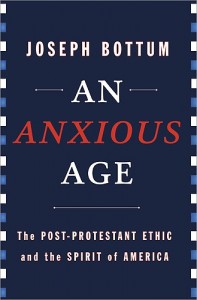
Over time, a more familiar leftist activist culture came to dominate the movement; at right about that time (with the help of coordinated repression) it started losing steam. But I’m reminded of that early movement moment by the release of Joseph Bottum’s new book, An Anxious Age: The Post-Protestant Ethic and the Spirit of America. I once met Bottum around his dinner table when he was editor of First Things, an organ of religious neoconservatism; he’s also a writer for The Weekly Standard and an avid science fiction reader. He explains in an interview on the book’s Amazon page (which Paul Elie points to at Everything That Rises):
In some ways, An Anxious Age really began when I was sent out to report on the protestors at Occupy Wall Street — and couldn’t finish the assignment. I could feel a spiritual anxiety about modern civilization radiating from nearly all of them, but I could find no easy way to explain it.
Now, two years later, this book is my answer: Not just those protestors, but nearly everyone today is driven by supernatural concerns, however much or little they realize it. Radicals and traditionalists, liberals and conservatives — together with politicians, artists, environmentalists, followers of food fads, and the chattering classes of television commentators: America is filled with people frantically seeking confirmation of their own essential goodness. We are a nation of individuals desperate to stand on the side of morality—anxious to know that we are righteous and dwell in the light.
More here.
The Vampire Squid Strikes Again: The Mega Banks’ Most Devious Scam Yet
Matt Taibbi in Rolling Stone:
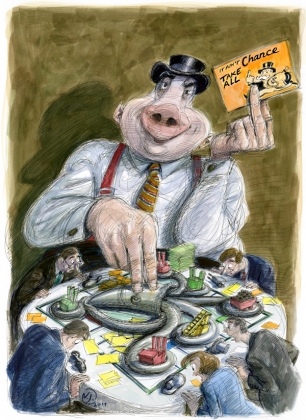
But the crazy thing is, nobody at the time quite knew it. Most observers on the Hill thought the Financial Services Modernization Act of 1999 – also known as the Gramm-Leach-Bliley Act – was just the latest and boldest in a long line of deregulatory handouts to Wall Street that had begun in the Reagan years.
Wall Street had spent much of that era arguing that America's banks needed to become bigger and badder, in order to compete globally with the German and Japanese-style financial giants, which were supposedly about to swallow up all the world's banking business. So through legislative lackeys like red-faced Republican deregulatory enthusiast Phil Gramm, bank lobbyists were pushing a new law designed to wipe out 60-plus years of bedrock financial regulation. The key was repealing – or “modifying,” as bill proponents put it – the famed Glass-Steagall Act separating bankers and brokers, which had been passed in 1933 to prevent conflicts of interest within the finance sector that had led to the Great Depression. Now, commercial banks would be allowed to merge with investment banks and insurance companies, creating financial megafirms potentially far more powerful than had ever existed in America.
More here.
Why Writers Are the Worst Procrastinators
Megan McArdle in The Atlantic:
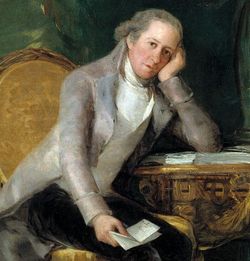
Over the years, I developed a theory about why writers are such procrastinators: We were too good in English class. This sounds crazy, but hear me out.
Most writers were the kids who easily, almost automatically, got A's in English class. (There are exceptions, but they often also seem to be exceptions to the general writerly habit of putting off writing as long as possible.) At an early age, when grammar school teachers were struggling to inculcate the lesson that effort was the main key to success in school, these future scribblers gave the obvious lie to this assertion. Where others read haltingly, they were plowing two grades ahead in the reading workbooks. These are the kids who turned in a completed YA novel for their fifth-grade project. It isn’t that they never failed, but at a very early age, they didn’t have to fail much; their natural talents kept them at the head of the class.
More here.