BMJ Article on Breast Cancer Screening Effectiveness Incredibly Flawed and Misleading

A few days ago, Zujaja posted this article on 3QD, calling into question the value of mammograms. Here is a reply from the American College of Radiology:

ScreenHunter_491 Feb. 16 15.09According to the American College of Radiology and Society of Breast Imaging, the recent breast cancer screening article (Miller et al) published in the British Medical Journal (BMJ) (1) is an incredibly misleading analysis based on the deeply flawed and widely discredited Canadian National Breast Screening Study (CNBSS). The results of this BMJ study, and others resulting from the CNBSS trial, should not be used to create breast cancer screening policy as this would place a great many women at increased risk of dying unnecessarily from breast cancer.

Experts called on to review the CNBSS confirmed that the mammography quality was poor (2). The trial used second hand mammography machines, which were not state of the art at the time of the trial. The images were compromised by “scatter,” which makes the images cloudy and cancers harder to see since they did not employ grids for much of the trial. Grids remove the scatter and make it easier to see cancers. Also, technologists were not taught proper positioning. As such, many women were not properly positioned in the machines, resulting in missed cancers. And the CNBSS radiologists had no specific training in mammographic interpretation. The CNBSS own reference physicist stated that “…in my work as reference physicist to the NBSS, [I] identified many concerns regarding the quality of mammography carried out in some of the NBSS screening centers. That quality [in the NBSS] was far below state of the art, even for that time (early 1980s).”(3)

In this latest BMJ paper, only 32 percent of cancers were detected by mammography alone. This extremely low number is consistent with poor quality mammography. At least two-thirds of the cancers should be detected by mammography alone (4).

More here. [Thanks to Sughra Raza.]

Robot navvies may be just around the corner

From The Economist:

TermiteIn a paper just published in Science, a group at Harvard, led by Justin Werfel, describes termite-inspired robots that can build things by combining magnetic bricks of a standard size. All their human controller has to do is program them with a few appropriate rules and leave them to get on with it.

Robot construction teams are not, in themselves, new. Researchers at the University of Pennsylvania have already demonstrated a system which uses remotely controlled flying robots to build things. What makes Dr Werfel’s approach different is that instead of having a controlling force, in the form of a computer program, sitting at the centre telling everything else what to do (as was the case in Pennsylvania), control is distributed throughout the system’s components, which cannot communicate with each other. The robots, which are little wheeled contraptions, do not need to see the bigger picture.

In the case of termites, the bigger picture is provided by natural selection, which has, over the millennia, refined the rules that individual termites obey. In the case of Dr Werfel’s robots, a human designer specifies the desired outcome and, with the help of a program developed by the team, generates the rules that will lead to its construction, with which each robot is then programmed. All that remains is to place a foundation brick to show the robots where to start building.

More here.

Raags to Riches: Globalism and Vernacular in Contemporary Pakistani Rap

Hamzah Saif in Chapati Mystery:

AdilRap’s transition from the poetry of marginalized African American communities to the mega-hits circulating in mainstream America today draws fierce debate. Consumerism and commodification are frequently found guilty of eviscerating a once-radical movement with the market’s golden handcuffs, swapping its class politics for “mere spectacle.” In contrast, Western popular and academic assessments of rap’s journey beyond American borders, particularly in the “Muslim world,” are markedly inattentive to this commercialism. Instead, this rap evokes a virtually unanimous nostalgia. There, 1986 Los Angeles is found alive in 2013 Lebanon, and New York’s Public Enemy and L.A.’s N.W.A are discovered rhyming through Beirut’s Rayess Bek and Tehran’s Yas. So prevalent is this penchant for locating the dissent lost in American rap in “over there” rap that the Washington D.C.-based think-tank, Middle East Institute, finds Iran’s Ayatollahs battling a reanimated Tupac, and Wall Street Journal has rappers soundtracking revolt from Egypt to Iran. The anachronism of finding 1980’s Ice Cube in contemporary Islamabad can be plausible only if one abundantly ignores the realities of contemporary rap. In a landscape where middle class white purchasers have dictated the contours of the genre’s production since at least 1992, it is particularly absurd to impose upon non-American “Muslim” rappers the romantic notion that their rap is protest. Imagining a resurrection of resistance in “over there” rap shortchanges the breadth of the non-American musical movements. Instead, they are much more productively seen as artists in the peripheral markets of globalized rap. Such a lens appropriately situates the rappers, and accords their work the creativity and artistry it deserves.

Far from culturally-appropriate replicas of bygone American rappers, Middle East and South Asia rappers are creators of an entirely new art, vastly expanding the frontiers of the genre. “It may not have started in our communities, but just like cricket”, says Islamabadi rapper Xpolymer Dar (Muhammad Dar), “we have made rap our own.” Indeed, in Dar’s country of Pakistan, where rap is a growing underground music genre, the ‘80s American rhymes for race and class justice are judged to have little resonance with Pakistani realities. Instead, it is the stylings of hyper-commercialized contemporary artists such as Eminem and 50 Cent that find ears, and have provided the launching pad for contemporary Pakistani rappers.

More here.

“Global Whitemanism”: The capitalist economy and dark dreams of the slaveholding South

Michael Bernath in Harvard Magazine:

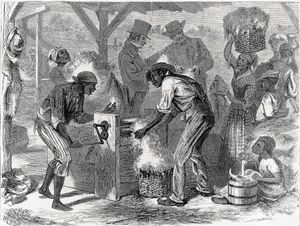
BlackThis is a dark book about a dark subject. Walter Johnson burst onto the historical scene with the 1999 publication of his influential Soul by Soul, which positioned the slave market as the central institution of the antebellum South, shaping not only the southern economy, but also white self-conceptions and black lives. With chilling efficiency, the book unpacked the practical and psychological difficulties in commodifying what should not be commodified. Johnson sought to reduce slavery to its basic equation—“a person with a price”—and to show how this omnipresent calculation permeated and undergirded every aspect of southern life. In River of Dark Dreams, Johnson deals with some of the same themes, but the Winthrop professor of history and professor of African and African American studies expands them outward in every direction. The new book, too, is rooted in an equation, or rather a conversion—“lashes into labor into bales into dollars into pounds sterling”—one that governed the lives of planters and slaves, shaped the land, development, and society of the Cotton Kingdom, and drove a global economy extending to banks in London and mills in Lancashire. The book is not simply the history of a region (the antebellum Mississippi Valley) or a work of political economy (what Johnson terms “slave racial capitalism”), though it is certainly both of these things. In a larger sense, it is the history of a mentality out of which would emerge a vision of global empire premised upon the commodification of cotton and the human beings forced to tend it.

…Throughout, Johnson seeks to stress the human and environmental resistance that always conditioned white ambitions, and to remind us that on the ground, “The Cotton Kingdom was built out of sun, water, and soil; animal energy, human labor, and mother wit; grain, flesh, and cotton; pain, hunger, and fatigue; blood, milk, semen, and shit.”

More here. (Note: One post throughout February will be dedicated to Black History Month.)

Sunday Poem

Lu Yu (AD 1125-1209)

On the day of Lu Yu's last sickness
a thin coffin was ready,
and two quilts to cover him,
and the gravediggers paid
their work done.
Then he started to write another poem
a short time before death,
about drinking wine again in the village —
He was working on the poem when they buried him,
so that half a line protruded from the earth
in wind and weather's hearing —
With sunlight touching the first young syllables,
the last ones flowering from a dark coffin:
“marketplace the in/drink more One”
The first three words above ground
the last ones wine in the Red Dust.
Near the village of Shanyang
in Chekiang Province…
.

by Al Purdy
from Beyond Remembering-The Collected Poems of Al Purdy. 2000

Saturday, February 15, 2014

Under the Spell of Yoga

William Dalrymple in the New York Review of Books:

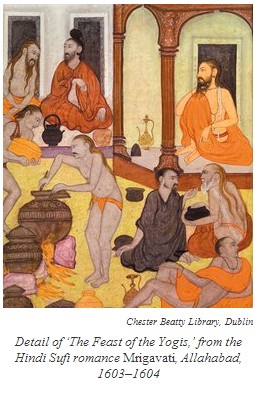
ScreenHunter_490 Feb. 15 14.43Around 1600, a dramatic shift took place in Mughal art. The Mughal emperors of India were the most powerful monarchs of their day—at the beginning of the seventeenth century, they ruled over a hundred million subjects, five times the number administered by their only rivals, the Ottomans. Much of the painting that took place in the ateliers of the first Mughal emperors was effectively dynastic propaganda, and gloried in the Mughals’ pomp and prestige. Illustrated copies were produced of the diaries of Babur, the conqueror who first brought the Muslim dynasty of the Mughal emperors to India in 1526, as well as exquisite paintings illustrating every significant episode in the biography of his grandson, Akbar.

Then, quite suddenly, at this moment of imperial climax, a young Hindu khanazad (or “palace-born”) prodigy named Govardhan began painting images of a sort that had never been seen before in Mughal art. They were not pictures of battles or court receptions. Instead they were closely observed portraits of holy men performing yogic asanas or exercises that aimed to focus the mind and achieve spiritual liberation and transcendence. The results of Govardhan’s experiments in painting—along with a superbly curated selection of several hundred other images from the history of yoga—were recently on view in “Yoga: The Art of Transformation,”a remarkable exhibition at the Freer and Sackler galleries in Washington, D.C., which will travel next to San Francisco and Cleveland.

More here.

Confounded: The Enigma of “Blind Tom” Wiggins

From BlackPast.org:

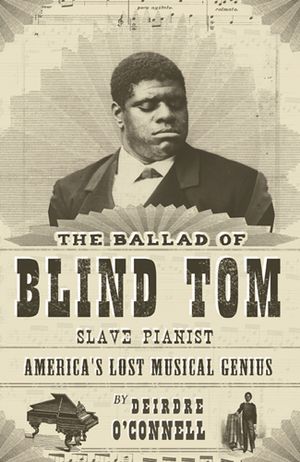
Blind_tom“I am astounded. I cannot account for it, no one can. No one understands it,” a St Louis man uttered after watching Blind Tom perform in concert in 1866. His mystification was by no means isolated. Few other performers on the nineteenth century stage aroused as much curiosity as “Blind Tom” Wiggins. Born a slave in Georgia in 1848, by the time he died Hoboken in 1908, he was an international celebrity and his name was a byword for inexplicable genius. From an early age, it was clear that Blind Tom possessed extraordinary musical gifts. He could imitate, either vocally or musically, any sound he heard. This, coupled with an encyclopedic memory and all-encompassing passion for music, meant that by the age of sixteen, he hovered somewhere between a respected concert pianist and glorified sideshow freak. For the following forty years, he toured the length and breadth of North America, soaking up the sounds of the Civil War and Gilded Age, then baffling audiences with his astonishing gifts. During the tumultuous election campaign of 1860, for instance, he was taken to a political rally in support of Democratic presidential candidate Senator Stephen Douglas of Illinois. Tom heard his speech and years after he would deliver this oration, capturing not only the senator's distinctive boom and mannerisms, but the crowd's heckles and cheers. Somehow he could recall the sensory snapshot of that moment with sparkling precision. One of his music teachers described how Tom, now a man in his thirties, learned Beethoven's 3rd Concerto to perfection in the space of an afternoon. He then stunned her by capping off the lesson by turning his back to the piano and playing the bass with his right hand and the treble with his left hand. Somehow Tom could separate the treble from the bass as if they were detached, self-contained streams that were independent of one another. Tom's gravity-defying acrobatics were also cause for much bewildered comment. He would routinely stand on one foot, his body bent forward and his back leg raised to form a “T.” Then he would leap. “It makes one giddy to see him make these circuits,” noted one man, “he comes six inches of the wall but never hits it.” Eccentric, ebullient, and hugely entertaining, nineteenth century audiences did not know what to make of Tom but one thing was certain: the American stage had never seen anyone like him.

Yet today this remarkable pianist is virtually forgotten. His story comes as a surprise to many who consider themselves well versed in African American history. “How is it I've never heard of him before?” is a question often put to me. The answer, I suspect, is that for all his genius, Blind Tom falls short on what an African American hero should be. After emancipation, he remained loyal to his master, electing to remain with him. Even at the height of his career, black newspaper editors kept him at arm's length, thinking him a buffoon who perpetuated negative stereotypes about the black race. Most damning of all, his most famous composition, The Battle of Manassas, tells the story of the great Confederate victory at Bull Run in April 1861. With a track record like this, little wonder some condemned Blind Tom to the ranks of Uncle Tom.

More here. (Note: One post throughout February will be dedicated to Black History Month.)

math and the universe

Our-Mathematical-Universe-by-Max-TegmarkEdward Frenkel at The New York Times:

Math is so effective in describing the world, he says, because physical reality is a mathematical structure. He calls it the Mathematical Universe Hypothesis (M.U.H.). What exactly this means is a big question, which is never fully answered. Mr. Tegmark’s argument is that all physical properties of an electron, say, can be described mathematically; therefore, to him, an electron is itself a mathematical structure — as is everything else, including us. “You’re a pattern in space-time,” Tegmark says, and he is not just speaking metaphorically. Well, it’s true that the trajectory of a human is a pattern in space-time, but does it mean that a human is this pattern? What accounts for consciousness, for example? “I think that consciousness is the way information feels when being processed in certain complex ways,” Tegmark says.

I tried to process this information, but didn’t feel much. Let’s go back to the notion of “mathematical structure.” We read in the book that it is a “set of abstract elements with relations between them,” like the set of whole numbers with operations of addition and multiplication. However, there is a lot more to math than such mathematical structures. Objects other than sets are necessary, and they have now become widespread. Moreover, there is an effort underway to overhaul the foundations of math in which set theory is no longer central. So mathematical structures constitute but a small island of modern mathematics. Why would someone who believes that math is at the core of reality try to reduce all of reality to just this island?

more here.

Without a Trace

Al Gore in The New York Times:

CoverOver the past decade, Elizabeth Kolbert has established herself as one of our very best science writers. She has developed a distinctive and eloquent voice of conscience on issues arising from the extraordinary assault on the ecosphere, and those who have enjoyed her previous works like “Field Notes From a Catastrophe” will not be disappointed by her powerful new book, “The Sixth Extinction: An Unnatural History.” Kolbert, a staff writer at The New Yorker, reports from the front lines of the violent collision between civilization and our planet’s ecosystem: the Andes, the Amazon rain forest, the Great Barrier Reef — and her backyard. In lucid prose, she examines the role of man-made climate change in causing what biologists call the sixth mass extinction — the current spasm of plant and animal loss that threatens to eliminate 20 to 50 percent of all living species on earth within this century.

Extinction is a relatively new idea in the scientific community. Well into the 18th century, people found it impossible to accept the idea that species had once lived on earth but had been subsequently lost. Scientists simply could not envision a planetary force powerful enough to wipe out forms of life that were common in prior ages. In the same way, and for many of the same reasons, many today find it inconceivable that we could possibly be responsible for destroying the integrity of our planet’s ecology. There are psychological barriers to even imagining that what we love so much could be lost — could be destroyed forever. As a result, many of us refuse to contemplate it. Like an audience entertained by a magician, we allow ourselves to be deceived by those with a stake in persuading us to ignore reality. For example, we continue to use the world’s atmosphere as an open sewer for the daily dumping of more than 90 million tons of gaseous waste.

More here.

the story of israel

Ea95b13a-88f0-4414-a4ee-cdac5e719ddcSimon Schama at The Financial Times:

To those of us Jews whose identity and personal history are locked together with the fate of Israel, much of what Shavit unsparingly records makes bitterly painful reading, which is precisely why his book is not just enthralling, but morally dignified. The insomnia mission – keeping us up at night worrying open the scars that are more easily left untroubled – has been the historian’s obligation ever since Thucydides did a number on Athenian hubris. Our professional honour is preserved by such cold comforts, rather than the toasty pleasures of national self-congratulation. And it is just because Shavit’s pages are so full of unresolved conflicts, personal anguish and humane compassion for both suffering peoples, along with a brilliant gift for capturing the high voltage creative exuberance of an Israel living on the edge, that his book is, by some light years, the best thing to have been written on the subject.

Beginning with its title, which is at the same time spring-loaded with irony yet also innocent of it, Shavit has the rare gift of dual empathy. As you would expect, he conveys the anguish of Jews in the late 1930s and during the war, when they realised they had been abandoned by the rest of the world. That anguish reached its most acute moment in 1942, when at the same time, the killing centres opened for business in Poland and Rommel’s Afrika Korps stood poised to break through to Egypt and Palestine. But at no point does he ever look away from the magnitude of the Palestinian catastrophe. In fact, he seems all the more of an Israeli for being able to think and feel like a Palestinian.

more here.

translating the decameron

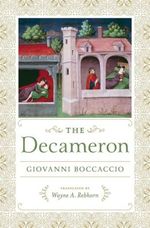
DecameronSteve Donoghue at The Quarterly Conversation:

“Translation,” our translator tells us, “makes strangers feel familiar, but a good one should also allow us to sense something of the alien in our midst.” The care with which Rebhorn pursues this “clearly contradictory, indeed paradoxical” balance is downright charming, and it pays off: this is a Decameron at once elegant and effusive, as varied in its tones and moods as the original. It’s as bawdy and explicit as, say, Richard Aldington’s scandalous and much-maligned 1930 version; it’s as soundly researched as Nichols or McWilliam, and if it lacks the doyennish aura of command Frances Winwar was able to bring to her own 1930 translation (the only full version by a woman to date, it seems), it also lacks that version’s thee’s and thou’s, so lethal to 21st-century ears. Rebhorn’s Decameron will be the definitive one for a lifetime mainly because it manages the paradox he identifies: it sets this stranger down in our midst and proceeds to find our common dialects.

Evidence of his care and playfulness is everywhere, especially in the tell-tale details. This is amply true in such famous stories as that of the patient Griselda or the naive young woman Alibech and the randy monk Rustico (a tale so gloriously, sacrilegiously raunchy it cannot be bowdlerized and was simply omitted from many a pre-modern translation), but it also shows to keen effect in much smaller moments. Take as one example the tenth story of the third day: the Venetian cook Chichibio, in the employ of Florentine magnate Currado Gianfigliazzi, is cooking a crane in the kitchen for his master and his master’s guests when a girl he loves asks him for a thigh of the bird.

more here.

Saturday Poem

Louis Riel's Address to the Jury

Gentlemen of the Jury:
I cannot speak
English well, but am trying
because most here
speak English

When I came to the North West
I found the Indians suffering
I found the half-breeds
eating the rotten pork
of the Hudson Bay Company
and the whites
deprived

And so:
We have made petitions I
have made petitions
We have taken time; we have tried
And I have done my duty.

My words are
worth something.
.

by Kim Morrissey
from Batoche
Coteau Books, 1989

Louis Riel

After 400 years, mathematicians find a new class of solid shapes

Akshat Rathi in The Conversation:

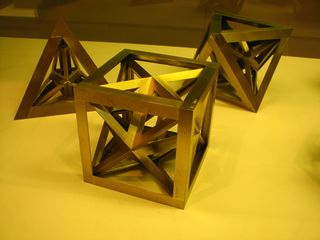
B5f4gxh7-1392312201The work of the Greek polymath Plato has kept millions of people busy for millennia. A few among them have been mathematicians who have obsessed about Platonic solids, a class of geometric forms that are highly regular and are commonly found in nature.

Since Plato’s work, two other classes of equilateral convex polyhedra, as the collective of these shapes are called, have been found: Archimedean solids (including truncated icosahedron) and Kepler’s solids (including rhombic polyhedra). Nearly 400 years after the last class was described, researchers claim that they may have now invented a new, fourth class, which they call Goldberg polyhedra. Also, they believe that their rules show that an infinite number of such classes could exist.

Equilateral convex polyhedra need to have certain characteristics. First, each of the sides of the polyhedra needs to be of the same length. Second, the shape must be completely solid: that is, it must have a well-defined inside and outside that is separated by the shape itself. Third, any point on a line that connects two points in a shape must never fall outside the shape.

Platonic solids, the first class of such shapes, are well known. They consist of five different shapes: tetrahedron, cube, octahedron, dodecahedron and icosahedron. They have four, six, eight, twelve and twenty faces, respectively.

More here.

Friday, February 14, 2014

do animals have fun?

Baffler_24_Graeber_ImageDavid Graeber at The Baffler:

It’s not just that scientists are reluctant to set out on a path that might lead them to see play—and therefore the seeds of self-consciousness, freedom, and moral life—among animals. Many are finding it increasingly difficult to come up with justifications for ascribing any of these things even to human beings. Once you reduce all living beings to the equivalent of market actors, rational calculating machines trying to propagate their genetic code, you accept that not only the cells that make up our bodies, but whatever beings are our immediate ancestors, lacked anything even remotely like self-consciousness, freedom, or moral life—which makes it hard to understand how or why consciousness (a mind, a soul) could ever have evolved in the first place.

American philosopher Daniel Dennett frames the problem quite lucidly. Take lobsters, he argues—they’re just robots. Lobsters can get by with no sense of self at all. You can’t ask what it’s like to be a lobster. It’s not like anything. They have nothing that even resembles consciousness; they’re machines. But if this is so, Dennett argues, then the same must be assumed all the way up the evolutionary scale of complexity, from the living cells that make up our bodies to such elaborate creatures as monkeys and elephants, who, for all their apparently human-like qualities, cannot be proved to think about what they do.

more here.

ava gardner and barbara stanwyck

Basinger_1-030614_jpg_600x695_q85Jeanine Basinger at The New York Review of Books:

Stanwyck became one of the greatest interpreters of female vulnerability the movies ever had. In Clash by Night (1952), she plays a former good-time girl trying to do right by her stolid husband, but she’s tempted by a sexy and knowing Robert Ryan. Alone in her kitchen, feeling the heat, she tries to pour herself a cup of coffee. Her hand starts to shake, the cup starts to rattle, and she just can’t do it. Finally, she gives up and breaks down weeping, the hardbitten woman showing the audience who she is, and doing it with nothing but a coffee pot.

Both actors could be dangerous on film. Gardner destroys men through sex and by being beautiful enough to drive them mad, but Stanwyck lifted male destruction to an art form. In Double Indemnity (1944), with nothing but an ankle bracelet and a blond wig, she lures Fred MacMurray to murder her husband. She’s both comic and cruel in The Lady Eve (1941) as she reveals past amours on her wedding night to the hapless Henry Fonda, and horrifically cruel in The File on Thelma Jordon (1950) when she jabs a cigarette lighter in Richard Rober’s eyeball. Late in life, when most stars had long since retired, she played a steely matriarch in The Thorn Birds (1983) on TV, and was unafraid to enact an older woman’s sexual desire.

more here.