
Category: Recommended Reading
Bigotry in the USA: Photos From a Ku Klux Klan Initiation
Ben Cosgrove in Life:
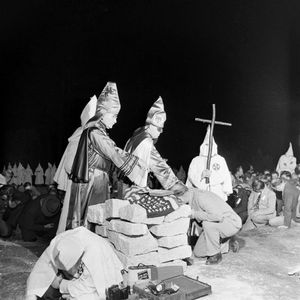
On the evening of May 9 at 8 p.m. a mob of fully grown men solemnly paraded up to a wide plateau of Stone Mountain outside Atlanta, Ga., and got down on their knees on the ground before 100 white-sheeted and hooded Atlantans. In the eerie light of a half-moon and a fiery cross they stumbled in lockstep up to a great stone altar and knelt there in the dirt while the “Grand Dragon” went through the mumbo jumbo of initiating them into the Ku Klux Klan. Then one new member was selected from the mob and ceremoniously “knighted” into the organization in behalf of all the rest of his fellow bigots. This was the first big public initiation into the Klan since the end of World War II. It was put on at a carefully calculated time. The anti-Negro, anti-Catholic, anti-Semitic, anti-foreign, anti-union, anti-democratic Ku Klux Klan was coming out of wartime hiding just at the time when the CIO and the A.F. of L. were starting simultaneous campaigns to organize the South. . . . But it is doubtful that the Klan can become as frighteningly strong as it was in 1919. One indication of the Klan’s impotence was its lack of effect on Negroes, who were once frightened and cowed by the white-robed members. More than 24,000 Negroes have already registered for next July’s primaries in the Atlanta vicinity alone, where the Stone Mountain ritual was held.
As mentioned in one of the captions in the gallery above, the Stone Mountain ceremony was put off several times during the preceding year because of wartime sheet shortages. Or at least that’s what LIFE reported at the time. The magazine also made a point of characterizing the garb and actions of members at Klan meetings (slides #10 through 15) as both creepy and pathetic. “Childish ritual and secretiveness,” the magazine noted, “have always been the great attractions for the kind of people who make good Klansmen.”
The more things change. . . .
More here. (Note: One post throughout February will be dedicated to Black History Month.)
The Brain’s Inner Language
James Gorman in The New York Times:
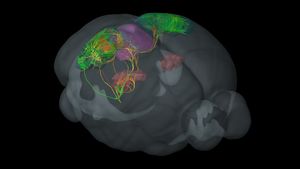
“The other highly related problem is: How does that neural computation create behavior?” he said. How does the mouse brain decide on action based on that input? He imagined the kind of experiment that would get at these deep questions. A mouse might be trained to participate in an experiment now done with primates in which an animal looks at an image. Later, seeing several different images in sequence, the animal presses a lever when the original one appears. Seeing the image, remembering it, recognizing it and pressing the lever might take as long as two seconds and involve activity in several parts of the brain. Understanding those two seconds, Dr. Reid said, would mean knowing “literally what photons hit the retina, what information does the retina send to the thalamus and the cortex, what computations do the neurons in the cortex do and how do they do it, how does that level of processing get sent up to a memory center and hold the trace of that picture over one or two seconds.” Then, when the same picture is seen a second time, “the hard part happens,” he said. “How does the decision get made to say, ‘That’s the one’?” In pursuit of this level of understanding, Dr. Reid and others are gathering chemical, electrical, genetic and other information about what the structure of that part of the mouse brain is and what activity is going on.
More here.
A Star in a Bottle

Raffi Khatchadourian in The New Yorker:
Years from now—maybe in a decade, maybe sooner—if all goes according to plan, the most complex machine ever built will be switched on in an Alpine forest in the South of France. The machine, called the International Thermonuclear Experimental Reactor, or iter, will stand a hundred feet tall, and it will weigh twenty-three thousand tons—more than twice the weight of the Eiffel Tower. At its core, densely packed high-precision equipment will encase a cavernous vacuum chamber, in which a super-hot cloud of heavy hydrogen will rotate faster than the speed of sound, twisting like a strand of DNA as it circulates. The cloud will be scorched by electric current (a surge so forceful that it will make lightning seem like a tiny arc of static electricity), and bombarded by concentrated waves of radiation. Beams of uncharged particles—the energy in them so great it could vaporize a car in seconds—will pour into the chamber, adding tremendous heat. In this way, the circulating hydrogen will become ionized, and achieve temperatures exceeding two hundred million degrees Celsius—more than ten times as hot as the sun at its blazing core.
No natural phenomenon on Earth will be hotter. Like the sun, the cloud will go nuclear. The zooming hydrogen atoms, in a state of extreme kinetic excitement, will slam into one another, fusing to form a new element—helium—and with each atomic coupling explosive energy will be released: intense heat, gamma rays, X rays, a torrential flux of fast-moving neutrons propelled in every direction. There isn’t a physical substance that could contain such a thing. Metals, plastics, ceramics, concrete, even pure diamond—all would be obliterated on contact, and so the machine will hold the superheated cloud in a “magnetic bottle,” using the largest system of superconducting magnets in the world. Just feet from the reactor’s core, the magnets will be cooled to two hundred and sixty-nine degrees below zero, nearly the temperature of deep space. Caught in the grip of their titanic forces, the artificial earthbound sun will be suspended, under tremendous pressure, in the pristine nothingness of iter’s vacuum interior.
For the machine’s creators, this process—sparking and controlling a self-sustaining synthetic star—will be the culmination of decades of preparation, billions of dollars’ worth of investment, and immeasurable ingenuity, misdirection, recalibration, infighting, heartache, and ridicule. Few engineering feats can compare, in scale, in technical complexity, in ambition or hubris. Even the iterorganization, a makeshift scientific United Nations, assembled eight years ago to construct the machine, is unprecedented. Thirty-five countries, representing more than half the world’s population, are invested in the project, which is so complex to finance that it requires its own currency: the iter Unit of Account.
More here.
Is Venezuela Burning?
Mike Gonzalez in Jacobin:
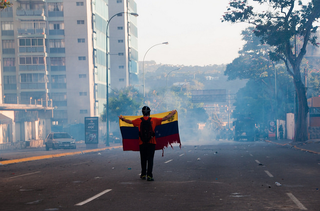
Between 2002 and 2014, the Right failed to dislodge Chavez; on the contrary, Chavez’s electoral support rose consistently until his death early last year. After that, his nominated successor, Maduro, won the presidential elections in April 2013. But this time the right-wing candidate, Henrique Capriles Radonski, came within 250,000 votes (under one percent) of winning.
It was a clear expression of the growing frustration and anger among Chavez supporters. 2012 had seen inflation rates hovering around fifty percent (officially) and the level has risen inexorably throughout the last year. Today the basic basket of goods costs 30% more than the minimum wage — and that is if the goods are to be found on the increasingly empty shelves of shops and supermarkets. The shortages are explained partly by speculation on the part of capitalists — just as happened in Chile in 1972 — and partly by the rising cost of imports, which make up a growing proportion of what is consumed in Venezuela. And that means not luxuries, but food, basic technology, and even gasoline.
All of this is an expression of an economic crisis vigorously denied by the Maduro government but obvious to everyone else. Inflation is caused by the declining value of the bolivar, Venezuela’s currency, itself the result of economic paralysis. The truth is that production of anything other than oil has ground to a virtual halt. The car industry employs 80,000 workers, yet since the beginning of 2014 it has produced 200 vehicles — what would normally be produced in half a day.
How is it possible that a country with the world’s largest proven reserves of oil (and possibly of gas, too) should now be deeply in debt to China and unable to finance the industrial development that Chavez promised in his first economic plan?
The answer is political rather than economic: corruption on an almost unimaginable scale, combined with inefficiency and a total absence of any kind of economic strategy. In recent weeks, there have been very public denunciations of speculators, hoarders, and the smugglers taking oil and almost everything else across the Colombian border. And there have been horrified reports of the “discovery” of thousands of containers of rotting food. But all of this has been common knowledge for years. Equally well known is the involvement of sectors of the state and government in all these activities.
More here.
What’s Wrong with Inequality?
Over at Philosophy Bites:
Why do so many people object to inequality? Is there something intrinsically wrong with it? Is it wrong because it has bad consequences? Or is there nothing wrong with it? Harvard philosopher Tim Scanlon discusses these questions with Nigel Warburton in this episode of the Philosophy Bites podcast.
Tuesday, February 25, 2014
DAG-3QD Peace and Justice Symposium: What is the future for Colombia’s Rebels?
Dear Reader,
We are very pleased to collaborate with the Amsterdam-based Dialogue Advisory Group (DAG) to bring to you online symposia on topics of international peace and justice. This is the sixth in this series of symposia; the first five can be seen here.
DAG is an organization which discreetly assists government, inter-government and other actors to confidentially manage national and international mediation efforts. Among their publicly known activities is DAG’s involvement in verifying the ETA ceasefire in Basque Country and the decommissioning of the weapons of INLA, a dissident Republican armed group in Northern Ireland.
DAG is directed by Ram Manikkalingam who also teaches politics at the University of Amsterdam. He advised the previous President of Sri Lanka during the peace process with the Tamil Tigers and prior to that advised the Rockefeller Foundation’s program in international peace and security.
In the DAG-3QD Peace and Justice Symposia internationally recognized figures will debate challenges in conflict resolution and human rights. One (or more) author(s) will present a thesis in the form of a short essay and then the others will present critiques of that point of view. Finally, the initial author(s) will also have an opportunity to present a rebuttal to the critiques.
The topic this time is the future of the FARC rebels in Colombia.
The distinguished participants in this symposium:
- Ivan Briscoe is a Senior Research Fellow at the Conflict Research Unit of Clingendael, where he specializes in the political economy of post-conflict countries and analysis of organized crime, with a regional focus on Latin America. His has written widely on drug trafficking, shadow state structures and the dynamics of inequality, and has carried out extensive field research on these subjects in Central America, the Andes and the southern cone. Prior to joining Clingendael in 2009, he was Senior Researcher at the Foundation for International Relations and Foreign Dialogue (FRIDE) in Madrid, and before then worked a decade as a journalist and newspaper editor in Latin America, France and Spain, including stints in El País, Agence France Presse, and the UNESCO Courier. He continues to write a weekly column for the Buenos Aires Herald, and regularly contributes to openDemocracy. He can be followed on Twitter here: @itbriscoe
- Timo Peeters is a research fellow at the Conflict Research Unit, Clingendael. A criminologist trained in Utrecht University, he is a specialist in the phenomenon of vigilante groups.
- Annette Idler has worked as an academic and practitioner on conflict prevention, peace building, development and transnational organised crime. She is in the final stage of her doctoral research at the University of Oxford's Department of International Development in which she analyses violent non-state actor interactions in Colombia’s borderlands and their impact on citizen security. As a Drugs, Security and Democracy Fellow, sponsored by the Social Science Research Council and Open Society Foundations, she conducted over one year of extensive fieldwork in Colombia’s crisis-affected borderlands and was visiting researcher at universities in Colombia, Ecuador and Venezuela. Annette has obtained an MA in International Relations from King’s College London’s Department of War Studies and a BA double degree in German-Spanish Studies/International Politics from the University Complutense of Madrid, Spain, and the University of Regensburg, Germany. She is co-founder of a peace, security and development consulting service and previously worked for UNDP’s Bureau for Crisis Prevention and Recovery, the UN Economic Commission for Latin America and the Caribbean and the German Development Organisation InWEnt. She has published several journal articles and a book chapter on violent non-state actors, citizen security, borderlands and Colombia.
- Barbara Unger is Programme Director for Latin America at the Berghof Foundation. She was a freelance advisor and trainer for peace and conflict, a coordinator of Zivik project 2002-2004, and also previously worked with the German Development Corporation. She is a long-term activist and member of Peace Brigades International, a member of the German Platform for Conflict Management, and Board member of the Forum Ziviler Friedensdienst.
- Katrin Planta is Researcher and Project Officer on Dialogue, Mediation and Peace Support Structures at the Berghof Foundation. She previously worked as a project officer on the ‘Resistance and Liberation Movements in Transition’ programme and spent six months in Colombia conducting interviews for a research project on armed groups’ cohesion based at Oxford University.
I would like to thank the participants as well as Ram Manikkalingam, Fleur Ravensbergen, Daniël Grütters, and Pamela Kalkman of the Dialogue Advisory Group for working closely with me in organizing these symposia. The logo for the symposium has been designed by Amanda Beugeling.
We look forward to your comments and feedback.
Yours,
S. Abbas Raza
NOTE: DAG and 3QD wish to acknowledge the generous contribution of the Dutch Stichting Democratie en Media toward these symposia, as well as the support of our readers.
THE SYMPOSIUM
[Click the links below to read the essays.]
- Back to Basics for Colombia's Rebels by Ivan Briscoe and Timo Peeters
- The Margins at the Centre of the FARC’s Future by Annette Idler
- Peace Beyond a Peace Deal by Katrin Planta and Barbara Unger
- The Shady Side of a Modern State by Ivan Briscoe and Timo Peeters
***********************
***********
******
*
Please leave comments about any of the essays in the symposium in the comments area of this post. Thank you.
Back to basics for Colombia’s rebels
by Ivan Briscoe and Timo Peeters
For the first time ever, Colombia last year produced over a million barrels of oil a day. To reach this grail of the global carbon club, with only Venezuela, Mexico and Brazil now producing more oil in Latin America, the country managed to double its production in the space of six years. It tapped the brain drain from Venezuela's post-2003 oil industry. It dispatched state and private explorers deep into the bush and the sierra. And as the industry grew and boomed, the armed rebellion against the state, now well into its middle age, decided it would also join the bonanza.
A recent analysis of the new tactics of the Revolutionary Armed Forces of Colombia (FARC) illustrates that despite the relatively advanced stage of peace negotiations with the government, and the hope that a 50-year conflict may soon come to a negotiated end, there are rich pickings to be had throughout investment-friendly Colombia via the cunning use of arms.[1] It now appears that 2012 was the year in which more attacks on oil pipelines were carried out than ever before; production and theft have marched in lock step. “Miners' commissions”, explains the report's author Ariel Ávila, has been the novel term given to the spawning guerrilla units specialized in pipeline heists.
President Juan Manuel Santos and his team of negotiators in Havana would not necessarily be dismayed by these oil grabs. The entire approach of their peace diplomacy has been grounded in close reading of previous failed negotiations, an appreciation of the organizational dynamics and esprit de corps within the FARC, and a studiedly careful handling of Colombian political and public opinion – including the twitter rage of former President Álvaro Uribe, Colombia's main curmudgeon. Skirmishes, raids and drug production have continued ever since the sides first met in Oslo in October 2012: close to 500 security force officers were killed by the FARC last year. Yet it is Santos' hope, recently relayed in an interview with El País,[2] that the circuitous route to a final deal will eventually bring all sides and factions on board. “The painter wants to sell his work when it is complete,” he explains.
Progress has been made. Preliminary deals have already been reached on rural development and on the FARC's political participation. Although not formerly affiliated to the FARC, the Marcha Patriótica party can be expected to lead the radical cause in this year's elections – and pull a right-leaning political establishment leftwards. Crucially, a third phase of peace talks is now mulling over narco-trafficking, in which the FARC has been involved, largely at the level of protecting coca leaf production, since the 1980s. The rebel group's initial proposal envisages a daring, possibly quixotic combination: community control over crop substitution, alongside major state intervention to buy up surplus crops, maintain farmers' income and find alternative economic uses for marijuana, coca and opium poppy.[3]
The Margins at the Centre of the FARC’s Future
by Annette Idler
Many analysts are optimistic that peace will be signed in Colombia still this year. Nevertheless, uncertainty prevails regarding the FARC's future. Ivan Briscoe's and Timo Peeters' reflection on various post-conflict scenarios is therefore a welcome contribution. Pointing the FARC's role as spoilers to Colombia's mining sector in the midst of the peace process, the authors present two post-conflict scenarios: a demobilised FARC as political party and the fragmentation of the rebels into greedy drug traffickers. Briscoe and Peeters are critical about these scenarios, suggesting that the FARC might become social bandits instead.
They are right in cautioning about dichotomised scenarios. Yet, while the concept of social banditry contributes towards a more nuanced understanding of the rebels' embedment in Colombia's socio-economic context, it is silent on two points critical for the FARC's future: first, the shadow citizenship that they have established, and second, the regional dimension.
First, in many Colombian borderlands characterised by weak state governance, the FARC do not flaunt authority like social bandits, they are the authority. Arguably, they have won the communities' respect by filling the state's governance void. In 2012, during one of my fieldwork trips to Putumayo, a farmer described to me his life in the 1990s when the FARC was the sole authority: “At least we had our land, our farm and they helped us feed our families”. Indeed, the FARC have helped building health centres, roads, and have provided “justice”, although in highly questionable ways. I thus agree with Briscoe and Peeters that some ex-FARC members are likely to persist as local caudillos. Nonetheless, their authority in certain areas suggests that their leadership will go beyond social banditry to facilitating “shadow citizenship”, the provision of goods and services based on undemocratic means in return for social recognition.
The FARC's continued illicit authority has consequences for the mining sector that go beyond oil pipeline robberies cited by the authors. They not only spoil the extractive industry, they also control it through levying taxes. Certainly, attacks against the extractive industry constitute an effective means of demonstrating strength during the peace talks. Yet once the deal is brokered, the FARC remnants won't need to flex muscles anymore and can concentrate on reaping economic benefits instead. Therefore, the less visible, yet more pervasive challenge for the Colombian government than curbing oil thefts is to ensure that the revenues of the extractive industry will enter the legal rather than illegal post-conflict economy. This is crucial if Colombia's mining locomotive is to pull the country further towards economic growth.
Peace beyond a peace deal
by Katrin Planta and Barbara Unger
Against the background of advancing peace negotiations between the Colombian government and the Revolutionary Armed Forces of Colombia (FARC), Ivan Briscoe and Timo Peeters discuss various scenarios for the post-agreement development of this five decade old guerrilla organization and its estimated 10.000 combatants. Outlining two extreme and seemingly antithetic patterns of evolution: integration into democratic (party) politics or irrevocable merger with common crime, they conclude that FARC is most likely to take a third path bringing them back to their origins as “social bandits”.
As social processes cannot be programmed, such scenario development is always tainted with speculation. However, it is still a highly valuable and necessary exercise: the faster talks advance, the more Colombian actors need to consider and prepare for post-agreement challenges. With this in mind, would like to comment on three important aspects. Firstly, we believe that nuances do matter. Any consideration of FARC's post-agreement development must distinguish between the trajectory of ex-combatants' individual futures and that of FARC as a collective entity. Secondly, FARC's evolution will not occur in a bell jar: It will not only depend on the groups' own characteristics and nature, but to a great extent on contextual factors. Finally, in a country suffering from rampant social inequality and marginalization, massive social violence, blatant human rights abuses, and general insecurity well beyond the long-standing armed conflict, it would be erroneous to assume that an eventual agreement with FARC and a subsequent demobilization of its militants represents the main key to “genuine peace and security”.
With regards to our first point, Colombia has a rich experience of demobilization and reintegration of guerrilla and paramilitary groups resulting both from peace negotiations and desertion. Variation in individual post-militancy trajectories ranges from a “simple” return to home communities vs. large-scale migration to urban centers, and from the generation of stable income in the legal economy or establishment in the political arena, to (re)recruitment into armed groups and criminal activities. Hence it is not contradictory to presume that out of a single armed organization there might emerge both dedicated politicians and criminals. And while some FARC commanders might manage to maintain their leadership within a particular region, be it as local leader within the institutional framework or as de facto leader , it seems far-fetched to assume that there is a way back “to the roots” for FARC, as if Colombia and its armed conflicts, had not changed in the last five decades.
The shady side of a modern state
by Ivan Briscoe and Timo Peeters
In our article, we took a schematic approach in discussing three scenarios for the post-conflict development of the FARC. It goes without saying that by taking such an approach nuance is exchanged for a degree of provocation since future reality is far too complex and dynamic to be captured so easily. We would like to thank the other authors for their valuable comments, and admit that maybe we made the forking path rather too simplistic.
Annette Idler puts forward the intriguing concept of “shadow citizenship”. However, this notion of FARC filling the state's governance void by delivering goods and services in return for social recognition needs clarification. How would this look in a demobilizing context such as Colombia? Are we talking about the kind of shadow citizenship currently facilitated by remnant factions of Sendero Luminoso in Peru's VRAE area, protecting rural population against unpopular coca eradication programmes that threaten local livelihoods? Or a more “top-down” and predatory provision of public goods in the form of a regional “defence” force with strong ties to politicians who grant the fighters political favors in exchange for votes, such as AUC in its heyday and the Sicilian Cosa Nostra during the Cold War? Or are we talking about a more “bottom-up” form of shadow citizenship as is currently seen in Mexico's bellicose state of Michoacán, where popular resistance against the Knight Templar Cartel is rooted in a long and robust tradition of localism and popular revolt? We should bear in mind that Colombian departments such as La Guajira and Magdalena have similar histories of popular resistance. In each case, the sort of citizenship on view generates quite different forms of popular representation, risks of violence, and linkages with the central state.
Katrin Planta and Barbara Unger rightly stress that a genuine post-conflict transformation must incorporate all Colombians, with an emphasis on the war-affected and historically neglected rural areas. The sentiments are noble; but what can realistically be expected from Bogotá? As mentioned in our article, inequality in Colombia has risen by 9.4 per cent between 1990 and 2010 (while inequality in Latin America as a whole declined in the same period by 5 per cent). Social exclusion is deep-seated in Colombia. Recently signed Free Trade Agreements with Canada, the United States, and the European Union have only fuelled mass protests by farmers (30 out of 32 largest cities saw big rallies during last's year's three-week strike), as rural workers are unable to come to terms with the demands of transnational agro-industry.
Monday, February 24, 2014
perceptions
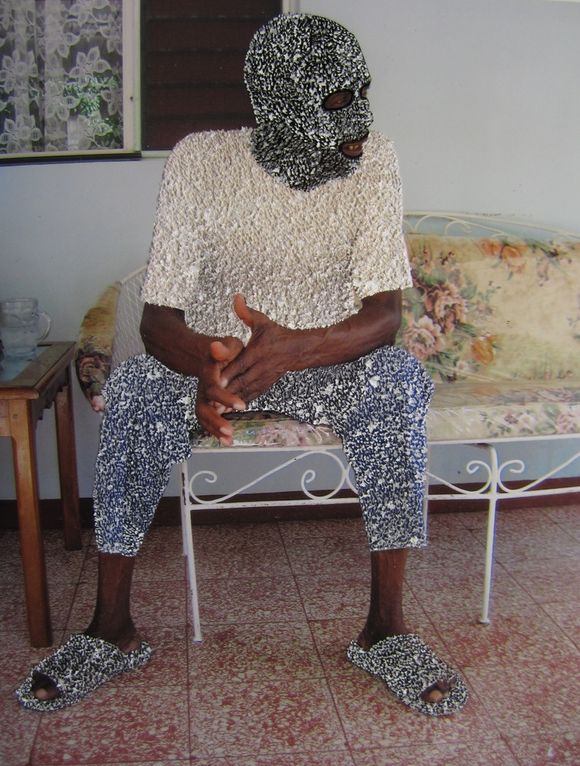
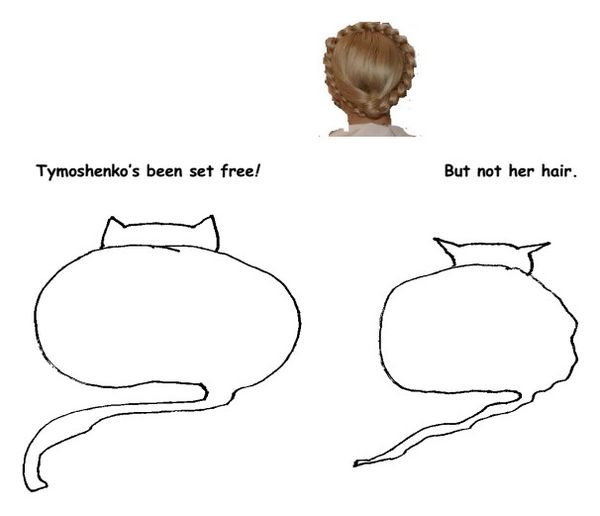
Catspeak
by Brooks Riley
Sunday, February 23, 2014
The Blood of Entertainers
From Blackpast.org:
In the following article, Janie L. Hendrix, President and CEO of Experience Hendrix and the younger sister of music legend Jimi Hendrix, reflects on the lives of their grandparents, Bertram Philander Ross Hendrix and Zenora Moore. Her article reminds us of the rich entertainment heritage dating back to the beginning of the 20th Century that Jimi Hendrix drew upon when he eventually became one of the most famous and successful Rock musicians of all time.
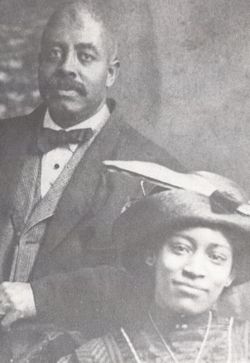
This post-Civil War era was one of great struggles for African Americans. Prior to her union with Bertram, Fanny Hendricks, having recently ended her marriage to Jefferson Hendricks, was a single parent seeking work. The elder Bertram had previously been married as well. The exact details of Bertram’s and Fanny’s relations remain unknown; however there is speculation that Fanny may have worked in the grain mill owned by Bertram. Fanny gave the newborn the first name of his father, possibly to ensure that the community would know the lineage of her child. Those of mixed race or African American heritage faced obstacles in Urbana.
More here. (Note: One post throughout February will be dedicated to Black History Month.)
On Malayalam and Melancholia
Yasmin Nair over at her website [h/t: Doug Henwood]:
When asked by anyone, Where are you from, in India? my response is always, “My parents are from Kerala, but I’m from Calcutta.” It’s not a response that would have been welcomed when I was actually growing up in India, when where you were from was determined by your parents’ birthplace. In the Northeast of India, Malayalis or Keralites (there is some sort of distinction, but I’ll leave it to better minds to parse that out) were lumped together with all the rest of the “southies,” including people from southern states like Karnataka, Andhra Pradesh, and Tamil Nadu.
I was born in Calcutta (now Kolkata), and then wandered through Kathmandu, Bombay (now Mumbai), and back to Cal. I’ve spent very little actual time in Kerala, although both my parents’ families as well as my extended family are inextricably woven into its history and politics. I know of some of that lineage, but a very particular family history has meant it being occluded or veiled in ways that I may or may not grapple with.
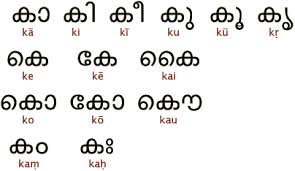
My relationship to Malayalam falls within that particular and peculiar history. In a country like India, where millions are perforce inter-lingual, negotiating several different languages, sometimes simultaneously, the presence of languages is carefully calibrated. There is one’s “mother tongue,” which is what Malayalam is to me, and there is one’s “first” language, which is what English has always been to me. Then, if you went to the kind of educational institution I attended, there’s a “second language,” Hindi, in my case (English is the official language of India) and, upto a certain point in your education, a “third” language, the language of the state you reside in; you’re required to learn all of these.
For some, a “mother” and “first” language are the same, but for me, Malayalam has always been hard. I have distant but painful memories of being taught the script, which is beautiful, at a very young age, long before I began kindergarten, and failing miserably. Or, perhaps, simply performing the way any pre-schooler might, but still being made to feel the stinging thwack of a wooden ruler on my bare thighs. I hated it and to this day have no desire to learn it.
I spoke it haltingly, even at home, where we spoke in various combinations of Malayalam, English, Nepali, Hindi, Marathi, and Bengali, depending on where we were. I couldn’t or, rather, wouldn’t write or read it, my truculence hardened by those early memories as well as a desire to escape.
I can’t understand everything these people are saying to each other, but enough to gather that it’s a fairly typical conversation amongst two people who know each other well. I listen to the sound of Malayalam and it occurs to me, as it always has, that Malayalam is a profoundly melancholy language.
More here.
Recline! Why “leaning in” is killing us.

Rosa Brooks in Foreign Policy:
Ladies, if we want to rule the world — or even just gain an equitable share of leadership positions — we need to stop leaning in. It's killing us.
We need to fight for our right to lean back and put our feet up.
Here's the thing: We've managed to create a world in which ubiquity is valued above all. If you're not at your desk every night until nine, your commitment to the job is questioned. If you're not checking email 24/7, you're not a reliable colleague.
But in a world in which leaning in at work has come to mean doing more work, more often, for longer hours, women will disproportionately drop out or be eased out.
Why? Because unlike most men, women — particularly women with children — are still expected to work that “second shift” at home. Men today do more housework and childcare than men in their fathers' generation, but women today still do far more housework and childcare than men.
And just as work has expanded to require employees' round-the-clock attention, being a good mom has also started requiring ubiquity. Things were different in my own childhood, but today, parenting has become a full-time job: it requires attendance at an unending stream of birthday parties, school meetings, class performances, and soccer games, along with the procurement of tutors, classes, and enrichment activities, the arranging of play dates, the making of organic lunches, and the supervising of elaborate, labor-intensive homework projects than cannot be completed without extensive adult supervision.
Oh yes: By incredible coincidence, parenting was discovered to require the near-constant attention of at least one able-bodied adult at just about the same time women began to pour into the workforce in large numbers. Sorry 'bout that, girls!
It's hard enough managing one 24/7 job. No one can survive two of them. And as long as women are the ones doing more of the housework and childcare, women will be disproportionately hurt when both workplace expectations and parenting expectations require ubiquity.
More here.
Fascism, Russia, and Ukraine: Two Views
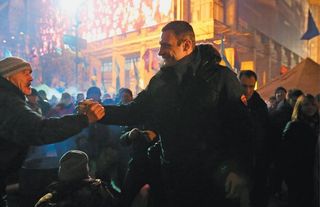
First, Timothy Snyder in The NYRB:
The protests in the Maidan, we are told again and again by Russian propaganda and by the Kremlin’s friends in Ukraine, mean the return of National Socialism to Europe. The Russian foreign minister, in Munich, lectured the Germans about their support of people who salute Hitler. The Russian media continually make the claim that the Ukrainians who protest are Nazis. Naturally, it is important to be attentive to the far right in Ukrainian politics and history. It is still a serious presence today, although less important than the far right in France, Austria, or the Netherlands. Yet it is the Ukrainian regime rather than its opponents that resorts to anti-Semitism, instructing its riot police that the opposition is led by Jews. In other words, the Ukrainian government is telling itself that its opponents are Jews and us that its opponents are Nazis.
The strange thing about the claim from Moscow is the political ideology of those who make it. The Eurasian Union is the enemy of the European Union, not just in strategy but in ideology. The European Union is based on a historical lesson: that the wars of the twentieth century were based on false and dangerous ideas, National Socialism and Stalinism, which must be rejected and indeed overcome in a system guaranteeing free markets, free movement of people, and the welfare state. Eurasianism, by contrast, is presented by its advocates as the opposite of liberal democracy.
The Eurasian ideology draws an entirely different lesson from the twentieth century. Founded around 2001 by the Russian political scientist Aleksandr Dugin, it proposes the realization of National Bolshevism.
More here. Next, Stephen F. Cohen in The Nation:
Omissions of facts, by journalists or scholars, are no less an untruth than misstatements of fact. Snyder’s article was full of both, which are widespread in the popular media, but these are in the esteemed NYRB and by an acclaimed academic. Consider a few of Snyder’s assertions:
§ ”On paper, Ukraine is now a dictatorship.” In fact, the “paper” legislation he’s referring to hardly constituted dictatorship, and in any event was soon repealed. Ukraine is in a state nearly the opposite of dictatorship—political chaos uncontrolled by President Viktor Yanukovych, the Parliament, the police or any other government institution.
§ ”The [parliamentary] deputies…have all but voted themselves out of existence.” Again, Snyder is alluding to the nullified “paper.” Moreover, serious discussions have been under way in Kiev about reverting to provisions in the 2004 Constitution that would return substantial presidential powers to the legislature, hardly “the end of parliamentary checks on presidential power,” as Snyder claims. (Does he dislike the prospect of a compromise outcome?)
§ ”Through remarkably large and peaceful public protests…Ukrainians have set a positive example for Europeans.” This astonishing statement may have been true in November, but it now raises questions about the “example” Snyder is advocating. The occupation of government buildings in Kiev and in Western Ukraine, the hurling of firebombs at police and other violent assaults on law enforcement officers and the proliferation of anti-Semitic slogans by a significant number of anti-Yanukovych protesters, all documented and even televised, are not an “example” most readers would recommend to Europeans or Americans.
More here.
Vermeer and the Threshold: Considering the tension between concentration and self-awareness
Morgan Meis in The Smart Set:
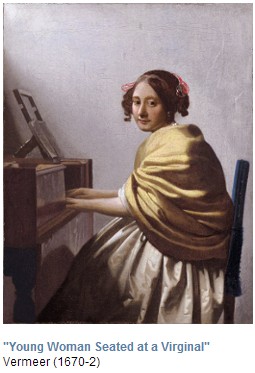
Vermeer used various painterly tricks to make these moments – these mundane tasks – look special. He expended a great deal of time and energy capturing the effects of light. He studied the way light comes in through a window, bathing a room. He seems to have painted most of his pictures in one or two rooms in his own home. He knew that light well. He analyzed that light, meditated on it. Using that light, he projected images through a camera obscura and probably through other kinds of lenses and mirrors available in 17th-century Holland. This allowed Vermeer to concentrate on every sparkle, shine and glimmer. He concocted different methods for reproducing those glimmers and shines. Sometimes he would render an object, like a knob or finial, simply as an effect of light. That’s to say, we only know the object is there because of how Vermeer painted the light shining upon it.
Art historians love to wax poetic about “brushstrokes” and a particular attitude to canvas and pigment they like to call “painterly.” But the funny thing about Vermeer is that many of his paintings were probably made by the careful application of small splotches of paint, in an almost paint-by-numbers attempt to reproduce, inch by inch, the image of a camera obscura. The current film, Tim’s Vermeer, documents the process by which tech engineer and non-painter Tim Jenison paints a Vermeer using simple tricks of mirrors and a camera obscura. The result is not a Vermeer painting. But it is close enough to show that much can be accomplished with a camera obscura and a small mirror. The film proves that some of what Vermeer achieved in the area of “miraculous” realism and the capturing of minute effects of light was a more or less mechanical affair.
More here.
How Iowa Flattened Literature: With CIA help, writers were enlisted to battle both Communism and eggheaded abstraction
Eric Bennett in the Chronicle of Higher Education:

Seven years earlier, Engle, then director of the Iowa Writers' Workshop, had approached the Rockefeller Foundation with big fears and grand plans. “I trust you have seen the recent announcement that the Soviet Union is founding a University at Moscow for students coming from outside the country,” he wrote. This could mean only that “thousands of young people of intelligence, many of whom could never get University training in their own countries, will receive education … along with the expected ideological indoctrination.” Engle denounced rounding up students in “one easily supervised place” as a “typical Soviet tactic.” He believed that the United States must “compete with that, hard and by long time planning”—by, well, rounding up foreign students in an easily supervised place called Iowa City. Through the University of Iowa, Engle received $10,000 to travel in Asia and Europe to recruit young writers—left-leaning intellectuals—to send to the United States on fellowship.
More here.
Sunday Poem
A Small Cowering Thing
I saw it hovering in the distance, a trim and pinioned harrier
stalling in mid-flight, almost loitering,
carrying out aerial reconnaissance in lordly indifferent leisure
(yet bird-alert, genetic with intent), and reconnoitering
the terrain that rolled away beneath its hanging there
in level slabs of icy light and deckle-flecked leaf-shed shade,
slice like a kid’s model glider
in strictly-plotted arcs of eliding mathematical certitude.
And oh! how it rose then, abrupt in updraft, as if on a swing
or swift and aquiline as a Frisbee; floated; and dropped
slow and deliberate and soundless as a plumbline in water
to fathom its shadow.
And a small cowering thing
huddling in that solemn hush of darkness stopped
to cry out its astonishment as if it could, or mattered.
by David Solway
from Canadian Poetry Online