Obama, Poet

Rebecca Mead in The New Yorker:

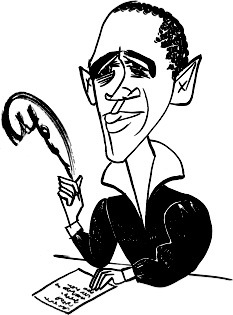
ObamaIn his first book, “Dreams from My Father,” Barack Obama described the marijuana that he smoked as a young man as “something that could flatten out the landscape of my heart, blur the edges of my memory.” This confession of youthful indiscretion was at once more sober and more lyrical than those proffered by Presidents Forty-two (“I didn’t inhale”) and Forty-three (“When I was young and irresponsible, I was young and irresponsible”), and it comes as little surprise to discover that another, less publicized intoxication to which the young Obama succumbed was the composition of lyric poetry. In 1981, Feast, a literary magazine produced at Occidental College, published two poems by Obama, who was then a student there. The first, “Pop,” appears to be a loving if slightly jaded portrait of Obama’s maternal grandfather, with whom he spent a large part of his childhood. Free in structure and with a bold use of enjambment, it begins, “Sitting in his seat, a seat broad and broken / In, sprinkled with ashes, / Pop switches channels, takes another / Shot of Seagrams, neat, and asks / What to do with me, a green young man / Who fails to consider the / Flim and flam of the world, since / Things have been easy for me.” The second, “Underground,” offers a vivid if obscurely symbolic description of a tribe of submarine primates. An exemplary few lines go, “Under water grottos, caverns / Filled with apes / That eat figs. / Stepping on the figs / That the apes / Eat, they crunch.”

Harold Bloom, who in fifty-three years of teaching literature at Yale University has had many undergraduate poems pressed hopefully upon him said, when reached by telephone in New Haven last week, that he was not familiar with Obama’s oeuvre. But after studying the poems he said that he was not unimpressed with the young man’s efforts—at least, by the standards established by other would-be bards within the political sphere. “At eighteen, as an undergraduate, he was already a much better poet than our former Secretary of Defense William Cohen, who keeps publishing terrible poetry,” Bloom said.

More here. (Note: I cannot think of a better ending to our Black History Month tribute than a reminder of where this amazing race has arrived. Leader of the Free World.)

RNA activity mapped across cells

Brendan Borrell in Nature:

MapScientists can now take snapshots of where and how thousands of genes are expressed in intact tissue samples, ranging from a slice of a human brain to the embryo of a fly. The technique, reported today in Science1, can turn a microscope slide into a tool for creating data-rich, three-dimensional maps of how cells interact with one another — a key to understanding the origins of diseases such as cancer. The methodology also has broader applications, enabling researchers to create, for instance, unique molecular ‘barcodes’ to trace connections between cells in the brain, a stated goal of the US National Institutes of Health's Human Connectome Project. Previously, molecular biologists had a limited spatial view of gene expression, the process by which a stretch of double-stranded DNA is turned into single-stranded RNAs, which can in turn be translated into protein products. Researchers could either grind up a hunk of tissue and catalogue all the RNAs they found there, or use fluorescent markers to track the expression of up to 30 RNAs inside each cell of a tissue sample. The latest technique maps up to thousands of RNAs.

In a proof-of-principle study, molecular biologist George Church of Harvard Medical School in Boston, Massachusetts, and his colleagues scratched a layer of cultured connective-tissue cells and sequenced the RNA of cells that migrated to the wound during the healing process. Out of 6,880 genes sequenced, the researchers identified 12 that showed changes in gene expression, including eight that were known to be involved in cell migration but had not been studied in wound healing, the researchers say. “This verifies that the technique could be used to do rapidly what has taken scientists years of looking at gene products one by one,” says Robert Singer, a molecular cell biologist at Albert Einstein College of Medicine in New York, who was not involved in the study.

More here.

A Bird-Like Flock of Autonomous Drones

Ed Yong in Not Exactly Rocket Science:

In a field outside Budapest, Hungary, ten quadcopter drones are flying as a coordinated flock. They zip through the great outdoors, fly in formation, or even follow a leader.

The little machines are the work of Hungarian scientists led by physicist Tamas Vicsek from Eotvos University in Budapest. They’re autonomous, meaning that they compute their flight plans on their own, without any central control. They can follow instructions, but they work out their own paths using GPS signals to navigate and radio signals to talk to one another. They’re the closest thing we have to an artificial flock of birds.

The copter flock is a real-life version of an influential computer programme called Boids, created by Craig Reynolds in 1986. He programmed virtual flying objects—the eponymous Boids—to move according to three simple rules. They aligned with the average heading of their neighbours; they were attracted to each other; and they also repulsedeach other to keep some personal space. These three simple rules were enough to simulate a realistic bird-like flock.

More here.

A Pakistani Jew steps cautiously out of the shadows

Marc Goldberg in The Times of Israel:

ScreenHunter_541 Feb. 28 13.03His real name is Faisal Benkhald, though he has recently adopted the Yiddish first name “Fishel.” He was born in Karachi in 1987, the fourth of five children born to a Jewish mother and a Muslim father. Though registered at birth as Muslim, he considers himself Jewish and is now fighting for state recognition of his chosen religion — an apostasy.

As far as the Pakistani authorities are concerned, Fishel is still Faisal, a Muslim. That’s what’s written on his documentation. But he wouldn’t be the only Jewish Pakistani to have a Muslim identity card: The Jews of Pakistan learned to disappear long ago. Some, like Fishel’s parents, registered their children as Muslims to blend in, and all tried to hide.

Except Fishel.

In a series of Twitter exchanges and emails in recent weeks, The Times of Israel explored Fishel’s unique story.

His earliest childhood memories include the aroma of his mother’s challah, baking in the oven every Friday afternoon. Before dusk he would watch her recite blessings over the Shabbat candles.

“When she used to put her hands over her eyes it felt so serene as if she has no worries of worldly life, reciting the blessing welcoming the holy day. Her lovely eyes and smile looking at me are engraved in my memory, I always prayed with her.”

More here.

Mark Blyth to Judge 4th Annual 3QD Politics & Social Science Prize

UPDATE 3/24/14: Winners announced here.

UPDATE 3/14/14: Finalists announced here.

UPDATE 3/14/14: Semifinalists announced here.

UPDATE 3/10/14: Voting round is now open. Click here to see full list of nominees and vote.

Dear Readers, Writers, Bloggers,
ScreenHunter_537 Feb. 24 13.22We are very honored and pleased to announce that Mark Blyth has agreed to be the final judge for our 4th annual prize for the best blog and online writing in the category of politics and social science. Details of the previous three politics (and other) prizes can be seen on our prize page.

Mark Blyth is professor of international political economy at Brown University. He is based in the Department of Political Science, but his research begs and borrows from multiple fields. He is particularly interested in how uncertainty and randomness impact complex systems, particularly economic systems. He was a member of the Warwick Commission on International Financial Reform that made a case for macro-prudential regulation. He is the author of Great Transformations: Economic Ideas and Institutional Change in the Twentieth Century (Cambridge: Cambridge University Press 2002), and most recently, Austerity: The History of a Dangerous Idea (Oxford University Press 2013). His academic writings have appeared in such places as the American Political Science Review, the Review of International Political Economy, and the Journal of Evolutionary Economics, while his more popular writings have appeared in Foreign Affairs and Foreign Policy magazine. He has also written for 3 Quarks Daily.

As usual, this is the way it will work: the nominating period is now open. There will then be a round of voting by our readers which will narrow down the entries to the top twenty semi-finalists. After this, we will take these top twenty voted-for nominees, and the editors of 3 Quarks Daily will select six finalists from these, plus they may also add up to three wildcard entries of their own choosing. The three winners will be chosen from these by Mark Blyth.

The first place award, called the “Top Quark,” will include a cash prize of 500 dollars; the second place prize, the “Strange Quark,” will include a cash prize of 200 dollars; and the third place winner will get the honor of winning the “Charm Quark,” along with a 100 dollar prize.

(Welcome to those coming here for the first time. Learn more about who we are and what we do here, and do check out the full site here. Bookmark us and come back regularly, or sign up for the RSS feed.)


Details:

Politics-Announcement-2014The winners of this prize will be announced on March 24, 2014. Here's the schedule:

February 24, 2014:

  • The nominations are opened. Please nominate your favorite blog entry by placing the URL for the blog post (the permalink) in the comments section of this post. You may also add a brief comment describing the entry and saying why you think it should win. (Do NOT nominate a whole blog, just one individual blog post.)
  • Blog posts longer than 4,000 words are strongly discouraged, but we might make an exception if there is something truly extraordinary.
  • Each person can only nominate one blog post.
  • Entries must be in English.
  • The editors of 3QD reserve the right to reject entries that we feel are not appropriate.
  • The blog entry may not be more than a year old. In other words, it must have been written after February 23, 2013.
  • You may also nominate your own entry from your own or a group blog (and we encourage you to).
  • Guest columnists at 3 Quarks Daily are also eligible to be nominated, and may also nominate themselves if they wish.
  • Nominations are limited to the first 200 entries.
  • Prize money must be claimed within a month of the announcement of winners.

March 8, 2014

  • The nominating process will end at 11:59 PM (NYC time) of this date.
  • The public voting will be opened soon afterwards.

March 13, 2014

  • Public voting ends at 11:59 PM (NYC time).

March 24, 2014

  • The winners are announced.

One Final and Important Request

If you have a blog or website, please help us spread the word about our prizes by linking to this post. Otherwise, post a link on your Facebook profile, Tweet it, or just email your friends and tell them about it! I really look forward to reading some very good material, and think this should be a lot of fun for all of us.

Best of luck and thanks for your attention!

Yours,

Abbas

Thursday, February 27, 2014

where’s the dance talk?

P10_Flanders_409141hJudith Flanders at the Times Literary Supplement:

In 1930s literary London, ballet was everywhere. Virginia Woolf, several Stracheys, the Bells, E. M. Forster, H. G. Wells, John Middleton Murry and Katherine Mansfield, Aldous Huxley, the Sitwells and T. S. Eliot all attended the Ballets Russes. Louis MacNeice’s Les Sylphides appeared in 1939, and in the same year Henry Green’s Party Goingused the same ballet as a structural underpinning. It wasn’t just the intelligentsia, either. Compton Mackenzie wrote two novels with a dance protagonist, and even Eric Ambler’sCause for Alarm (1938) contained a reference to Diaghilev.

All the more peculiar, then, that those who have since studied modernism, both in the visual arts and in literature, have barely acknowledged the movement’s links to dance. Where is the equivalent to Adorno on Stravinsky and Schoenberg? Where the monographs to match those on Cubism, or the modern novel? If the link between the “Demoiselles d’Avignon” and temporality in fiction is worth examining, why not between that same painting and Nijinsky’s Sacre du Printemps?

A few dance writers have attempted to bridge the gap, but almost no literary specialists. Now Susan Jones, a Conrad scholar as well as, before that, a dancer, is ideally placed to take the subject forward, as one who can see how, “At the still point of the turning world . . . there the dance is”.

more here.

Is Absolute Secularity Conceivable?

6564296735_0de7b5f03a_z

Simon During over at The Immanent Frame:

Is absolute secularity conceivable? The question arises from the paradoxical intuition that the secularization thesis is simultaneously both right and muddled. Perhaps the most fundamental problem with the broader secularization thesis (which I take to claim that, over the past half-millennium or so, Western society has undergone a systemic diminution of religious practice) is that it isn’t clear what the non-secular is. After all, it can be extended from those beliefs and practices that avowedly depend on religious revelation to those that affirm some form of transcendentalism, though they may make no room for God as such. But for a long time both radical atheists and Christian apologists have argued that what looks as if it is secular through and through may not, in fact, be secular at all. From this point of view, important elements of enlightened secularity in particular can be understood, not as Christianity’s overcoming, but as its displacement. Thus, for instance, in his Scholasticism and Politics (1938), Jacques Maritain, following Nietzsche, speaks of the “Christian leaven fermenting in the bosom of human history” as the source of democratic modernity. Here the secular, political concept of human equality is seen to have a Christian origin and to bear a continuing Christian charge, even though its purposes and contexts have changed.

Numerous applications of the displacement model of secularization are current, but here I will point to just one. It concerns philosophical anthropology. The argument is that certain post-Enlightenment concepts of the human (or of “man”) remain Christian in their deep structures. Of these, the most important is the philosophical anthropology of negation (to use Marcel Gauchet’s term), according to which human nature is not just appetitive but necessarily incomplete, that is to say, inadequate to its various ecologies and conditions, and for that reason beset by fear, uneasiness, anxiety, and so on. For those who accept the displacement model, this anthropology, even in its modern forms, remains dependent on the revealed doctrine that human nature as such is fallen.

More here.

The Mammoth Cometh

02cover-16x9-master675-v3

Nathaniel Rich in the NYT Magazine:

[Ben] Novak is tall, solemn, polite and stiff in conversation, until the conversation turns to passenger pigeons, which it always does. One of the few times I saw him laugh was when I asked whether de-extinction might turn out to be impossible. He reminded me that it has already happened. More than 10 years ago, a team that included Alberto Fernández-Arias (now a Revive & Restore adviser) resurrected a bucardo, a subspecies of mountain goat also known as the Pyrenean ibex, that went extinct in 2000. The last surviving bucardo was a 13-year-old female named Celia. Before she died — her skull was crushed by a falling tree — Fernández-Arias extracted skin scrapings from one of her ears and froze them in liquid nitrogen. Using the same cloning technology that created Dolly the sheep, the first cloned mammal, the team used Celia’s DNA to create embryos that were implanted in the wombs of 57 goats. One of the does successfully brought her egg to term on July 30, 2003. “To our knowledge,” wrote the scientists, “this is the first animal born from an extinct subspecies.” But it didn’t live long. After struggling to breathe for several minutes, the kid choked to death.

This cloning method, called somatic cell nuclear transfer, can be used only on species for which we have cellular material. For species like the passenger pigeon that had the misfortune of going extinct before the advent of cryopreservation, a more complicated process is required. The first step is to reconstruct the species’ genome. This is difficult, because DNA begins to decay as soon as an organism dies. The DNA also mixes with the DNA of other organisms with which it comes into contact, like fungus, bacteria and other animals. If you imagine a strand of DNA as a book, then the DNA of a long-dead animal is a shuffled pile of torn pages, some of the scraps as long as a paragraph, others a single sentence or just a few words. The scraps are not in the right order, and many of them belong to other books. And the book is an epic: The passenger pigeon’s genome is about 1.2 billion base pairs long. If you imagine each base pair as a word, then the book of the passenger pigeon would be four million pages long.

There is a shortcut. The genome of a closely related species will have a high proportion of identical DNA, so it can serve as a blueprint, or “scaffold.” The passenger pigeon’s closest genetic relative is the band-tailed pigeon, which Shapiro is now sequencing. By comparing the fragments of passenger-pigeon DNA with the genomes of similar species, researchers can assemble an approximation of an actual passenger-pigeon genome. How close an approximation, it will be impossible to know. As with any translation, there may be errors of grammar, clumsy phrases and perhaps a few missing passages, but the book will be legible. It should, at least, tell a good story.

More here.

On “We Real Cool”

An interview with Gwendolyn Brooks by George Stavros in English.Illinois:

Q. How about the seven pool players in the poem “We Real Cool”?

A. They have no pretensions to any glamor. They are supposedly dropouts, or at least they're in the poolroom when they should possibly be in school, since they're probably young enough, or at least those I saw were when I looked in a poolroom, and they. . . . First of all, let me tell you how that's supposed to be said, because there's a reason why I set it out as I did. These are people who are essentially saying, “Kilroy is here. We are.” But they're a little uncertain of the strength of their identity. [Reads:]

Gwendolyn_Brooks_cropped We real cool. We
Left school. We

Lurk late. We
Strike straight. We

Sing sin. We
Thin gin. We

Jazz June. We
Die soon.

The “We”—you're supposed to stop after the “We” and think about their validity, and of course there's no way for you to tell whether it should be said softly or not, I suppose, but I say it rather softly because I want to represent their basic uncertainty, which they don't bother to question every day, of course.

Q. Are you saying that the form of this poem, then, was determined by the colloquial rhythm you were trying to catch?

A. No, determined by my feeling about these boys, these young men.

More here. (Note: One post throughout February will be dedicated to Black History Month.)

LIT UP BY THE LUMINARIES

Robert Macfarlane in More Intelligent Life:

CattonI first read “The Luminaries” as a judge of the Man Booker prize for fiction last year. Without that compulsion I might never have picked it up, put off by its cubical bulk and astrological armature. What a loss that would have been! I have now read it three times—2,496 pages in sum—and each reading has yielded new dividends. And its consequences enact its concerns, for Catton takes such pains not only for the joy of evocation, but also to carry out a huge thought-experiment into the nature of value. Almost everyone in Hokitika is dedicated to the acquisition of wealth and the maximisation of profit. It is a community driven by capital, in which relationships are ruled by cost-benefit analysis. One of the few transactions to defeat this fierce logic is the unconditional love that develops between two characters: a young prospector and a “whore”. Their love eventually emerges as a gold standard: a touchstone with which to test the value of all things.

And so this phenomenal book, apparently about digging into the Earth's innards in search of wealth, ends up delving into the heart's interior to find true worth. All the while the landscape goes about its business: rain clatters fatly onto the roofs of Hokitika's 100 pubs, storms pummel the sand-bars, the snowmelt of the high peaks swells the rivers, and the rivers crash down towards the sea, carrying gold which shines in their eddy-pools, as one early prospector put it, “like the stars of Orion on a dark, frosty night”.

More here.

Who’s Afraid of Walter Mitty?

Liam Heneghan in the Los Angeles Review of Books:

Mitty1-243x366In those days, over 30 years past, when it was not unusual in Dublin bookshops for patrons to discuss books with each other, a youth not very much older than I was at the time told me that James Thurber's writing was “total shite.” I glowered, bought My World and Welcome to It (1942), and shuffled out onto Nassau Street with the book stuffed into a paper bag. I was mainly interested in the pictures anyway.

By that time I was already fairly progressed in my reading of Thurber, who was a favorite of my father’s and consequently whose books, some of them at least, were strewn about the house. My mother claimed that Thurber was the only writer that made had her laugh out loud on a Dublin bus. Thurber’s best known story The Secret Life of Walter Mitty, which had first appeared in The New Yorker in 1939, was assigned reading for Ireland’s intermediate certificate English course (the “intercourse” as we called it), the national curriculum for students aged 12 to 15 years old. The story was therefore known to most Irish youth.

I have been rereading Thurber in recent months, more than 35 years after I first encountered him, partly in anticipation of the release of Ben Stiller’s film version of the Walter Mitty story, and partly because I had picked up a copy of the excellent compilation of Thurber’s Writings and Drawings (1996) in the Library of America series. In the intervening years since my early reading of Thurber I lived for a long time in the United States, first in New York, then a brief stint in Georgia, and now in Chicago where it snows a lot. Having more familiarity with locations and situations that once seemed exotic and urbane to me, at least when viewed from Dublin in the 1970s, I can now assess Thurber’s work with more culturally attuned eyes and significantly older ones.

More here.

Thursday Poem

Miller Moth

.
Promises were made
that dress of yours
yellow as a Miller moth
batting about the bulb
of a painted porch light
yearning on hanger
to caress a slope of shoulder
ride a swell of hip
bell the well-turned ankle
pleat and dart pooled about
first one foot
then the other
rose to lip
a halting smile of neckline
assumed an aspect
of sail gathered wind
sung vows in the rigging
where I madly batted
drawn, ensnared.
.

by Dave Hardin
from The Lost Country, Fall 2013

A Fluid New Path in Grand Math Challenge

Jet-eddies-web_cropped

Erica Klarreich in Quanta:

In Dr. Seuss’s book “The Cat in the Hat Comes Back,” the Cat makes a stain he can’t clean up, so he calls upon the help of Little Cat A, a smaller, perfect replica of the Cat who has been hiding under the Cat’s hat. Little Cat A then calls forth Little Cat B, an even smaller replica hidden under Little Cat A’s hat. Each cat in turn lifts his hat to reveal a smaller cat who possesses all the energy and good cheer of the original Cat, just crammed into a tinier package. Finally, Little Cat Z, who is too small to see, unleashes a VOOM like a giant explosion of energy, and the stain disappears.

A similar process lies at the heart of a speculative new approach to a problem that has bedeviled mathematicians for more than 150 years: understanding the solutions to the Navier-Stokes equations of fluid flow, which physicists use to model ocean currents, weather patterns and other phenomena. These equations are so complex that in most cases, no one knows whether the solution will be smooth and well-behaved, without any sudden shifts of direction or explosions of energy, for instance. And computer models of the solutions run aground, unable to accurately capture the behavior of small eddies.

Now, in a paper posted online on February 3Terence Tao of the University of California, Los Angeles, a winner of the Fields Medal, mathematics’ highest honor, offers a possible way to break the impasse. He has shown that in an alternative abstract universe closely related to the one described by the Navier-Stokes equations, it is possible for a body of fluid to form a sort of computer, which can build a self-replicating fluid robot that, like the Cat in the Hat, keeps transferring its energy to smaller and smaller copies of itself until the fluid “blows up.” As strange as it sounds, it may be possible, Tao proposes, to construct the same kind of self-replicator in the case of the true Navier-Stokes equations. If so, this fluid computer would settle a question that the Clay Mathematics Institute in 2000 dubbed one of the seven most important problems in modern mathematics, and for which it offered a million-dollar prize. Is a fluid governed by the Navier-Stokes equations guaranteed to flow smoothly for all time, the problem asks, or could it eventually hit a “blowup” in which something physically impossible happens, such as a non-zero amount of energy concentrated into a single point in space?

More here.

Redistribution, Inequality, and Growth

IMF paper table

Jonathan D. Ostry, Andrew Berg, and Charalambos G. Tsangarides over at the (seemingly very different) IMF:

Economists are increasingly focusing on the links between rising inequality and the fragility of
growth. Narratives include the relationship between inequality, leverage and the financial
cycle, which sowed the seeds for crisis; and the role of political-economy factors (especially
the influence of the rich) in allowing financial excess to balloon ahead of the crisis. In earlier
work, we documented a multi-decade cross-country relationship between inequality and the
fragility of economic growth. Our work built on the tentative consensus in the literature that
inequality can undermine progress in health and education, cause investment-reducing political
and economic instability, and undercut the social consensus required to adjust in the face of
shocks, and thus that it tends to reduce the pace and durability of growth.

That equality seems to drive higher and more sustainable growth does not in itself support
efforts to redistribute. In particular, inequality may impede growth at least in part because it
calls forth efforts to redistribute that themselves undercut growth. In such a situation, even if
inequality is bad for growth, taxes and transfers may be precisely the wrong remedy.

While considerable controversy surrounds these issues, we should not jump to the conclusion
that the treatment for inequality may be worse for growth than the disease itself.

More here. Also see here.

Wednesday, February 26, 2014

Moral Panics, Sex Panics and the Production of A Lebanese Nation

ScreenShot2014-02-22at12.02.26PM

Maya Mikdashi in Jadaliyya:

In the past few months sex panics and moral panics, centered on gendered bodies and abuses, have rocked Lebanon. In this article I want to revisit three of these panics: photos of a semi-nude Lebanese Olympic Skier’s body and reactions to it; the impunity of wife murderers and wife abusers; and the razing of a Syrian makeshift refugee camp after (ultimately false) accusations of sex abuse by a camp resident of a mentally disabled Lebanese man. I bring these three cases together in order to think about the political work that the moral/sex panicdoes in making and remaking Lebanese national identity and in articulating its gendered architecture. I do so in order to avoid thinking each separately under the rubrics of sexual discrimination or abuse in Lebanon.

Jackie Chamoun is a skier representing Lebanon at the Winter 2014 Olympics. Her qualification for the premier international sporting event is itself a success, given the lack of training infrastructures and support for athletes (particularly females) in Lebanon. Recently, photos a friend of Chamoun’s took for a calendar, featured the athlete in various poses (though not full frontal) and topless. The photos spread through the Internet like wildfire. In response, the Caretaker Lebanese minister for Youth and Sports, Faisal Karami, ordered an investigation into the photos. He stated that they, and by extension Chamoun, were damaging to the country’s image. In a country with chronic youth unemployment and a widely corrupt professional sports system, as well as the lack of support for sports and youth more broadly, it was these photos that were just too much for the good minister. Almost immediately, people reacted, both positively and negatively, to Karami’s announcement. But what was the image of Lebanon that Karami wanted to protect, and why was the site of a female athletic body—and athletes, given that their bodies are their work, are rightly proud and confident in them— so threatening to that image?

More here.

How to Talk about Climate Change, Part 1: The Blame Game

Stephanie Bernhard in Full Stop:

Shutterstock_83447575-1024x681If you want to see an expression of pure despair, ask a college freshman to parse Rachel Carson’s rhetorical choices at 8:00 in the morning. That’s what I’m doing this semester for a composition class I’m teaching at the University of Virginia. The course is called “Representing Climate Change,” and our collective goal is to discover and deploy effective methods of talking and writing about our looming environmental crisis. The task is daunting. Climate change is at once really easy and really hard to write about. It’s easy because there is so much to say, and hard because progress toward a solution is so slow.

But what do I know about the fossil fuel industry? I study literature. I am not a scientist. My specialties are agrarian novels and Modernist aesthetics, not cloud formation or sea ice. When making arguments, I have to trust the vast majority of scientists who agree that humans are changing the climate, that the changes will have huge and unpleasant effects, and that we should really get our act together and fix the problem. The scientists’ job is to perform and publish the research that supports these claims. My job — and my students’ job — starts where peer review ends: we need to make scientific evidence digestible and believable to a general audience. Since solving climate change requires mass engagement, how we talk about the problem matters as much as the science that confirms its urgency.

More here.

Alec Baldwin: Good-bye, Public Life

Alec Baldwin in New York Magazine:

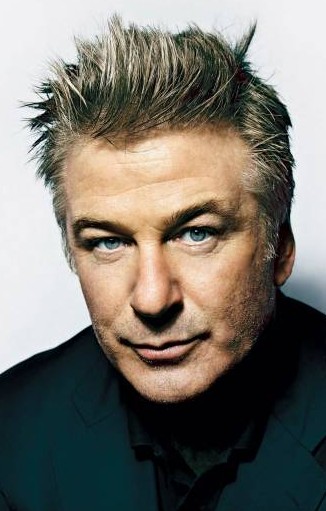
ScreenHunter_540 Feb. 26 14.23I flew to Hawaii recently to shoot a film, fresh on the heels of being labeled a homophobic bigot by Andrew Sullivan, Anderson Cooper, and others in the Gay Department of Justice. I wanted to speak with a gay-rights group that I had researched and admired, so I called its local Honolulu branch.

The office number turned out to be some guy’s cell phone. I left him a message—I said, “I’m from out of town, I’m visiting Hawaii on business, I’d like to get some information on your group.” After two or three more calls, he answered the phone. I said, “Yeah, I’m the guy that called about your organization.” And he said, somewhat impatiently, “Okay, well, what did you want?” I said, “Well, let me put it to you this way, Nick. Your name is Nick? Nick, let me begin by asking you a question. Who would you say, by your estimation, is the most homophobic member of the entertainment industry currently in the media?” And he paused for a long count of four and said, “Um … Alec Baldwin?”

And I said, “Ding, ding, ding, ding! Bingo, Nick, bingo! That’s who you’re talking to.”

He said, “C’mon!”

I said, “Nick, I want to come in and talk.”

I met with Nick and others from two LGBT organizations. We talked for a while about the torment of the LGBT life many of them have lived while growing up in traditional Hawaiian families. Macho fathers. Religious mothers. We talked a lot about words and their power, especially in the lives of young people.

One young man, an F-to-M tranny, said, “Are you here to get dry-cleaned, like Brett Ratner?” Meaning I could do some mea culpa, write them a six-figure check, go to a dinner, sob at the table, give a heartfelt speech, beg for forgiveness.

More here.

Wednesday Poem

When All This Is Over

After all the heads have rolled
and the young insurgents put up against the wall
by the firing squads
when the puppet masters
have taken their seats in the boardroom
and the bombardiers are sipping drinks
with the chiefs of police
when the journalists change sides again
and the commentators
redefine what they meant in the first place
and the judges sell their shares
in revolutionary understanding
and the clergy decide
that forgiveness was always forgiven
and educators rediscover
the meaning behind the meaningless
when poets grow tired
of too long battling futility
when arrogant financiers
have poisoned all the blood banks
and the drug companies
have rendered us venomous
unfit for social consumption
when we see that things have returned again to how they are
we want to believe
that the ruthless men in the big black cars
are lonely as sin
behind their bullet proof glass
and that it means something
that they may have doubts
in the middle of the night like we have
only worse
we pray
because maybe they can do something about it
before the eagle
stoops and tears their liver out
.
by Macdara Woods