Quietest Places in the World

Trevor Cox in American Scientist:

CoxWhile I was on an expedition to record singing sand dunes, I experienced something quite rare: complete silence. The scorching summer heat kept visitors away. Most of the time my recording companion, Diane Hope, and I were on our own. We camped at the foot of Kelso Dunes, in a barren, scrubby valley with dramatic granite hills behind us. Virtually no planes flew overhead, and only very occasionally did a distant car or freight train create noise. Much of the day there was a great deal of wind, but at twilight and early in the morning the winds calmed down and the quiet revealed itself. Overnight I heard the silence being interrupted only once, when a pack of nearby coyotes howled like ghostly babies. Early on the second morning, while I was waiting for Diane to set up some recording equipment, I had a chance to contemplate real silence. The ear is exquisitely sensitive. When perceiving the quietest murmur, the tiny bones of the middle ear, which transmit sound from the eardrum to the inner ear, vibrate by less than the diameter of a hydrogen atom. Even in silence, tiny vibrations of molecules move different parts of the auditory apparatus. These constant movements have nothing to do with sound; they stem from random molecular motion. If the human ear were any more sensitive, it would not hear more sounds from outside. Instead, it would just hear the hiss generated by the thermal agitation of the eardrum, the stapes bone of the middle ear, and the hair cells in the cochlea.

…A former colleague of mine, Stuart Bradley from Auckland University, has visited Antarctica, another place devoid of vegetation where silence can be heard. Stuart is a tall New Zealander, sporting a fine mustache like a soccer player from the 1970s. Ironically, what Stuart does in Antarctica is make noise and briefly ruin the pristine natural soundscape. He uses a sodar (a sound radar system) to measure weather conditions, sending up strange chirps that bounce off of turbulent air in the atmosphere before returning to the ground to be measured. I asked Stuart if he had experienced silence in Antarctica, and he told me about his time in the dry valleys, possibly the most barren places on Earth, which lack snow and ice cover: “Sitting up on the valley wall on a still day, there was no sound I could identify (except heartbeat? breathing?). No life (apart from me). So no leaves either. No running water. No wind noise. I was certainly struck by the primeval ‘feel.’” Stuart commented on how different this was than the sound of a silent laboratory, “I didn’t get the claustrophobic feel one can get in an anechoic chamber …I suspect this is because, although it was incredibly quiet, it was also a very, very open vista. The valley walls were 1,500–2,000 meters high, and the visibility was amazing!”

More here.

Tuesday, September 9, 2014

the ideal busts of the Victorian parlor

LF_GOLBE_BUSTS_AP_001Stefany Anne Golberg at The Smart Set:

The Victorian Age, by most accounts, was dirty and crowded and busy. It was an age in which nobility and refinement were greatly valued because they were so fragile. Ideal busts like those in the Corcoran Atrium were not made for museums or galleries. They were made for private homes, to be installed in the parlor. Sculptors like Hiram Powers could hardly keep up with the demand for ideal busts. Still, even as Powers churned them out, his ambitions for the busts were high. Powers called his sculptures “unveiled souls.” The ideal bust shed the body to reveal what was within.

Why did we create a form of sculpture that gives us only the head, neck, and shoulders? Perhaps it is because man is made of dust but pointed to the stars. Our heads drag our cumbersome bodies around town. We move hunched over, propelled by the weight of our thought-machines. We are mental locomotives. Only what rises above the shoulders is truly important. What lurks below the heart is dark and hidden. Our heads are the keepers of our brains and our eyes. Our bodies hold our inner stuff. Our motion may be in our legs but our dreams are in our skulls.

It seems natural that we would create a form of sculpture expressing this Cartesian inclination. A bust has just enough body to hold up the head. Nonetheless, a head alone will not suffice. A disembodied head evokes the guillotine and the sword. As a sculpted portrait, a simple head on a stick won’t do.

more here.

What David Foster Wallace misunderstood about John Updike

John_UpdikeWilliam Deresiewicz at The New Republic:

He knew who he was, and he knew 
who he wanted to be: an unembarrassed, unreconstructed middle-American. He shied away from nothing that he saw or learned in modern art or thought—not then, not ever—but the self-assurance that he carried with him out of Berks County made him proof against adopting the attitudes they entail. Atheism, alienation, and angst; elitism and cosmopolitanism; aesthetic 
austerity and experimentalism; political and spiritual extremism: these were not for him. Updike’s life and work are testaments to the idea that mid-American values, beliefs, and sensibilities are adequate to address and interpret modern experience. The conviction made him, and to many it has 
made him unforgivable.

Ipswich was the place where Updike did his finest work, and also where he found, reveled in, and immortalized the “adulterous society” of young professionals at play in the prosperity of Ike and JFK, the 
“post-pill paradise” of Tarbox and Couples. The novel’s magic circle of ten marriages (and about that many liaisons) is modeled, Begley tells us, on the even dozen that composed the Updikes’ little world. Ten of the twelve were adulterous, and all of the 
former ended in divorce.

more here.

THE FALCONERS OF THE EASTERN PONTOS

IMG_3823-1000x666Alexander Christie-Miller at The White Review:

Each autumn as the cold spreads across Russia and Eastern Europe it sets in train a vast migration of birds of prey. Passing through the Caucasus and entering Anatolia, eagles, kites, harriers, buzzards and hawks gather in the thousands where they travel through narrow bottlenecks formed by the passes of the Kaçkar Mountains.

A few months before I witnessed this spectacle myself, I had met a Turkish conservationist who described a tradition connected with it. As the migration reaches its peak in September, the men of the region send their children to hunt for an insect, a large burrowing cricket. This is placed alive inside a trap where it acts as bait for a bird, the red-backed shrike. Once the shrike is caught it is tethered to a long pole, which, after two or three days, it becomes accustomed to using as a perch. Equipped with these aerial rods, the men take to the mountains to fish the skies for sparrowhawks. Attracted by the fluttering of the shrike, the hawks plunge into nets. From that moment, the men keep the birds with them almost constantly, and within only a few hours a hawk has forgotten its wildness to the point that it is content to eat from a man’s fist. Within as little as a week, it may trust its new keeper so completely that it will fall asleep on his hand. When the birds are thoroughly tame, usually within ten days, they are taken out to the cornfields to hunt quail, which pass through the region on a parallel migration. The hawk is held in the palm of the hand and cast like a winged javelin at its quarry. If properly trained, the bird will remain with its kill until its captor comes to retrieve it. After about a month and a half of hunting in this way, when the quail season ends, the hawks are released back into the wild to complete their migration, bound for North Africa or the Mediterranean.

more here.

Ngugi wa Thiong’o tipped for 2014 Nobel prize in literature

Alison Flood in The Guardian:

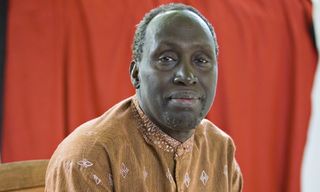
Ngugi-wa-Thiongo-011A run of bets originating in Sweden has seen the odds plummet on Ngugi wa Thiong'o, the distinguished Kenyan author, winning the Nobel prize for literature next month. The chances of the recently-retired Philip Roth taking the Nobel have also fallen dramatically, according to betting firm Ladbrokes.

Ladbrokes said that odds on Ngugi being named winner of the world's most prestigious literary award, given out every October in Stockholm, had shortened from 33/1 to 10/1. “It's always worth following the Swedish money and at this stage the one they like is Ngugi wa Thiong'o,” said spokesman for the betting firm Alex Donohue. Ngugi's books include Caitani Mutharabaini (Devil on the Cross), a novel written on toilet paper while he was imprisoned following the performance of his play, Ngaahika Ndeenda (I Will Marry When I Want), which was critical of the inequalities of Kenyan society. He had been a favourite to take the Nobel in 2010, but that year the prize went to Mario Vargas Llosa. Tomas Tranströmer, 2010's fourth favourite to win, went on to take the Nobel in 2011.

Favourite this year, according to Ladbrokes' odds, is Japanese novelist Haruki Murakami at 5/1,with Ngugi in joint second place with Algerian novelist Assia Djebar. Roth, who recently announced his happy retirement from the world of novel writing, comes in at 16/1, as do the feted Czech writer Milan Kundera, and the Syrian poet, Adonis.

More here.

Tennis Gets Anxious

Asad Raza in The New Yorker:

Tennis-Anxiety-2-690Change, John Kenneth Galbraith wrote, comes from the changing of generations. Tennis fans understand the sentiment, and a constant theme of U.S. Open commentary is worrying about when the next generation of stars will emerge. Maybe the Open’s placement in the calendar, on the cusp of fall, inspires these annual reflections. This year, the tone of these conversations is louder and more pessimistic—one writer, not atypical, pronounced, “Call me Cassandra if you like. The ATP Dark Age is coming.” In the lead-up to Flushing Meadows, these anxieties seemed to intensify, to the point that the question was no longer “When will they get here?” but “Will they get here at all?”

Some of this worry is a natural, if preëmptive, reaction to the imminent disappearance of champions who link us to the sport’s past. Thirty-four-year-old Venus Williams, who reached her first final here in 1997, and whose accomplishments include being the first African-American woman No. 1 in the Open era, joined the tour when it still featured Martina Navratilova, Steffi Graf, and Monica Seles. Her sister, thirty-two-year-old Serena Williams, who first won this tournament in 1999, possesses seventeen Grand Slam singles trophies, four Olympic gold medals (an achievement matched by her sister), and a regal bearing that has edged beyond diva and toward natural force. Then there is thirty-three-year-old Roger Federer, whose win over Pete Sampras in the fourth round at Wimbledon, in 2001, is considered the dawn of the most numerically successful and aesthetically appreciated career in the history of men’s tennis.

It’s hard to say goodbye to beloved players, followed faithfully for many years, and this might explain fans’ escalating worry about what the sport will be like after Federer and Serena Williams.

More here.

Can we talk? The unruly life and legacy of Joan Rivers

Kathleen Geier in After Hours:

Joan RiversThere's something about the outpouring of sentimental tributes to the late Joan Rivers that just feels wrong. The Rivers celebrations have shown a disconcerting tendency to sanitize this messy, maddening, and sometimes appalling human being. In truth, Rivers was a profoundly unsettling figure, and if you were paying any attention at all, it's almost impossible not to have deeply ambivalent feelings about her.
For one thing, in their apparent efforts to turn this acid-tongued comic into a lovable, albeit slightly naughty grandma, many of these encomiums grossly misrepresent the nature of her humor, which was utterly scabrous. For example: in her recent book, Rivers charged HBO with committing “crimes against humanity” for putting Lena Dunham's “fat ass on display.” That is far from the only time Rivers viciously mocked Dunham's weight. Earlier this year, she claimed that Dunham is “sending a message out to people saying, 'It's okay. Stay fat. Get diabetes. Everybody die, lose your fingers.'”
Some critics claim to discern a humanistic project behind Rivers' comedy of cruelty. For example, Mitchell Fain argued that Rivers “says things out loud what we’re all thinking, in our worst moments,” and that by doing so, “the monster gets smaller.” What seems far likelier is that the monster gets socially sanctioned. For decades, a staple of Rivers' act have been nasty jokes about female celebrities who are fat, stupid, or slutty, and male celebrities who are allegedly gay. Rarely did she talk smack about straight male celebrities. I'm a longtime Rivers watcher and I'm hard-pressed to think of any prominent examples.
That brings us to Joan Rivers' politics, which mostly were horrible.
More here.

Can Pseudonyms Make Better Online Citizens?

Erin O'Donnell in Harvard Magazine:

NamePeople socialize online more than ever: posting photos on Instagram, job-hunting on LinkedIn, joking about politics on Twitter, and sharing reviews of everything from hotels to running shoes. Judith Donath, a fellow at Harvard’s Berkman Center for Internet and Society, argues against using real names for most of these Internet interactions and relying instead on pseudonyms. A made-up handle is essential to maintain privacy and manage one’s online identity, she says. Her new book, The Social Machine: Designs for Living Online (MIT Press, 2014), also contends that well-managed pseudonyms can strengthen online communities, an idea that contradicts the conventional wisdom that fake names bring out the worst in people, allowing “trolls” to bully others or post hateful, destructive comments without consequences. Real names, such thinking goes, keep online conversations civil.

But Donath often uses a pseudonym online, not because she wants to “anonymously harass people or post incendiary comments unscathed,” as she explained in a commentary published on Wired.com this spring, but because she prefers to separate certain aspects of her life. In the age of Google, a quick search of a person’s name gathers everything he or she has posted under that name, from résumés to college party photos. As a public figure who studies how people communicate online, Donath’s academic writing can be found online under her real name. But when she writes product reviews on shopping sites such as Drugstore.com, or restaurant reviews on Yelp, she might use a pseudonym. “I would like to be known online for what I write,” she says. “I don’t necessarily feel like I need to be known for what I’ve been eating.”

More here.

A Doctor’s Malaise, and a Profession’s

Florence Williams in The New York Times:

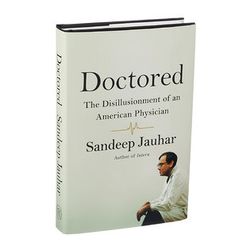
BookSandeep Jauhar’s new memoir, “Doctored: The Disillusionment of an American Physician,” tells the story of two midlife crises: the author’s own,, and that of modern American medicine, now in about its fourth decade under managed care. Both prove to be frustratingly intransigent, with only small signs of hope. “Intern: A Doctor’s Initiation” t become much better, at least not for Dr. Jauhar, who takes his first job at Long Island Jewish Medical Center and becomes the director of its heart failure program. (He is also an occasional contributor to The New York Times.) Full of ideals about saving lives and providing compassionate, ethical care, he finds himself underpaid, overworked and pressured to cut corners in every direction. describes a profession that is like so many of its patients: full of malaise and desperation. Doctors are reported to commit suicide at a higher rate than other professionals, and Dr. Jauhar cites a 2008 survey in which only 6 percent of 12,000 physicians rated their morale as positive.

Then again, Dr. Jauhar is constitutionally dissatisfied. Just ask his father, who says of his wife, the author’s mother, “Like you, she is not a happy person.” (Some of the best scenes feature the father, who comes across as comically histrionic, neurotic and self-absorbed. “If you lose your job,” he tells his son, “we are finished. I will be the first to have a heart attack!” And then he tosses in: “And make some friends, Sandeep. You have no friends.”) Then Dr. Jauhar has his wife to contend with. Also a doctor, she keeps putting off her own job to stay home with their toddler, while telling her husband to bring home more money. “Money doesn’t buy happiness,” he counters. “Yes it does!” she replies.

More here.

Tuesday Poem

Loss

Something in me repeats in an obsessive beat
that I may have lost something
or left it behind
in the café or the bookstore
where I’d been
I searched my possessions
and no loss was found
nor did I discover what had been lost
but the loss
kept asserting its existence
through palpitations and minor fits
Athenian sophists philosophized:
“A thing you haven’t lost
is necessarily in your possession
you haven’t lost a tail—therefore, you have a tail
or vice versa
what you’ve lost was necessarily yours”
but what have I lost?
I must look for my loss
in order to know what I’m looking for
is it an object or a thing or the thing
and was it mine before it was lost
or is it that some inner authority
is trying to bequeath me, like a Hellenistic sophist,
something I had never possessed
as for example a chance
as if I ever stood a chance


by Mordechai Geldman
from Halachti Shanim Le-Tzidcha
publisher: Hakibbutz Hameuchad, Mossad Bialik, 2011

Monday, September 8, 2014

Sunday, September 7, 2014

From Normativity to Responsibility etc

Professor-Joseph-Raz-1024x735

Richard Marshall interviews Joseph Raz in 3:AM Magazine:

3:AM: One of the ideas you have argued for(in your 2000 Seeley Lectures)is that we ought to accept the legitimacy of difference. So you think someone can reasonably approve of normative practices that are positively hostile to each other, but that only commits one to respecting both positions and not engaging with them. Is that right, and if it is, doesn’t non-engagement itself suggest a lack of respect?

JR: Accepting, or respecting difference is of course code. What we should respect are practices, styles of life, ideals and aspirations that are valuable, or that have some good, some value in them, and we should respect them for that reason (even when we have a very imperfect understanding of their value). I put it like that for pure gold is rarely found in human affairs. Our lives are wrought of alloys of mixed quality elements, some inferior or even seriously flawed. Human practices that have value often also enshrine prejudice or superstition, and perpetuate objectionable discriminations or exclusions. In saying, as it were, that that’s life, I do not mean that we should be complacent about the unworthy aspects of our practices, or those of others. On the contrary, I suggest that we should not be complacent and should try to identify the less wholesome aspects of our own practices, as well as in those of others, distance ourselves from them and strive to rectify them.

So one reason why it is important to know about and to have a balanced view of practices we have no intention of sharing is that understanding them is close to being a precondition for understanding ourselves and our engagements with various practices. The recognition of the value in what is strange or alien to our ways anchors our humanity, protects us from smugness and intolerance. Our knowledge of and respect for other people’s practices also creates for us the opportunity to change, to come to engage with people who might otherwise appear strange or worse, and possibly also to find that we can acquire a taste for the practices that initially were so alien to us – that is the second main reason for seeking to understand and for coming to respect the value of those practices. I am not suggesting that we should for ever be looking for new friends, or for a change in our activities and tastes, merely that it is good to have the option, and the option is made real in part through understanding what it is like to take it.

In the preceding comments I emphasized the barriers between people and the hostilities that sometimes accompany them that are bred by ignorance leading to narrow and misguided understanding of the range of activities and practices that can contribute to human fulfillment, to the quality of our lives. I also implied that being unaware of the shortcomings in our own practices may well contribute to such hostilities.

More here.

The International Interest

Dfvrdgdfg

Komala Ramachandra in Caravan (Photo: Adnan Abidi/REUTER):

OVER THE LAST FEW MONTHS, scrutiny of foreign funding for non-governmental organisations in India has been increasing. Although this trend is widely acknowledged, few commentators have pointed out that growing suspicion of NGOs that receive such funding is part of an emerging global reaction to civil society. India has joined the likes of Russia, Egypt, Israel, Venezuela, Bolivia and Ecuador in trying to silence groups that raise objections to human rights violations and environmental degradation. These governments allege that foreign-funded NGOs threaten national security, often conflating such security—which it is their duty to provide—with the economic interests of private corporations that stand to benefit from silencing democratic opposition. What these governments have not done, however, is address the substantive concerns such organisations raise about lapses in due process for those harmed by industrial projects, and about such projects’ long-term environmental impacts.

In early June, an Indian Intelligence Bureau report blaming foreign-funded environmental organisations for a significant slowdown in economic growth was leaked to the press. The report alleged that these groups were acting on behalf of foreign entities rather than in the best interests of the Indian people, and argued that foreign influence should be controlled to protect India’s “national economic security.” It cited examples of non-governmental organisations stalling investments in fields such as nuclear power, coal mining, large-scale infrastructure and genetically modified crops, and raised the spectre of what has often been called a “foreign hand” guiding NGOs.

Around the time the IB report was leaked, in Russia the Ministry of Justice registered five internationally funded NGOs as “foreign agents” under a 2012 law aimed at organisations attempting to influence state decision-making or policies. (Infringements of the statute, which is enforced partly through annual audits and surprise inspections, are punishable by thousands of dollars in fines and up to three years in prison.) A week earlier, the Russian government had issued a notice of violation to a foreign-funded human rights NGO for providing legal assistance to other groups targeted under the law.

This followed similar crackdowns around the world, by governments across the political spectrum. In late December, a high-ranking minister from the office of Bolivia’s president, Evo Morales, announced the immediate expulsion from the country of a Danish-funded rural-development NGO called IBIS, which was accused of political action against the government. IBIS had supported peoples’ organisations expressing concern about the impacts of industrial development and climate change in indigenous areas, and trying to influence democratic decision-making—activities protected under the Bolivian constitution.

More here.

The Trouble With Harvard

PicTNR

Steven Pinker in The New Republic:

The most-read article in the history of this magazine is not about war, politics, or great works of art. It’s about the admissions policies of a handful of elite universities, most prominently my employer, Harvard, which is figuratively and literally immolated on the cover.

It’s not surprising that William Deresiewicz’s “Don’t Send Your Kid to the Ivy League” has touched a nerve. Admission to the Ivies is increasingly seen as the bottleneck to a pipeline that feeds a trickle of young adults into the remaining lucrative sectors of our financialized, winner-take-all economy. And their capricious and opaque criteria have set off an arms race of credential mongering that is immiserating the teenagers and parents (in practice, mostly mothers) of the upper middle class.

Deresiewicz writes engagingly about the wacky ways of elite university admissions, and he deserves credit for opening a debate on policies which have been shrouded in Victorian daintiness and bureaucratic obfuscation. Unfortunately, his article is a poor foundation for diagnosing and treating the illness. Long on dogmatic assertion and short on objective analysis, the article is driven by a literarism which exalts bohemian authenticity over worldly success and analytical brainpower. And his grapeshot inflicts a lot of collateral damage while sparing the biggest pachyderms in the parlor.

We can begin with his defamation of the students of elite universities. Like countless graybeards before him, Deresiewicz complains that the kids today are just no good: they are stunted, meek, empty, incurious zombies; faithful drudges; excellent sheep; and, in a flourish he uses twice, “out-of-touch, entitled little shits.” I have spent my career interacting with these students, and do not recognize the targets of this purple invective. Nor does Deresiewicz present any reason to believe that the 18-year-olds of today’s Ivies are more callow or unsure of their lives than the 18-year-olds of yesterday’s Ivies, the non-Ivies, or the country at large.

More here. See also this bloggingheads discussion between William Deresiewicz and Glenn Loury.

What The Economist should have read before suggesting that US slavery wasn’t always so bad

Chris Blattman over at his website:

First, remind me, when I’m writing my first book, to try to get The Economist to write a racially insensitive review. I’m pretty sure Edward Baptist’s sales are pretty terrific right now.

The Economist has withdrawn the offending book review and apologized (the book in question, and the article and apology). Here’s the uncontroversial bit:

Mr Baptist, an historian at Cornell University, is not being especially contentious when he says that America owed much of its early growth to the foreign exchange, cheaper raw materials and expanding markets provided by a slave-produced commodity. But he overstates his case when he dismisses “the traditional explanations” for America’s success: its individualistic culture, Puritanism, the lure of open land and high wages, Yankee ingenuity and government policies.

Nothing in history (least of all the growth of the largest economy humankind has ever known) has a single explanation. Academics like to overstate their case and need to be reined in a little.

Even so, here’s the jawdropping finale:

…Slave owners surely had a vested interest in keeping their “hands” ever fitter and stronger to pick more cotton. Some of the rise in productivity could have come from better treatment. Unlike Mr Thomas, Mr Baptist has not written an objective history of slavery. Almost all the blacks in his book are victims, almost all the whites villains. This is not history; it is advocacy.

What could have shed light on this, had The Economist writer bothered to read the literature (and had the academics bothered to write in comprehensible prose)?

First, when do employers use coercion and how well does it work? There’s a pretty new and exciting literature here:

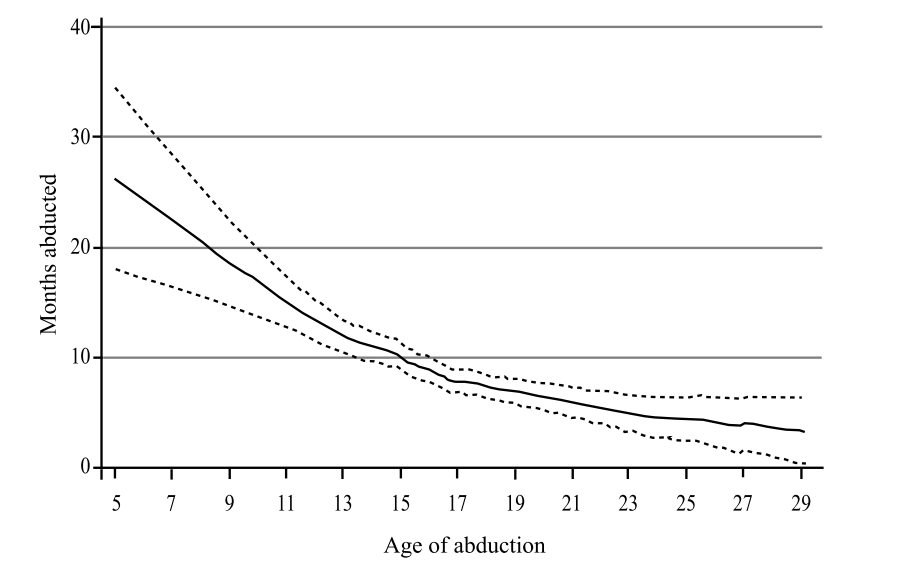
* Violence and pain work better in labor markets where people have really poor options, and are easily controlled, like children or the least educated. You see this in child labor during British industrialization, or even in child soldiering in Uganda (my own work). Here’s a graph of how long someone stayed with a rebel army in Uganda based on his age of conscription. The paper argues that ones you can scare and indoctrinate the easiest (in this case, kids) stay longest:

Screen Shot 2014-09-05 at 10.07.24 AM

More here.