lessons in how to write

Henry Hitchings in The Guardian:

Professor-Steven-Pinker-011If you want to start an argument online, make an assertion about English usage. “Apostrophes are on their way out”, or “People who misuse apostrophes deserve to be guillotined”. For extra spice, add a dash of what's commonly considered solecism: “People who fret about apostrophes are, like, literally the worst thing in the world.” This gambit, of course, also works beyond cyberspace. On the page, and in conversation, we frequently observe that one person's idea of linguistic rectitude is another's of insufferable fussiness. Most of us have strong views about how best to use language; where the more intricate details are concerned, those views are often an amalgam of aesthetic taste, ingrained social prejudice, popular myth and a form of reasoning that we insist is logic though it may smell like something else.

In The Sense of Style, Steven Pinker cheerfully launches himself on to this terrain. The Harvard psychology professor is a rigorous thinker whose previous books, including The Language Instinct and The Stuff of Thought, have been distinguished by a flair for making highly technical subjects seem not just accessible but positively jaunty. Now his distaste for the deathly edicts that glut most current volumes on literary style has led him to create what he calls “a writing guide for the 21st century”. The book has two parts: in the first, Pinker identifies the techniques that make prose compelling and the bad habits that can make it soggy, and in the second he focuses on contentious points of usage, of the sort addressed by the American humorist Calvin Trillin's quip: “'Whom' is a word that was invented to make everyone sound like a butler.”

More here.

Sunday Poem

Djinn

Haunted, they say, believing
the soft, shifty
dunes are made up
of false promises.

Many believe
whatever happens
is the other half
of a conversation.

Many whisper
white lies
to the dead.

“The boys are doing reallt well.”

Some think
nothing is so
until it has been witnessed.

They believe
the bits are iffy;

the forces that bind them,
absolute.

by Rae Armantrout
from Poetry, Vol. 192. No. 3, June
publisher: Poetry, Chicago, 2008

Saturday, September 6, 2014

Outlook: Gloomy

JS1562652

Jacob Burak in Aeon (Photo by Springer Collection/Corbis):

I have good news and bad news. Which would you like first? If it’s bad news, you’re in good company – that’s what most people pick. But why?

Negative events affect us more than positive ones. We remember them more vividly and they play a larger role in shaping our lives. Farewells, accidents, bad parenting, financial losses and even a random snide comment take up most of our psychic space, leaving little room for compliments or pleasant experiences to help us along life’s challenging path. The staggering human ability to adapt ensures that joy over a salary hike will abate within months, leaving only a benchmark for future raises. We feel pain, but not the absence of it.

Hundreds of scientific studies from around the world confirm our negativity bias: while a good day has no lasting effect on the following day, a bad day carries over. We process negative data faster and more thoroughly than positive data, and they affect us longer. Socially, we invest more in avoiding a bad reputation than in building a good one. Emotionally, we go to greater lengths to avoid a bad mood than to experience a good one. Pessimists tend to assess their health more accurately than optimists. In our era of political correctness, negative remarks stand out and seem more authentic. People – even babies as young as six months old – are quick to spot an angry face in a crowd, but slower to pick out a happy one; in fact, no matter how many smiles we see in that crowd, we will always spot the angry face first.

More here.

Will Scotland Choose Independence?

Scotland_independence_vote_ap_img

D.D. Guttenplan in The Nation (AP Photo/Jill Lawlless):

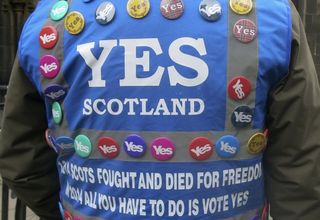
The question on the ballot is simple—and binding: “Should Scotland be an independent country?” For most Scots, the answer is simple, too. Polls show at least 40 percent on either side, with the Noes ahead—but the Yeses gaining. “England looks like a strange country,” says Lesley Riddoch, author of Blossom: What Scotland Needs to Flourish. “That’s what you can’t see if you live in it.”

“If we split we’re no’ going to have an army, a navy or an air force—just a coast guard,” says the taxi driver who picks me up at Edinburgh’s Waverly Station. “You can only defend an island if we stick together.”

Anxiety about how Scotland would fare on its own is a common theme among No supporters—though more often expressed in terms of economics than national security. Would the Royal Bank of Scotland—which got a £46 billion bailout from the British taxpayer in 2008—have survived? Can a small country generate the jobs, and the exports, needed to prosper in the global economy?

Alex Salmond, leader of the Scottish Nationalist Party (SNP), argues that thanks to North Sea oil, “Scotland is one of the richest countries in the world, wealthier per head than France, the UK and Japan.” Speaking at a forum at Edinburgh University, Salmond’s biographer, David Torrance, dismissed such claims as “intellectually dishonest.”

Nor is Torrance sympathetic to the view that only the dead hand of London-centered rule keeps Scotland from becoming a Scandinavian-style social democracy. “All the tools required to decrease inequality—taxation, property tax, education, welfare provision—already exist,” says Torrance, pointing out that the Scottish Parliament currently controls spending on health and education, and that Labour and the Tories have both pledged greater devolution if the referendum fails.

For Better Together backers like novelist J.K. Rowling, independence is a risky distraction. “All the major political parties are currently wooing us with offers of extra powers,” said Rowling in June, announcing a £1 million donation to the No campaign. If Scotland leaves now, she warned, “we will have to deal with three bitter neighbours.”

More here.

Back to Yalta?: Stephen Cohen and the Ukrainian crisis

Koposov_468w

Nikolay Koposov in Eurozine (Photo: Zurbagan /Shutterstock.com. Source: Shutterstock):

Cohen built his reputation as a leading scholar of Russian studies in the 1970s, and his interest in Soviet history was informed by his leftist political sympathies. Cohen's focus has always been on the “lost alternatives” to Stalinism and the possibility of “socialism with a human face”. In the 1980s, he was an ardent supporter of Mikhail Gorbachev's attempt to reform Soviet society. But the more hope he invested in perestroika, the bitterer his disappointment became in Boris Yeltsin's “dismantling” of the USSR. Cohen considers Yeltsin's reforms “the worst economic and social catastrophe ever suffered by a major nation in peacetime”, and even a case of the “de-modernization” of a highly developed society. Hence his sympathy for Putin, whom he refuses to accuse of “de-democratizing” Russia simply because what Yeltsin built had (according to Cohen) nothing to do with democracy. However, the United States wholeheartedly supported Yeltsin through its “ill-conceived and ultimately disastrous crusade to transform post-communist Russia into 'the kind of Russia we want'”, or a society similar to the American one. But for Cohen, that was a purely messianic and unrealistic goal.

Cohen's critics have suggested several explanations for his praise of Putin: a desire to always go against the flow, ardent anti-Yeltsinism, or a rejection of “American imperialism” that makes him blind to the problems associated with its opponents. Some even suspect him of anti-Americanism. For his part, Cohen presents himself as a “political realist” and an American patriot whose concern is the security of the United States, which according to him has been consistently undermined by US policymakers and experts whose incompetence and “Putinophobic follies” have deprived the United States of “the best potential partner we had anywhere in the world to pursue our national security”.

This is not perhaps the most natural self-presentation for a leftist intellectual. However, it reflects the contradictory situation in which an “old-school leftist who has carried on the mental habits of decades of anti-anti-communism seamlessly into a new career of anti-anti-Putinism” can find himself. Indeed, Putin's Russia, “a country of corrupt crony capitalism […] and a repressive state that increasingly leans on a subservient church as its source of moral authority” can only “stand for everything a leftist should detest”. The “fellow travellers” of the 1930s managed to overlook the gulag because their dreams of the “radiant future” were associated with the USSR. There are no similar dreams in the present-day world: “Russia is not the vessel for their [former Soviet fellow travellers'] ideological fantasies, but merely a placeholder for their accumulated discontent”, writes Jonathan Chait.”

I value Cohen's calls for critical re-examination of US foreign policy as well as Russian history. However, this re-examination need not lead us to support an openly anti-democratic regime and identify its interests with the legitimate interests of the country it runs.

More here.

The Age of Hobsbawm

07freedland-master495Jonathan Freedland at The New York Times:

In these lectures and reviews, he argues that the high culture that was once the basic diet of the European bourgeoisie is shriveling fast — either unknown to new generations or else swamped by today’s deluge of permanent, round-the-clock electronic entertainment, “the great simultaneous circus show of sound, shape, image, color, celebrity and spectacle that constitutes the contemporary cultural experience.” Addressing the Salzburg Festival, he cites as an example “the crisis in classical music, whose fossilized repertoire and aging public” mean that a once vital form is now reduced to a handful of great works repeated as if on a loop, performed in lavish but subsidized opera houses to a rich but diminishing audience. With a knack for the telling fact, he reports that the core public for live classical music in New York is estimated “at no more than some 20,000 people.”

Again and again, he mourns those features of the European cultural landscape that have been erased. One chapter is devoted to the disappearance of Mitteleuropa, its once ethnically mixed, plural cities now rendered monochromatically “mononational”; another laments the destruction of the place Jews made for themselves within German culture. The grief of that observation is personal. For Hobsbawm — though born in Alexandria, Egypt, in 1917 — grew up in Austria and Germany. He was a schoolboy witness in Berlin the day Hitler was sworn in as chancellor. And yet, departure from Germany was not solely a relief. It was also a loss.

more here.

ON THE LETTERS OF DAVID MARKSON

UrlLaura Sims at The Quarterly Conversation:

A recluse is someone who “lives a solitary life and tends to avoid other people . . . often for religious meditation.” The novelist David Markson, famously reclusive in the last few decades of his life, would have scoffed at the latter part of that definition—unless you count literature as a religion, of course. In one of his notes to me from Fare Forward: Letters from David Markson, which recounts our seven-year correspondence and friendship, he brings up his “goddamn reclusiveness” himself, saying he “cannot explain” it, “but it’s in the last few books, I’m sure.” It certainly is—his books are full of narrators shut off from the world—either by choice or circumstance, or a little of both. The narrator of Reader’s Block, for instance, often remarks, “Nobody comes. Nobody calls,” perhaps because “Children depart, miscellaneous relationships wither. Friends move to distant places. Friends die.” But he also recalls that, “In fact Protagonist has any number of friends. Among the living and accessible,” and that he himself doesn’t know “why or even when it was that he commenced to fall out of touch.”

Knowing these narrators and how their lives paralleled David’s own, it’s difficult to deny his being a recluse. I certainly held that image of him, and nursed it, secretly cherishing it because it meant I was one of the few people with whom he corresponded, and with whom he would occasionally meet. Arranging our first meetings in person was something of a nightmare—even after he’d said “I will will will see you when you’re here,” and committed to a date, time, and place, he would often cancel at the last minute, citing one or more of his myriad illnesses, his anxiety over the pending results of medical tests, or even inclement weather.

more here.

Philip Larkin: Life, Art and Love

1d952e3b-fa0a-477e-973f-cd86e026a506Roger Lewis at the Financial Times:

Philip Larkin was the greatest poet of the 20th century, his works an elegy for England and Englishness, a meditation on loneliness and loss. I salute James Booth for making this plain in his new book, for ever since the early 1990s the crude critical consensus has been that beneath the “monument” of Larkin’s reputation ran a sort of “sewer” that for some reason called his artistry into question.

Yet since when was it necessary to be a nice person if you wanted to be a creative genius? Wagner was horrible. Orson Welles was difficult. The controversy over Larkin’s apparent misogyny and Little Englandism took hold, however, and Booth does brilliantly well to remind us of the “quirky self-ironic euphoria and manifest enjoyment of the process of writing itself” that always characterised every Larkin sentence, whether in his verse, his letters, his reviews or his pair of novels. It is perhaps the sheer playfulness of Larkin’s high intelligence that the professors couldn’t tolerate. Booth, literary adviser to the Philip Larkin Society and a former colleague of the poet’s at Hull university, reminds us that this was a person of myriad facets – ribald, reactionary, wistful, astringent, reflective by turns.

more here.

Future Footprints

Rob Nixon in The New York Times:

BookFor the first time in history, a sentient species, Homo sapiens, has become a force of such magnitude that our impacts are being written into the fossil record. We have decisively changed the carbon cycle, the nitrogen cycle and the rate of extinction. We have created ­new atomic isotopes and plastiglomerates that may persist for millions of years. We have built mega­cities that will leave a durable footprint long after they have vanished. We have altered the pH of the oceans and have moved so many life-forms around the globe — inadvertently and ­intentionally — that we are creating novel ecosystems everywhere. Since the late-18th-century industrialization that marks the Anthropocene’s beginnings, humans have ­shaken Earth’s life systems with a profundity that the paleontologist Anthony Barnosky has likened to an asteroid strike. The Anthropocene — the Human Age — provides Diane Ackerman with the subject for her 24th and most ambitious book. Ackerman has established herself over the past quarter of a century as one of our most adventurous, charismatic and engrossing public science writers. Since her 1990 breakout title, “A Natural History of the Senses,” she has demonstrated a rare versatility, a contagious curiosity and a gift for painting quick, memorable tableaus drawn from research across a panoply of disciplines. “The Human Age” displays all these alluring qualities, as Ackerman delves into fields as diverse as evolutionary robotics, urban design, nanotechnology, 3-D printing and biomimicry. The book simultaneously raises unanswered questions about the politics and ethics of the Anthropocene idea.

…We learn that at Stockholm’s Central ­Station engineers are harvesting the concentrated body heat from 250,000 daily commuters to warm a 13-story office building nearby. We learn how research into what the biologist Joshua Lederberg describes as “the menagerie of the body’s attendant microbes” is altering assumptions about the multispecies being that we habitually call the self. We hear about brain scientists measuring the evolutionary impact of the online life, not least on our Google-corroded memories. We hear how, as humans are precipitating the planet’s sixth extinction, we are also producing unheard-of synthetic “species.”

More here.

Friday, September 5, 2014

Philosophy, science and expertise

Mark English in Scientia Salon:

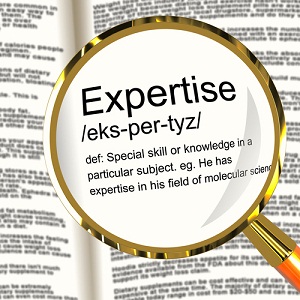
ExpertiseLet me make a very simple — and, I hope, uncontroversial — point about expertise and authority before looking at some questions pertaining to the current (increasingly bitter) debate about the nature and status of philosophy and its relation to the sciences.

Expertise implies epistemic authority: the expert — by definition — speaks with authority within his or her area of expertise. If the expertise is recognized, the authority automatically follows and doesn’t have to be claimed or argued for.

But the word “expertise” normally applies only to reasonably narrow, clearly defined and recognized areas of knowledge, theoretical or practical. And general philosophy (encompassing all the traditional sub-disciplines) is just too broad and ill-defined for the word to apply in any natural or straightforward sense. Its meaning must be, as it were, stretched to fit.

There is even disagreement about what philosophy is about — or if it is about anything at all.

Some see it as the normative study of rationality. But it is simply not plausible in my view that philosophy (or any single discipline) could effectively encompass the entire realm of reason or rationality. Logic perhaps, but reason is a much broader concept.

Massimo Pigliucci prefers to see philosophy as being concerned with the exploration of conceptual as distinct from empirical space (the sciences being focused on the latter)[1]. But, again, conceptual space is just too vast an area to be subsumed by any one discipline. Besides, unconstrained by empirical (or mathematical) considerations, conceptual space is really not all that interesting. And of course, the sciences are just as much about model-building (i.e., exploring conceptual space) as they are about empirical evidence; and mathematics is pretty much all about exploring conceptual spaces of certain kinds.

More here.

Can news literacy grow up?

Lindsay Beyerstein in the Columbia Journalism Review:

Newslit1In 2005, as Howard Schneider was developing a plan for Stony Brook University’s new journalism school, he taught a course called Ethics & Values of the American Press as a way to get to know the students. He was shocked to discover that about a third of his students believed everything they read—from The New York Times to People magazine—and judged it all to be equally credible. Another third reflexively rejected anything in the news as hopelessly biased. And the remaining third were confused and peppered him with questions, like, “Is Michael Moore a journalist?” and “Is Oprah a journalist when she interviews the survivors of Hurricane Katrina?”

“That class haunts me,” says Schneider, a former editor at Newsday. It also shaped his proposal for the new journalism school. At the time, Bowling Alone, Robert Putnam’s 2000 treatise on the decline of civic engagement in America, had helped spur a national debate about the future of democracy and what our young people needed to be effective citizens. Schneider was convinced that a modern journalism school could no longer teach only journalism; it needed to reinvent itself as the purveyor of a core competency for the entire student body: the ability to be savvy and critical consumers of news and information.

He oversaw the creation of a 15-week “news-literacy” class, open to all students at Stony Brook, and a movement was born. In 2006, the John S. and James L. Knight Foundation gave Stony Brook $1.7 million to enroll 10,000 students in the course—the university hit that mark this fall.

More here.

Marat and Sade in Las Vegas

Marat-sade[1]Stefany Anne Golberg at The New England Review:

In the days before personal computers, when Xeroxing books was a punishable crime, I hand-typed the entirety of The Persecution and Assassination of Jean-Paul Marat as Performed by the Inmates of the Asylum of Charenton Under the Direction of the Marquis de Sade for my personal collection, as such a book was not generally available in 1980s Las Vegas. I’d borrowed a copy from the UNLV library. Marat/Sade is a play written by the German postwar playwright Peter Weiss. Weiss incorporates a play within the play, one written by de Sade, to be performed by his fellow inmates at the Charenton asylum. So Weiss’s actors play lunatics staging de Sade’s play, and also act as various historical figures with whom de Sade has philosophical dialogues.

What was the appeal, for a fifteen-year-old girl, of a story about a nihilistic and lecherous Revolution-era Frenchman—portrayed by a postwar German avant-gardist—who writes and directs a play in an insane asylum? In Marat/Sade, an actress plays a somnambulist who plays the part of Charlotte Corday, assassin of the Jacobin leader Jean-Paul Marat, as he lay in the bathtub. Marat is played by a paranoid schizophrenic. The radical priest Jacques Roux, who stabbed himself to death in prison, is played by an inmate in a straightjacket. These characters felt very true to me, their concerns urgent ones. They screamed for freedom, and for justice, and then broke into ecstatic singing, and laughed until the asylum staff beat them back into the corners.

more here.

george herbert: writing for god

George-herbertMark Jarman at Hudson Review:

The most curious event in George Herbert’s short life, after its abrupt change of direction, may be his marriage in 1629 to Jane Danvers, a cousin of his stepfather. Her father, Charles Danvers, had, as Drury notes, “a particular fondness for George Herbert,” and the marriage itself seems to have been urged on Jane and George by Danvers. It seems to have been little more than the sanctification of a platonic relationship. As a teenager Herbert had told his mother he would dedicate his life to chastity. In a chapter entitled “The Parson’s State of Life,” in The Country Parson, he claims explicitly “virginity is a higher state than matrimony,” and therefore, the parson is “rather unmarried than married.” This seems to be a Pauline view, but even St. Paul admitted that it was better to marry than to burn. In Herbert’s case, though, not being married presented an impediment to his success as a parson. He notes in the same chapter that, for an unmarried country parson, ministering to women alone, without an audience, can lead to all kinds of rumor and gossip. So, in these circumstances, he concludes, it is probably better for a parson to marry, as long as “the choice of his wife [is] made rather by his ear than by his eye” and that he choose her for “humble and liberal disposition . . . before beauty, riches, or honour.” Jane Danvers and George Herbert were married for only four years, until he died, during which time there were no children. The role he expected of her is clearly laid out in The Country Parson. Six years after Herbert died, Jane Danvers remarried, had a daughter with her second husband, outlived him, too, and died some fifteen years after Herbert’s death. I find it notable that she had a child with her second husband. Though she grieved for her first husband for six years before marrying again, it may have been a welcome change to enter into a conjugal relationship with a willing man.

more here.

Roberto Bolaño’s final novella

Antonin_artaud_jeune_b_sdDan Piepenbring at Paris Review:

The English translation of Roberto Bolaño’s excellent final novella, A Little Lumpen Novelita, is out this month. The book opens with an epigraph by Antonin Artaud, who was born today in 1896: “All writing is garbage. People who come out of nowhere to try to put into words any part of what goes on in their minds are pigs.”

Since I read it about a month ago, I’ve thought of this quotation every day, often as I’m writing—you can imagine the rat-a-tat of my keyboard punctuated with an occasional “All writing is garbage.” It’s a bracing sentiment, taunting and misanthropic, and a truer one than most of us would care to admit. At the moment, it flies in the face of our glad-handing literary culture, where every book is a good book and every writer in every MFA program partakes of a dignified struggle with Art.

Here’s how that quotation, which comes from Artaud’s The Nerve Meter (1925), goes on:

The whole literary scene is a pigpen, especially today. All those who have points of reference in their minds, I mean on a certain side of their heads, in well-localized areas of their brains, all those who are masters of their language, all those for whom words have meanings, all those for whom there exists higher levels of the soul and currents of thought, those who represent the spirit of the times, and who have named these currents of thought, I am thinking of their meticulous industry and of that mechanical creaking which their minds give off in all directions—are pigs.

more here.

the birth of an inspiring new feminism

Cobble, Gordon and Henry in Salon:

Beyonce_swiftTexts have helped to spread feminist ideas since the beginning of the U.S. women’s movement — from suffragist newspapers in the nineteenth century to mimeographed manifestos of the late 1960s to bestselling feminist books in all eras. In the late 1960s, it was not uncommon for feminist groups to write political statements, or manifestos, outlining their beliefs and goals. Such documents tended to come out of consciousness- raising and political groups, produced by a collective of women rather than just one author. Documents of this type, such as the “Redstockings Manifesto” (1969), were widely circulated in pamphlet form and often republished in feminist journals and anthologies, some of which became bestsellers, such as the collection “Sisterhood Is Powerful” (1970). Likewise, the emergence of a new feminist sensibility in the post-1990 era can be connected to texts, whether Rebecca Walker’s 1992 Ms. essay or feminist books preceding it, such as Susan Faludi’s “Backlash: The Undeclared War Against American Women” (1991) and Naomi Wolf’s “The Beauty Myth: How Images of Beauty Are Used Against Women” (1991). Texts were especially important in giving a presence to this new feminism, since it did not rely on the gathering of women in activist groups. If the women’s liberation movement of the late 1960s and 1970s was characterized by the rapid formation of groups and publication of their manifestos, the feminism that emerged in the mid-1990s developed primarily through the publication of individually authored texts. Texts named the generation, texts energized it, and reading texts became a way of participating in the contemporary movement.

…Perhaps one of the biggest changes in popular culture over the last two decades has been the emergence of women (and often feminist) comedians into the previously all-male world of stand-up comedy and comedy writing. Women like writer-actress-producer Tina Fey used humor to challenge sexism and misogyny and to astutely reflect on what passed for gender equality in the twenty-first century. On the inaugural episode of Fey’s critically acclaimed series “30 Rock” (2006–13), which she wrote, her alter ego, Liz Lemon, is described as “a third- wave feminist,” and over the course of the series Fey humorously poked fun at modern womanhood and the media-hyped crisis over “having it all.” Other feminist comedians during this period included Mindy Kaling, Sarah Silverman, Wanda Sykes, and Margaret Cho, who famously summed up her generation’s entitlement: “If you say you’re not a feminist you’re almost denying your own existence. To be a feminist is to be alive.”

More here.

Jihad’s fatal attraction

Scott Atran in The Guardian:

ScreenHunter_786 Sep. 05 12.23In a speech on Wednesday, President Obama said: “Whatever these murderers think they will achieve by murdering innocents like Steven [Sotloff], they have already failed.”

Not so, says the evidence. Publicity, Islamic State (Isis) knows, is the oxygen of terrorism. And publicity it has received in spades with the beheadings of two American journalists. So an organisation that hardly anyone knew existed only a few months ago is now the world’s, and particularly the west’s, premier political and public concern, eclipsing Iran’s nuclear programme and Russia’s actions in Ukraine.

The aim of Isis’s strikingly gruesome spectacle is to terrorise and fascinate public sentiment. Especially in the media-driven political theatre of western liberal democracies, public fury reliably leads to precipitate political reaction. Like the kind of heedless, scatter-gun approach pursued by America and Britain that transformed al-Qaida from a small band of fairly well-educated violent extremists into a youthful social movement that appeals to many thousands of disaffected Muslim immigrants in the western diaspora, and many more millions who are economically and politically frustrated back home.

Unlike al-Qaida, though, from which Isis was expelled earlier this year, Isis tolerates no compromise with other interpretations of Islam, much less with Islam’s duty to rule the world. In its view, America and Britain are too weak in the conviction of their ideas and ideals to ultimately matter. For the devoted actor, rightness of cause will always win against apparent material advantage as long as the cause has the minimal material means to endure.

Isis’s violence is far from being nihilistic – a charge usually levelled by those who are wishfully blind to the attraction of their foes. The moral worldview of the devoted actor is dominated by what Edmund Burke referred to as “the sublime”: a need for the “delightful terror” of a sense of power, destiny, a giving over to the ineffable and unknown.

More here.

The Harm Men Do Women in the Bronx

Cassie Rodenberg in Scientific American:

JohnBased on ethnographic fieldwork conducted while residing next to a crack house in El Barrio, New York, for almost five years, this article analyses how the social and economic marginalization of second- and third-generation Puerto Rican immigrants in the inner city has polarized violence and sexuality against women and children, both within the family and on the street. Traditional working-class patriarchy has been thrown into crisis by the restructuring of the global economy and the expansion of women’s rights. Unable to replicate the rural-based models of masculinity and family structure of their grandfathers’ generation, a growing cohort of marginalized men in the de-industrialized urban economy takes refuge in the drug economy and celebrates a misogynist, predatory street culture that normalizes gang rape, sexual conquest, and paternal abandonment. Marginalized men lash out against the women and children they can no longer support economically nor control patriarchally.¹

John’s girl, Diane, jumps into cars. She sits on a bucket seat ripped from a SUV. There, in its place left on the side of the road, she waits for men to drive by, stare, comment, gesture. Men like the punk rocker look, so she rips her tights, more than the day typically does, for show. She’s had a good run of not being raped, so she figures she’ll be fine. John sits on cardboard next to the bucket seat anticipating her return. Sometimes he get impatient and leaves to get food. As if staying would do anything. Her money buys them the crack and heroin, the rented room. These things, this discontent, come outs when she smokes crack. It becomes unreal that you do everything. But it is expected. It is the way things go.

More here.

3QD Science Prize Finalists 2014

Hello,

FinalistScience2014The editors of 3QD have made their decision. The twenty semifinalists have been winnowed down to six, and three wildcard entries added. Thanks again to all the participants. Details of the prize can be found here.

On the right is a “trophy” logo that our finalists may choose to display on their own blogs.

So, here it is, the final list that I am sending to Frans B. M. de Waal, who will select the 1st, 2nd, and 3rd prize winners from these: (in alphabetical order by blog name here)

  1. 3 Quarks Daily: The Dictionary is not Literature
  2. Curious Meerkat: Eating Insects
  3. Eruptions: So, You Think Yellowstone Is About to Erupt
  4. Genotopia: On city life, the history of science, and the genetics of race
  5. Preposterous Universe: Why the Many-Worlds Formulation of Quantum Mechanics Is Probably Correct
  6. Science Sushi: Did Allergies Evolve To Save Your Life?
  7. Slate: Promiscuity Is Pragmatic
  8. The Loom: The Wisdom of (Little) Crowds
  9. The Philosopher's Beard: Love's Labours Lost: How Robots Will Transform Human Intimacy

We'll announce the three winners on September 22, 2014.

Good luck!

Abbas

P.S. The editors of 3QD will not be making any comments on our deliberations, or the process by which we made our decision, other than to simply say that we picked what we thought were the best six posts out of the semifinalists, and added three others which we also liked.