
Category: Recommended Reading
Palestinians die in the most cynical of all military games
Hussein Ibish in The National:

But this time it’s different. It’s no longer about Egypt playing a crucial mediating role. Instead, Hamas is mainly seeking to extract concessions not from Tel Aviv or Ramallah, but from Cairo.
Hamas, or more likely loosely affiliated rogue elements based in Hebron, deliberately lit a fire by kidnapping and murdering three Israeli teenagers. This unleashed a brutal series of tit-for-tat attacks between Israelis and Palestinians that spiralled out of control.
Certainly, the Palestinian Authority based in Ramallah had no control over what was going on in occupied East Jerusalem, let alone unrest among Palestinian citizens of Israel.
The Israeli government, too, clearly lost control of the situation when fanatics grabbed an innocent teenager and tortured and burnt him to death. Even Israel’s security forces seemed to be acting beyond any bounds of restraint as they brutally beat a 15-year-old Palestinian-American cousin of the murder victim.
Passions ruled the day. Years of incitement and frustration on both sides boiled over.
As rocket attacks on southern Israel from Gaza increased, it also seemed that Hamas leaders perhaps didn’t control their own military, and certainly not that of other, more extreme groups like Islamic Jihad.
Yet Hamas sought some kind of benefit in the chaos.
More here.
Wednesday Poem
First Things to Hand
In the skull kept on the desk.
In the spider-pod in the dust.
Or nowhere. In milkmaids, in loaves,
Or nowhere. And if Socrates leaves
His house in the morning,
When he returns in the evening
He will find Socrates waiting
On the doorstep. Buddha the stick
You use to clear the path,
And Buddha the dog-doo you flick
Away with it, nowhere or in each
Several thing you touch:
The dollar bill, the button
That works the television.
Even in the joke, the three
Words American men say
After making love. Where's
The remote? In the tears
In things, proximate, intimate.
In the wired stem with root
And leaf nowhere of this lamp:
Brass base, aura of illumination,
Enlightenment, shade of grief.
Odor of the lamp, brazen.
The mind waiting in the mind
As in the first thing to hand.
by Robert Pinsky
World’s First Climate-Controlled City
Carl Engelking in Discover:

The Mall of the World is expected to accommodate some 180 million visitors annually, and every visitor can savor the sealed city for a week without ever stepping foot outside. Enclosed promenades 7 kilometers long, with trams for quick transport, will connect visitors to all the facilities and districts throughout the mall. The Mall of the World’s centerpiece will be the cultural district, which will recreate the world’s most famous landmarks from London, New York and Barcelona. The cultural district will be enclosed in a massive, golf-ball shaped dome and play host to weddings, conferences, performances, and a host of other celebrations.
More here.
Bertrand Russell’s lofty pacifism
Jonathan Ree in The New Humanist:
a very widespread feeling that however bad their policies may be, there is nothing that private people can do about it. This is a complete mistake. If all those who disapprove of government policy were to join massive demonstrations of civil disobedience they could render government folly impossible and compel the so-called statesmen to acquiesce in measures that would make human survival possible.
The impact of Russell’s rhetoric – his arch sarcasms, unflappable certainties and stark antitheses – was enhanced by images of a dapper old gentleman sitting down in the street with fellow protestors and getting himself arrested in 1961 for breach of the peace. When asked by the magistrate whether he promised to be of good behaviour he said, “No, I do not” and was sentenced to seven days in Brixton prison.
More here.
Tuesday, July 15, 2014
Adventures in the Anthropocene

Some 40 per cent of the earth's ice-free land mass is now intensively farmed to produce food. Only 12 per cent of its rivers run freely to the seas. Nearly one billion people go hungry every day; 1.5 billion are overweight or obese. Each year, more than 300,000 sea birds die on fishing lines and 100 million sharks are killed. Every square kilometre of sea contains 18,500 pieces of floating plastic. Only 1 per cent of the world's urban population are breathing air clean enough to meet EU standards according to a 2007 report by the World Bank (the Chinese government, fearing social unrest, redacted it on publication).
These are the facts we hear every day, yet we seem inured to their impact. In the wake of last February's storms, I took a train ride across Suffolk and into Essex. The land around the tracks was flooded, it was an almost apocalyptic scene, yet my fellow passengers barely gave the inundation – and the devastation that it represented to both the wildlife and the human managers of the land – a second glance. It felt like a glimpse of the future: a drastically changed world, greeted with a weary shrug of the shoulders.
more here.
How women got in on the Civil Rights Act

For twenty years, the belief that the sex provision was a monkey wrench that unintentionally became part of the machine was the conventional wisdom about Title VII. But when scholars—including Michael Gold, Carl Brauer, Cynthia Deitch, Jo Freeman, and Robert Bird—dug into the archives they not only learned that the real story of the sex amendment was quite different; they essentially uncovered an alternative history of women’s rights.
The person behind the sex amendment was the seventy-nine-year-old leader of a tiny fringe organization called the National Woman’s Party. Alice Paul was a major figure in the American suffragist movement, back at the time of the First World War. Paul was a Quaker. She attended Swarthmore and then the University of Pennsylvania, where she earned the first of many advanced degrees. In 1907, she went to study in Britain and got caught up in the suffragist movement, led by Emmeline Pankhurst. It changed her life.
Pankhurst ranks with Gandhi and King as one of the great practitioners of what King and others called “direct action.” She had suffragists break windows, chain themselves to the gates of Buckingham Palace, disrupt meetings.
more here.
Nadine Gordimer (1923 – 2014)

'Beethoven was one sixteenth black,' the presenter of a classical music programme on the radio announces along with the names of musicians who will be heard playing the String Quartets No. 13 Op. 130 and No 16 Op. 135.
Does the presenter make the claim as restitution for Beethoven? Presenter's voice and cadence give him away as irremediably white. Is one sixteenth an unspoken wish for himself?
Once there were blacks wanting to be white.
Now there are whites wanting to be black.
It's the same secret.
Frederick Morris (of course that's not his name, you'll soon catch on I'm writing about myself, a man with the same initials) is an academic who teaches biology and was an activist back in the apartheid time, among other illegal shenanigans an amateur cartoonist of some talent who made posters depicting the regime's leaders as the ghoulish murderers they were and, more boldly, joined groups to paste these on city walls.
more here.
The Advanced Metrics of Attraction
John Allen Paulos in The New York Times:

The second relevant statistical notion is Bayes’s theorem, a mathematical proposition that tells us how to update our estimates of people, events and situations in the light of new evidence. A mathematical example: Three coins are before you. They look identical, but one is weighted so it lands on heads just one-fourth of the time; the second is a normal coin, so heads come up half the time; and the third has heads on both sides. Pick one of the coins at random. Since there are three coins, the probability that you chose the two-headed one is one-third. Now flip that coin three times. If it comes up heads all three times, you’ll very likely want to change your estimate of the probability that you chose the two-headed coin. Bayes’s theorem tells you how to calculate the new odds; in this case it says the probability that you chose the two-headed coin is now 87.7 percent, up from the initial 33.3 percent.
More here.
ISIS: The New Taliban
Ahmed Rashid in The New York Review of Books:

Yet despite these accomplishments, ISIS may not be as unusual as it has been described. Nor does it seem primarily interested in global jihad. In many ways, what the group is doing to Syria and Iraq resembles what the Taliban did in Afghanistan and Pakistan in the early 1990s. Like the Taliban, ISIS’s war so far has been about conquering territory rather than launching an al-Qaeda-style global jihad or issuing fatwas to bomb New York or London. Although it has attracted some three thousand foreigners to fight for it, ISIS’s real war is with fellow Muslims, and in particular Shias, against whom it has called for a genocidal campaign. Just as the Taliban changed the contours of Islam in south and central Asia so ISIS intends to do the same in the Middle East. ISIS is also seeking territorial control of the central Middle East region. There are several instructive parallels between the two groups. The hardcore forces of ISIS probably number fewer than 10,000 trained fighters; the Taliban never numbered more than 25,000 men—even at the height of the US surge when there were over 150,000 Western troops in Afghanistan and twice that many Afghan soldiers.
More here.
Monday, July 14, 2014
perceptions
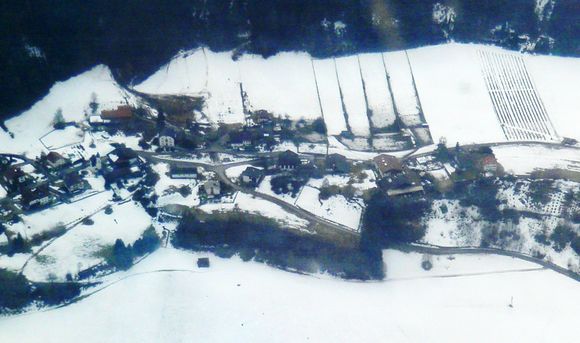
Sughra Raza. Aerial “painting” over Innsbruck, March 2012.
Digital photograph.
CATSPEAK
by Brooks Riley

Sunday, July 13, 2014
Germany Wins, World Cup Justice Is Served
Tunku Varadarajan in The Daily Beast:

We had had a captivating but goalless 90 minutes of regulation play and were in the game’s supplementary phase. Andre Schürrle, Germany’s winger, ran down Argentina’s left flank and looped a luscious pass to Götze in the 23rd minute of extra time. Götze, the German center-forward, had made his way into a scoring position behind a scrum of defenders, and what he did next was balletic and ruthless: He let the ball come on to his chest, which was tensed to receive it but soft enough to drop the ball to his feet; and as the ball descended, the pace of Schürrle’s pass having been taken off it, Götze whipped it into the Argentine goal. Germany led 1-0. Minutes later, it had won, 1-0.
Let us pause, here, for a taste of numbers: Until Götze’s goal, scored with just over six minutes left on the clock, Argentina had not conceded for 457 minutes of play. That is an astonishing spell of impregnability, one that looked set to last through to a penalty shoot-out tonight.
More here.
How Politics and Lies Triggered an Unintended War in Gaza
J. J. Goldberg in Forward:

That’s unusual language for a military mouthpiece. Typically they spout lines like “We will take all necessary actions” or “The state of Israel will defend its citizens.” You don’t expect to hear: “This is the politicians’ idea. They’re making us do it.”
Admittedly, demurrals on government policy by Israel’s top defense brass, once virtually unthinkable, have become almost routine in the Netanyahu era. Usually, though, there’s some measure of subtlety or discretion. This particular interview was different. Where most disagreements involve policies that might eventually lead to some future unnecessary war, this one was about an unnecessary war they were now stumbling into.
Spokesmen don’t speak for themselves. Almoz was expressing a frustration that was building in the army command for nearly a month, since the June 12 kidnapping of three Israeli yeshiva boys. The crime set off a chain of events in which Israel gradually lost control of the situation, finally ending up on the brink of a war that nobody wanted — not the army, not the government, not even the enemy, Hamas.
More here.
Whisper it softly: it’s OK to like Germany
Stewart Wood in The Guardian:
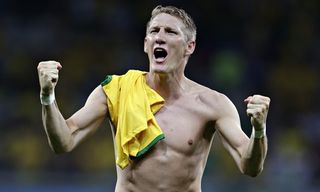
Dip into the weekend papers, the blogosphere & the musings of the twitterati, and you'll see multiple variants on a similar sentiment: “I can't quite believe it, and I never thought this would happen, but I find myself supporting Germany. Fancy that!”
Usually our praise for German football is similar to our praise for Germans in other spheres of life where they lead the world. We cloak it in begrudging virtues: “efficient”, “clinical”, “ruthless”. Germans are applauded in the language we use to describe well-functioning inanimate objects, such as Mercedes cars, or Miele dishwashers. And characteristics of good cars and dishwashers are, by implication, characteristics of people that you admire in a slightly resentful way.
So we are impressed with Germany, but we don't have any particular affection for it or its people. We have respect for Germany, but we don't want to spend much time there. We applaud Germans' economic success, but we resent their dominance of the European Union. We make lots of jokes at their expense, but we say they have no sense of humour.
More here.
The problem of Richard Feynman
Via Jennifer Ouellette, Matthew R. Francis in Galileo's Pendulum:
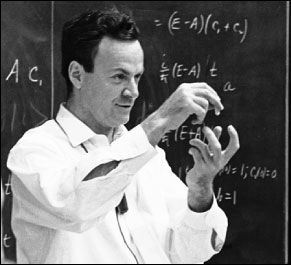
Feynman stories that get passed around physics departments aren’t usually about science, though. They’re about his safecracking, his antics, his refusal to wear neckties, his bongos, his rejection of authority, his sexual predation on vulnerable women. Admittedly, that last one isn’t usually spelled out so blatantly. It’s usually framed as “oh, times were different” or “that was just Feynman being himself” or (if the person was at leasttrying to not to let the behavior slide) “he was a flawed human being”. Some simply ignore that side of him entirely. Some will pull out the admirable example of his encouragement of Joan Feynman, his sister, as proof that he couldn’t truly harbor horrible attitudes about women.
The problem is that the facts are against any excuses. Feynman pretended to be an undergraduate to get young women to sleep with him. He targeted the wives of male grad students. He went to bars and practiced a technique that isn’t so different from the reprehensible “game” of the pick-up artists (PUAs).[1] This is all public record, including anecdotes in his own words from his sorta-memoirs Surely You’re Joking, Mr. Feynman and What Do You Care What Other People Think?[2]
At Boing Boing, Maggie Koerth-Baker quoted from an infamous passage where Feynman describes the evolution of his thinking on disrespecting women. (For an even longer quote, see this one at the Restructure! blog.) Not only did he think this way, he also considered it important enough to describe in detail for his memoirs several decades after the events in question, and not to repudiate it either. As Koerth-Baker says,
To Feynman’s credit, he seems to decide this isn’t something he wants to keep doing. But he never seems to get what was really wrong with the idea and it’s frustrating that he seems to get close to the realization that you can (le gasp!) just treat women like humans, only to swish past it and end up in a pit of vile crap.
He evidently considered it an important part of his life’s story.
And let’s face it: Feynman frequently unkind toward men too. In his memoirs, he tends to spin things to make himself into the smartest one in the room, and to make even his friends look like losers by comparison. Excessive self-deprecation is one thing, but it seems a trifle unfair to take potshots at friends in a medium where they can’t defend themselves.
In my best behavior, I am really just like him
Look underneath my floorboards for the secrets I have hid.
So wrote Sufjan Stevens in his powerful and creepy song “John Wayne Gacy, Jr.” While I think Stevens is going for a quasi-Calvinist perspective on human nature — we’re all so fundamentally screwed up that the difference between an ordinary singer and a serial killer is small — the point that we all harbor secrets is a valid one. Feynman’s life — both the bad and good — are more public knowledge than hopefully most of ours will ever be.
More here.
The Trouble With Brain Science
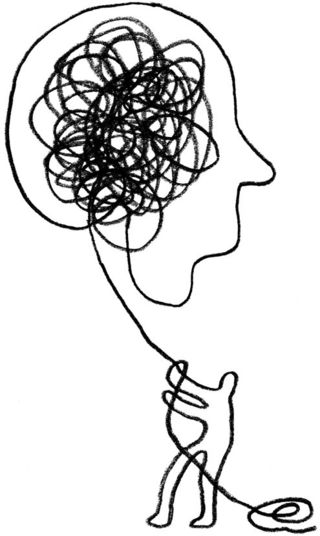
Gary Marcus in the NYT (image by Tim Lahan):
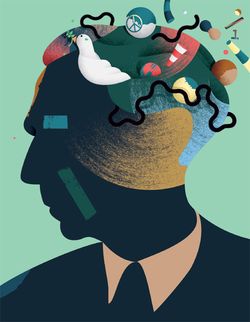
Different kinds of sciences call for different kinds of theories. Physicists, for example, are searching for a “grand unified theory” that integrates gravity, electromagnetism and the strong and weak nuclear forces into a neat package of equations. Whether or not they will get there, they have made considerable progress, in part because they know what they are looking for.
Biologists — neuroscientists included — can’t hope for that kind of theory. Biology isn’t elegant the way physics appears to be. The living world is bursting with variety and unpredictable complexity, because biology is the product of historical accidents, with species solving problems based on happenstance that leads them down one evolutionary road rather than another. No overarching theory of neuroscience could predict, for example, that the cerebellum (which is involved in timing and motor control) would have vastly more neurons than the prefrontal cortex (the part of the brain most associated with our advanced intelligence).
But biological complexity is only part of the challenge in figuring out what kind of theory of the brain we’re seeking. What we are really looking for is a bridge, some way of connecting two separate scientific languages — those of neuroscience and psychology.
Such bridges don’t come easily or often, maybe once in a generation, but when they do arrive, they can change everything. An example is the discovery of DNA, which allowed us to understand how genetic information could be represented and replicated in a physical structure. In one stroke, this bridge transformed biology from a mystery — in which the physical basis of life was almost entirely unknown — into a tractable if challenging set of problems, such as sequencing genes, working out the proteins that they encode and discerning the circumstances that govern their distribution in the body.
Neuroscience awaits a similar breakthrough.
More here.
What Happens When Digital Cities Are Abandoned?

Laura Hall in The Atlantic (image: flickr/Ray Dumas):
The nomenclature of the early Internet is domestic: home pages, key words, hosts. And in those days, the web was small, knowable. Search engines contained a finite, hand-indexed listing of every website that had been submitted.
In the late 1990s, GeoCities was one of the first sites that let people create webpages of their own. It was organized into topic-based neighborhoods, and those into suburbs, with what were essentially house numbers. Because the service was around so early on, and because it was free, many users found their first taste of internet self-expression there. When Yahoo! shut down GeoCities in April 2009, there was a concerted effort to collect and archive all of the site’s contents.
“The great paradox about these digital communities is that they’re easily kept around forever, and they are even more easily deleted utterly,” said Jason Scott, an Internet advocate and archivist who launched a digital preservation team that year. His Archive Team worked quickly to capture as much of the info as they could, backing it up on the Internet Archive and releasing a torrent of all of the files, and a handful of other sites scraped and reposted what they could.
“When we founded Archive Team, it was in a dearth of recognition that these communities had lasting historical and societal value,” Scott said. “They were considered to be byproducts, like a street corner—thinking of it as the point where two streets collide, rather than being a hangout that when removed, removes the entire community.”
I recently tried to revisit my own first homepage, a wonder of center-aligned blinking text, purple tiled backgrounds, clever “Under Construction” gifs and pixel-art icons I had traded with other GeoCities page owners. But all that remains is a single mention of the username on someone else’s page, a record of my having visited there once. Because of the nature of the sites, none of the archives of GeoCities is 100 percent complete, and it’s difficult to know for sure how much actually still exists; much of the data is simply being stored for a later date, when technology has reached the ability to collate and curate it all.
More here.