Limbo

The firstborn was handed back to them
in a small cask not much bigger than
a shoebox only wooden no more about it
they took it home by pony and trap
wasn’t the river in flood at the gate?
they had to climb down and wade through it
and she went alone with him
to the corner of a field below the house
a dry shaded place where he opened a grave
for it was April then and the pinkish
blossoms of whitethorn were emerging
and they lifted it low together
onto sods of damp earth
placed holy water with it
and everything she could to lay
a holy innocent to rest
as far as giving the boy a name
it was Martin the brother in Chicago
and when it came to saying good-bye
he had to draw her away she was so
lonely that shook him while
he covered it with clay for up to then
never a care but a demon for style
high heels you’ve never seen the like
though she gave birth again
she was often seen alone in that field
.

by Catherine Phil MacCarthy
from The Invisible Threshold
Publisher: Dedalus Press, Dublin

Thursday, July 10, 2014

On failed replications in social psychology

Jason Mitchell at Harvard:

Fixing_scienceWhen an experiment is expected to yield certain results, and yet it fails to do so, scientists typically work to locate the source of the failure. In principle, the cause of an experimental failure could lurk anywhere; philosophers have pointed out that a failed experiment might very well indicate a previously undetected flaw in our system of logic and mathematics[1]. In practice, however, most scientists work from a mental checklist of likely culprits. At the top of this list, typically, are “nuts-and-bolts” details about the way in which the experiment was carried out—was my apparatus working properly? did my task operationalize the variable I was aiming for? did I carry out the appropriate statistical analysis in the correct way? and so on. Very often, the source of the failure is located here, if only because the list of practical mistakes that can undermine an experiment is so vast.

Considerably lower down the list are various doubts for expecting particular results in the first place, such as uncertainty about the theory that predicted them or skepticism about reports of similar effects[2]. In other words, when an experiment fails, scientists typically first assume that they bungled the details of the experiment before concluding that something must be wrong with their initial reasons for having conducted it in the first place (or that logic and mathematics suffer some fatal flaw). This makes good sense: it would be inane to discard an entire theoretical edifice because of one researcher’s undetected copy-and-paste error or other such practical oversight.

More here. And see also this comment from Neuroskeptic.

The search for a science of the mind

P12_Kuper_a_1080478hAdam Kuper at the Times Literary Supplement:

In the early twentieth century, a handful of Cambridge men, young medical doctors mostly, established modern anthropology, neuroscience, psychology and psychotherapy in Britain. Ben Shephard sums up their quest as “a search for a science of the mind”, which was certainly a large part of it, but they were interested in a great many other things as well. They were close associates who influenced one another, but it would be a mistake to exaggerate the coherence of their projects or the extent to which they shared a common sense of what they were after. Because they were so eclectic and ranged so widely, they were not installed as ancestor figures in the disciplines into which the human sciences were beginning to fragment, even if they were influential in the committees that helped to shape the new professional institutions. Their names are therefore mostly unfamiliar today. Shephard rescues them from the oubliette of disciplinary histories and presents them as members of a cohort: a network of eccentric, wilful, brilliant men who were prepared to go anywhere, try anything, to advance the scientific understanding of human nature.

Central members of this cohort were brought together in the 1898 “Cambridge Anthropological Expedition to Torres Straits”, that narrow stretch of sea, with numerous islands, which separates Australia and New Guinea. The expedition was organized by a zoologist, Alfred Haddon.

more here.

Did the Civil Rights Act change the Constitution?

37259vMaggie Gram at n+1:

THIS JULY MARKS the fiftieth birthday of the 1964 Civil Rights Act. It is one of the most important pieces of legislation that Congress has ever passed; it made racial discrimination illegal in many of the walks of public life where it had been legally permissible before. Ten years before the Civil Rights Act became law, the 1954 decision in Brown v. Board of Educationhad taken America by surprise, generating a set of iconic images1 that are still stamped in our national historical memory. But a decade afterBrown, only two percent of southern African American children were attending integrated schools.2 Brown’s imagery stuck in the mind’s eye, but it was the Civil Rights Act that remade the country.

Other laws, of course, have also helped shape the country. But the Civil Rights Act is different in one major way: for many Americans born since its passage, it is very difficult to imagine political and social life without it. Imagine the United States losing the Civil Rights Act’s bans on employment discrimination or on the segregation of public places. Imagine us giving up its tools for the integration of schools and other public facilities. For a lot of people, it’s nearly unthinkable.

more here.

The extraordinary life of Simone de Beauvoir

Hulton-archiveAnne Hollander at The New Republic (from the archives):

They help to create a world, she wrote, where men are forever feeling betrayed, not supported, by the true character and the quality of women, because when fantasy is governing perception, the truth appears as a blasphemy. Neutral facts about women are perceived by men, and by women themselves, not as welcome illuminations but as bad news, festering blemishes on the lovely structure that both sexes agree is woman's proper moral and physical shape. Men need the structure and try to force its preservation; but they also feel entitled to hate the rituals of fakery that women perform to maintain it, especially when they tail. Women in such a world feel chronically in the wrong, most acutely wrong in moments when the truth of the self betrays the fantasy, but obscurely wrong in essence for consenting to the fantasy in the first place. Woman as Object may be spared the burden of responsibility carried by primary Subjects only by suffering the dishonor of constant two-way self-betrayal. Much heavier burdens and worse sufferings then follow, as women are given and often meekly accept every form of raw deal in punishment tot representing falsity and moral weakness.

The sophistication of Beauvoir's account gave her book a lasting resonance, but her brisk solutions of 1949 were too simple for the way that history was going.

more here.

The Collapse of the Status Quo in Israel

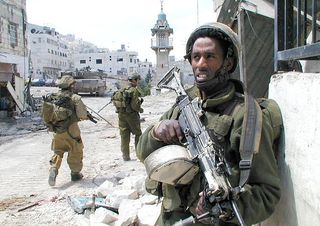
800px-Flickr_-_Israel_Defense_Forces_-_Standing_Guard_in_Nablus

Jon Western over at Duck of Minerva (image from wikimedia commons):

Officially, the Israeli government is still committed to the two-state solution, but for all practical purposes, Netanyahu and the right wing have largely abandoned it. With the continual expansion of settlements, it becomes harder and harder every day to imagine that any future Israeli government will be willing to drive anywhere from 100k to nearly a quarter of a million settlers out of the West Bank – even if the Palestinians accept territorial exchange for blocks of settlements. As of last week, the most immediate task for Netanyahu to preserve the status quo was to break the Palestinian unity government between the PA and Hamas that developed last month following the collapse of Kerry’s peace talks earlier this spring. The IDF response in Hebron and elsewhere in the search for the missing teens was designed to find the boys and to wedge the PA from Hamas.

More broadly, prior to the escalation of violence in the last six days, life for most Israelis has been pretty easy. The security situation has been relatively calm. And, even though the entire Middle East is in turmoil, there is some sense that this has actually been to some benefit to Israel. Hezbollah and Iran both have their hands full in Lebanon and Syria with the recent actions of ISIS and other Sunni extremists. The economy is doing well. Indeed, a common lament up until the last few days in Tel Aviv is that the hardest thing about life there is getting a reservation at any one of the dozens of new upscale restaurants.

We also met with Dani Dayan, a leading figure in the settler movement. A few weeks earlier, he had published a seemingly conciliatory op-ed in the New York Times in which he spoke about reconciliation with the Palestinians. But, when pressed deeper about the details – in particular, what exactly is the alternative if the two-state solution is dead, he said a one-state solution was untenable given the demographics in which Palestinians would soon constitute a majority. Instead, he argued that a “normalized” status quo was both acceptable and sustainable. He said the settlements should be allowed to continue with Israeli government support. He noted that Israeli politics had increasingly turned and has much stronger settler representation than ever. Even the IDF has changed and many of its officers come from the settler communities – they will never force Israelis off of their lands in Judea and Samaria. In short, he argued that it was time to recognize the real situation and “normalize” the occupation.

More here.

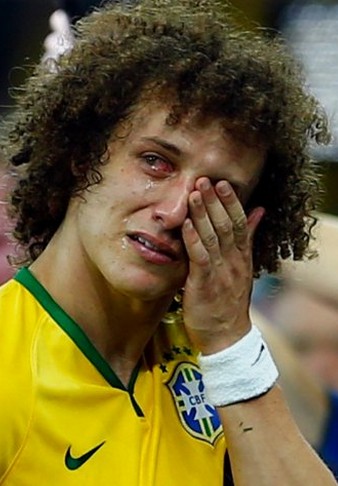
Brazil’s World Cup Debacle Lays Bare its Soccer Myths

Image.img

David Goldblatt in Al Jazeera America (Vanderlei Almeida / AFP / Getty Images):

After the 1998 World Cup final, when France swept aside Brazil and the catatonic Ronaldo, there was eventually sufficient political pressure to force the creation of congressional inquiries into the CBF (the Brazilian football federation) and its relationship with Nike, as well as the wider pathologies of the Brazilian game. Those reports, long moldering on the ministry of sports website revealed that Brazilian football is, despite very stiff global competition, amongst the most dysfunctional, badly organized and corrupt system around. More than that, both reports, published in 2001, recommended the criminal investigation and prosecution of a large swathe of Brazil’s football establishment. Brazil’s victory in the World Cup in 2002 ensured that not a single investigation or prosecution would be pursued.

I suspect that a victory in 2014 would have resulted in a similar absolution of the people and institutions that have run this World Cup. That the broken promises to the poor, the squandered opportunities for progressive urban redevelopment, the widespread and shameless stealing that has characterized the seven years since the tournament was awarded to Brazil, would all be, if not forgotten rendered utterly marginal. That is going to be a much harder act to pull off. But as Carlos Drummond de Andrade, the mid-century Brazilian poet and football chronicler, wrote in 1982 after the famous defeat to Italy – it’s time for Brazil to wipe its tears, roll up its sleeves and get back to the serious business of political reform.

But Germany’s victory has not only changed the long-term resonance of the tournament in Brazil but showed us something about football itself. We can be grateful that the world’s press has not chosen to describe the game in terms of blitzkrieg, but offered the lesser clichés of the clinical, efficient Teutonic machine. It is extraordinary how words can blind us to what is going in front of our eyes: Germany were not clinical or efficient, they were dazzling.

More here.

The Influencing Machine

DonationJessica Pishko in The Morning News:

People talk about feeling in debt when someone donates an organ. Dr. Sally Satel, who had a kidney transplant and is a doctor, eloquently writes about her mixed feelings of relying on someone else for a vital organ. She thinks organ donation should be a purely financial transaction, more like buying a used car, without all of the feelings that come along with a personal exchange. “I wanted my donor to be completely anonymous so I could avoid the treacherous intimacy of accepting an organ from someone I knew,” she writes. She later quotes the work of two sociologists who discuss the “tyranny of the gift,” the idea that once someone does something altruistic, they are bound forever like debtor and debt holder, “in a mutually fettering way.” I see where she’s coming from. Permanent ties to people used to make me nervous. But then I had a child.

My uncle received a kidney from an old student of his. I’ve met the donor, and he seems like a nice guy. He gets a lot of hugs and congratulations. I don’t know if my uncle feels indebted, but I suppose he might. Maybe he is more comfortable being intimately entangled with other people. I’ve heard there are strangers who offer to donate kidneys. My father has received emails from around the world—war-ravaged African countries, China, the Middle East—from people offering their kidneys. They don’t name their price, but he usually assumes the debt would be too big to ever repay. It turns out Dr. Satel got a kidney from a friend who was just the right distance: not too intimate, not too far. I’m glad it worked out for her that way, but it must be a struggle to maintain relationships that aren’t too entangled, that aren’t too fettering. She was relieved to find out she wouldn’t have to talk to her friend about the kidney she gave her; all that gratitude would just go unsaid.

More here.

Housekeeping can be a matter of life and death—at least for social animals like ants

Katie Langin in National Geographic:

Tidy-ants-death-colonies-red-ant_81512_600x450According to a study published Tuesday in the journal Biology Letters, common red ants (Myrmica rubra) that were prevented from removing their nestmates' corpses died more frequently than those allowed to bring out their dead. The tiny ants—each roughly the size of a medium-grain rice kernel—live under rocks and logs in densely packed colonies. More than a thousand worker ants can be found in a single nest. These insects reap many benefits from group living, as they work together to gather food, care for their queen, and defend their nest. But the situation also puts them at risk of being hit by disease epidemics: If one individual in the colony comes down with an illness, the blight can spread rapidly. This places a premium on good hygiene.

Dead Are Deadly

Many insects habitually remove dead nestmates from their colony. Scientists have long assumed that this behavior is based on a need to keep the rest of the colony healthy. But until now that idea hadn't been put to a formal test. The new study, conducted by researchers at the Université Libre de Bruxelles and the Université de Liège in Belgium, tested the health benefits of corpse removal in common red ant colonies kept in artificial nests. Some of the nests had wide exits. Others had narrow openings that made it difficult for the ants to transport and deposit corpses outside. In each colony, the scientists fatally froze ten worker ants, placed their corpses back in the nest, and monitored the survival of the remaining workers. The result: The ants in colonies that couldn't remove corpses didn't fare as well. By the end of the 50-day experiment, mortality had more than doubled in the corpse-littered colonies, from 6 percent to 13 percent. Why the higher death rate? The researchers can't say for sure, but they speculate that “corpses artificially staying longer in the nest may have increased the occurrence of microorganisms, requiring a greater investment in the immune system for live ants and possibly resulting in a reduced lifespan.”

More here.

Wednesday, July 9, 2014

On Cruelty

9780226144320

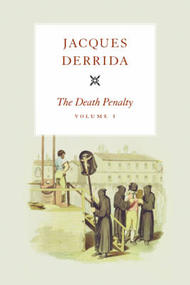
Judith Butler reviews Jacques Derrida's The Death Penalty: Vol. I, in The LRB:

‘Whence comes this bizarre, bizarre idea,’ Jacques Derrida asks, reading Nietzsche on debt in On the Genealogy of Morals, ‘this ancient, archaic (uralte) idea, this so very deeply rooted, perhaps indestructible idea, of a possible equivalence between injury and pain (Schaden und Schmerz)? Whence comes this strange hypothesis or presumption of an equivalence between two such incommensurable things? What can a wrong and a suffering have in common?’ By way of an answer, he points out that ‘the origin of the legal subject, and notably of penal law, is commercial law; it is the law of commerce, debt, the market, the exchange between things, bodies and monetary signs, with their general equivalent and their surplus value, their interest.’

In the first volume of The Death Penalty, Derrida considers the jus talionis, the principle of equivalence according to which a relation is set up ‘between the crime and the punishment, between the injury and the price to be paid’. Debt, in On the Genealogy of Morals, gives Nietzsche a way of understanding how ‘the “consciousness of guilt”, “bad conscience”’ came into the world. Earlier he laments ‘that whole sombre thing called reflection’, in which the self becomes its own object of relentless scrutiny and self-punishment. If one wants to keep a promise, one must burn memory into the will, submit to – or submit oneself to – a reign of terror in the name of morality, administer pain to oneself in order to ensure one’s continuity and calculability through time. If I am to be moral and keep my promises, I will remember what I promised and remain the same ‘I’ who first uttered that promise, resisting any circumstances that might alter its continuity through time, never dozing when wakefulness is needed. The promise takes on another meaning in Nietzsche when what I have promised is precisely to repay a debt, a promise by which I enter into, and become bound by, a certain kind of contract. What I have apparently burned into the will, or had burned there, is a promise to remember and repay that debt, to realise the promise within a calculable period of time, and so to become a calculable creature. I can be counted on to count the time and count up the money to make the repayment: that accountability is the promise. I can count on myself, and others can count on me. If I prove capable of making a contract, I can receive a loan and be relied on to pay it back with interest, so that the lender can accumulate wealth from my debt in a predictable way. And if I default, the law will intervene to protect his interest in the interest he exacts from me.

More here.

How Much Do Our Genes Influence Our Political Beliefs?

Edsall

Thomas B. Edsall in the NYT

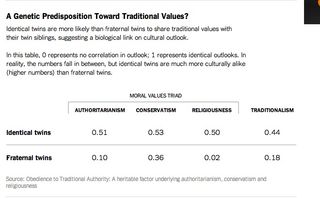
In “Obedience to Traditional Authority: A heritable factor underlying authoritarianism, conservatism and religiousness,” published by the journal Personality and Individual Differences in 2013, three psychologists write that “authoritarianism, religiousness and conservatism,” which they call the “traditional moral values triad,” are “substantially influenced by genetic factors.” According to the authors — Steven Ludeke of Colgate, Thomas J. Bouchard of the University of Minnesota, and Wendy Johnson of the University of Edinburgh — all three traits are reflections of “a single, underlying tendency,” previously described in one word by Bouchard in a 2006 paper as “traditionalism.” Traditionalists in this sense are defined as “having strict moral standards and child-rearing practices, valuing conventional propriety and reputation, opposing rebelliousness and selfish disregard of others, and valuing religious institutions and practices.”

Working along a parallel path, Amanda Friesen, a political scientist at Indiana University, and Aleksander Ksiazkiewicz, a graduate student in political science at Rice University, concluded from their study comparing identical and fraternal twins that “the correlation between religious importance and conservatism” is “driven primarily, but usually not exclusively, by genetic factors.” The substantial “genetic component in these relationships suggests that there may be a common underlying predisposition that leads individuals to adopt conservative bedrock social principles and political ideologies while simultaneously feeling the need for religious experiences.”

From this perspective, the Democratic Party — supportive of abortion rights, same-sex marriage and the primacy of self-expressive individualism over obligation to family — is irreconcilably alien to a segment of the electorate. And the same is true from the opposite viewpoint: a Republican Party committed to right-to-life policies, to a belief that marriage must be between a man and a woman, and to family obligation over self-actualization, is profoundly unacceptable to many on the left.

If these predispositions are, as Friesen and Ksiazkiewicz argue, to some degree genetically rooted, they may not lend themselves to rational debate and compromise.

More here.

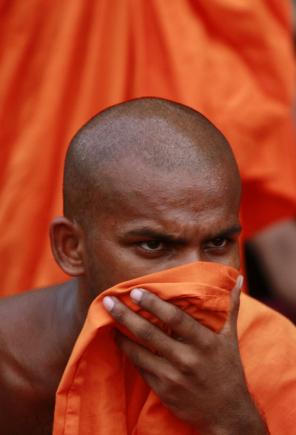
How Sinhala Extremism Turned Against Sri Lanka’s Muslims After the Civil War

Island-of-the-pure_caravan-magazine_2014_01

Samanth Subramanian in Caravan (Gemunu Amarasinghe / AP Photo):

One evening in Colombo, my friend Sanjaya dropped by, intending to collect me on our way to someplace else. I offered him a drink—beer, I seem to remember now, but given how the next two hours slipped clean out of our hands, more likely it was arrack. Arrack did that to you: it greased the passage of time. We sat around my dining table, Sanjaya telling stories and I listening. He told yarns tall and magnificent, embellishing on the run and possessing such a fondness for the absurd that he giggled as if he were hearing the tale and not narrating it. When he laughed, his eyes narrowed into letterbox slits, he quivered noiselessly, and his shoulders heaved. His mirth was tectonic.

“You heard they pulled a Muslim shrine down?” Sanjaya asked.

It had happened in the previous week in Anuradhapura, the ancient capital of Sri Lanka, and the most holy of towns for the island’s Buddhists. A group of Buddhist protesters—a busload, or two busloads, according to conflicting media reports—had arrived with crowbars and hammers and taken apart a small, old dargah. In this enterprise, they had not been stopped by the police or local administrators. Anuradhapura now bristled with communal tension.

“We should go there,” I said.

“We should,” Sanjaya said thoughtfully. “I know a guy who caught the whole thing on video.”

During the final years of the civil war, Sri Lankan Buddhism had developed a muscular right wing. First, in 2004, there was the launch of the Jathika Hela Urumaya, a political party led by Buddhist monks, some of whom admitted quite freely to being racists and bayed for a destructive, damn-the-consequences annihilation of the guerrillas of the Liberation Tigers of Tamil Eelam. Nine of its monks entered parliament, and the party became a member—and an ideological heavyweight—in the coalition that ruled Sri Lanka. After some years, even the JHU was deemed by some to be too timid. In 2011 and 2012, two other sets of monks splintered from the JHU and started the Sinhala Ravaya (the Sinhalese Roar) and the Bodu Bala Sena (the Army of Buddhist Power), hijacking for themselves the shrill energy of Sinhalese Buddhist nationalism. On the flag of the Sinhala Ravaya, a lion bounds forward, holding a sword thrust forward in attack. The Sinhalese roar is practically audible.

During those two years, the Buddhist right developed a taste for straight thuggery. The Tamils, cautious and defeated, living under a crushing military presence in the country’s north and east, posed no present threat to Sinhalese Buddhism. So, instead, the Bodu Bala Sena and the Sinhala Ravaya—as well as the JHU, their milquetoast cousin—retrained their energies upon Sri Lanka’s Muslims, who form roughly 10 percent of the population.

More here.

More Chicks and Dicks: On Samuel Beckett

Beckett

Joanna Walsh in Berfrois (image–Goppeldangers: Samuel Beckett by Nell Frizell):

The first time I read More Pricks Than Kicks I was assailed by terrible cramps that rippled up and down the front of my torso until I stopped reading. It seemed appropriate. Echo’s Bones is a long short story originally intended as the ‘recessional’ to More Pricks Than Kicks, Beckett’s 1934 collection of stories about Belacqua – Dubliner, eternal student, abject sufferer from his own body: goitre, hammer toe, sexual dysfunction and moral turpitude. Although Beckett had to be persuaded to write the story in order to flesh out the collection, Echo’s Bones gave Shatton & Windup [1] “the jim-jams” and it was rejected. Now here it is, resurrected and larger-than-life, bulked-out by an introduction and notes longer than the text itself.

The beautiful new Faber edition (taking notes, my pencil sunk into what must truly be the Andrex of paper stock) is annotated almost out of existence, making the task of reading nearly as great a labour as digging up your own coffin, as Belacqua (now deceased), finds.

There is much to annotate. In a letter to Thomas McGreevy, in 1933, Beckett says Echo’s Boneswas a “story into which I put all I knew and plenty that I was better still aware of.” Beckett started his career, under the influence of Joyce, by saying everything, and ended up by saying nothing: the less he wrote, the more he was capable of meaning. In a late interview with James Knowlson, Beckett said, “I realised that James Joyce had gone as far as one could in the direction of knowing more, [being] in control of one’s material. He was always adding to it; you only have to look at his proofs to see that. I realised that my own way was in impoverishment, in lack of knowledge and in taking away, in subtracting rather than in adding. ”Cut out the style.” as Lord Gall advises Belacqua, several times.

In an essay on Joyce’s Finnegans Wake, Beckett said of his mentor, “his writing is not about something; it is that something itself.” In Echo’s Bones, Beckett addresses, creatively, the anxiety of what relations words can have with what is. If More Pricks than Kicks is set in a Grosz world of the solidly physical, with its cast of scholars and whores (there are no other women: “Toutes êtes, serez ou futes, De fait ou de volonté putes,” Chas quotes, in A Wet Night) in Echo’s Bones, though set in the afterlife, flesh is still pervasive.

More here.

third place

Dbp_1994_1718_sporthilfe_fussball_fifa-wm-pokalRowan Ricardo Phillips at The Paris Review:

And yet before Sunday’s final, there’s Saturday’s game, which for me carries the same weight—not for its importance, but for the window it provides into the people who play. This will be the third-place game, in which the losers of the two semifinals meet to decide who finishes third and who finishes fourth. Finals are dreamscapes, heavy shimmering things. The spectacle and competition make a final less about its players and more about the game itself; the players fill a void that’s been waiting for them, as even now such voids are waiting in the Moscow of 2018 and the Qatar of 2022. But that third-place game …

While the semifinalists of the World Cup prepare for their games with the taste of victory still fresh, the third-place game is a consolation for losers. Whether you lost 4-0 or to a last-second goal, there you are. There are times when national pride and/or a collective feeling of fleeting opportunity coaxes one final good performance out of a team. There are other occasions in which the semifinal loss still stings too much, a nation having expected much more than third from its team.

In urban planning, cultural studies, and sociology, there’s a concept called third placeinvented by Ray Oldenburg. If home is the first place and work is the second, the third place is an intermediary area to create and foster community—the setting where you hang out and become a regular among regulars—the barbershop or hair salon, the record store, the pub, the bowling alley.

more here.

Seven Reasons Not to Write Novels and Only One Reason to Write Them

Javier-Marías-para-Jot-Down-port-2Javier Marías at Threepenny Review:

I can think of seven reasons not to write novels:

First: There are too many novels and too many people writing them. Not only do those already written continue to exist and demand to be eternally read, but thousands more entirely new novels keep appearing in publishers’ catalogs and in bookshops around the world; then there are the many thousands rejected by publishers that never reach the bookshops, but which nonetheless exist. It is, then, a commonplace activity, one that is, in theory, within the grasp of anyone who learned to write at school, and for which no higher education or special training is required.

Second: And precisely because anyone, whatever his or her profession, can write a novel, it is an activity that lacks merit and mystery. Poets, philosophers, and dramatists do it; so do sociologists, linguists, publishers, and journalists; politicians, singers, TV presenters, and football coaches; engineers, school teachers, civil servants, and movie actors; critics, aristocrats, priests, and housewives; psychiatrists, university professors, soldiers, and goatherds.

more here.

painting’s first avant-garde

Schwabsky_birthbadtaste_ba_imgBarry Schwabsky at The Nation:

The art that flourished in Italy in that period has come to be known as Mannerism, and from the seventeenth through the nineteenth centuries it was considered of no intrinsic interest, merely (as one art historian summarized it) “a servile, uncritical imitation of the manners of the great masters, and especially of the anatomical exaggerations of Michelangelo’s figure style.” In the twentieth century, parallels with aspects of modernism—those expressive distortions of the figure that, as Matisse would have it, turned the image of a woman into a painting—breathed new life into an art that had lain neglected for centuries. To eyes liberated from the old canons of realism, the Mannerists could be seen not as weak imitators but as true originals whose disproportionate emotional and intellectual demands on their own art made them seem uncannily contemporary: the American kids on their Fulbrights are crazy for them, Roberto Longhi was to note, with some condescension, in the 1950s. And yet even then, and still today, it would have been hard to argue that the great Italian art of the sixteenth century was Florentine Mannerism—not when the likes of Titian, Tintoretto and Paolo Veronese were flourishing in Venice, which despite certain setbacks was largely insulated from the warfare and religious upheaval common elsewhere in Italy. The Venetians, and especially Tintoretto, may at times show mild affinities with their central Italian contemporaries, but they never betray the anxiety and inner conflict we find among the Mannerists.

more here.

Discovery of a new means to erase pain

From EurekAlert:

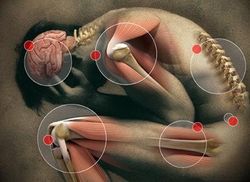
Pain%20site%202A study published in the scientific journal Nature Neuroscience by Yves De Koninck and Robert Bonin, two researchers at Université Laval, reveals that it is possible to relieve pain hypersensitivity using a new method that involves rekindling pain so that it can subsequently be erased. This discovery could lead to novel means to alleviate chronic pain. The researchers from the Faculty of Medicine at Université Laval and Institut universitaire en santé mentale de Québec (IUSMQ) were inspired by previous work on memory conducted some fifteen years ago. These studies had revealed that when a memory is reactivated during recall, its neurochemical encoding is temporarily unlocked. Simultaneous administration of a drug that blocks neurochemical reconsolidation of the memory results in its erasure.

The investigators wanted to see whether a similar mechanism was at play during neurochemical encoding of pain sensitization. To this end, they injected capsaicin in the foot of mice. Capsaicin, the pungent chemical in chili pepper, triggers a burning sensation. The procedure, which causes no physical damage, triggers pain hypersensitivity through a process of protein synthesis in the spinal cord. After capsaicin injections, the mechanical pressure at which mice would flinch was about a third of that in the normal situation. Three hours later, the researchers administered a second dose of capsaicin and, at the same time, a drug that blocks protein synthesis. The hypersensitivity then vanished rapidly. Within less than 2 hours, the pressure tolerated by the mice was back to 70% of normal.

More here.

What is a caliphate?

Samira Shackle in The New Humanist:

FlagISIS has declared a new caliphate in Iraq and Syria – but has overstated its theological authority. This week, the Islamic State of Iraq and al-Sham (ISIS) announced that it was establishing a caliphate: the Islamic State, spanning the territory in Syria and Iraq that it has seized control of in recent weeks and months. The Sunni militant group’s statement, published online in various languages, said: “Here the flag of the Islamic State, the flag of monotheism, rises and flutters. Its shade covers land from Aleppo to Diyala.” The new caliph is the ISIS's leader, Abu Bakr al-Baghdadi. The restoration of a caliphate has long been the stated objective for many jihadist organisations, which seek to overthrow the nation-state system imposed on the Middle East after World War I. But what exactly is a caliphate, and is the jihadist interpretation of the term accurately rooted in history?

In the simplest sense, the word “caliphate” means “succession” in Arabic, and refers to a political-religious entity. The term dates back to the 7th century, following the death of the Prophet Muhammad. Various caliphates ruled over large parts of the Muslim world over the following centuries, until the last one, the Ottoman Empire, was abolished in 1924. In recent decades, extremist groups including Al-Qaeda, and Hizb ut-Tahrir have campaigned for the restoration of a caliphate. They have been unsuccessful because, unlike ISIS, they haven’t been able to control enough territory to make the idea a reality. It’s also worth noting that such campaigns rely on an emotional connection to the idea of the Muslim ummah (community) rather than a feasible project. In the modern political context of the Middle East, national divisions are important. ISIS and other extremist groups have spoken about European colonialism imposing borders – but today, there is no wide scale clamouring to break down these borders among populations in the region. Historically, caliphates are governed by Islamic law. In the Sunni tradition, the leader is elected, and in the Shia tradition, selected from a group of imams. However, the Ottoman Empire – the last widely acknowledged caliphate – was certainly not a beacon of religious piety.

More here.

The disarray at Belo Horizonte

Tunku Varadarajan in The Daily Beast:

ScreenHunter_721 Jul. 09 13.26One has to believe that Brazil was at the receiving end of some great celestial wrath. In the days before the game, there was talk of nothing else but Neymar, Brazil’s key striker and talisman, who was to miss the semifinal due to an injury inflicted on him in the quarters. The team and its management wallowed in self-pity, dwelling more on his loss—and the loss, also, of captain Thiago Silva, owing to an accumulation of yellow cards—than on the Germans. In being so wrapped in resentment over the absent Neymar, they paid the Germans scant respect. There has been a palpable hubris in Brazil these last weeks, hubris as thick as the local feijoada. Brazilians have felt entitled to this World Cup, forgetting the truth that this Brazil team is probably the worst to have taken the field for the country.

Brazilian strategy, from the start of the cup, was four-pronged: Make teams play you on reputation, not on true ability; let Neymar score the goals (since nobody else can); let Thiago Silva marshal a semblance of defense; and let the crowd do the rest. That strategy unraveled completely Tuesday night, in the face of a massacre.

More here.

Also see this (thanks to Brooks Riley): If Milton Did Post-Match Analysis for Germany-Brazil.