How to Choose?

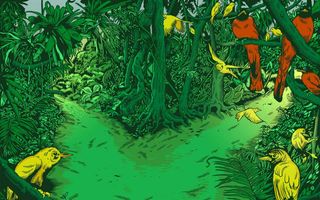
JUNGLE-PATH-FINAL-

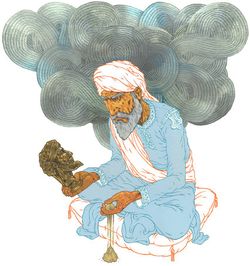
Michael Schulson in Aeon (Illustration by Tim McDonagh):

Over the millennia, cultures have expended a great deal of time, energy and ingenuity in order to introduce some element of chance into decision-making. Naskapi hunters in the Canadian province of Labrador would roast the scapula of a caribou in order to determine the direction of their next hunt, reading the cracks that formed on the surface of the bone like a map. In China, people have long sought guidance in the passages of the I Ching, using the intricate manipulation of 49 yarrow stalks to determine which section of the book they ought to consult. The Azande of central Africa, when faced with a difficult choice, would force a powdery poison down a chicken’s throat, finding the answer to their question in whether or not the chicken survived – a hard-to-predict, if not quite random, outcome. (‘I found this as satisfactory a way of running my home and affairs as any other I know of,’ wrote the British anthropologist E E Evans-Pritchard, who adopted some local customs during his time with the Azande in the 1920s).

The list goes on. It could – it does – fill books. As any blackjack dealer or tarot reader might tell you, we have a love for the flip of the card. Why shouldn’t we? Chance has some special properties. It is a swift, consistent, and (unless your chickens all die) relatively cheap decider. Devoid of any guiding mind, it is subject to neither blame nor regret. Inhuman, it can act as a blank surface on which to descry the churning of fate or the work of divine hands. Chance distributes resources and judges disputes with perfect equanimity.

Above all, chance makes its selection without any recourse to reasons. This quality is perhaps its greatest advantage, though of course it comes at a price. Peter Stone, a political theorist at Trinity College, Dublin, and the author of The Luck of the Draw: The Role of Lotteries in Decision Making (2011), has made a career of studying the conditions under which such reasonless-ness can be, well, reasonable.

‘What lotteries are very good for is for keeping bad reasons out of decisions,’ Stone told me. ‘Lotteries guarantee that when you are choosing at random, there will be no reasons at all for one option rather than another being selected.’ He calls this the sanitising effectof lotteries – they eliminate all reasons from a decision, scrubbing away any kind of unwanted influence. As Stone acknowledges, randomness eliminates good reasons from the running as well as bad ones. He doesn’t advocate using chance indiscriminately. ‘But, sometimes,’ he argues, ‘the danger of bad reasons is bigger than the loss of the possibility of good reasons.’

More here.

Who Is Mehdi Nemmouche, and Why Did He Want To Kill Jews?

Toxicfrance1620

Marc Weitzmann in Tablet:

Last May 24, a Saturday, at 3:27 p.m., according to the accusatory file, a man appeared at the doorstep of the Jewish Museum of Belgium. Out of his bag he pulled a Magnum .357 and fired. The bullets hit Emanuel and Miriam Riva, a couple of Israeli tourists in their mid-fifties who had just entered the place. Each was struck in the back of the skull, and they died on the spot. (Later on, a witness showing up a few minutes after the killing would post on his Facebook page a picture of Miriam’ s body lying in her blood, her hand still carrying the museum’s pamphlet program; what her children, ages 15 and 16, living in Israel, thought of the photograph is not known.) Letting go of the Magnum, the shooter then took from his bag a Kalashnikov, aimed it at a 65-year-old woman by the name of Dominique Sabrier, and shot her, also in the head.

A retired art publisher of Polish descent, Sabrier had left France for Brussels only two months before. Her reason for moving, ironically enough, was, according to her friends, the anti-Semitic atmosphere that now permeates France. The Toulouse killing had scared her, as had the hate demonstration in Paris the previous winter—when, for the first time since World War II, anti-Jewish slogans were chanted in public in the French capital. In Brussels, a city Sabrier knew, she hoped to live a quiet retirement. She had registered for law classes at the Free University of the town and was volunteering as a tourist guide at the museum.

Alexander Strens, 25, found the time to seek refuge under his reception desk—before the killer found him and shot him, once again in the head. Strens, hired at the museum’s communication department the previous year, was the only victim still alive after the shooting. Sent to the Saint-Pierre hospital of Brussels, he was declared brain dead there the next day. He died on June 6, raising the murder total to four. Although Strens’ mother is Jewish, his father is a Muslim Berber from Morocco and, in accordance with the wishes of both families, he was buried in the Muslim cemetery of Taza.

Then, with Strens—and with no more reason than it had when it started, the massacre ends. The surveillance video shows the shooter running away, bag in hand. He disappears.

Brussels is the capital of Europe. The day after the shooting, an election was held for a new European parliament. Xenophobic nationalist parties across the continent were predicted to win a lot of seats even before the killing, and as soon as the news broke the already perceptible tension among the continental political class was imbued with a new sense of frailty and paranoia: Was the scheduling of the massacre just a coincidence? Or was a message being sent—and by whom? Europe was under siege, no doubt, and humiliated, too.

More here.

Hans Christian Andersen’s painful fairy-tale life

P2_ThisWeek_HansAn_1083516kDinah Birch at the Times Literary Supplement:

Andersen was profoundly committed to the Romantic ideal of the extraordinary genius, singled out for distinction from birth. “It doesn’t matter if you’re born in a duck yard if you’ve lain in a swan’s egg”, as he explains in “The Ugly Duckling”, one of his most self-reflective tales. His desire to please his many acquaintances meant he could be irritatingly anxious and deferential, and his inclination to a fawning submissiveness in his relations with aristocratic patrons was vexing to those wishing to promote the professional dignity and independence of writers. But he never doubted his credentials as an artist. Despite his lifelong social uncertainties, he was convinced that his unique gifts meant that he was perfectly entitled to special treatment from the hands of fate and his friends.

Binding is especially persuasive in tracing Andersen’s creative relations with Walter Scott, whose work had been translated into Danish in the 1820s. Andersen’s first published tale, “The Apparition at Palnatoke’s Grave” (1822), was influenced by the character of Madge Wildfire in Scott’s The Heart of Midlothian (1818), a novel that acquired cult status among its European readers, and made a lasting impression on Andersen. The story was published under the pseudonym of Villiam Christian Walter, in a volume that included one of the plays that won the approval of the Royal Theatre. Choosing the name “Walter” was an act of homage, but it was also a bold statement of intent. Binding suggests that Gerda’s journey to the icy palace of Kay’s glamorous captor in “The Snow Queen” reflects Jeanie Deans’s indomitable walk to London, undertaken so that she can plead with Queen Caroline for the pardon and release of her condemned sister.

more here.

ROCK STARS and their EX-LOVERS

Article_molotkowAlexandra Molotkow at The Believer:

Rock stars are the gods of the last century, avatars for the emotional and religious yearnings 1960s youth would have had nowhere else to place. Bob Dylan’s cryptic magnetism marked him as the Person With the Answers; Mick Jagger’s shaking hips stood for personal and sexual liberation. “Mick Jaggerpersonified a penis,” wrote Pamela Des Barres, the famed groupie and author of several books, in her 1987 memoir, I’m With the Band: Confessions of a Groupie. As a teenager, she “rushed home from school every day to throb along with Mick while he sang: ‘I’m a king bee, baby, let me come inside.’”

Getting in close proximity to a rock star, then—for a night, or a string of tour dates, or the time it would take them to compose an album especially for you—would seem a service to a higher power. “Perhaps by embracing their cherished rock gods, groupies tap into their own divinity,” Des Barres wrote in 2007’sLet’s Spend the Night Together: Backstage Secrets of Rock Muses and Supergroupies. Unfortunately, rock stars are not gods but rather human beings whose emotions happen to resonate with millions—emotions that are inspired by other human beings, some of whom have written memoirs.

more here.

Kabuki at Lincoln Center

140728_r25267-320Joan Acocella at The New Yorker:

For people accustomed to the cooler precincts of modernist and postmodernist art, it is often a joy to reëncounter older, messier forms of theatre, with coincidences and murders and the like. Therefore, when I arrived at the Rose Theatre for “The Ghost Tale of the Wet Nurse Tree,” the Kabuki company Heisei Nakamura-za’s contribution to the Lincoln Center Festival, I was not surprised to find the lobby packed with people spending too much money at the snack bar and looking as though they were going to a soccer game.

Here, with considerable abridgment, is what happens in “The Ghost Tale of the Wet Nurse Tree.” The distinguished painter Shigenobu and his wife, Oseki, have a new baby boy. Hanging around the neighborhood is a self-styled samurai, Namie, wearing a hat the size of a washtub, with a nasty smirk on his face. Shigenobu announces that he’s leaving town to create a dragon painting for a famous temple. Incredibly, he entrusts the care of his wife and son to Namie.

more here.

Medina in Birmingham, Najaf in Brent: Inside British Islam

Christopher de Bellaigue in The Guardian:

Mosque-009Along with the “Trojan Horse” controversy about the imposition of a strict Islamic ethos on a number of Birmingham schools, the disclosure that several hundred Britons have been to Syria and Iraq to fight with the jihadis has fired up those who believe that Islam represents an urgent threat to this country. Amid the hype – some of it justifiable, much not – nuance has inevitably been lost. It is significant that the British jihadis have chosen to realise their fantasies not here but in Mesopotamia. From a theological point of view, a caliphate can only be set up in Muslim lands. Britain would be a poor choice even for a pilot scheme – it has a substantial opposing majority and a competent intelligence service. As for the Birmingham “conspiracy”, that, too, is more complicated than it seems: while there have undoubtedly been moves to Islamise the schools' curricula and atmosphere, much of the pressure in this direction has come from parents. It would be understandable if law-abiding families with children at schools such as the formerly “outstanding” Park View Academy – now deemed “inadequate” and placed in special measures – felt targeted by former education secretary Michael Gove's campaign to “drain” the fundamentalist “swamp”. While in opposition, Gove authored a famously error-strewn and intemperate screed on Islamic fundamentalism, “Celsius 7/7”. And before his unexpected sacking, he wanted to inculcate “British values” in people whose social attitudes suggest they have had a bellyful.

The deeper concern is that a significant number of British Muslims are getting more conservative while much of the rest of society – including, of course, very many other Muslims – liberalises apace. Exporting high-profile hate preachers such as Abu Qatada is no solution, for whether one likes it or not the values of conservative Muslims are “British”, too. As the shortcomings of “Celsius 7/7” demonstrated, and as Innes Bowen confirms in her sober, meticulous and revelatory new book, the state's attitude towards British Muslims has been defined in part by ignorance.

More here.

Thursday Poem

In My Spare Time

During my long, boring hours of spare time
I sit to play with the earth’s sphere.
I establish countries without police or parties
and I scrap others that no longer attract consumers.
I run roaring rivers through barren deserts
and I create continents and oceans
that I save for the future just in case.
I draw a new colored map of the nations:
I roll Germany to the Pacific Ocean teeming with whales
and I let the poor refugees
sail pirates’ ships to her coasts
in the fog
dreaming of the promised garden in Bavaria.
I switch England with Afghanistan
so that its youth can smoke hashish for free
provided courtesy of Her Majesty’s government.
I smuggle Kuwait from its fenced and mined borders
to Comoro, the islands
of the moon in its eclipse,
keeping the oil fields in tact, of course.
At the same time I transport Baghdad
in the midst of loud drumming
to the islands of Tahiti.
I let Saudi Arabic crouch in its eternal desert
to preserve the purity of her thoroughbred camels.
This is before I surrender America
back to the Indians
just to give history
the justice it has long lacked.

I know that changing the world is not easy
but it remains necessary nonetheless.
.

by Fadhil al-Azzawi
from Poetry International

translation: 2000, Khaled Mattawa

Treat ageing

From Nature:

By 2050, the number of people over the age of 80 will triple globally. These demographics could come at great cost to individuals and economies. Two groups describe how research in animals and humans should be refocused to find ways to delay the onset of frailty.

Age1The problems of old age come as a package. More than 70% of people over 65 have two or more chronic conditions such as arthritis, diabetes, cancer, heart disease and stroke1. Studies of diet, genes and drugs indicate that delaying one age-related disease probably staves off others. At least a dozen molecular pathways seem to set the pace of physiological ageing. Researchers have tweaked these pathways to give rodents long and healthy lives. Restricting calorie intake in mice or introducing mutations in nutrient-sensing pathways can extend lifespans2 by as much as 50%. And these 'Methuselah mice' are more likely than controls to die without any apparent diseases3. Post-mortems reveal that tumours, heart problems, neurodegeneration and metabolic disease are generally reduced or delayed in long-lived mice. In other words, extending lifespan also seems to increase 'healthspan', the time lived without chronic age-related conditions.

These insights have made hardly a dent in human medicine. Biomedicine takes on conditions one at a time — Alzheimer's disease, say, or heart failure. Rather, it should learn to stall incremental cellular damage and changes that eventually yield several infirmities. The current tools for extending healthy life — better diets and regular exercise — are effective. But there is room for improvement, especially in personalizing treatments. Molecular insights from animals should be tested in humans to identify interventions to delay ageing and associated conditions. Together, preclinical and clinical researchers must develop meaningful endpoints for human trials.

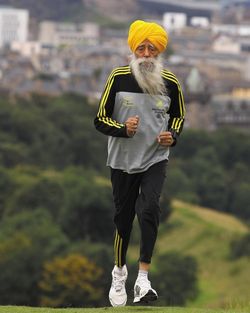
Picture: Fauja Singh, here aged 100, prepares for Britain's Edinburgh marathon in 2011

More here.

Wednesday, July 23, 2014

For Arab Christians and Secular Arab Nationalists, Isis May be the Death Knell

Arab-christian-retreat-011

William Dalrymple in The Guardian (Photograph: Karim Sahib/AFP/Getty Images):

According to tradition it was St Thomas and his cousin Addai who brought Christianity to Iraq in the first century. At the Council of Nicea, where the Christian creed was thrashed out in AD325, there were more bishops from Mesopotamia than western Europe. The region became a refuge for those persecuted by the Orthodox Byzantines, such as theMandeans – the last Gnostics, who follow what they believe to be the teachings of John the Baptist. Then there was the Church of the East, which brought the philosophy of Aristotle and Plato, as well as Greek science and medicine, to the Islamic world – and hence, via Cordoba, to the new universities of medieval Europe.

Now almost everywhere Arab Christians are leaving. In the past decade maybe a quarter have made new lives in Europe, Australia and America. According to Professor Kamal Salibi, they are simply exhausted: “There is a feeling of fin de race among Christians all over the Middle East. Now they just want to go somewhere else, make some money and relax. Each time a Christian goes, no other Christian comes to fill his place and that is a very bad thing for the Arab world. It is Christian Arabs who keep the Arab world 'Arab' rather than 'Muslim'.”

Certainly since the 19th century Christian Arabs have played a vital role in defining a secular Arab cultural identity. It is no coincidence that most of the founders of secular Arab nationalism were men like Michel Aflaq – the Greek Orthodox Christian from Damascus who, with other Syrian students freshly returned from the Sorbonne, founded the Ba'ath party in the 1940s – or Faris al-Khoury, Syria's only Christian prime minister. Then there were intellectuals like the Palestinian George Antonius, who in 1938 wrote in The Arab Awakening of the crucial role Christians played in reviving Arab literature and the arts after their long slumber under Ottoman rule.

If the Islamic state proclaimed by Isis turns into a permanent, Christian-free zone, it could signal the demise not just of an important part of the Arab Christian realm but also of the secular Arab nationalism Christians helped create.

More here.

Miss America Hypocrisy: The Vanessa Williams Nude Photo Shaming

1406130490930.cached

Amanda Marcotte in The Daily Beast (NBC/Getty):

In the three decades since the scandal erupted, some things have changed and some haven’t. You still have plenty of people who want to shame young women for failing to meet the paradoxical demand to be sexy and not sexual, but there’s a growing chorus of people who see through that hypocrisy and have stopped punishing women for being, well, human beings who enjoy sex.

Beauty pageants, of course, are ground zero for the hypocritical demands on women to flaunt their bodies without actually acknowledging the existence of sex. The whole point of being a pageant queen is to trot around in your bikini to be ogled at while feigning sexual naiveté. But, of course, women—even young women—are actually sexual beings, as much as society denies that. Williams is hardly the only beauty queen who has been the subject of a scandal because she was caught dropping the “what is this sex you speak of?” act and found to be—gasp!—interested in actually enjoying her youth.

In 2006, Miss Nevada Katie Rees, got a bunch of exploitative attention for “sexy” pictures of her showing off her breasts and underwear and kissing other women, an offense for which she lost her crown. A few years later, Miss California Carrie Prejean endured having a few semi-nude photos leaked. She was able to keep her crown, but only after Donald Trump did a big, pompous show of how magnanimous he was being by saying, “We have determined that the pictures taken were fine.” That it’s a subject that needs to be “determined” at all is ridiculous, suggesting that being in pageants still comes at the price of having outsiders—outsiders like Donald Trump—feel entitled to sit in judgment of your sexual behavior.

Women who want to go into politics find themselves under similar pressure to conceal that they have bodies under their clothes or that they know what sex is all about. Witness what happened to Krystal Ball, a young Democrat who wanted to run for Congress in 2010. A pair of conservative bloggers decided to shame her by running pictures they obtained from a party she attended many years prior, where she was seen posing for prank photos with a dildo.

More here.

Bayesian Superman

Unbreakable4

Noah Smith over at his website (via Crooked Timber):

Consider Proposition H: “God is watching out for me, and has a special purpose for me and me alone. Therefore, God will not let me die. No matter how dangerous a threat seems, it cannot possibly kill me, because God is looking out for me – and only me – at all times.”

Suppose that you believe that there is a nonzero probability that H is true. And suppose you are a Bayesian – you update your beliefs according to Bayes' Rule. As you survive longer and longer – as more and more threats fail to kill you – your belief about the probability that H is true must increase and increase. It's just mechanical application of Bayes' Rule:
P(Hmid E) = frac{P(Emid H) cdot P(H)}{P(E)}
Here, E is “not being killed,” P(E|H)=1, and P(H) is assumed not to be zero. P(E) is less than 1, since under a number of alternative hypotheses you might get killed (if you have a philosophical problem with this due to the fact that anyone who observes any evidence must not be dead, just slightly tweak H so that it's possible to receive a “mortal wound”).

So P(H|E) is greater than P(H) – every moment that you fail to die increases your subjective probability that you are an invincible superman, the chosen of God. This is totally and completely rational, at least by the Bayesian definition of rationality.

If you think this is weird, consider a closely related question: Suppose H was true, and you were an invincible God-protected superman. How would you know? Simple: you'd go get in a bunch of dangerous situations, and when you failed to die, you'd gradually realize the truth. The more dangerous the situations you chose, the faster the truth would be revealed – if you jumped in front of a train and failed to die, that would be stronger evidence than if you just drove to the store without a seat belt and made it back safely.
But nevertheless, every moment contains some probability of death for a non-superman. So every moment that passes, evidence piles up in support of the proposition that you are a Bayesian superman. The pile will probably never amount to very much, but it will always grow, until you die.
So does this mean that any true Bayesian will eventually accept invincibility as his working hypothesis? No. There are other hypotheses that explain your failure to die just as well as H does, and which are mutually exclusive with H. The ratio of the likelihood of H to the likelihood of these alternatives will not change as you continue to live longer and longer. But this gets into a philosophical thing that I've never quite understood about statistical inference, Bayesian or otherwise, which is the question of how to choose the set of hypotheses, when the set of possible hypotheses seems infinite.
More here.

The Problem of Slavery

KaraWalker_Spillman-2

Scott Spillman in The Point (image Kara Walker, savant, 2010):

As 12 Years a Slave repeatedly shows, the idea that black slaves were something less than human—although appealing for obvious reasons to masters— was subject to an inevitable tension, first at the abstract level of argument and then, more fatally, at the concrete level of daily life. The movie’s signal achievement is to bring out the various consequences of this tension, perhaps most powerfully in the relationship between the white master Edwin Epps (Michael Fassbender) and his slave girl Patsey (Lupita Nyong’o). Epps, who repeatedly refers to his slaves as his “property” and compares them to baboons, nevertheless warns his jealous wife that he would sooner send her away than lose Patsey. Later, in one of the film’s most memorable scenes, Epps is himself driven into a jealous rage by his suspicion that Patsey has escaped his control and cheated on him with a neighbor. Unable to whip Patsey himself, he compels Northup to do it. As Northup draws blood, Epps looks on with a blend of satisfaction, hatred and horror utterly belying his claim that Patsey means no more to him than a ball of yarn or a beast of prey.

For the historian David Brion Davis, this dynamic describes the basic “problem” of slavery. Ideally, as Aristotle noted long ago, a slave is like a tool or a domestic animal—something the master owns and over which he has complete control. Yet such a “natural slave” has never existed; and no system of slavery has ever successfully dehumanized its slaves to the point where they are indistinguishable from mere property. This inherent contradiction led, according to Davis, not only to complicated relationships between masters and their slaves, but to organized opposition, for which “the essential issue was how to recognize and establish the full and complete humanity of a ‘dehumanized people.’”

When and how the contradiction of treating a person as property became enough of a moral issue that people would demand an end to slavery is the question that has occupied the bulk of Davis’s career, especially in the three long works culminating with The Problem of Slavery in the Age of Emancipation, which he completed this year at the age of 86.

More here.

An interview with Rohan Maitzen

Matthew Jakubowski in Truce:

Before I ask more about your blogging—when you decided to pursue your interest in ethical criticism as a research topic, can you say more about that particular choice, especially how becoming a mother made you want to do work that mattered more in the world? It sounds like several things going on then affected the approach to your reading, writing, and research.

Maitzen-profileIt was really a convergence of things that led me to change the kind of academic work I was doing. I published my first book and not long after I was awarded tenure: this meant I had a secure opportunity to reconsider my priorities, and I found that doing more of the same was not high on the list. Then, being a new mother made doing any research and writing more difficult: there’s nothing like being both very busy and very sleep-deprived to make you ask hard questions about the value of how you spend your time.

Anthony Trollope once observed that “(No) man … can work long at any trade without being brought to consider much whether that which he is doing daily tends to evil or to good.” I have rarely had this concern about the teaching part of my job. Sure, I worry plenty about what exactly I’m doing in the classroom and whether I’m doing it well, but that teaching students to be better readers (more attentive, more questioning, more informed) is a good thing to attempt has always seemed to me inarguable. I wanted to feel as urgent and committed to the other facets of my work.

More here.

The Map: A Palestinian Nation Thwarted and Speaking Truth to Power

Map-story-of-palestinian-nationhood

Juan Cole in TruthDig:

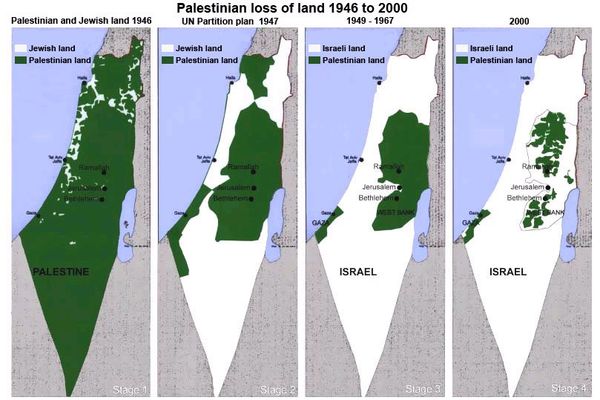
The map is useful and accurate. It begins by showing the British Mandate of Palestine as of the mid-1920s. The British conquered the Ottoman districts that came to be the Mandate during World War I (the Ottoman sultan threw in with Austria and Germany against Britain, France and Russia, mainly out of fear of Russia).

But because of the rise of the League of Nations and the influence of President Woodrow Wilson’s ideas about self-determination, Britain and France could not decently simply make their new, previously Ottoman territories into mere colonies. The League of Nations awarded them “Mandates.” Britain got Palestine, France got Syria (which it made into Syria and Lebanon), Britain got Iraq.

The League of Nations Covenant spelled out what a Class A Mandate (i.e. territory that had been Ottoman) was:

“Article 22. Certain communities formerly belonging to the Turkish Empire have reached a stage of development where their existence as independent nations can be provisionally recognised subject to the rendering of administrative advice and assistance by a Mandatory [i.e., a Western power] until such time as they are able to stand alone. The wishes of these communities must be a principal consideration in the selection of the Mandatory.”

That is, the purpose of the later British Mandate of Palestine, of the French Mandate of Syria, of the British Mandate of Iraq, was to ‘render administrative advice and assistance” to these peoples in preparation for their becoming independent states, an achievement that they were recognized as not far from attaining. The Covenant was written before the actual Mandates were established, but Palestine was a Class A Mandate and so the language of the Covenant was applicable to it. The territory that formed the British Mandate of Iraq was the same territory that became independent Iraq, and the same could have been expected of the British Mandate of Palestine. (Even class B Mandates like Togo have become nation-states, but the poor Palestinians are just stateless prisoners in colonial cantons).

More here.

How Might Quantum Information Transform Our Future?

Scott Aaronson in Big Questions Online:

ScreenHunter_725 Jul. 23 17.22Picture, if you can, the following scene. It’s the year 2040. You wake up in the morning, and walk across your bedroom to your computer to check your email and some news websites. Your computer, your mail reader, and your web browser have some new bells and whistles, but all of them would be recognizable to a visitor from 2014: on casual inspection, not that much has changed. But one thing has changed: if, while browsing the web, you suddenly feel the urge to calculate the ground state energy of a complicated biomolecule, or to know the prime factors of a 5000-digit positive integer—and who among us don’t feel those urges, from time to time?—there are now online services that, for a fee, will use a quantum computer to give you the answer much faster than you could’ve obtained it classically. Scientists, you’re vaguely aware, are using the new quantum simulation capability to help them design drugs and high-efficiency solar cells, and to explore the properties of high-temperature superconductors. Does any of this affect your life? Sure, maybe it does—and if not, it might affect your children’s lives, or your grandchildren’s. At any rate, it’s certainly cool to know about.

Privacy and security are different as well in this brave new world. When you connect to a secure website—let’s say, to upload sensitive financial data—there’s still a padlock icon in your web browser; indeed, the user experience is pretty much the same as it was in 2014. But, you’ve heard, the previous mechanism that encrypted your data was broken by quantum computers, with their ability to factor large numbers.

More here.

Work Life: Tell the negative committee to shut up

Fanuel Muindi in Science:

WorkWhen I started out in Stanford University's biology doctoral program, I didn't feel ready. My feeling that I was poorly prepared was corroborated by a committee that told me often how underprepared and unqualified I was. I attempted to argue my case, but the committee held to its position: I was unworthy. Fast forward 2 years: Just before I walked into my qualifying exam, the committee convinced me that I was going to fail. I succeeded, but that didn't change its low opinion of me. Then, at the end of my third year, I was selected to receive a Diversifying Academia, Recruiting Excellence (DARE) fellowship, which targets students in their final 2 years of graduate school who are interested in pursuing academic careers. The committee now argued that I didn't belong in the company of the other fellows, who, it insisted, were way more accomplished than I was.

Later, when I interviewed for postdoc positions, committee members had nothing positive to say. “You are not ready,” they said. “You are not good enough.” When the time came to defend my Ph.D. thesis, they were at it again: “You don't deserve this,” they said, after I had succeeded. “Your work isn't that good. You won't get it published anywhere decent.” It was a continuous barrage of criticism aimed at undermining my self-confidence.

More here.

Love People, Not Pleasure

Arthur C. Brooks in The New York Times:

AbdABD AL-RAHMAN III was an emir and caliph of Córdoba in 10th-century Spain. He was an absolute ruler who lived in complete luxury. Here’s how he assessed his life: “I have now reigned above 50 years in victory or peace; beloved by my subjects, dreaded by my enemies, and respected by my allies. Riches and honors, power and pleasure, have waited on my call, nor does any earthly blessing appear to have been wanting to my felicity.” Fame, riches and pleasure beyond imagination. Sound great? He went on to write: “I have diligently numbered the days of pure and genuine happiness which have fallen to my lot: They amount to 14.”

Abd al-Rahman’s problem wasn’t happiness, as he believed — it was unhappiness. If that sounds like a distinction without a difference, you probably have the same problem as the great emir. But with a little knowledge, you can avoid the misery that befell him. What is unhappiness? Your intuition might be that it is simply the opposite of happiness, just as darkness is the absence of light. That is not correct. Happiness and unhappiness are certainly related, but they are not actually opposites. Images of the brain show that parts of the left cerebral cortex are more active than the right when we are experiencing happiness, while the right side becomes more active when we are unhappy.

More here.

Tuesday, July 22, 2014

A talk with climate defeatist Paul Kingsnorth

Pkmugshot2_illustrationWen Stephenson at Grist:

Some have called Kingsnorth a catastrophist, or fatalist, with something like a death wish for civilization (see John Gray in The New Statesman and George Monbiot in The Guardian). Others might call him a realist, a truthteller. If nothing else, I’d call him a pretty good provocateur.

Kingsnorth tossed a grenade in the January/February issue of Orion Magazine with his controversial essay “Confessions of a Recovering Environmentalist.” There, Kingsnorth gets to the heart of his case. “We are environmentalists now,” he writes, “in order to promote something called ‘sustainability.’ What does this curious, plastic word mean? … It means sustaining human civilization at the comfort level that the world’s rich people — us — feel is their right, without destroying the ‘natural capital’ or the ‘resource base’ that is needed to do so.”

Ouch. But he isn’t finished.

If “sustainability” is about anything, it is about carbon. Carbon and climate change. To listen to most environmentalists today, you would think that these were the only things in the world worth talking about. … Carbon emissions threaten a potentially massive downgrading of our prospects for material advancement as a species. … If we cannot sort this out quickly, we are going to end up darning our socks again and growing our own carrots and other such unthinkable things.

more here.