Why Talk Feminism in World of Warcraft?

INLINE_washko_01

Angela Washko in Creative Time Reports:

When women and minorities who love games question why they are abused, poorly represented or made to feel out of place, self-identified gamers often respond with an age-old argument: “If you don’t like it, why don’t you make your own?” Those on the receiving end of this arrogant question are doing just that, reshaping the gaming landscape by independently designing their own critical games and writing their own cultural criticism. Organizations like Dames Making Games, game makers like Anna Anthropy, Molleindustria and Merritt Kopas and game writers like Leigh Alexander, Samantha Allen, Lana Polansky and others listed on The New Inquiry’s Gaming and Feminism Syllabus are becoming more and more visible and broadly distributed in opposition to an industry that cares much more about consumer sales data and profit than about cultural innovation, storytelling and diversity of voices.

What’s especially strange about the sexism present in WoW is that players not only come from diverse social, economic and racial backgrounds but are also, according to census data taken by the Daedalus Project, 28 years old on average. (“It’s just a bunch of 14-year-old boys trolling you” won’t cut it as a defense.) If #gamergate supporters need to respect this diversity, many non-gamers also need to accept that the dichotomy between the physical (real) and the virtual (fake) is dated; in game spaces, individuals perform their identities in ways that are governed by the same social relations that are operative in a classroom or park, though with fewer inhibitions. That’s why—instead of either continuing on quests to kill more baddies or declaring the game a trivial, reactionary space where sexists thrive and abandoning it—I embarked on a quest to facilitate conversations about discriminatory language in WoW’s public discussion channels. I realized that players’ geographic dispersion generates a population that is far more representative of American opinion than those of the art or academic circles that I frequent in New York and San Diego, making it a perfect Petri dish for conversations about women’s rights, feminism and gender expression with people who are uninhibited by IRL accountability.

More here.
War and Peace in the Bhagavad Gita

Doniger_2-120414_jpg_250x1368_q85

Wendy Doniger reviews Richard H. Davis's The Bhagavad Gita: A Biography, in the NYRB:

How did Indian tradition transform the Bhagavad Gita (the “Song of God”) into a bible for pacifism, when it began life, sometime between the third century BC and the third century CE, as an epic argument persuading a warrior to engage in a battle, indeed, a particularly brutal, lawless, internecine war? It has taken a true gift for magic—or, if you prefer, religion, particularly the sort of religion in the thrall of politics that has inspired Hindu nationalism from the time of the British Raj to Indian Prime Minister Narendra Modi today.

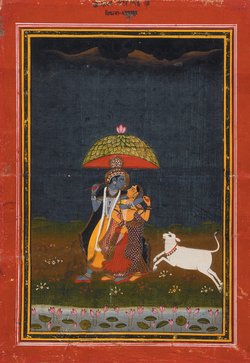
The Gita (as it is generally known to its friends) occupies eighteen chapters of book 6 of the Mahabharata, an immense (over 100,000 couplets) Sanskrit epic. The text is in the form of a conversation between the warrior Arjuna, who, on the eve of an apocalyptic battle, hesitates to kill his friends and family on the other side, and the incarnate god Krishna, who acts as Arjuna’s charioteer (a low-status job roughly equivalent to a bodyguard) and persuades him to do it.

In his masterful new biography of the Gita—part of an excellent Princeton series dedicated to the lives of great religious books—Richard Davis, a professor of religion at Bard College, shows us, in subtle and stunning detail, how the text of the Gita has been embedded in one political setting after another, changing its meaning again and again over the centuries. For what the Gita was in its many pasts is very different from what it is today: the best known of all the philosophical and religious texts of Hinduism.

The Gita incorporates into its seven hundred verses many different sorts of insights, which people use to argue many different, often contradictory, ideas. We might divide them into two broad groups: what I would call the warrior’s Gita, about engaging in the world, and the philosopher’s Gita, about disengaging. The Gita’s theology—the god’s transfiguration of the warrior’s life—binds the two points of view in an uneasy tension that has persisted through the centuries.

More here.

The earliest known Arabic short stories

Robert Irwin in The Independent:

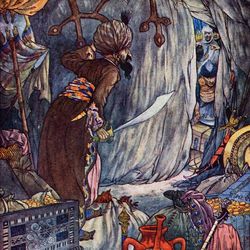
AliThe Ottoman sultan Selim the Grim – having defeated the Mamluks in two major battles in Syria and Egypt – entered Cairo in 1517. He celebrated his victory by watching the crucifixion of the last Mamluk sultan at the Zuwayla Gate. Then he presided over the systematic looting of Cairo’s cultural treasures. Among that loot was the content of most of Cairo’s great libraries. Arabic manuscripts were shipped to Istanbul and distributed among the city’s mosques. This is probably how the manuscript of Tales of the Marvellous and News of the Strange ended up in the library of the great mosque of Ayasofya. There it lay unread and gathering dust, a ragged manuscript that no one even knew existed, until 1933 when Hellmut Ritter, a German orientalist, stumbled across it and translated it into his mother tongue. An Arabic edition was belatedly printed in 1956.

In the 1990s, when I was working on my book The Arabian Nights: A Companion, I came across references to this story collection and, since it sounded very like The Arabian Nights (or, to give it its correct title, The Thousand and One Nights), I thought I ought to have a look at it. The stories in Tales of the Marvellous were indeed as fantastic and exotic as those in the Nights, and I felt as other scholars might feel if they had come across a missing part of The Canterbury Tales or a lost play by Shakespeare. The stories are very old, more than 1,000 years old, yet most of them are quite new to us. Some years later, I suggested to Malcolm Lyons, the translator of a recent edition of the Nights, that having completed that mighty task, he might consider translating Tales of the Marvellous. He sounded unenthusiastic and I thought no more about it. Then, last summer, he emailed to let me know that he had completed the translation. Now it has been published, meaning these stories can be read in English for the first time.

More here.

Why Are So Few Blockbuster Drugs Invented Today?

Dan Hurley in The New York Times:

Mag-16insulin-t-articleLargeOn Sept. 25, 1990, James D. Watson, the Nobel Prize-winning co-discoverer of the double-helix structure of DNA, and at the time the director of the National Center for Human Genome Research, wrote a letter to this paper making a prediction: “The ability to sequence DNA quickly and cheaply will also provide the technological basis for a new era in drug development.”

…If you read them now, the claims made for genomics in the 1990s sound a bit like predictions made in the 1950s for flying cars and anti-gravity devices,” Jack Scannell, an industry analyst, told me. But rather than speeding drug development, genomics may have slowed it down. So far it has produced fewer returns on greater investments. Scannell and Brian Warrington, who worked for 40 years inventing drugs for pharmaceutical companies, published a grim paper in 2012 that showed the plummeting efficiency of the pharmaceutical industry. They found that for every billion dollars spent on research and development since 1950, the number of new drugs approved has fallen by half roughly every nine years, meaning a total decline by a factor of 80.

…“I’ve done an about-face,” said Swinney, who estimates that more than 80 percent of research funding is still spent on target-based approaches. “The target-based research made possible by genomics is cool and fascinating,” he went on. But, he conceded, “you know what? We almost never use this information before we discover a drug. . . . This whole idea is too simplistic for the overall complexity of biology.”

More here.

Monday, November 24, 2014

Saying what you mean

by Carl Pierer

Beautiful Grice

After dinner and upon noticing a stain, Abelard ejects: “Oh no, I look like a pig.”

Bertha: “Well, and you've spilled sauce down your tie!”

Often an utterance means something over and above of what it literally says. Is it in such cases always possible to return to the “literal” meaning? Is it possible to sincerely answer the question “Do you think I'm fat?” with “You have nice feet” and only mean that the questioner has nice feet?

To capture and analyse what is going on in these cases, H.P. Grice introduces the term “implicature”. Abelard's statement by itself is usually understood metaphorically; it is rather unlikely that he literally looks like a pig. More plausibly, he means that he looks messy – possibly because he spilled some sauce. This is an example of conventional implicature – an implicature associated with certain set phrases, where the implicature is not depended on the context in which the utterance is made. The second sentence, Bertha's utterance, also seems to carry a meaning above what she literally said. It seems that in this context Bertha suggests precisely the literal meaning of Abelard's sentence. This kind of implicature, which depends on the context, Grice calls conversational implicature.

On the face of it, Bertha's utterance is at best redundant or worse, it does not make sense. If Abelard is really implicating: “Oh no, I've spilled sauce down my tie”, Bertha's repetition of this very fact does not add anything to the conversation. Although this happens all too often, it seems reasonable to suppose that usually people try to contribute to the conversation. In a meaningful exchange (whatever that means), people try to be constructive. This idea is captured by Grice in what is called the Cooperative Principle. Wayne Davis concisely puts the cooperative principle thusly:

Cooperative Principle. Contribute what is required by the accepted purpose of the conversation.”

For instance, if asked where to have lunch, a person will usually name a place. Another perfectly common reply is: “I'd like to have some lasagne”. Yet, strictly speaking this does not answer the question. In fact, at first sight, it violates the cooperative principle: the purpose of this exchange is to figure out where to go for lunch, so saying what you want to have for lunch is not directly relevant. And still, it is a meaningful contribution, provided that we understand “I'd like to have some lasagne” as implicating “Somewhere where they serve lasagne”.

Read more »

Sunday, November 23, 2014

Big ideas are destroying international development

Michael Hobbes in The New Republic:

ScreenHunter_878 Nov. 23 18.04It seemed like such a good idea at the time: A merry-go-round hooked up to a water pump. In rural sub-Saharan Africa, where children are plentiful but clean water is scarce, the PlayPump harnessed one to provide the other. Every time the kids spun around on the big colorful wheel, water filled an elevated tank a few yards away, providing fresh, clean water anyone in the village could use all day.

PlayPump International, the NGO that came up with the idea and developed the technology, seemed to have thought of everything. To pay for maintenance, the elevated water tanks sold advertising, becoming billboards for companies seeking access to rural markets. If the ads didn’t sell, they would feature HIV/AIDS-prevention campaigns. The whole package cost just $7,000 to install in each village and could provide water for up to 2,500 people.

The donations gushed in. In 2006, the U.S. government and two major foundations pledged $16.4 million in a public ceremony emceed by Bill Clinton and Laura Bush. The technology was touted by the World Bank and made a cameo in America’s 2007 Water for the Poor Act. Jay-Z personally pledged $400,000. PlayPump set the goal of installing 4,000 pumps in Africa by 2010. “That would mean clean drinking water for some ten million people,” a “Frontline” reporter announced.

By 2007, less than two years after the grants came in, it was already clear these aspirations weren’t going to be met. A UNICEF report found pumps abandoned, broken, unmaintained. Of the more than 1,500 pumps that had been installed with the initial burst of grant money in Zambia, one-quarter already needed repair. The Guardian said the pumps were “reliant on child labour.”

More here.

Disgust is often used as a tool of persuasion. But are gut feelings ever a reliable guide in questions of right and wrong?

Carol Hay in Aeon:

Falun-52258036Every spring a pro-life group – one whose campaigning methods are so shockingly offensive that I won’t publish their name here – sets up shop on my university’s campus quad. The group’s shtick involves displaying billboard-sized images of aborted foetuses juxtaposed with gory photos of atrocities such as mass graves and lynchings.

The group has been haunting me for years; when I was in grad school, their designated free-speech zone happened to be right outside my cubicle window. Most years, I took advantage of my location to plaster the window with pro-choice signs of my own. A few years ago, they visited the campus where I’m now an assistant professor, setting up their grisly billboards in a 20-foot circle right in the middle of campus. Several of my students, tickled at the prospect of witnessing their visibly pregnant, feminist ethics professor debate the morality of abortion, managed to convince me to try to talk to the protesters. It went about as well as you might expect.

What went considerably better was the response from the rest of the student body. After the initial shock wore off and they came to understand that, as a public university, we were obliged to respect the protesters’ rights to free speech, the students mounted a spirited counter-protest.

More here.

Aga Khan Museum

Nadia Al-Issa in Art Asia Pacific:

Qureshi_rise_and_fall_346Housed within the 6.8-hectare Aga Khan Park—designed by Serbian-Lebanese landscape architect Vladimir Djurovic—are two new additions to Toronto’s cultural scene. One is the Ismaili Centre Toronto, designed by renowned Indian modernist architect Charles Correa. The other is the Aga Khan Museum, designed by Pritzker Prize-winning Japanese architect Fumihiko Maki. Under development for almost a decade, the much-awaited cultural complex, situated in Toronto’s Don Mills neighborhood, opened to the public this September. The complex is an initiative of the Aga Khan Trust for Culture (AKTC), part of the Aga Khan Development Network (AKDN). Founded by His Highness the Aga Khan, the 49th hereditary Imam of the Nizari Ismailis, AKDN is a group of non-denominational development organizations that work in sectors as diverse as the environment, education, health, rural development, culture and architecture in the Muslim world. The Ismailis are the second largest Shia Muslim community, with 15 million followers in 25 countries within Asia, Africa, the Middle East, Europe, North America and Australia. The community’s history spans 12 centuries and at its height included the reign of the Fatimid Caliphate (909–1171), a formidable Islamic state that was seated in Cairo.

…Connecting the Ismaili Centre and the Aga Khan Museum is the centerpiece of the Aga Khan Park: inspired by the gardens at Humayun’s Tomb in Delhi, the Taj Mahal in Agra, and the Alhambra Palace in Grenada, Spain, Djurovic’s design is a contemporary take on the Islamic “Garden of Paradise.” The Aga Khan Park’s centerpiece harkens back to the Charbagh, a traditional Persian garden divided into four parts by walkways or water channels that intersect at a central fountain or pool. In Djurovic’s rendition, concrete paths separate four granite-lined reflecting pools and converge onto a massive central pool flanked by flowering serviceberry trees. Adjacent to the reflecting pools is a site-specific floor painting by contemporary Pakistani artist Imran Qureshi. Part of the museum’s inaugural show, “The Garden of Ideas: Contemporary Art from Pakistan,” the installation renders a landscape of violently splattered foliage and delicately executed flowers, which speaks to the complex process of domesticating nature and nature’s inherent unruliness.

Picture: IMRAN QURESHI, Rise and Fall, 2014

More here.

Sunday Poem

Closet Case
.

why is it
that you always
say the most significant
things
when you’re walking away
or
looking into your closet
searching
for something to wear

you must know
I think
that I cannot make out
what you’re saying

and then
you hold it
against me
like an old
belt
that’s too tight
to wear anymore

why is it
that you always
tell me later
that you told me
things
earlier
and make me feel
as if I was there
hanging
next to your old
wool sweater
that you used to love
but no longer
wear?
.

by Bill Schneberger

efusing Marcuse: 50 Years After One-Dimensional Man

1412595698marcuse666

Stephen Whitfield in Dissent (photo from Wikimedia Commons):

However closely or accurately New Leftists and others might have read One-Dimensional Man, as well as Marcuse’s subsequent works, he was once taken very seriously. He helped to define the zeitgeist in a way that needs to be understood, if not resurrected. But in the decades since the New Left crested and collapsed, has the stature of any intellectual fallen more dramatically than that of Herbert Marcuse?

To be sure, his reputation has not faded into utter oblivion. An International Herbert Marcuse Society still holds biennial conferences, and anthologies and monographs on his work continue to appear. But they are not central to academic discourse and tend to be reviewed only in specialized journals.

In 1987, the social critic Russell Jacoby traced a downward trajectory in the vitality and scope of the American intelligentsia, yet his The Last Intellectuals mentions Marcuse only briefly. Eight years later, One-Dimensional Man did not make the Times Literary Supplement list of the hundred most influential books published since the end of the Second World War. Nor did the TLS cite any of Marcuse’s other works—not even what he regarded as his “most important book,” Eros and Civilization: A Philosophical Inquiry Into Freud (1955), the volume that had presumably irritated Pope Paul VI.

Marcuse’s stature has shrunk even as scholarly interest in other exemplary figures of the Frankfurt School has intensified. Consider Theodor W. Adorno and Walter Benjamin. Each of them dealt directly, explicitly and frequently with cultural questions, and far less with political ones. Yet they have recently been the subjects of massive biographies, which make the case for their continuing salience in grasping the implications of modernity itself. Marcuse is associated with the crisis of Marxism, however, in a way that they are not. The “crisis” could be defined as Marxism’s historical entanglement with the tyrannies of Stalinism and Maoism, or its imminent demise given the capacity of capitalism to generate mass acceptance and even allegiance that doomed any hope of systematic change. Even though Marcuse’s dissertation topic had addressed the way that novelists portray artists (the Künstlerroman), his death roughly coincided with the emergence of cultural studies, which marked an abrupt shift in academic fashion.

More here.

Wishing Away the World Without the West

Imrs

Naazneen Barma, Ely Ratner and Steve Weber in The Monkey Cage over at the Washington Post (photo Takaki Yajima/AFP):

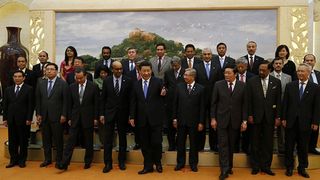
In our original World Without the West essay (2007), we argued that emerging powers are preferentially engaging with each other — “routing around” the Western liberal order rather than joining it or trying actively to undermine it. This argument attracted two main criticisms. Consistent with realist theories of international politics, the first critique posits that what we’re witnessing today is simply the early stages of an eventual attempt to overthrow the liberal order. (We disagree, but we’ll save that one for another day.) On the other side of the spectrum, however, is the view articulated by Voeten that a combination of interests, inducements and constraints will lead countries like China to ultimately conform, more or less, to the way the United States and the West have done business for the last 70 years.

The crux of our disagreement with this liberal internationalist perspective largely revolves around two questions. Will Chinese-led multilateral institutions “really fundamentally challenge the existing order or have profound implications for China’s ties to global multilateral institutions?” And even when they have similar functional objectives — on issues like regional stability, counterterrorism or poverty alleviation — will their approach be sufficiently different from liberal practice so as to diverge from prevailing norms and institutions? Voeten thinks the answer is no to both these questions.

We disagree because we think it’s overly optimistic to assume that Chinese interests and behavior will conform quite so neatly to the post-WWII system. And, to put a finer point on it, we believe both logic and evidence are now frequently pointing in the opposite direction.

More here.

Saturday, November 22, 2014

The Banality of Islamic State: How ISIS Corporatized Terror

RTR3WJAI-sm

Cam Simpson in Bloomberg ​Businessweek (Photograph by Reuters):

The group’s leaders portray themselves as akin to seventh century warriors thundering forth on horseback to expand their religious empire by sword. They call their car bombs “steeds” and their drivers the “death admirers, the knights of martyrdom.” But in many important ways they have much less in common with ­medieval warriors than they do with modern ­bureaucrats, and a successful attempt to defeat them may require understanding their logistics, their financing, and their management structure as much as their extreme theology.

It may sound bizarre for a group calling itself a caliphate, but the foundation of its management model, as identified by experts, is more akin to that of General Motors than it is to a ­religious dynasty from the Dark Ages. After decades, we may have arrived at the ultimate professionalization of terror.

During a routine January 2007 patrol in Anbar province, in a town along the Euphrates called Tuzliyah al Gharbiyah, a unit of U.S. Marines stumbled on a cache of nine documents in a roadside ditch. They included financial records, payrolls, supply purchase records, administrative records, and other details of fund flows into and out of a single local cell in Anbar of a group then calling itself the “Islamic State of Iraq.” Not long after, Iraqi militiamen working with the U.S. stormed a home in a town farther down the Euphrates. They found a computer hard drive holding ledgers with 1,200 files detailing the finances and operations of provincial-level managers overseeing the cell and others like it across Anbar province.

Taken together, the Anbar records allowed for a forensic ­reconstruction of the back-office operations of a terrorist ­insurgency from its local level up to its divisional headquarters. The data were handed over to the National Defense ­Research ­Institute of Rand Corp., a U.S. ­Department of Defense-funded think tank based in Santa Monica, Calif. Seven researchers set out to ­determine what the ledgers, receipts, memos, and other records meant. What they concluded in a 2010 report, written for then-Defense Secretary Robert Gates, should be ­familiar to students of business management: The group was ­decentralized, organized, and run on what’s called the “multidivisional-­hierarchy form” of management, or M-form for short.

More here.

the life of larkin

23larkin-illo-master495Clive James at The New York Times:

James Booth’s new biography of Philip Larkin is not very exciting, perhaps because Booth has the sense to leave the exciting writing to Larkin. But it is very welcome. If you believe that Larkin (1922-85) wrote some of the best English-language poems of modern times, then it has been a trial to see his questionable track record as an everyday human being get in the way of his reputation as an artist.

The obfuscation happened in a hurry, only a few short years after Larkin’s death. His pair of distinguished literary executors, Anthony Thwaite and Andrew Motion, served him faithfully with a selection of his letters (edited by Thwaite) and a biography (written by Motion). Unfortunately for Larkin’s image — which had been fairly staid until then, the poet having lived a quiet and mostly provincial life as a university librarian — it became evident that he had indulged himself in racist and sexist language. It had not occurred to the executors that they might have prefaced their respective volumes with a health warning in capital letters pointing out what should have been obvious: that Larkin talked that way only in his private life; that he believed his letters to be part of his private life, too; and that in his public life he was courteous and charming to anyone he met, of whatever gender or racial background.

more here.

Patrick Modiano’s ‘Suspended Sentences’

La-ca-jc-patrick-modiano-20141123-001David L. Ulin at the LA Times:

When Patrick Modiano won the Nobel Prize for literature in October, a lot of readers (myself included) were taken by surprise. Until now, he has been relatively unknown in the U.S., although he is a bestseller in his native France and winner of the Prix Goncourt who has published steadily since his first novel, “La Place de l'Étoile,” appeared in 1968, and co-wrote the screenplay for Louis Malle's 1974 movie “Lacombe Lucien.”

Like that film, much of Modiano's fiction has roots in the paradoxes of the Vichy era, which remains, for him, a matter of both personal and collective history. Born in 1945, he grew up estranged from his father, a black marketeer, and has called himself “a product of the dunghill of the Occupation, that bizarre time when people who should have never met did meet and by chance produced a child.”

Such tensions are very much at work in “Suspended Sentences,” a book that gathers three novellas originally published between 1988 and 1993 and now available in English for the first time. “I thought I'd written them discontinuously, in successive bouts of forgetfulness,” Modiano has said of these efforts, “but often the same faces, the same names, the same places, the same sentences recur from one to the other.

more here.