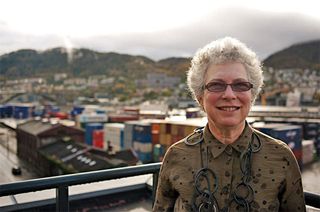
R.I.P. Mark Strand, 1934-2014

Joseph Brodsky used to tell this anecdote, repeated in his Nobel lecture. A journalist was interviewing him and Mark Strand and maybe John Ashberry. At some point, the journalist asked something like, “To pose the Adorno question, how can you write poetry after Auschwitz?” [The original Adorno line, taken out of context, isTo write poetry after Auschwitz is barbaric.”] To which, Mark Strand retorted, “How can you eat lunch after Auschwitz?” Over at the New York Review of Books:

My Death (1968)

Sadness, of course, and confusion.
The relatives gathered at the graveside,
talking about the waste, and the weather mounting,
the rain moving in vague pillars offshore.

This is Prince Edward Island.
I came back to my birthplace to announce my death.
I said I would ride full gallop into the sea
and not look back. People were furious.

I told them about attempts I had made in the past,
how I starved in order to be the size of Lucille,
whom I loved, to inhabit the cold space
her body had taken. They were shocked.

I went on about the time
I dove in a perfect arc that filled
with the sunshine of farewell and I fell
head over shoulders into the river’s thigh.

And about the time
I stood naked in the snow, pointing a pistol
between my eyes, and how when I fired my head bloomed
into health. Soon I was alone.

Now I lie in the box
of my making while the weather
builds and the mourners shake their heads as if
to write or to die, I did not have to do either.
TRIESTE BY DAŠA DRNDIĆ

TriesteKristine Rabberman at The Quarterly Conversation:

Jan Morris describes the city of Trieste as “an allegory of limbo,” demonstrated by its shifting political allegiances—first as a part of the Habsburg empire, then later given to Italy, briefly ruled by the Germans during World War Two, and finally given back to Italy in 1954 against the wishes of Yugoslavia. In 1943, when the Germans took over Trieste, they established a police barracks and extermination camp in the former rice mill of San Sabba. Drndić’s documentary evidence of the horrors experienced there shines a light on an often-overlooked part of the Holocaust. And the ability of local families such as the Tedeschis to blend into the majority during periods of crisis presents questions of culpability and identity. What does it mean to be Jewish? How to cope with the human toll of a commitment to national identity? Are children guilty of the sins of their parents? Are any families free from the ghosts of ancestors’ mistakes?

Throughout Trieste, Drndić provides a wealth of historical evidence: trial transcripts, interviews, photographs, music, maps, genealogical charts. This documentary evidence is presented in overwhelming detail. In one 44-page span, Drndić provides a list “of about 9,000 Jews who were deported from Italy, or killed in Italy or in the countries Italy occupied between 1943 and 1945.”

more here.

I Refuse by Per Petterson

W512813Neel Mukherjee at The Guardian:

Petterson’s great theme is time and how we experience it. This has a direct bearing on how narrative positions and unspools itself in relation to the consciousness of time, and on how a writer represents human interiority perceiving it. In one sense, this is the only true problem – or subject, if you will – of the realist novel. As Tommy asks in middle age: “Is time like an empty sack you can stuff any number of things into, does it never go just from here to there, but instead in circles, round and round, so that every single time the wheel has turned, you are back where you started.” Petterson’s signature technique lies in drawing the most zigzag line imaginable through narrative chronology but the effect is not of confusion, rather of a dense, layered complexity: it is the realist novel form’s mimetic faithfulness to life itself.

His prose, which has the quality of northern light, and the stark clarity of its winters, too, is honed to rise to this level of truth-telling. Stream-of-consciousness is a much-misunderstood term but, cleaving close to the characters’ points of view, Petterson’s long ribbons of sentences, held together by a rich, repeated use of “and”, sometimes euphorically defying grammar but always truthful and pitch-perfect, bring fresh meaning to the term and its possibilities.

more here.

The English and Their History

1b58ec88-8e2d-4e24-a9ce-fdf9d6bf546fChristopher Sylvester at the Financial Times:

There have been two massive history books published this year that deserve to be widely read. One is the English translation of The Transformation of the World: A Global History of the Nineteenth Century by the German historian Jürgen Osterhammel. The other is this compelling and intriguing analysis of English history by Robert Tombs, a Cambridge professor who is better known as a specialist in France. Both are vast in scope and full to the brim with scholarship that has been painstakingly absorbed only to be disgorged with an exhilarating mixture of conviction and lightness of touch.

Each of the seven parts of The English and Their History contains narrative chapters followed by a chapter reflecting on how the period in question has been remembered and represented. Tombs embraces transnational comparisons and demonstrates that English history and identity merit examination apart from their British perspective. By drawing on literature and art he seeks “to make memory and its creation an inherent part of the story”. Four “memory themes” predominate: the protracted legacy of the Norman Conquest; the Whig notion of progress arising out of the post-civil war settlement; the sometimes proud, sometimes toxic legacy of empire; and the myth of post-imperial decline. He demonstrates a seamless mastery of political, economic, social and cultural history, and, while even-handed in ideological terms, he offers robust judgments in hearty and often sonorous prose.

more here.

Anjelica Huston: What are men so angry about?

Chrissy Iley in The Telegraph:

Anj2_3118024bThe first time I met Huston, about 15 years ago, she wept into her white wine over her father’s death. John, who died in 1987, cast a long shadow over Anjelica, leading her to seek out other hugely charismatic men like Jack Nicholson. They were a couple for 17 years, and from the outside they seemed impossibly glamorous. They were part of the in crowd, travelling with the Rolling Stones, Andy Warhol, Marlon Brando, Harry Dean Stanton; theirs was life of models, motorbikes, and far flung film locations. But in reality, the relationship was tortuously on/off. When they eventually split for good, in 1989, she again cried in front of me and likened the break-up to a death in the family. She’d wake up and instantly wonder what his breakfast choices would be, and would he jump or dive into his pool? These were his little routines, and she was no longer a part of them.

After that we only spoke about him when I really pushed her. So it was somewhat shocking that the second volume of her memoirs, Watch Me, is in many ways a love letter to Jack. It’s as if in the process of writing the book she is no longer angry or even hurt, but for the first time understands him. “Jack is Jack,” she says with a wise smile. We are curled on to her comfy sofas in her new house in the Pacific Palisades, a suburban chic district of Los Angeles. It has a bohemian feel; beautiful art on the walls, a cat curled on the chair, and her dog – a Mexican hairless – at her side. She shared her previous home with the sculptor Robert Graham, to whom she was married from 1992 until his death in 2008. For a long time afterwards, Huston lived in his giant studio, Graham’s huge black and white charcoals and imposing figures surrounding her like ghosts. Why was she so kind to Jack? Did he read the book? “Yes,” she says enthusiastically. “I think he liked it. I hope he did.”

More here.

New Novellas About Family

Jenny Offil in The New York Times:

BookIt is hard to resist Ludmilla Petrushev­skaya’s darkly comic new collection of ­novellas, “There Once Lived a Mother Who Loved Her Children, Until They Moved Back In.” The suffocating domestic life she renders so vividly begins before you even open the book. The cover itself is cleverly claustrophobic with the title crammed above a drawing of an unhappy family staring at a picked-over roast.

This sense of scarcity and deprivation recurs in all the stories, each of them set in the bleak Soviet-era communal housing blocks, known as kommunalkas, where multiple families, sometimes related, sometimes not, were placed in a single apartment and forced to share kitchen and bathroom quarters. This system was put into place after the Bolshevik Revolution of 1917 and heralded as a way to ­address inequitable living conditions. “We have everything we want; we are very happy,” as a slogan of the time went. But the reality of communal living was often very different from its state-­sponsored ideal. The most meager of possessions were jealously guarded or fought over. It was not unheard-of for light switches to be claimed as “mine” and “yours” by feuding neighbors. The walls were thin too. In the world of the kommunalka, there was little or no privacy, and family members and neighbors could hear the goings-on of everyone around them.

More here.

Saturday Poem

Wolf Between the Trees
.

His wife, his wife,
his daughter, his daughter,
his granddaughter, her brother,
knelt in a circle
in huckleberry woods,
digging with fingers, under pine needles,
a small hole in which to place
smoking sweetgrass, optic moisture,
& by the grandson, his grandfather's ashes,
gray Douglas Woolf, fine at last,
poured from expensive plastic bag
removed from official metal box,
taken from out a brown grocery bag,
his usual appertenance.

.

Fifty steps from here
he wrote accurate prose
in his favourite ramshackle cabin,

juncos rescued from the cat & buried
under bushes, small daughters
didnt know what they were
rehearsing, now

his favourite knitted cap
has a rock in it, thrown
far as can be into the woods

as they call them back in New England
where few people came
to know he was from, gone
back there as well as here, wouldnt
you say?

.

Now the women have a picnic,
sitting close as they can to the wolf in the woods,
huckleberry cider, jack cheese, bean & chile spread,
nothing from Europe, songs from mountain folk,
holed up in dark city, sitting firm
on clear prose, tears in all their eyes,
smiles on their faces, smoke from the sweetgrass,
no airliners in the sky, no
mote in that eye.

Below Nine Mile Creek, in Wallace,
Idaho it is 99 degrees. An old man in a see-through hat
leaned on the wall outside a bar.

I said when does it warm up? He replied
moving nothing but his toothpick,
wait till next winter.

.

Doug will be up there next winter,
no romance, no spooks, meaning
no, he will not be writing a story, that is
over. If you want to visit, use your fingers,
open a book,
dig.
,

by George Bowering
from Blonds on Bikes
Vancouver: Talonbooks, 1997.

Friday, November 28, 2014

The Cretan Paradox

IC_MEIS_ELGRECO_CO_004

Morgan Meis in The Smart Set:

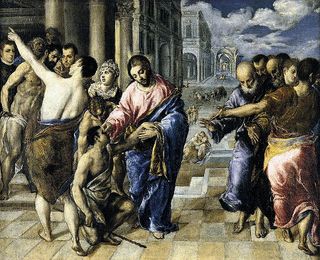
El Greco is confusing. He is one of the few universally acknowledged great artists of history who does not fit into any of the established art movements or categories. Given his time period (late 16th – early 17th centuries), his art should fit into the early Baroque. But it does not. One characteristic of all the artists we now call Baroque is a fidelity to the physical presence of bodies. Think of Caravaggio’s light-splashed naturalism, the glow on the cheeks of the young boy-models that he dressed up in all manner of costumes. Or think of Rubens’ fleshy obsession with the might and heft of the human form, the huge canvases like giant meat towers made of bodies laboring at some common task.

El Greco, by contrast, painted unnatural bodies. They aren’t the sorts of bodies that exist in this, our world. El Greco’s bodies are longer and stretchier than those we encounter in daily life. He portrayed the human form as you might see it in a vision or a mystical trance. He looked at painting, it would seem, in the same way that his contemporary — the great mystic Saint Theresa of Ávila — looked at prayer. They were both seeking spiritual ecstasy.

Except, there is no evidence that El Greco had any interest in spiritual visions or mystical ecstasies. Instead, he read boring tracts of Counter-Reformation theology and studied Renaissance art theory (we still have his library). El Greco was no Baroque painter, but he was no mystic either.

What to do with an artist who slips through every explanation?

More here.

Entwined Fates: A Conversation with Margaret Levi

Levi640

Over at Edge:

The thing that interests me has to do with how we evoke, from people, the ethical commitments that they have, or can be encouraged to have, that make it possible to have better government, that make it possible to produce collective goods, that make it possible to have a better society.

I'm a political scientist, political economist, so I think about this not so much from the perspective of moral reasoning, or philosophy, or psychology for that matter—though all those disciplines come into play in my thinking—but I think about it in terms of the institutional arrangements and contextual arrangements in which people find themselves. It is about those that evoke certain behaviors as opposed to other kinds of behaviors, and certain attitudes as opposed to other kinds of attitudes, that ultimately lead to actions. I'm ultimately interested not just in how the individual's mind works, but how individual minds work together to create an aggregate outcome.

To give you a much more concrete example of that: a recent book that I coauthored with John Ahlquist called, In the Interest of Others, looked at a variety of labor unions, because they are basically mini-governments, in order to understand why it was that some were getting people to act on various social justice commitments and others didn't even ask the question.

The first thing we had to think about was how much of this was self-selection. Had we just picked unions that picked people that then asked them to do what they were already willing to do? The unions that we looked at were three dockworker unions, two in the United States: the On the Waterfront Union on the East Coast, the ILA—the International Longshoremen's Association—and the more left-wing union, the ILWU—International Longshore and Warehouse Union—and a comparable union in Australia to the ILWU. We also looked at the Teamsters.

This gave us a set of organizations that, as it turns out, attracted virtually the same kind of people with the same heterogeneous mix of political attitudes and commitments to larger social justice issues. We started our investigation looking from the 1930s until the 1990s. In the early part of that story the only people who joined unions were those who needed the jobs that the unions represented. In the midst of the depression they weren't about to choose a union simply for political reasons.

More here.

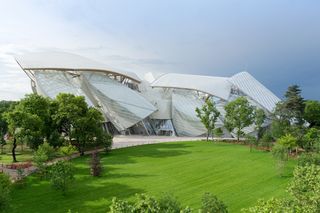
Paris Envy: Frank Gehry’s Vuitton Foundation

14.-The-Fondation-Louis-Vuitton-©-Iwan-Baan

Joseph Giovannini in the LA Review of Books (image The Fondation Louis Vuitton © Iwan Baan):

IN TODAY’S EFFICIENT, RATIONALIST, COST-CONSCIOUS architecture culture, squishy, unquantifiable qualities like enchantment are off the drafting table — exiled, beyond the grid, outside the design equation. But in museum design, ineffable qualities that mystify a museum are probably the single most important factor in signaling that the building brackets an out-of-the-ordinary precinct, one that promises special objects and a special experience inside. Architecture as warm visual bath introduces visitors into an immersive experience that preconditions the way they will see the Kiefers and the Pollocks beyond. Enchantment at the front door heightens anticipation. It opens pores.

There is, of course, the Calvinist alternative: museums as Minimalist white warehouses that offer a more blunt, frontal encounter with works of art that stand alone in cool, uninflected Newtonian space. But Frank Gehry, whose Louis Vuitton Foundation museum and cultural center just opened last month, subscribes instead to what might be called architectural Catholicism. Historically, the architects of cathedrals have always used the powers of a subjective and sometimes sumptuous architecture to condition worshippers to the messages delivered inside. By the time they kneel in a pew, the environment has already persuaded them through their awakened senses to believe.

Even by Gehry’s elevated standards, no contemporary museum anywhere is more enchanting than the Louis Vuitton Foundation, inaugurated two weeks after the opening of a major retrospective of his work at the Pompidou Center. Equipped with as many glass sails as a three-master, all billowing cubistically in contradictory directions, the building lists to starboard while leaning fore, its prow sailing over a stepped cascade of lapping water. The museum seems to glide within the surrounding canopy of trees in the park, its upper sails piercing the tree line.

You are not on LSD. All sail and no boat, it’s a vision, one that provoked a perfectly sober, gainfully employed psychologist seeing the building for the first time to respond: “I nearly wept in awe. Amazed by how soft, alive and enfolding it is.”

More here.

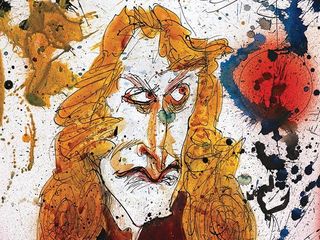
The Loneliest Genius

4801_0c7119e3a6a2209da6a5b90e5b5b75bd

Leonard Mlodinow in Nautilus (illustration by Ralph Steadman):

Describing his life, shortly before his death, Newton put his contributions this way: “I don’t know what I may seem to the world, but, as to myself, I seem to have been only like a boy playing on the sea shore, and diverting myself in now and then finding a smoother pebble or a prettier shell than ordinary, whilst the great ocean of truth lay undiscovered before me.”

One thing Newton never did do, actually, was play at the seashore. In fact, though he profited greatly from occasional interaction with scientists elsewhere in Britain and on the Continent—often by mail—he never left the vicinity of the small triangle connecting his birthplace, Woolsthorpe, his university, Cambridge, and his capital city, London. Nor did he seem to “play” in any sense of the word that most of us use. Newton’s life did not include many friends, or family he felt close to, or even a single lover, for, at least until his later years, getting Newton to socialize was something like convincing cats to gather for a game of Scrabble. Perhaps most telling was a remark by a distant relative, Humphrey Newton, who served as his assistant for five years: he saw Newton laugh only once—when someone asked him why anyone would want to study Euclid.

Newton had a purely disinterested passion for understanding the world, not a drive to improve it to benefit humankind. He achieved much fame in his lifetime, but had no one to share it with. He achieved intellectual triumph, but never love. He received the highest of accolades and honors, but spent much of his time in intellectual quarrel. It would be nice to be able to say that this giant of intellect was an empathetic, agreeable man, but if he had any such tendencies he did a good job suppressing them and coming off as an arrogant misanthrope. He was the kind of man who, if you said it was a gray day, would say, “no, actually the sky is blue.” Even more annoying, he was the kind who could prove it. Physicist Richard Feynman voiced the feelings of many a self-absorbed scientist when he wrote a book titled, What Do You Care What Other People Think? Newton never wrote a memoir, but if he had, he probably would have called it I Hope I Really Pissed You Off, or maybe, Don’t Bother Me, You Ass.

Today we all reason like Newtonians. We speak of the force of a person’s character, and the acceleration of the spread of a disease. We talk of physical and even mental inertia, and the momentum of a sports team. To think in such terms would have been unheard of before Newton; not to think in such terms is unheard of today. Even those who know nothing of Newton’s laws have had their psyches steeped in his ideas. And so to study the work of Newton is to study our own roots.

More here.

(NOT) Five African novels to read before you die

Readabook-383x325Aaron Bady in The New Inquiry:

University of Leeds professor Brendon Nicholls made a list of the “Five African Novels to Read Before You Die” yesterday, and it’s a fine list, if your best-case scenario is that literate first-world types manage to read a handful of creative works from Africa in their lifetime. And let’s be real, most Westerners are not even going to do that. So his list is fine, albeit extremely predictable:Achebe and Ngugi, of course, and let’s add Ayi Kwei Armah’s most canonical novel—because we need more than one West African male novelist from the 60’s—and, hmm, oh, shoot, we need some women, so, okay, Tsitsi Dangerembga, obviously, and Bessie Head, I guess. But not the really hard Bessie Head novel, let’s try the one that won’t confuse people. DONE.

I’m giving Nicholls some good-natured sass, here (sorry dude), because, as someone who studies, reads, and teaches contemporary African literature, I’m just very bored with this list, which is a fine list, but it’s a bit, I do’t know, “Five White Writers You Should Read Before You Die: Shakespeare, Milton, Dostoyevsky, Austin, Woolf.” Does the world need another suggestion that you read Things Fall Apart? It’s a great novel, but everybody knows that, or if they don’t, there’s no hope for them anyway…

As we peer forward towards 2015, the literatures of the Africas are much more interesting than those five books and the canon-making principles they index. The old canons have become a critical crutch: Nicholls’ list is a good place to start if you want to appreciate what has been going on for the last decade; anyone worth reading will probably have read at least most of these people, and if they haven’t, the people they have read probably will have. Those writers are really helpful for appreciating what African writers are doing right now, and there’s no getting away from that. They’re also great writers…

For this reason, Nicholls list is a perfectly good place to start, as long as you don’t want to read anything written in the last three decades. If you do want to read things that were written in the last thirty years, however—maybe, for example, because you want to read things that were written in your lifetime, and you were born, say, in 1979, like me—you are in luck! I have a list for you.

Read the rest here.

PD James: She was fascinated by death all her life

Jake Kerridge in The Telegraph:

PDJamesforweb_3120694bPD James had, to quote the title of what is probably her finest novel, A Taste for Death. Only last month she attended the launch party for CJ Sansom’s latest Shardlake mystery. Picking up the hefty tome and noticing its size, she said: “This will see me out.” It’s the sort of morbid joke you would expect from someone who famously said that when she first heard the story of Humpty Dumpty, her initial response was to wonder: “Did he jump or was he pushed?” She was fascinated by death all her life. She brought that fascination to a genre, detective fiction, that had previously tended to ignore the subject. Yes, old-style detective fiction was littered with corpses, but they are principally there to provide a puzzle for the reader, and the realities of violent death are ignored.

James was one of the first writers to combine a pleasingly complicated Christie-esque mystery with the depth of literary fiction, and she was the first of these new-style crime writers to be taken to the reading public’s heart. In her novel Devices and Desires(1989) she has a character reading an old-fashioned crime novel in which there is a “detective who, despite his uncertainties, would get there in the end because this was fiction; problems could be solved, evil overcome, justice vindicated, and death itself only a mystery which would be solved in the final chapter.” The implication is clear: no such comforting falsehoods are to be expected at the end of a James novel. Everything will not be alright again once the murderer is caught. But millions of readers adored her uncompromising view of the evil lurking in ordinary life.

More here. (Note: I had the pleasure of meeting Ms. James in 1993 in Chicago and she was every bit the Grand Dame I had imagined her to be, I mourn her loss today.)

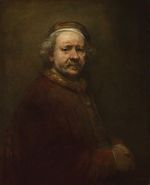
the Rembrandt effect

Clar05_3623_01T.J. Clark at The London Review of Books:

Let us call this the Rembrandt effect. It is an immensely powerful one, whose mechanics remain largely a mystery. It proved inimitable; or rather, the imitations seemed often to get the mechanics right, but mostly failed to deliver the effect. People in the 17th century appear to have wanted the effect and been willing to pay for it. Their dismal handbooks of art theory (and even more dreadful guides to the progress of the soul) had nothing germane to tell them about the picture of self on offer from the disreputable showman, with his ‘whore’ of a wife and his sordid bankruptcy, but there was apparently a thriving market for the kind of face-to-faceness he specialised in. A market for the unspeakable, we might say. Whether or not Rembrandt was bankrupt, his prices remained high. Italian noblemen and international bankers beat a way to his door – a German called Everhard Jabach, art dealer-cum-financier in Paris, seems to have been the first owner of Self-Portrait as Apostle Paul. Shades of the prison house clearly appealed.

What I now think was wrong in my previous approach to Rembrandt was my choice of terms. My essay assumed that the ‘look’ of self-portraiture was paramount, and extracted the look from the ‘face’. Rembrandt did not. His pictures – not just his self-portraits, but the whole world he shows us, predicated as it is on faces – have to do centrally with the belonging of eyes and eyesight to the unlikely cluster of ‘features’ that cling to the lower front half of the skull, exposing the brain to the world. Exposure of this kind has dangers.

more here.

why are novelists turning back to religion?

501828083_14Philip Maughan at The New Statesman:

There is also a sense that, in recent years, novelists have formed part of a rearguard action in response to the New Atheist consensus that emerged after Richard Dawkins’s God Delusion was published in 2006. The aggressive incuriosity and self-righteousness exhibited by the more militant end of the movement seemed to devalue the freedom of thought required to write a novel. “I never quite understood why you would read fiction to understand the human condition,” Dawkins surprised nobody by saying in 2013. One other thing that unites writers with believers is a sense that the truth can be story-shaped.

“It’s extremely hard to convince a New Atheist polemicist that the standard way of understanding scripture is one that allows for it to be metaphorical,” Spufford said. “It’s the fundamentalists who claim the Bible is a handbook or a scientific treatise who are the marginal ones.”

Deterministic ideas, whether theological, political or scientific, produce novels in which destinies are sewn up and moral questions tidily resolved. When Nick Hornby read Gilead, the second novel by the American writer Marilynne Robinson, he wrote in the Believer magazine: “For the first time I understood the point of Christianity – or at least, I understood how it might be used to assist thought.” He is not the only one for whom that book has had the effect of a conversion (James Wood in the New Yorker was reduced to “a fond mumbling”) – not a conversion to Christianity, of course, but to a new understanding of religion’s place in human culture and intellectual activity.

more here.

rebecca west visits america in 1924

Rebecca_west_6Rebecca West in The New Republic:

Really, it is just like that. America is a continent with which one can have innumerable love-affairs. I am not monogamous myself in my passion for the Mississippi. There are times when I think with as insistent a longing for a place named Bingham, which is in the state of Utah. It is a mining-camp. One drives in one’s automobile on noble roads planted with poplars over a green and fertile plain (it was desert till the Mormons irrigated it) to a canyon that drives a wedge into the foothills of the snow-peaked mountains. There is one long winding street of wooden houses, paintless, dilapidated; some with verandas on which men in broad hats sit in rocking chairs, spitting slowly and with an infinity of sagacity; some with plate glass windows, on which the washed-off word “saloon” still shows as a pathetic shadow, which are eating-houses of incredible bareness and dinginess, some others with plate-glass windows that show you men on high chairs with white sheets round them being shaved, and tin cans everywhere. Then at the end of the street one comes on a mountain of copper. Just that, a mountain of copper. Pyramid-shaped it is, and cut into regular terraces all the way from the apex to the base, where lies a pool of water emerald as Irish grass. It sounds the hardest thing in the world, and the terraces have as sharp an edge as a steel knife. Yet it seems a shape just taken for an instant by the ether. One feels as if one were standing in front of a breaking wave of a substance more like cloud-stuff than water, yet like the sea; for the whole hillside is luminously and transparently pale, and reticulated with mineral veins that are blue and green like sea water.

more here.

Frank Sinatra and the Lost Art of Livin’

From DelanceyPlace:

BookHe adored openly and gave not a damn who saw. In the middle of parties, amid any gathering, he blurted encomiums of love and appreciation: 'Doesn't she look radiant?', he would say of Bacall. ('I remember feeling so happy,' she said of such eruptions.) Whatever his latest elations and fancies, they were always made grandly audible: 'No one prettier has ever been in my house!' 'You're beautiful tonight!' 'You look mah-velous!' (That was in fact exactly how he said it.) Public proclamation did not faze him; after all, he sang the same sentiments on records and stages-legendarily making every woman feel that he sang only to her.

“Thus, in 1965, to his still-secret girlfriend Mia Farrow, thirty years his junior: He popped his head out of the Palm Springs swimming pool, adjacent to the golf course. And there, dripping chlorine with house guests agape, he bellowed toward her 'I love you!' Recalled one witness, 'If anyone had been on the Tamarisk seventeenth green that second, they would have had the scoop of the year.' Before becoming at age twenty-one, the third Mrs. Frank Sinatra, Mia Farrow had shorn her locks, cropped them all but off, stirring a nationwide hubbub. (She was then an ingenue on television's Peyton Place, whose mailbags lumped with outrage de coiffure.) 'But,' she later wrote, 'there was no drama, no fight with Frank, he loved my hair the minute he saw it, so I kept it short for years.' Indeed, he promptly gave her a pale yellow Thunderbird-'to match your hair.' 'I'm proud of her', he announced to everyone, crowing of her beauty and her brains and her bangs. …

More here.

Thursday, November 27, 2014

the eternal battle between the history and the meaning of Thanksgiving rages on

PI_GOLBE_THANKS_FT_001Stefany Anne Golberg at The Smart Set:

For the last thirty years of his life — the first thirty years of 20th century America — the historical genre painter Jean Leon Gerome Ferris devoted himself to capturing the history of America in paint. He called the result of this enormous task — a series of 78 scenes from the landing of Columbus to the start of World War I — The Pageant of a Nation. No one had ever seen America like this: All her heroes, great and small, presented in one complete and satisfying narrative — the most extensive series of American historical paintings by an individual artist before or since.

The paintings, wrote the authors of History of the Portrait Collection, Independence National Historical Park, were “expertly executed reproductions of the past”; Ferris on par with the best historical genre painters of his time. They were meticulously researched and crafted. And yet, the authors wrote, Ferris’ paintings said more about the era in which they were created than the events they portray. The paintings “formed a bridge between fact and fiction over which the viewers…were willing travelers.” The Pageant of a Nation, wrote the authors, confused “verity with verisimilitude.”

In one of the most widely reproduced Ferris paintings, The First Thanksgiving, the characters are just as they exist in our Thanksgiving myth. The Pilgrims don the familiar tall hats and buckles. The Wampanoag wear feathered headdresses. The women smile. The Wampanoag are serious.

more here.

The Retreat: choosing to spend Thanksgiving alone doesn’t need to mean being lonely

Susan Harlan in The Morning News:

The-retreatLast year, I opted out of Thanksgiving. I had never failed to celebrate a major holiday before. When I used to live in New York City, I was accustomed to spending Thanksgivings with friends and their families as my own family was far away in California. This usually involved waiting amongst crowds in Penn Station and then taking the train out to New Jersey. Now that I live in a small city in North Carolina, I receive generous offers of holiday festivity that usually involve large quantities of bourbon. But last year, I felt the need to be elsewhere.

So I set off.

This was not my first retreat, as I had started to call my weekend getaways. Since the beginning of the school year, I had been taking long drives over the weekends get to know North Carolina better, but also because I found myself restless at home. I didn’t necessarily have to go anywhere in particular; I just liked to drive along two-lane highways, past small-town cemeteries, BBQ joints, and rummage stores. “What are you up to this weekend?” friends would ask. “Going on a retreat,” I would reply. I found old lodges, log cabins, inns, and motels in the mountains. I brought my dog Millie, lots of books, a notebook. A flashlight and bug spray. Some groceries. Red wine. Blue rubber rain boots and several good sweaters that I left in the car.

“In the mountains, there you feel free.” So says the first speaker in T.S. Eliot’s The Waste Land, which was among the books I brought with me, along with Dylan Thomas and Walt Whitman, Isak Dinesen’s Out of Africa, and M.F.K. Fisher’s As They Were. These books were my supplies. And in the evenings, in the mountains, I did feel free, even if I knew I was not. One afternoon in late October, I sat on a bench on a sloping hillside and watched the wind blow red and yellow leaves off the trees in the distance, a declaration of the end of fall. I liked to rent cabins in the woods, and some people asked if I was scared of being murdered in one of these isolated places. Sometimes they were joking, but sometimes they weren’t. They genuinely found the idea terrifying. Before I went away for Thanksgiving, I showed a friend a picture of the cabin I had rented. She gasped.

“That looks like it should be in a horror film,” she said.

More here.

where “race blind” means “no black and Hispanic kids”

Freddie deBoer over on his blog:

Pew-Race-ChartThis is a question that people like Andrew absolutely have to answer if they want to grapple with this issue in an honest way: are you comfortable with a university system with incredibly low percentages of black and Hispanic students? With percentages of black and Hispanic students that are far lower than their averages in the population? That’s what you’re actually advocating for when you call for an end to affirmative action. We know that. We don’t have to guess. Andrew spills a lot of ink weeping for a plaintiff who won’t be able to go to Harvard. For her, the alternative was likely… going to Cornell, or Brown, or Dartmouth. (The horror! The horror!) For students like those in the UC system, the demise of race-based affirmative action can be the difference between attending a 4-year university or not at all. And if you oppose affirmative action then what, exactly, is the alternative for solving our enormous race-based economic and social inequalities? The self-same people who oppose affirmative action are the ones who oppose redistributive social programs! What makes this all so infuriating is that going to college and getting an education is exactly the way that conservatives say they want underrepresented minorities to get ahead. It’s the work hard, fly right, bootstraps vision of racial justice. I have no doubt that Andrew earnestly wants to end the massive gaps in quality of life between the races in contemporary American life. But what’s his plan? If “no” to reparations and “no” to affirmative action, 50 years after the heyday of the Civil Rights movement, how exactly do we get to racial economic equality?…

This whole debate depends on a flatly bogus notion of what college is, or what our country is. There is no such thing as meritocracy. There has never been anything resembling meritocracy. Not in colleges and not in our economy writ large. Anyone even remotely familiar with the history of our higher education system is aware that the system began as an explicit method for perpetuating received advantage. The notion of merit only began to creep in when America’s vast inequalities became too glaring to ignore. Andrew mentions the legacy of anti-Semitism in higher education and equates the current standing of Asian Americans to the past standing of Jews in that context. That’s a ludicrous comparison; our elite colleges were involved in an open and direct conspiracy to exclude Jewish students at all costs, whereas Asian American students attend US colleges far out of proportion with their overall percentage of our society. But he might stop and think about what that legacy actually tells us about our college system. No honest person with a minimum amount of understanding of our system would ever conclude that it has ever been anything resembling a meritocracy. Affirmative action has been one of the only genuine attempts to forcibly reduce the inherent inequality of our entire system. In its place, opponents propose… nothing.

Read the rest here.