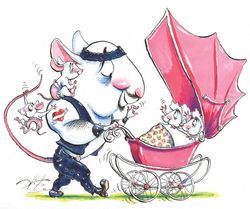
The Joke

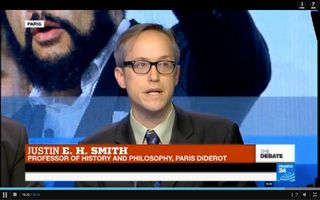
Last month, the PEN America Center announced its intention to honor Charlie Hebdo, the Paris-based satirical weekly, with its annual Freedom of Expression Courage Award at a gala to be held in New York City on May 5. In recent days, six members of the organization—Peter Carey, Michael Ondaatje, Francine Prose, Teju Cole, Rachel Kushner, and Taiye Selasi—have withdrawn from the gala in protest over what they see as a misguided decision. These writers, along with more than two dozen others, put their names to a letter released this afternoon in which they ask to be disassociated from the award. By honoring Charlie Hebdo, the letter states, “PEN is not simply conveying support for freedom of expression, but also valorizing selectively offensive material: material that intensifies the anti-Islamic, anti-Maghreb, anti-Arab sentiments already prevalent in the Western world.” Justin E. H. Smith addressed the Charlie Hebdo killings, and the response of the Anglo-American left, in “The Joke,” an essay published in the April issue of Harper’s Magazine.

Justin E. H. Smith in Harper's:
885872_1000422204204_96195232_oIn the days after the Charlie Hebdo attacks I stalked Paris as if lost, dazed and despondent not only at the senselessness and irreversibility of murder but also at the great gap that had appeared between me and so many people I consider friends and equals: educated, cultivated, sensitive people, defenders of the oppressed and marginalized. Righteous folk.

I heard from them countless variations on the banality that “violence is always wrong.” How did I know that this judgment, though perfectly true in itself, was only a banality, the expression of a sentiment that had little to do with pacifism? By the clockwork predictability of the “but” that always followed.

But what?

But racist cartoons, in the preferred formulation of much of today’s online left, are “not okay.” But offending other people’s faith is “not okay.” The judgment came from my academic peers in the established Western left and my students in the up-and-coming Western left, as well as from the archconservative Catholic League, the Putin regime, and the Putinite puppet regime of Chechen warlord Ramzan Kadyrov. Five cartoonists had just been killed by a death squad, and many on the left and the right seemed uncertain about which party had committed the greater offense.

Some, it’s true, gave a halfhearted defense of free speech: “We defend their right to express themselves, but we do not defend the offensive content.” Many explained their lack of solidarity with the cartoonists as a matter of personal taste. They had no problem with offensive humor in general, but personally, they explained, Charlie Hebdo’s “just not my cup of tea.” In context it was perfectly clear that this judgment of taste, this polite refusal of tea, was also a moral distancing, a political washing of hands.

More here.
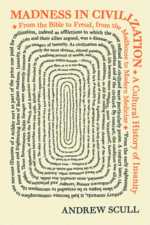
A Cultural History of Insanity from the Bible to Freud

K10439Daniel Pick at Literary Review:

If there is a subtext to Scull's mostly cool and appraising survey, it is indeed the propensity of the doctors to go mad for their theories and to regard abandonment of doubt as tantamount to professional strength. The notorious surgeon Henry Cotton, who was allowed during the interwar years to bring havoc to the lives of his patients in New Jersey, was already the protagonist in one of Scull's earlier books, Madhouse(meaning not so much a residence for the mad, but a site of mad operations). Cotton's reign at the Trenton State Hospital is also briefly recapped here. His crazed surgical practices were based upon his settled view that the patients were almost invariably suffering from sepsis; their condition often required, in his eyes, the excision of parts or the whole of their internal organs. He caused much misery (and many deaths) with his unfettered assaults upon stomachs, spleens, cervixes and colons. Despite the serious misgivings of colleagues, nobody seemed able to stop him or blow the whistle. Such institutional failings and cover-ups, a collective incapacity to curb the lunacy of the individual or coterie, as we know all too well from more recent scandals, provide the most shocking story of all.

From Cotton we move on to the vicissitudes of insulin treatment, the sagas of those experiments to deliberately infect physically healthy patients with the blood of malaria sufferers, and so to the postwar brain operators such as Walter Freeman, who so refined the treatment that he boasted of how he could deal with a dozen or more people in sequence in a single afternoon.

more here.

on M.H. Abrams (1912 – 2015)

ImgresWilliam H. Gass at the New York Review of Books:

Many of Abrams’s essays in The Fourth Dimension of a Poem are defensive. They point to elements in poetry that are frequently overlooked, and aspects that should be attended to. They wish to protect the traditional humanist from the poststructuralist’s heavy boot. And often there is a tone not of defeat, but of hopelessness in the arguments of the opposing sides when Abrams refers to them. The issues seem so minuscule; yet one kind of thinking about literature is at war with another; the quarrel has been going on since caves were invented; and the price to the defeated side may be silence for centuries.

The poet composes the poem; the critic explains it. The poet is inspired to write the lines; the critic interprets them. But suppose, as has been proposed by followers of Jacques Derrida, there is no right reading of the work, no correct sense for it. Out of a cage of calculations, suppose we are free to choose the pigeon we like best.

It might be a rich source of amusement for a poet to wonder whether her poem about her broken heart could be interpreted as a ballad in praise of the changing seasons, or a song about pregnant girls who’ve been put in prison; but if the poem (à la Derrida) is receptive to any interpretation, the poet’s shattered heart can turn into a fistful of fluttering leaves by means of a single metaphor’s transformation; subsequently these leaves can be felt falling on prison walls with the fierceness of a heavy rain or the tears of a hundred captive nuns.

more here.

on Remarque’s ‘The Promised Land’

The-Promised-Land-by-Erich-Maria-Remarque-hardback-coverNeal Ascherson at the London Review of Books:

Remarque apparently knew that The Promised Land would be his last novel, and meant it to be one of his finest, perhaps his masterwork – even in comparison to All Quiet on the Western Front. But he died in 1970, leaving it unfinished: a massive stub. Michael Hofmann, his translator, recalls some other unfinished fictions. But this is notThe Mystery of Edwin Drood or The Man without Qualities. Those two books lack their ends, but what remains doesn’t feel raw or rough; they simply break off. The Promised Land in contrast feels unpruned. Most of it, perhaps as much as three-quarters of its intended length, seems to be there. But the telling is sometimes baggy, repetitive, irrelevant or all three, and any reader will begin to notice passages that Remarque might have cut out or cut down if he had been allowed more time.

The book’s history, as far as we are told about it, remains rather unclear. There were several successive versions – one account says there were six – and this is alleged to be the last, Remarque having junked the others. This makes it all the more peculiar that his widow, the Hollywood superstar Paulette Goddard, went to Munich a year after his death and launched an earlier and much inferior draft entitled Schatten im Paradies, translated as Shadows in Paradise (Remarque had left Germany in 1931, hounded by the Nazis even before they came to power, but continued to write in German). That text was pretty universally panned. Remarque, the critics said, had clearly been suffering from a senile decay of talent.

more here.

Donca Steriade: Searching for the building blocks of language

Daniel Pritchard at the MIT website:

ScreenHunter_1167 Apr. 29 17.36It was in grade school classes that most of us first learned about the syllable — the tiny unit of organization for speech sounds, bundles of which can be combined to construct words, phrases, sentences, paragraphs, mystery novels, biology textbooks, national constitutions, etc.

The humble syllable performs impressive work, and for the field of linguistics it also holds a special analytical importance: it has long been considered to be one of the basic units of language. Speech has many qualities — including sound, meaning, rhythm, and syntax — and for each of those qualities there is a basic building block, a sort of linguistic atomic unit. For many years, the prevailing view in the linguistic field has been that the syllable is the basic building block of language in the area of rhythm.

But MIT linguistics professor Donca Steriade is no longer so sure about that. Along with a number of like-minded linguists, and bolstered by a growing body of research, Steriade believes that the emphasis on syllables is misplaced. Instead she suggests that a different element — known as the “interval” — may be the basic unit of rhythm in human language.

More here.

David Simon: ‘There are now two Americas. My country is a horror show’

David Simon in The Guardian:

ScreenHunter_1166 Apr. 29 17.08America is a country that is now utterly divided when it comes to its society, its economy, its politics. There are definitely two Americas. I live in one, on one block in Baltimore that is part of the viable America, the America that is connected to its own economy, where there is a plausible future for the people born into it. About 20 blocks away is another America entirely. It's astonishing how little we have to do with each other, and yet we are living in such proximity.

There's no barbed wire around West Baltimore or around East Baltimore, around Pimlico, the areas in my city that have been utterly divorced from the American experience that I know. But there might as well be. We've somehow managed to march on to two separate futures and I think you're seeing this more and more in the west. I don't think it's unique to America.

I think we've perfected a lot of the tragedy and we're getting there faster than a lot of other places that may be a little more reasoned, but my dangerous idea kind of involves this fellow who got left by the wayside in the 20th century and seemed to be almost the butt end of the joke of the 20th century; a fellow named Karl Marx.

More here.

Woody Allen’s 30 best one-liners

Martin Chilton in The Telegraph:

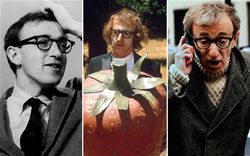
Wooodysummarypic_2625449c'There are worse things in life than death. Have you ever spent an evening with an insurance salesman?'

Sex is like bridge. If you don't have a good partner, you'd better have a good hand.

From Manhattan – in taxi with Tracy – “You're so good looking I can barely keep my eyes on the meter”

To Shrink: Doc, uh, my brother is crazy. He thinks he's a chicken. Doc says: So why don't you turn him in? Allen: I would, but I need the eggs.

'Not only is there no God, but try getting a plumber on weekends.'

'When I was kidnapped, my parents snapped into action. They rented out my room.'

'I failed to make the chess team because of my height.'

'I’m very proud of my gold pocket watch. My grandfather, on his deathbed, sold me this watch.'

More here.

Wednesday Poem

Terms of Venery

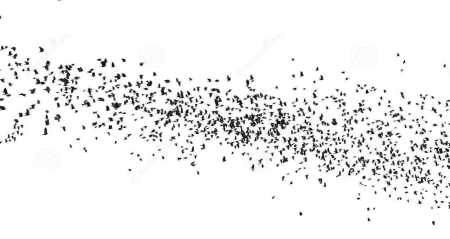
In droves and skeins and sords and doles,
gleans, lofts, coffles, fevers, mysteries,
shoals, by murders, bevies, drifts, mischiefs, Bird flock
as clews, as swarms, like living chainmail
spread across the scene. The many

separate but uniform configure one
flexible screen to which each body fastens
by the rivet of its eye, by the rivet of its melting
mind forged and recast by instinct. Separate
uniform animals or one animal many times

reflected. Whatever they’re made of canceling
whatever the ground is made of, silver or feathers
or fins revising the surface under them till it is
nothing or nothing familiar, face of
the gravel, the river, air stuttered

through chinks in the swarm is
refracted, resolved or nearly
remembered foliage
recovered to the blasted tree
by the flocked rooks settling.

by Margaret Ross
from Ecotheo Review
April, 2015

Facing Fear

J.B. Mackinnon in Orion Magazine:

ChadFarnesAs a teenager, anxiety overtook me like a metamorphosis, replacing my previous self cell by cell. The term “anxiety” has Latin roots in the verb “to choke,” which captures the internal experience so much better than the put-upon oppression implied by the word “stress.” I developed the notion that I suffered from life-threatening asthma, waking in the night to study my lips in the mirror for any blue hint of oxygen deprivation. I was fine, of course, and when I could no longer believe I had asthma, I moved on to doubting my heart. Cardiologists soon dismissed that concern, too, until at last my fears found their perfect expression: I was losing my mind. No test, no expert, could prove this wasn’t so—in fact, both testing and experts were likely to support the theory. I remember lying in bed with awful stillness, convinced that even a heavy sigh would be enough to snap the thread by which I was clinging to sanity. To this day I can’t be sure what would have happened if I’d simply given in to the gravitational pull toward madness. No one who knew me well at that time had any doubt that I could walk into any psychiatrist’s office in the land and walk out a few minutes later with a diagnosis of generalized anxiety disorder and scrip for mood-smoothing drugs. Xanax. Celexa. Beta-blockers. But I never took pills. Instead, the cover of an outdoor magazine changed my life.

The cover photograph featured John Bachar, a rock-­climbing god from California. In the image, Bachar hangs off one arm, his feet plastered to sweet nothings on a near-vertical cliff. Bachar is climbing a route called “Crack-A-Go-Go” in Yosemite National Park, and his blond ringlets are freedom itself, his skin as golden as the stone is gray. He’s climbing ropeless. If he falls, he dies. When I saw that photo on a gas station newsstand, I was in the agonies of a road trip with my mother, convinced that every moment I spent watching her try not to fall asleep at the wheel was one that I would otherwise have passed in the arms of the beautiful girls back home who by now, surely, would have noticed my existence. I knew nothing of rock climbing, the majestic Yosemite Valley, or John Bachar. All I knew was that I wanted to do that, to go there, to be him. Within a couple of years, I—the kid with the stomach butterflies and stress-induced ­hemorrhoids—could regularly be found with my blond hair in the breeze, sunburned skin against pale limestone, climbing ropeless up a cliff face. I had discovered the rock-climbing cure for anxiety disorder.

More here.

Tuesday, April 28, 2015

A Palestinian poet, an Australian artist, and a Mossad-led assassination in Italy

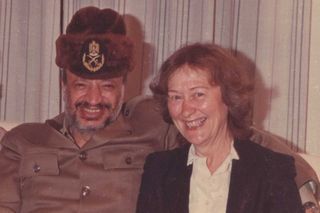
Family albums have a habit of turning up surprises. When Jesse Cox found a photo of his great aunt, Australian painter Janet Venn-Brown, casually hanging out with the former chairman of the Palestinian Liberation Organisation, Yasser Arafat, he was curious to find out more. What he uncovered was a story of love, murder and mystery.

Jesse Cox at the Australian Broadcasting Company:

6416666-3x2-700x467On 16 October 1972, Palestinian writer and translator Wael Zuaiter was assassinated in Rome by Mossad, Israel's secret service.

To this day there remain conflicting theories about why Zuaiter was targeted.

Was he involved in terrorism, or was he becoming too influential in Italian politics, advocating for Palestine? Or perhaps most tragically: was it a mistake, a hastily conceived plan resulting from inaccurate intelligence?

On the evening he was killed, Zuaiter had left the apartment of his fiancée, Australian painter Janet Venn-Brown. Janet is my great aunt and growing up I had heard fragments of Zuaiter's story from my mum.

I remember going to see Stephen Spielberg's Munich with her and watching a dramatised version of Zuaiter's assassination played out on the screen. I became intrigued by how our family had somehow been caught up in this much bigger story.

More here.

Robert Trivers: Vignettes of Famous Evolutionary Biologists

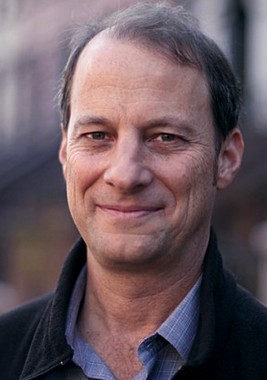
Robert Trivers in The Unz Review:

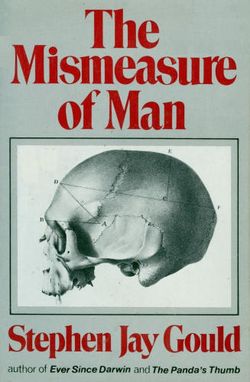
GouldmismeasureI first met S. J. Gould when he was a freshly minted Assistant Professor in Invertebrate Paleontology at Harvard and I a graduate student in evolutionary biology. Invertebrate Paleontology was well known then as a backwater in evolutionary biology, 80% devoted to the study of fossil foraminifera whose utility was that they predicted the presence of oil. In this environment, it was obvious that Gould would go far. New York City Jewish bright, verbiage pouring from his mouth at the slightest provocation, he would surely make a mark here.

This was not why I was visiting him. I had heard he was an expert in ‘allometry’—indeed had done his PhD thesis on the subject. Back then I wanted to know everything in biology, so I sought him out. Allometry refers to the way in which two variables are associated. It can be 1:1—the longer the fore-arm, the longer the total arm, or it can show deviations. For examples, the larger a mammal is, the more of its body consists of bone. Why? Because the strength of bone only goes up as the square of bone length whereas body weight goes up as the cube—thus larger bodies, weighing more, require relatively more bone. But what about antler size, I wanted to know, why is it that the larger the body size of the deer, the relatively larger his antlers? Why would natural selection favor that?

Gould leaned back in his chair. No, you have this all wrong, he said. This is an alternative to natural selection, not a cause of natural selection. My head spun. Natural selection was unable to change a simple allometric relationship regarding antler size that it had presumably created in the first place? Had it not already done so in adjusting bone size to body size? As I left his office, I said to myself, this fool thinks he is bigger than natural selection. Perhaps I should have said, bigger than Darwin, but I felt it as bigger than natural selection itself—surely Stephen was going for the gold!!

More here. [Thanks to Omar Ali.]

George Packer wants an exciting politics of heroism, sacrifice, war. It’s dead wrong

Corey Robin in Salon:

ScreenHunter_1165 Apr. 28 16.42George Packer is bored with American politics. “The 2016 campaign doesn’t seem like fun to me,” he writes in The New Yorker. Today’s politics “doesn’t quicken my pulse.” It “doesn’t shock me into a state of alert indignation.” The “thrill is gone.”

When George Packer gets bored, I get worried. It means he’s in the mood for war.

Packer claims he lost his passion for politics sometime between Obama’s first and second term. That’s the moment he confronted “the stuckness of American politics,” the moment when he realized that not only were “the same things” happening but that they would “keep happening.” Money would keep pouring in, filibusterers would keep filibustering, extremists would keep getting more extreme. Now he knows “we are paralyzed.” There are no more surprises.

This isn’t the first time Packer’s found himself yawning his way through a campaign. During the 2000 election, he complained that Al Gore was “more a technician than a leader,” whose “campaign slogan might as well have been, ‘First, do no harm.’” It wasn’t just Gore who had lackluster ambitions; there wasn’t “any burning issue galvanizing the electorate” either. Not just in 2000, but pretty much throughout the 1990s. As Packer would write a year later in the New York Times Magazine:

A strange thing happened after the cold war ended: patriotism all but disappeared from American politics. The right and left essentially offered a choice between hedonisms: tax cuts or spending. No one asked for sacrifice; no one spoke to common purpose.

A burning issue, a galvanized electorate, common purpose, sacrifice: that’s what Packer looks for in politics.

More here.

Lincoln’s assassination and the legacy of violence

ConspiratorsJonathan W. White at The American Scholar:

When on March 4, 1865, Abraham Lincoln delivered his second inaugural address from the East Portico of the U.S. Capitol, the sun broke through the clouds and shone down on him as he called for “malice toward none” and “charity for all.” Lincoln hoped for reconciliation between North and South, asking American citizens “to bind up the nation’s wounds” and to “achieve and cherish a just, and a lasting peace.”

A few weeks later, when Robert E. Lee surrendered at Appomattox Court House, cannons boomed in celebration throughout the Union. Four long years of killing and dying were over, and northerners rejoiced at the long-awaited triumph. Many of them welcomed Lincoln’s call for reconciliation. “The hour of victory is always the hour for clemency,” editorialized The New York Times, while Horace Greeley’s New York Tribune headlined “Magnanimity in Triumph” and Henry Ward Beecher preached a sermon in Brooklyn entitled “Love Your Neighbor, the Nation’s Motto.” From ordinary Americans up to the highest councils of the nation, northerners appeared ready to reunite with the South in the spirit of brotherhood. Assistant Secretary of State Frederick W. Seward remembered that the discussion at Lincoln’s final cabinet meeting was focused on “kindly feelings toward the vanquished.”

more here.

how Hitchcock the ham became film’s greatest artist

2015_16_hitchcock

Leo Robson at The New Statesman:

Of the several-hundred volumes on Hitchcock published over the past half-century, the majority divide into acts of critical exegesis indifferent to his public persona or even his private self and brisk, myth-laden biography in which Hitchcock emerges as a superb technician, the man who invented the inverse zoom, who got Detective Arbogast to fall backwards so brilliantly down Mrs Bates’s staircase.

Peter Ackroyd, a biographer of Dickens, Blake and London, belongs comfortably to the second camp but nonetheless finds himself in a challenging position. He can’t really argue in 2015 that Hitchcock wasn’t some kind of genius, at least not with the hectic casualness that has characterised his recent work, from his ongoing history of Britain to the series of Brief Lives of which this is the latest. On the other hand, he cannot, as a sceptical Englishman, accept the highfalutin terms in which this tickled showman is routinely praised. But his attempt to rebuff this sort of criticism is undone by the impression that he has never read any.

more here.

israel, the land of home and exile

PI_GOLBE_ISRAEL_CO_005Stefany Anne Golberg at The Smart Set:

For thousands of years, people have moved in and out and around the land of Israel as if on a cosmic conveyor belt—in, out, around, and also down, deep down into the Earth. In Israel, every bit of wall you can see stands for thousands of years of walls unseen. An anonymous, grassy hill on a roadside is 20 layers or more of competing civilizations in Israel, each layer crushing the other, informing the other, and also protecting each other from the forces of Nature that, eventually, come to erase them all. Israelites overtaken by Persians overtaken by Greeks overtaken by Romans overtaken by Arabs overtaken by Crusaders overtaken by Mamluks overtaken by Ottomans, etc. — and on top of the hill, some grass, maybe a goat. Israel is a story of human occupation and also human abandonment. If Israel could be seen on a map of time, you would see layers of people crashing into each other, collapsing on top of one another, pushing each other out, passing each other by, just missing each other, wandering away from each other, buried upon one another. Israel is thick with the endeavors and failures of people.

Home, in Israel, is unstable and always has been. Israel is forever re-organizing her temples, transmogrifying her language. In Israel, we start to wonder if “home” has ever been a place of respite or peace — if it isn’t, instead, a battle, a battle against Time, an attempt to make sense out of our existence on Earth, which comes out of nowhere and seems to go nowhere.

more here.

The Mr. Mom Switch

Erin O'Donnell in Harvard Magazine:

MomIn the mouse world, virgin male mice are not known as nurturers. They’re aggressive and infanticidal, regularly injuring or killing newborn mice fathered by other males. But research led by Catherine Dulac, Higgins professor of molecular and cellular biology, reveals that these murderous mice can be turned into doting dads simply by stimulating a set of neurons, shared by both males and females, that appears to drive parental behavior. Dulac examines control of instinctive behavior in animal brains, particularly social actions such as courtship and parenting. Previous work in her lab revealed that mouse brains hold circuits that determine whether the animals adopt stereotypical male or female behavior: Dulac discovered that the vomeronasal organ (VNO), a set of chemical-sensing receptors in the nasal septa of mice, dictates which of the two circuits is activated. (Female mice lacking a functional VNO engaged in “very bizarre male-like behaviors,” Dulac reports, emitting ultrasonic vocalizations normally sung by males to attract mates.)

In the most recent research, first described in the journal Nature last year, the investigators set out to learn if male mice had a similar capacity to match females’ parenting abilities. A female mouse that has never encountered a male or babies will nonetheless spring into action if pups are placed in her cage. “She will immediately build a nest, retrieve the pups, groom them, and crouch around them,” Dulac explains. “This is very robust, stereotyped behavior. If you do the same experiment with virgin males, they will immediately attack the pups.” Yet when the researchers removed the VNO of virgin male mice, changing the way they sensed the pups, the normally hostile males became “perfect dads,” Dulac reports. The infanticidal instinct vanished; the males built nests and placed the pups in them, groomed the pups, and huddled by them protectively. These findings, she says, suggest that there are “circuits in the male brain that underlie parental behavior,” but those behaviors are “normally repressed.”

More here.

On Food Labels, Calorie Miscounts

Philip J. Hilt in The New York Times:

CalThe method most commonly used to assess the number of calories in foods is flawed, overestimating the energy provided to the body by proteins, nuts and foods high in fiber by as much as 25 percent, some nutrition experts say.

…An adult aiming to take in 2,000 calories a day on a low-carbohydrate, high-protein diet may actually be consuming several hundred calories less, he and other experts said. Calorie estimates for junk foods, particularly processed carbohydrates, are more accurate. The current calorie-counting system was created in the late 1800s by Wilbur Atwater, a scientist at the Department of Agriculture, and has been modified somewhat over the past 100 years. Researchers place a portion of food in a device called a calorimeter and burn it to see how much energy it contains. The heat is absorbed by water; one calorie is the amount of energy needed to raise the temperature of one gram of water by one degree Celsius. When experts talk about calories, however, they usually mean kilocalories; one kilocalorie equals 1,000 calories. Those are the amounts you see on food labels.

…Almonds are routinely listed as having about 160 calories a serving, when the real figure is about 120 calories, said Karen Lapsley, the chief scientist at the California Almond Board. Some manufacturers are considering making the change on their labels.

More here.

Tuesday Poem

This one and That one and the Other have families

This one and That one and the Other have families
that are happy and solid, children, grandchildren
even great-grandchildren, who are blonde and study hard,
and verygoodkids, they are good and Christian people
but meanwhile your own children, God of God are
suffering from psoriasis and psychologically
unstable, so why oh God of all the gods of clay
do your children suffer and have tongues of clay?
Your children are your children and seem step-children.
But their children, their grandchildren, their generations
are not like ours this bunch of degenerate
and untouchable fathers and mothers of beggars
yet these your children, God of gods, are still
your children and they recognise you and they do
just what you told them they should do, while they
make the signs, make the sign of the cross, gulp down
hosts like they are dying of hunger (though they are full)
and your priests absolve them, assent and eat with them
oysters and whatever debilities they have,
and they give a blessing to their menstrual women
so that they will bear children and they do bear them,
yet there are hardly any of us, or they die
of natural causes or commit suicide.
Is there a reason why? There is no reason why.
You are the God it occurs to you to be.

by Armando Uribe
from Odio lo que odio, rabio como rabio
publisher: Editorial Universitaria, Santiago de Chile, 1998

Read more »