
by Brooks Riley
Category: Recommended Reading
Sunday, May 3, 2015
What’s Wrong With Inequality?

Gary Gutting talks to Elizabeth Anderson over at The Stone:
GARY GUTTING: Public policy debates, particularly about economic issues, are often about how to treat people fairly. You argue for “democratic equality,” which says that treating people fairly requires treating them as equals. What do you mean by equality?
ELIZABETH ANDERSON: Talk about equality gets off on the wrong foot if we start from the assumption that it expresses an immediate moral demand to treat everyone the same. Of course, there are thousands of legitimate reasons why people may treat different individuals differently. What egalitarianism objects to are social hierarchies that unjustly put different people into superior and inferior positions.
G.G.: Let’s get specific. What do you see as unequal treatments that are unjust?
E.A.: Of course, there are standard cases of discrimination on the basis of antipathy against, or favoritism towards, arbitrary identity groups — such as race, gender and sexual orientation. But I want to stress the many ways in which unjust social hierarchy is manifested in other ways besides direct discrimination or formally differential treatment. The discrimination/differential treatment idea captures only a small part of what counts as unjust inequality.
On this broader view of unjust inequality, we can see three different types of social hierarchy at work. One is inequalities of standing, which weigh the interests of members of some groups more heavily than others. For example, perhaps out of negligence, a courthouse or hotel may lack elevators and ramps for people in wheelchairs. A law firm may promote a culture of off-hours socializing over drinks between partners and associates that excludes women who need to spend time with their children from opportunities for networking and promotion. As Anatole France noted, “The law, in its majestic equality, forbids the rich as well as the poor to sleep under bridges.”
Another type of social hierarchy is inequalities of power: when some groups exercise arbitrary, unaccountable power over subordinates, and can order them around or harass and abuse them, without subordinates’ having a voice in how they are treated. Traditional hierarchies, as of masters over slaves, landlords over serfs, and dictators over subjects, are of this sort.
More here.
Culture After Google
Emilie Bickerton in The New Left Review:
Literature on the social impact of the internet has always struggled to keep up with the breakneck pace set by its subject. First-generation thinking about the net took form in the early 1990s, when usage was rapidly expanding with the dissemination of early browsers; it grew out of a pre-existing thread of technology advocacy that ran back to 60s counter-cultural consumerism. Wired magazine, founded in 1993, was its chief vehicle; key figures included tech-enthusiasts Stewart Brand, Kevin Kelly and Howard Reingold, with their ‘patron saint’ Marshall McLuhan. This euphoric perspective dominated throughout the ‘new economy’ boom: the internet was changing everything, and for the better, heralding a new age of freedom, democracy, self-expression and economic growth. Grateful Dead lyricist John Perry Barlow’s 1996 ‘Declaration of the Independence of Cyberspace’, delivered from Davos, set the tone: ‘Governments of the Industrial World, you weary giants of flesh and steel, I come from Cyberspace, the new home of Mind. On behalf of the future, I ask you of the past to leave us alone.’ Pitted against this, there had long existed a minor current of critical left writing, also running back to at least the early 70s; this included ‘left McLuhanite’ figures such as The Nation’s Neil Postman. More overtly political, Richard Barbrook and Andy Cameron’s classic 1995 essay, ‘The Californian Ideology’, skewered Wired in its early days, while on the ‘Nettime’ listserv and in the pages of Mute magazine, writers such as Geert Lovink attempted to forge a real ‘net criticism’. But these voices were mostly confined to the dissident margins.
With the 2000–01 dot.com crash there came something of a discursive shake-out. It was in the early post-crash years that Nicholas Carr’s Does IT Matter? (2004) was published, puncturing ‘new economy’ hype. But with the Greenspan bubble and massive state-intelligence funding after 9.11, American tech was soon on its feet again. Tim O’Reilly’s coining of the ‘Web 2.0’ buzzword in 2004 captured the returning optimism. The blog craze, Wikipedia and the first wave of social media all came into play during these years, and it was now that the landscape of tech giants was consolidated: Google, Facebook, Amazon, Apple, Microsoft. The technology discourses of this phase echoed the developing shape of the Web: with ‘open source’ (another O’Reilly buzzword) and Wikipedia, it was argued that undefined crowds could be superior producers of content and code than named (or paid) individuals.
When a second, much deeper crisis erupted in 2008, American tech was one of the few sectors to remain relatively unscathed, already moving into new lines of production: smartphones, tablets, e-readers. The uptake of these devices brought a qualitative expansion of internet use, blurring the boundary between everyday life and a ‘cyberspace’ that had hitherto been conceptualized as a separate sphere. Suddenly it was evident that all the talk of the internet’s capacity to instigate far-reaching social change was no mere talk. It was in these years that a set of more pessimistic and critical voices started to come to the fore, worrying about the dangers of the Web’s expanding use[.]
More here.
Death Is Optional
A conversation between Yuval Noah Harari and Daniel Kahneman over at Edge:
KAHNEMAN: You seem to be describing this as something that is already happening. Are you referring to developments such as the plans to do away with death? That absolutely would not be a mass project. But could you elaborate on that?
HARARI: Yes, the attitude now towards disease and old age and death is that they are basically technical problems. It is a huge revolution in human thinking. Throughout history, old age and death were always treated as metaphysical problems, as something that the gods decreed, as something fundamental to what defines humans, what defines the human condition and reality.
Even a few years ago, very few doctors or scientists would seriously say that they are trying to overcome old age and death. They would say no, I am trying to overcome this particular disease, whether it's tuberculosis or cancer or Alzheimers. Defeating disease and death, this is nonsense, this is science fiction.
But, the new attitude is to treat old age and death as technical problems, no different in essence than any other disease. It's like cancer, it's like Alzheimers, it's like tuberculosis. Maybe we still don't know all the mechanisms and all the remedies, but in principle, people always die due to technical reasons, not metaphysical reasons. In the middle ages, you had an image of how does a person die? Suddenly, the Angel of Death appears, and touches you on the shoulder and says, “Come. Your time has come.” And you say, “No, no, no. Give me some more time.” And Death said, “No, you have to come.” And that's it, that is how you die.
We don't think like that today. People never die because the Angel of Death comes, they die because their heart stops pumping, or because an artery is clogged, or because cancerous cells are spreading in the liver or somewhere. These are all technical problems, and in essence, they should have some technical solution. And this way of thinking is now becoming very dominant in scientific circles, and also among the ultra-rich who have come to understand that, wait a minute, something is happening here. For the first time in history, if I'm rich enough, maybe I don't have to die.
More here.
The Epic of a Genocide
James Reidel in the NYRB:
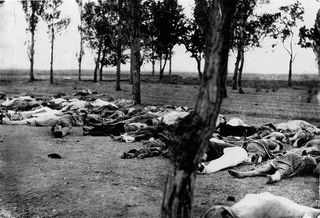
The Forty Days of Musa Dagh made Franz Werfel (1890-1945) one of the world’s most celebrated and controversial authors after it first appeared in German in 1933. He had worked a miracle for Armenians around the world, taking what might have been a footnote in the history of World War I—the deportation and mass murder of the Ottoman Empire’s Armenian minority—and writing an epic that anticipated the ominous events unfolding in Germany as Adolf Hitler and the Nazis came to power. The erosion of civil rights, the singling out of a minority for the nation’s problems, and the state-sanctioned violence perpetrated against it were becoming a reality for German Jews and this made Musa Dagh seem the work of a prophet.
The Forty Days of Musa Dagh began with Werfel’s second journey to the Middle East in the winter of 1930. He had just published his third major novel, The Pure in Heart(1929) and married his lover, Alma Mahler, Vienna’s legendary consort of genius, the widow of Gustav Mahler and the former wife of the architect Walter Gropius. After touring the ruins of Karnak, Alma and Werfel traveled on to Palestine and Jerusalem. In Damascus, Werfel toured a carpet factory with Alma. He saw a number of children working the looms, many of them maimed and crippled. When he asked the factory owner about them, he was told they were Armenian orphans. Their parents had been lost in the massacres, forced deportation marches, and concentration camps of World War I. These events would not have been a surprise to Werfel. In the years following the war, the atrocities committed against the Armenians surfaced in the news stories, some tied to the revenge shootings of Talaat Bey, Jemal Pasha, and other wartime Turkish leaders, victims of an Armenian revolutionary assassination program with the chilling name of “Operation Nemesis.”
More here.
Ben E. King (1938 – 2015)
marty napoleon (1921 – 2015)
rolf smedvig (1952 – 2015)
Adventures in medicine: ‘I journey through the body every day’
Gavin Francis in The Guardian:
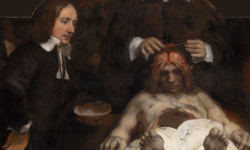
There was a time when if you wanted a good day out you might go along to see a public dissection – the bodies of criminals would be laid out in a public space and anatomised. The popularity of these events was not just educational, of course – it was partly about voyeurism, but it also spoke to a deep need to glimpse deeper into the mystery of our own humanity. It was considered entertainment to see life and death stripped back to essentials; the physician-anatomist was like a guide exploring inner space. These events became popular in the 16th century but had their roots in public spectacles of the Romans. Public dissections fell out of fashion around the time doctors were growing in power: no longer guides to a mysterious inner kingdom, but autocrats protecting secret knowledge. That paternalistic attitude reached a high point perhaps two or three decades ago, but is increasingly out of fashion. The time might be right to bring back public dissection, but instead of using scalpels and saws, I prefer to cut up the body using stories, literature and art.
More here.
Sunday poem
Lake Isle of Innisfree
I will arise and go now, and go to Innisfree, And a small cabin build there, of clay and wattles made: Nine bean-rows will I have there, a hive for the honey-bee; And live alone in the bee-loud glade. And I shall have some peace there, for peace comes dropping slow, Dropping from the veils of the morning to where the cricket sings; There midnight’s all a glimmer, and noon a purple glow, And evening full of the linnet’s wings. I will arise and go now, for always night and day I hear lake water lapping with low sounds by the shore; While I stand on the roadway, or on the pavements grey, I hear it in the deep heart’s core.
by W.B. Yeats
Want to Get Out Alive? Follow the Ants
Conor Myhrvold in Nautilus:
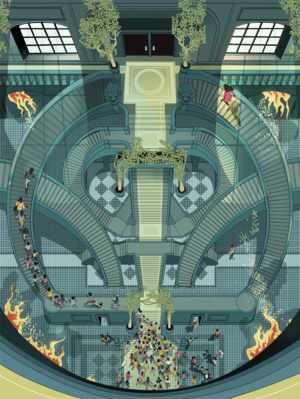
Humans, too, developed a tendency to clump together in the face of danger. There are many advantages to that, Tollrian says—from defense (it’s easier for a group to fight off a threat) to safety in numbers (people can hide in a crowd). When humans moved to agrarian and urban lifestyles, our dangers changed—but our responses didn’t, says Randolph Nesse, a professor of psychiatry at Arizona State University who studies the evolutionary reasons behind anxiety. “We continue to be afraid of things that were dangerous to our ancestors,” Nesse says. When we panic, ancient instincts kick in. In a room with six exits, it seems like the most logical course of action would be for the crowd to divide evenly among all six. Instead, we stampede to just one. We disregard logic and get injured. While we may not be able to unlearn our instincts, we might circumvent them if we better understand the nature of escape panic. Since studying panicking humans is difficult, scientists are turning to an unexpected source of inspiration: ants. “Humans and ants are hugely different animals,” says physicist Ernesto Altshuler at the University of Havana, Cuba, who studied how ants escape in emergency situations. “But when you are in panic, humans behave in a very elementary way, and we may look a little bit like ants.”
More here.
Saturday, May 2, 2015
Why birds don’t crash
Peter Reuell in the Harvard Gazette:

It’s a feat that David Williams is working to understand. A former postdoctoral fellow in the Harvard lab of Charles P. Lyman Professor of Biology Andrew Biewener, and now a postdoc at the University of Washington, Williams is the lead author of a study that shows birds use two highly stereotyped postures to avoid obstacles in flight.
The study could open the door to new ways to program drones and other unmanned aerial vehicles to avoid similar obstacles. The study is described in a paper recently published in the Proceedings of the National Academy of Sciences.
“This was somewhat surprising to us,” Williams said of the results. “In lower-order animals like insects, we think of these very stereotyped motor programs where you stimulate your muscle, and the passive dynamics of your exoskeleton or the tendons attached to that muscle control most of the motion.
“But when you look at higher-order animals, it’s common to expect that those motor programs are going to be more complex, and there’s going to be more subtle gradations in those programs. So it was surprising to see a very high-order animal like a bird using very simple motor programs. Biology is optimized to be just good enough to work, so what that indicates is those are very effective motor programs.”
More here.
Why we need physical books
William Giraldi in The New Republic:

A pleasing vista onto the early twentieth-century life of one English writer, Gissing’s autobiographical novel is also an effusive homage to book love. “There were books of which I had passionate need,” says Ryecroft, “books more necessary to me than bodily nourishment. I could see them, of course, at the British Museum, but that was not at all the same thing as having and holding them”—to have and to hold—“my own property, on my own shelf.” In case you don’t quite take Ryecroft’s point, he later repeats “exultant” when recalling that afternoon of finding the Gibbon—“the exultant happiness.”1 Exultation is, after all, exactly what the bibliophile feels most among his many treasures.
More here.
How we lost touch with animals, life and death, and learned to find butchery repulsive while eating more meat than ever
Amanda Giracca in Aeon:

Sitting out by the fire pit in my back yard on a late November evening, my fingers grew stiff and numb as I pulled at layers of epithelial tissue I could not see so much as sense, subcutaneous membranes of iridescent silver visible only when I shone my headlamp just right. I could see places where the talons of the hawk that had caught the squirrel had punctured into the muscle, bruising it. Little by little, I worked the rich gray pelt down and away from the purple muscles, snipped away the durable membranes, and turned the small mammal from one piece into two.
I snipped off the head and feet with a pair of shears and buried them in my compost pile. Yesterday, when Chris had given me the squirrel, the eyes had been wide-open and filmy white. I was grateful that they’d shrunk to nearly closed overnight. I’d hardly noticed the face as I skinned, but I might have if it still had the demon-ish pale glare. The task was engrossing, a science project, or dinner preparation, a little of each I suppose.
More here.
Introducing The Bookist, Amitava Kumar’s column on books and the art of writing
Amitava Kumar in the Hindustan Times:

I cannot discern her face but I see her reflection holding an iPod in her hand. Her nails are painted silver. We are on the 5.34 Metro North from Poughkeepsie to New York City.
I’m going to a party at a writer-friend’s house but the real reason I’m on this train is because I wanted to write this column. I wanted the time alone on the journey down to the city and back.
The writer Patricia Highsmith once said that she was rarely short of inspiration; she had ideas, she said, “like rats have orgasms”. I cannot make the same claim. I don’t think writers need ideas so much; what they really need is time.
Or, more accurately, the need is for those conditions of work, the meeting of place and habits, that allow the right words to emerge. I say this because I have beside me on the seat here a book called Daily Rituals.
It offers short accounts of how writers and artists work. The above quote from Highsmith is something I came across in this book. And the detail that, probably to keep distractions to a minimum, she ate the same food every day: American bacon, fried eggs and cereal.
More here.
Sam Harris exchanges emails with Noam Chomsky
From Sam Harris's blog:
April 26, 2015
From: Sam Harris
To: Noam Chomsky
Noam — I reached out to you indirectly through Lawrence Krauss and Johann Hari and was planning to leave it at that, but a reader has now sent me a copy of an email exchange in which you were quite dismissive of the prospect of having a “debate” with me. So I just wanted to clarify that, although I think we might disagree substantially about a few things, I am far more interested in exploring these disagreements, and clarifying any misunderstandings, than in having a conventional debate.
If you’d rather not have a public conversation with me, that’s fine. I can only say that we have many, many readers in common who would like to see us attempt to find some common ground. The fact that you have called me “a religious fanatic” who “worships the religion of the state” makes me think that there are a few misconceptions I could clear up. And many readers insist that I am similarly off-the-mark where your views are concerned.
In any case, my offer stands, if you change your mind.
Best,
Sam
April 26, 2015
From: Noam Chomsky
To: Sam Harris
Perhaps I have some misconceptions about you. Most of what I’ve read of yours is material that has been sent to me about my alleged views, which is completely false. I don’t see any point in a public debate about misreadings. If there are things you’d like to explore privately, fine. But with sources.
More here.
How to control someone else’s arm with your brain
on ‘SSES”‘SSES”“SSEY’ by Chaulky White

In 1990, Kevin White composed a piece of writing called ‘SSES”‘SSES” as his thesis for a master’s degree at Art Center College of Design in Pasadena. In it he used the structure of Joyce’s Ulysses as a lens to refract and reflect on his own travels through Asia in search of his (and Derek’s) father, who committed suicide in 1982. ‘SSES”‘SSES”, along with Kevin’s journals and notebooks, came into Derek’s possession when Kevin died of a drug overdose in 1997. Derek describes SSS on what might be page one (as we shall see, where the book begins and ends are not clearly delineated), as “a dilated (+belated) expansion of that book, a deconstructed REDUX w/ further recapitulations by me searching recursively in parallel for: my brother searching for: our father.” Embedding ‘SSES”‘SSES” within carefully but chaotically assembled pages composed of Kevin’s journal entries, fiction fragments, reproductions of his paintings, and designs for conceptual art pieces, Derek has created, or curated, something much more complex than an homage to his brother or an archive of his creative output. In Derek’s hands, and with recourse to the guidance of the structure of Homer’s Odyssey, what could have been a sort of Collected Writings of Kevin White becomes instead a labyrinthine and polyphonic odyssey of its own wherein Derek’s chronicling and deconstructing of his curatorial and editorial processes become as integral to the collection as what it collects. This is also, by the way, only half of it: Books 0 and I, “En-Telemachy (In Absence)” and “In Pursuit of Higher Art In.” Book 2, “The Homecoming,” remains in progress and will comprise Volume 2.
The radical demands and strategies to be found within SSS—and Derek White’s publishing project as a whole—spill out onto the cover page.
more here.
Einstein’s Dice and Schrödinger’s Cat

On a cold January day in 1947, Erwin Schrödinger took the podium at the Royal Irish Academy in Dublin and triumphantly announced that he had succeeded where Albert Einstein had failed for the past 30 years. Schrödinger said he’d devised a unified theory of everything that reconciled the general theory of relativity with quantum mechanics. His announcement caused a sensation in the international press, which shamelessly played up the David and Goliath angle, much to Schrödinger’s discomfort and Einstein’s irritation. It nearly destroyed their longstanding friendship. Matters became so acrimonious at one point, with rumors of potential lawsuits, that another colleague, Wolfgang Pauli, stepped in to mediate. A full three years would pass before the estranged friends gingerly began exchanging letters again.
This tale of two physicists, their shared quest for unification and the media frenzy that tore them apart is the focus of Paul Halpern’s latest book, “Einstein’s Dice and Schrödinger’s Cat.”
The men were natural allies. Both were Nobel laureates, recognized for foundational work in the earliest days of quantum mechanics. Each had a strong philosophical bent, which shaped his worldview.
more here.
the French Author Who Has Happiness Figured Out
David Marchese in NYMag:

…On a scale of 1 to 10, with 1 being suicidal despair and 10 being full-body bliss, how happy are you? Seven. But when I was a teenager, I was maybe a four.
Most teenagers are probably about a four. Yes, but it gets better with time. I saw a very interesting study that said that most people feel happier between 50 and 70 years old. With time, with the experience of life, we can know ourselves better, and that leads to happiness. There’s a part of the book where I explain that sociologists do experiments where they ask people to rate their happiness, exactly like you just did. And they’ve observed that if people don't work on themselves, if they don't try to change their minds, to practice the meditation, to do something special to improve their happiness, then the rating they give will always be the same. It’s like how lottery winners revert to their old levels of happiness over time — the external, material circumstances don’t affect their happiness in the long-term. It takes mental work. Like scientists say, we as individuals may have fixed natural levels of happiness. But you can change it if you work on it. So in all senses, your happiness depends on you.
More here.